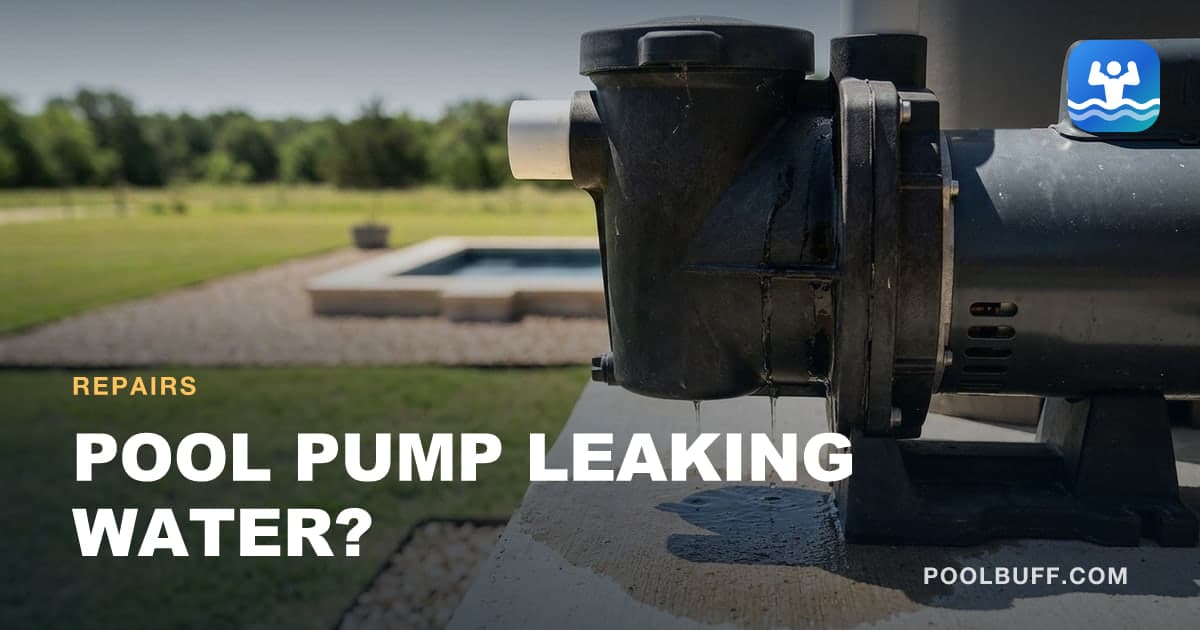
A leaking pump looks like one problem. It's really five, and they sit a few inches apart.
Four of them are a cheap o-ring or a fitting that needs redoing. One is a seal that's letting pool water into the motor, and that's the one you can't leave until the weekend. So the whole job comes down to one question: where exactly is the water coming from?
Key takeaways
- Where the water shows up first is the diagnosis. Dry the whole pump, run it, and watch with a flashlight.
- Water between the motor and the pump body is the shaft seal. Hayward says every seal leak should be fixed at once, because the water washes the grease out of the motor bearings.
- Running dry is how most seals get ruined, and Hayward, Pentair and Jandy all say so in their manuals.
- The makers disagree on lid o-ring lubricant. Hayward names Jack's 327, Jandy's variable-speed manual says soapy water only, and Pentair just says keep it clean and well lubricated.
- A housing that cracked in a freeze isn't a warranty claim with any of the three.
First, find where the water actually comes from
Water runs downhill and pools under the pump, so the puddle is almost never under the leak. A drip from the lid can run down the pot and look like a drain plug. A seal leak can run along the base and look like the discharge port.
So don't guess from the puddle.
- 1
Dry everything
5 minutesTurn the pump off. Wipe the whole thing dry with an old towel: lid, pot, ports, the joint in the middle, and the underside of the motor. Wipe the pad under it too, so a fresh drip shows.
- 2
Run it and watch
10 minutesStart the pump and get down level with it with a flashlight. The first wet spot is your leak. Dry your finger and touch the likely seams one at a time if it isn't obvious.
- 3
Then try it with the pump off
10 minutesThis one tells you which half of the system you're on.
A pump that sits below the pool's water level has the weight of the pool pushing into it even when it's off. A weak joint on the suction side leaks water with the pump off, then pulls air in once the pump starts. So a drip that stops when the pump starts is on the suction side: the lid, a drain plug or the suction union. You'll often see bubbles in the pump basket too.
A leak on the discharge side does the opposite. It gets worse with the pump running, because that side is under pressure. How pool plumbing works covers the two sides if that's new.
What each leak point means
| What has failed | How urgent | |
|---|---|---|
| Between the motor and the pump body | Shaft seal | Now. The water reaches the motor bearings |
| Around the lid | Lid o-ring, or a lid not locked down | Soon. It pulls air when running |
| The joint in the middle of the pump | Housing gasket or o-ring between the pot and the seal plate | Soon |
| At the inlet or outlet port | Thread sealant, a union o-ring, or a cracked port | Depends on the size of the leak |
| At the bottom of the pot | Drain plug o-ring or gasket | Soon. Often left loose after winter |
| A crack in the pot or housing | The housing itself, usually from a freeze | Replace the part |
Between the motor and the pump body: the shaft seal
This is the leak that matters. Everything else on this page can wait a day or two. This can't.
The shaft seal keeps pool water on the pump side and away from the motor. It comes in two halves. One is a ceramic seal, and the other is a spring-loaded seal with a carbon face. One half is fixed and the other turns with the shaft. Their two polished faces press together, and water can't get between them as long as they stay flat, clean and wet.
When they stop sealing, water creeps out along the shaft. You'll see it weeping from the gap between the motor and the back of the pump, or dripping off the bottom of the motor.
Why it can't wait. Hayward spells this out in its troubleshooting: seal damage lets chlorinated water seep into the motor bearings, where it wipes out the grease and the bearings start to whine. Its fix, word for word, is that all seal leaks should be replaced at once. By the time you hear the bearings, the $30 repair has become a motor. What a whining pump means picks up from there.
Pentair adds the money angle. Its manuals warn that water damage to the motor may void the motor warranty.
What kills a seal
- Running dry. This is the big one, and all three major makers say it. Water cools and lubricates the seal faces, and without it they overheat. Hayward says running dry may damage the seals, cause leakage and void the warranty. Pentair says a pump run dry will start leaking and the seal must be replaced. A pump that has lost prime is running dry, so a pump that won't prime is often how a seal leak starts.
- Grit or a scratch on the faces. Hayward warns that foreign matter or careless handling will easily scratch them. Pentair says a damaged face will leak.
- Wear. Pentair's IntelliFlo3 guide calls the shaft seal a wearable part that will need replacing after long use.
- Harsh water. Hayward lists a concentration of chemicals among the causes of seal damage.
Replacing it
The seal costs about $20 to $35 for the maker's own part on common Hayward, Pentair and Jandy pumps, based on Amazon prices in September 2026. The labor is the job: the motor assembly has to come out of the pump.
Before you start, know what the makers say. All three print the procedure, and all three say it's work for a qualified person. Hayward says only qualified personnel should attempt rotary seal replacement. Jandy says to have a qualified service technician replace the seal. Pentair says the pump should be serviced only by a qualified pool service professional. Plenty of owners do this job anyway. Just be honest with yourself about how you are with small, fussy parts.
The details that decide whether the new seal leaks:
- Turn the power off at the breaker and drain the pump before you touch a bolt.
- Both halves get replaced. A new spring seal against an old ceramic seat is still an old seal.
- Never touch the polished faces. Hayward says to wipe them with a clean, soft cotton cloth. Pentair says to clean them thoroughly before you put the pump back together.
- Get the direction right. On Hayward's pumps the ceramic seat goes in polished side out, and the spring seal's black polished face points toward the ceramic.
- Use what the manual names, because it changes by pump. Hayward uses a dilute solution of liquid soap on the seal recess. Pentair's IntelliFlo3 and WhisperFlo VST guides wet the ceramic seal's rubber with water, but the SuperFlo VS manual uses a silicone lubricant. The WhisperFlo VST also puts silicone sealant on the spring seal's metal flange, and the single-speed WhisperFlo manual says to give that sealant 24 hours to cure.
- Replace the gaskets you disturb. Hayward says to inspect the gaskets and replace any that are damaged. Pentair says to inspect the diffuser seal and the seal plate o-ring. They're cheap, and they're already out.
- Tighten the housing bolts to the manual's number. It varies more than you'd think. Hayward gives 80 inch-pounds on the Super Pump VS 600 and the Super Pump VS 700, and 185 on the TriStar VS, the MaxFlo VS 400 and the MaxFlo VS 500. Pentair gives 110 on the WhisperFlo, in a cross pattern.
- Fill the pot before you start it. Otherwise the new seal's first minute is a dry one.
Hayward also says that replacing a damaged impeller means fitting a new seal assembly with it.
The seal part number for your pump is on its catalog page. There's one for the Hayward Super Pump, the Hayward TriStar VS, the Pentair SuperFlo VS and the SuperMax VS, which shares its seal, the Pentair IntelliFlo3 and the Jandy FloPro, among others. The FloPro's seal is also the one the Jandy VS FloPro uses.
Around the lid
The lid is on the suction side, so a lid leak usually does its damage as air rather than water. That air is what stops a pump holding prime. If the pump sits below the water level, though, a bad lid seal will drip whenever it's off.
Check these in order:
- Is the lid actually locked? Each maker gives a reference. Pentair's IntelliFlo3 lid is right when the handles sit perpendicular to the suction port, and the WhisperFlo VST's when they sit horizontal. Jandy's is locked when the LOCKED mark lines up with the ports. Jandy says hand tight only, and never a tool.
- Is the basket seated? Jandy warns that a misaligned basket stops the lid seating properly, and the result is an air leak.
- Is the o-ring clean, and in the groove the right way up? Grit on the seat is enough to leak. Jandy's FloPro lid seal has two ribs on one side and one on the other, and the side with two ribs goes into the lid groove.
- Is it hard, flat or cracked? Then replace it. Genuine lid o-rings ran $8.99 to $15.50 on Amazon when I checked.
The joint in the middle of the pump
The pump comes apart in the middle, where the strainer pot bolts to the seal plate. A gasket or o-ring seals that joint. A leak there shows up as water under the middle of the pump rather than at either end.
Pentair's IntelliFlo3 guide gives the order for this exact leak, and it's a good one for any brand:
- Make sure the seal plate o-ring isn't pinched between the seal plate and the strainer pot.
- Tighten the bolts that join the pot and the seal plate.
- If it still leaks, take the pump apart and inspect every o-ring and seal for damage or debris.
If you're taking it apart anyway, the shaft seal is right there. On an older pump that's worth thinking about.
At the ports: threads and unions
Unions are the big screw-on collars on many newer pumps. They seal on an o-ring, not on the threads. Jandy says a union with clean o-rings should seal hand tight. If it doesn't, snug it gently with large tongue-and-groove pliers, and don't overtighten it. A leaking union usually needs its o-ring cleaned or replaced.
Threaded ports are where people do damage. Hayward's instructions are the most specific:
- PTFE tape, one to two layers, wound clockwise as you face the open end of the fitting.
- No plumber's pipe dope. Hayward says it may crack the plastic.
- Hand tight, then 1½ turns with a tool. The ports have molded thread stops, and Hayward says not to force a fitting past them.
- Tape cuts friction a lot, so a fitting turns further than it feels like it should. Hayward warns not to overtighten.
- If it leaks, take the fitting off, clean off the old tape, rewrap with one to two more layers and refit it.
Pentair's WhisperFlo manual simply says to use thread sealant on the male adapters.
A fine crack running out from a threaded port is a different story. That's the housing, and no amount of tape fixes it. Hayward sells its strainer housings as a replacement part, drain plugs included.
At the bottom: the drain plugs
Two plugs sit at the bottom of the strainer pot, below the water line. Each seals on its own o-ring or gasket.
They come out every fall, and that's when things go wrong. The o-ring gets lost, or the plug goes back in loose. Jandy's manual says to store the plugs somewhere safe over winter and not to lose the o-rings. Pentair's SuperFlo VS manual says to refit them hand tight only.
A leaking plug gets a new o-ring or gasket. Hayward's SPX4000FG, plug and gasket together, was $12.44 on Amazon when I checked.
A crack in the pot or housing
Hairline cracks in the strainer pot or the housing are almost always freeze damage. Water expands when it freezes, and a pump left full over a cold night splits.
And none of the three makers will pay for it:
- Hayward: letting the pump freeze with water in it voids the warranty.
- Pentair: freeze damage is not covered under warranty.
- Jandy: letting the pump freeze will cause severe damage and void the warranty.
The prevention is the same from all three. Drain the pump and pull both drain plugs when freezing weather is coming. Pentair and Jandy both say not to wrap the motor in plastic, which traps condensation. Closing a pool for winter covers the whole pad, and hard freeze protection covers the pools that stay open.
Will the warranty pay for a leak?
Usually not, and it's worth knowing before you spend an hour on hold.
- Hayward lists pump seals, o-rings and basket-strainers as normal wear items in its 2026 warranty terms, on both its dealer and online lines. They're covered for manufacturing defects only, which Hayward says normally show up within 30 days of installation. A seal you buy as a replacement part gets six months, parts only.
- Jandy's warranty excludes running a pump without enough water, over-tightening, under-tightening and cross-threading. It also excludes collateral damage caused by a failed component, o-rings included.
- Pentair's manuals warn that water damage may void the motor warranty.
So a seal that starts weeping in year three is yours to fix. And on a Jandy or a Pentair, the motor it ruins if you ignore it may be yours too.
Before you start it again
Hayward's startup instruction is worth using after any of these repairs. Fill the strainer housing with water first. If water leaks from anywhere on the pump or filter, don't start the pump. Fix it while the pump is still off, then start it and watch the repair for ten minutes.
Hayward also says seals and gaskets have a finite life. It wants them inspected often and replaced at least every ten years, or sooner if they're damaged.
Where to stop
The motor got wet. Pentair says to let wet motor internals dry before running the pump, and never to run a pump that has been flooded. A motor that trips the breaker or hums after a seal leak isn't a job for a towel.
The bearings are already whining. The seal leak has done its damage. Replace the seal, then decide about the motor.
The housing is cracked, or the pump is old enough that the seal is the third thing to go this year. At that point replacing the whole pump is often cheaper than chasing parts.
Go deeperPool pump won't prime? Work through it in orderThe same lid o-ring, drain plugs and unions, from the other side: when the leak is air coming in rather than water going out.Frequently asked questions
Why is my pool pump leaking water between the motor and the pump?
That's the shaft seal, also called the mechanical seal. It has two halves, a ceramic seal and a spring-loaded seal with a carbon face, and one of them turns with the motor shaft. They seal on two polished faces. Running the pump dry, a scratch or grit on those faces, or plain wear will open a gap, and water gets out along the shaft. Jandy's FloPro manual puts it simply: water between the motor and pump body means a damaged or failed mechanical seal.
Can I keep running a pool pump with a leaking shaft seal?
Not for long. Hayward's manuals say seal damage lets chlorinated water into the motor bearings, where it washes out the grease until the bearings whine, and that all seal leaks should be fixed at once. Pentair's manuals warn that water damage to the motor may void the motor warranty. The maker's own seal costs roughly $20 to $35. A motor costs many times that.
Why is my pool pump leaking after I replaced the seal?
Usually one of four things. The polished seal faces got scratched or dirty during the job, and every maker warns that a damaged face will leak. The spring half went on backward: Hayward says its black polished face must face the ceramic. The housing gasket got pinched between the two halves, which is Pentair's first check for a leak at that joint. Or the pump was started before the pot was full, and the new seal ran dry.
Why does my pool pump only leak when it is off?
Because the pump probably sits below the pool's water level. With the pump off, the weight of the pool pushes water into the strainer pot and out of any weak joint on the suction side. With the pump running, that same joint is under suction, so it pulls air in instead of letting water out. A drip that stops when the pump starts is usually the lid, a drain plug or the suction union. Look for bubbles in the pump basket too.
Should I use Teflon tape or pipe dope on pool pump fittings?
Follow your pump's manual. Hayward says PTFE tape, one to two layers, and never plumber's pipe dope, because it can crack the plastic. It says to go hand tight plus 1½ turns with a tool, and not to force a fitting past the molded thread stop. Pentair's WhisperFlo manual says to use thread sealant on the male adapters. Many newer pumps use unions instead, and a union with a clean o-ring should seal hand tight.
What lubricant should I use on a pool pump lid o-ring?
Whatever your pump's maker says, because they don't agree. Hayward's manuals name Jack's 327, and its support site recommends a silicone or Teflon-based lubricant and never petroleum jelly. Jandy's variable-speed pump manual says not to put lubricant or sealant on the o-ring at all, and to use only soapy water. Pentair's SuperFlo VS manual says to keep the lid o-ring clean and well lubricated without naming a product.
Is a cracked pool pump housing covered by warranty?
Not if it cracked from freezing. Hayward says letting the pump freeze with water in it voids the warranty. Pentair says freeze damage is not covered. Jandy says freezing will cause severe damage and void the warranty. All three say to drain the pump and pull both drain plugs before a freeze.
Does the warranty cover a leaking pool pump seal?
Usually not. Hayward's 2026 warranty terms call pump seals and o-rings normal wear items, covered for manufacturing defects only, which Hayward says normally appear within 30 days of installation. Jandy's warranty excludes running a pump without enough water and collateral damage from a failed component, o-rings included. Pentair's manuals say water damage may void the motor warranty.
How much does it cost to fix a leaking pool pump?
Most leaks cost less than the seal. On Amazon in September 2026, the makers' own lid o-rings ran $8.99 to $15.50 and a Hayward drain plug with its gasket was $12.44. Genuine shaft seals ran about $20 to $35 for common Hayward, Pentair and Jandy pumps. Cheaper copies exist, but Hayward's manuals say to replace the seal with a genuine Hayward seal assembly.