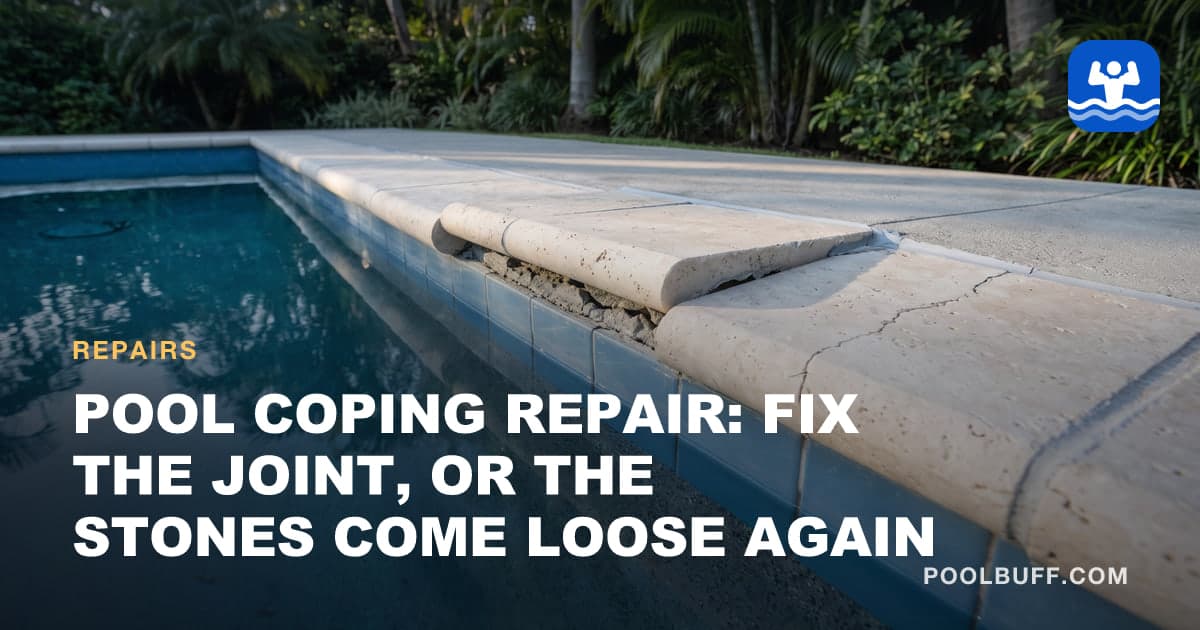
Coping is the cap on the pool wall: the stone, paver or concrete edge you sit on and push off from. It sits right where the pool meets the deck, and that's where its trouble starts.
On service stops I saw stones rocking loose, cracked and chipped edges, mortar joints crumbling, and the waterline tile under the coping cracking or popping off. All of it was on concrete pools. Where I could see a cause, it was a failed joint between the deck and the coping, freeze-thaw, or salt and pool chemicals. Sometimes I couldn't tell. I didn't do the repairs myself, so the how-to below comes from the makers' and trade groups' own instructions.
Key takeaways
- Coping sits on the pool's bond beam and the deck moves separately. Anything rigid bonded across that line will very likely crack, says ARDEX, which makes the setting mortars.
- The joint between deck and coping is there to protect the coping and its mortar bed, in the CDC's words. When I saw that joint fail, cracked coping or tile followed.
- One or two loose stones on a sound beam can be reset. Widespread cracking, crumbling mortar or a damaged beam means replacement.
- Sellers' replacement prices run from $15 a foot for pavers on Long Island to $160 for limestone near D.C. Ask whether removing the old coping and repairing the beam are included.
- Keep pool water at pH 7.2 or above. TEC, which makes pool tile mortars, says cement grout and mortar etch below 7.0.
Why coping comes loose
The pool shell and the deck are two separate slabs, and they move separately. Heat, cold, water and settling all move them by different amounts. Coping sits right on the line between them, on top of the pool's bond beam.
Anything rigid across that line cracks. ARDEX, which makes setting mortars, says coping bonded across the boundary between the shell and the surround is spanning what is really a movement joint, and will very likely crack. Techo-Bloc says the same about filling the gap between coping and pavers with something rigid. The Bureau of Reclamation's concrete repair guide puts it plainly for any repair: bond it across a joint and the repair cracks.
That's why the joint between the deck and the coping exists. The CDC's model code for public pools requires a continuous watertight expansion joint there, and says its job is to protect the coping and its mortar bed when the deck moves. When I saw that joint fail, cracked coping or tile followed. More on fixing the joint below.
Freeze-thaw breaks it up. Water expands about 9% when it freezes, and the Bureau's guide says freeze damage is usually worst at joints. Techo-Bloc adds a detail that matters for coping set in mortar: Type S mortar absorbs about 15% water and its coping about 3%, so the two don't freeze and thaw at the same rate. The paver makers' association says mortared paver joints have a high risk of breaking down where there's freezing or de-icing salt.
Acid and low pH dissolve the mortar. TEC, which makes pool tile setting materials, says cement grout and mortar etch and break down when pool water drops below pH 7.0. The Natural Stone Institute says limestone, marble and travertine are sensitive to acid. And the paver makers' association says acid spills do far more damage to pavers than salt water does. Pour acid into the water, not across the coping. Lowering pH safely covers how.
The tile under it suffers too. Laticrete's pool manual says the tile between the waterline and the coping sees big temperature swings, which can crack it or break its bond. A field report quoted by the National Tile Contractors Association says the meeting of coping, tile and bond beam accounts for a significant share of pool tile failures when it's built wrong. TEC and the tile industry's movement-joint guidelines call for a flexible joint between the tile and the coping, and TEC warns that covering an expansion joint makes the installation crack.
Reset, repair or replace
A few loose stones on a sound beam: reset them. Lift the loose pieces, clean the old mortar off the stone and the beam, and set them again. Techo-Bloc publishes the most complete reset method I found:
- If the old coping is damaged, remove it rather than covering it. Techo-Bloc says an overlay is never a fix for bad concrete.
- Use its polyurethane adhesive only if the beam is flat within 3/8 inch over 10 feet. Otherwise, set the stones in mortar.
- For mortar, it uses Type S, with mason's cord or cotton sash in the bed to wick water away, and it dips each stone in water before setting it.
- It sets the coping with a slight pitch back.
The makers don't agree about pitch. Unilock slopes its coping 2% away from the pool, Belgard says don't pitch it at all because the deck is pitched, and Pavestone says level from unit to unit. Follow the maker of the coping you're setting.
One cracked stone: replace that stone, if you can find one to match. Flamingo Blue Pools in Miami lists $50 to $100 a stone, and Pool Effects in Orange County says its reset prices depend on whether matching material is available.
Cracking or loose stones all the way around, crumbling mortar or a damaged beam: replace it. That's a job for a mason or a pool remodeler. The old coping comes off, the bond beam gets repaired, and new coping goes down in a fresh bed. Beltway Pools near Washington, D.C., describes exactly that sequence, starting with checking the beam and the expansion joint gap.
Poured-in-place cantilevered coping is part of the deck itself, poured as one piece around the pool. River Pools, which makes fiberglass pools and uses it, says a crack in the deck can carry through the coping, while paver coping repairs tend to be more localized. A cracked cantilevered edge is really a deck repair; pool deck resurfacing covers what that costs.
What it costs
No agency publishes these prices, so these are the sellers' own.
| Sellers' prices | Who and where | |
|---|---|---|
| Reset loose coping | $30-$45 a foot (Maryland); $500-$1,500 for a few pieces (Orange County, Calif.) | B&D Pools; Pool Effects |
| Replace one cracked stone | $50-$100 a stone (Miami) | Flamingo Blue Pools |
| Replace: concrete, paver or brick | $50-$100 a foot (D.C. area); $15-$25 pavers (Long Island); $12-$22 bullnose concrete (Dallas) | Beltway Pools; Brothers Paving & Masonry; Lalo's Tile & Coping |
| Replace: travertine | $80-$130 a foot (D.C. area); $25-$45 (Long Island); $20-$35 (Dallas) | Beltway Pools; Brothers Paving & Masonry; Lalo's Tile & Coping |
| Replace: bluestone or limestone | $90-$160 a foot (D.C. area); $30-$50 bluestone (Long Island) | Beltway Pools; Brothers Paving & Masonry |
| Removing old coping and prepping the beam | Included (D.C. area); add $5-$12 a foot (Long Island); $25-$50 a foot (Phoenix) | Beltway Pools; Brothers Paving & Masonry; AE Outdoor Living |
| Deck-to-coping joint, dug out and replaced | $9 a foot (Houston); $10-$11.50 (Pennsylvania) | Houston Mobile Blasters; DS Pool Service |
| Tile and coping together | $110-$160 a foot (Maryland) | Goudy Pools |
The spread is huge, and it isn't only the region. Beltway's process near D.C. includes taking off the old coping and repairing the beam as needed, and it puts 80 to 100 feet of coping at $6,000 to $15,000. The Long Island mason's lower figures are for setting new coping, with removal and beam repair extra. Ask every quote the same two questions: is removal in the price, and what happens if the beam needs work once the coping is off?
Measure the pool's perimeter before you compare, because coping is priced by the foot. A 16-by-32 rectangle is 96 feet.
The joint against the deck
Fix this whether or not you touch the coping. If it has failed, it's how the deck damages the coping in the first place.
What goes in it: a flexible sealant over a foam backer rod, never mortar or grout. The paver makers' association specifies urethane or neoprene sealant, as is typical in pool construction. Belgard calls for foam expansion material between coping and pavers to protect the bond.
Use a sealant made for pools. W. R. Meadows makes DECK-O-SEAL for pool deck joints and says:
- Keep the joint about twice as wide as it is deep, never less than 1/4 inch deep.
- Use a backer rod to set the depth, and let new concrete cure 28 days first.
- Where only the sealant is damaged and it's still bonded, cut out that section and reapply. If the bond has failed, dig out the whole joint.
- It can't be used underwater. For joints below the waterline it has separate products, and it says homeowners shouldn't attempt those.
General-purpose construction sealants aren't made for this. Sika's data sheet for Sikaflex-1a says not to use it in swimming pools or submerged conditions.
Sellers charge $9 to $11.50 a foot to dig out and replace the joint, as in the table above. Houston Mobile Blasters puts the average pool at $800 to $900, with a 75-foot minimum.
Salt pools and stone coping
I saw salt pit natural stone coping and decks on service stops. The salt system makers are careful about it:
- Hayward's AquaRite manual tells owners with natural stone coping or decks to consult a stone installation specialist about the type, installation, sealant and upkeep. Its warranty excludes damage to natural stone in or next to the pool.
- Pentair's IntelliChlor guide says some natural and manufactured surfaces are especially prone to deterioration around salt pools, and doesn't guarantee against it.
- The paver makers' association says salt on concrete pavers is mostly cosmetic, but salt combined with freezing speeds up damage.
Seal stone after the joints are done. W. R. Meadows makes DECK-O-SHIELD PLUS for pool coping and decks against salt, calls it a water repellent rather than waterproofing, and says not to put it on surfaces that will get caulk or sealant. Check the setting mortar too. ARDEX's data sheet for X 32, one of the mortars Unilock names for coping, lists pools as an approved use but not saltwater pools. If you're on salt, ask the installer which setting material they're using and whether its maker approves it for salt.
Vinyl liner and fiberglass pools
I only saw coping trouble on concrete pools, so this part is the makers' word.
Vinyl liner pools have an aluminum coping track under the stone or concrete edge, and the liner's bead locks into it. Latham, which makes vinyl liner pools, says a bead can come out of the track with age, water pressure and chemicals, and that temperature swings play a part. Sometimes pouring hot water on the liner softens it enough to push back in, but Latham says a bead falling out is often a sign the liner is due for replacement. Vinyl liner repair and replacement covers that decision.
Fiberglass pools sit inside a poured concrete bond beam, and the coping goes on top of it, either pavers or cantilevered concrete. River Pools' point about deck cracks running through cantilevered coping applies here most.
Permits and who to hire
Rules differ by town. Woodside, Calif., requires a building permit to repair a pool, and wants the electrical bonding shown on the plans for any pool deck that's altered or replaced. Austin exempts tiling and similar finish work from permits but doesn't name coping. Ask your building department before work starts, especially if the job will take up the deck.
Do it while the pool is drained, if a replaster is coming. Some sellers price tile and coping as one job: Goudy Pools puts them at $110 to $160 a foot in Maryland. The pool resurfacing cost guide covers the rest of a drained-pool job.
Questions for every quote:
- Is removing the old coping in the price? What about bond beam repair?
- What will the coping be set in, and does its maker approve it for this pool, salt included?
- How will the joint against the deck be done, and with what sealant?
- Will they keep a flexible joint between the tile and the coping?
- What's the warranty on the work, separate from the materials?
Frequently asked questions
Why is my pool coping loose?
Its mortar bed has failed. The sources name the same few causes: the deck moving against the coping when the joint between them has failed, water freezing in the joints, and acid or low pH dissolving cement mortar. On service stops I saw all of these on concrete pools, and sometimes the cause wasn't visible.
How much does it cost to fix pool coping?
No agency publishes a figure, so these are sellers' own. B&D Pools in Maryland lists $30 to $45 a linear foot to reset coping. Pool Effects in Orange County, Calif., puts resetting a few loose pieces at $500 to $1,500. Full replacement runs $50 to $160 a foot installed from Beltway Pools near Washington, D.C., and $15 to $50 a foot from a Long Island mason, by material.
Can you reset pool coping yourself?
The makers write their instructions for installers. Techo-Bloc's reset method lifts the stones, rebuilds the bed in Type S mortar and sets each stone with a slight pitch back, or uses a polyurethane adhesive only where the beam is flat within 3/8 inch over 10 feet. Any reset still needs a flexible joint against the deck, and a permit in some towns.
What should go between pool coping and the deck?
A flexible sealant over a backer rod, never mortar or grout. The CDC's model code for public pools requires a continuous watertight expansion joint there, and the paver makers' association specifies urethane or neoprene sealant. W. R. Meadows says its DECK-O-SEAL should be about twice as wide as it is deep.
Does salt water damage pool coping?
It can damage natural stone. Hayward's salt system manual tells owners with stone coping to consult a stone specialist, and its warranty excludes damage to natural stone near the pool. The paver makers' association says salt on concrete pavers is mostly cosmetic but speeds up damage when combined with freezing.