The liner is the one part of a vinyl pool that's genuinely a consumable, and people treat a hole in it as far more of a crisis than it is.
A pinhole is a fifteen-dollar fix that takes twenty minutes and holds for years. Nobody needs to drain anything.
Key takeaways
- Underwater patch kits genuinely work. Don't drain a pool to fix a pinhole.
- Never drain a vinyl pool without help. The liner is held in place by water pressure.
- Chronically low pH is the fastest way to kill a liner. It's a chemistry problem, not a material problem.
- Liner life is 8-12 years, and good water management is what puts you at the top of that range.
- Measure or template properly for a replacement. A poorly fitted liner wrinkles and stresses at the seams.
Finding the hole
Same approach as any leak. Confirm it's actually a leak first with a bucket test, then narrow it down.
Watch the level. If it drops to a certain point and stops, the hole is at that level. That alone often finds it.
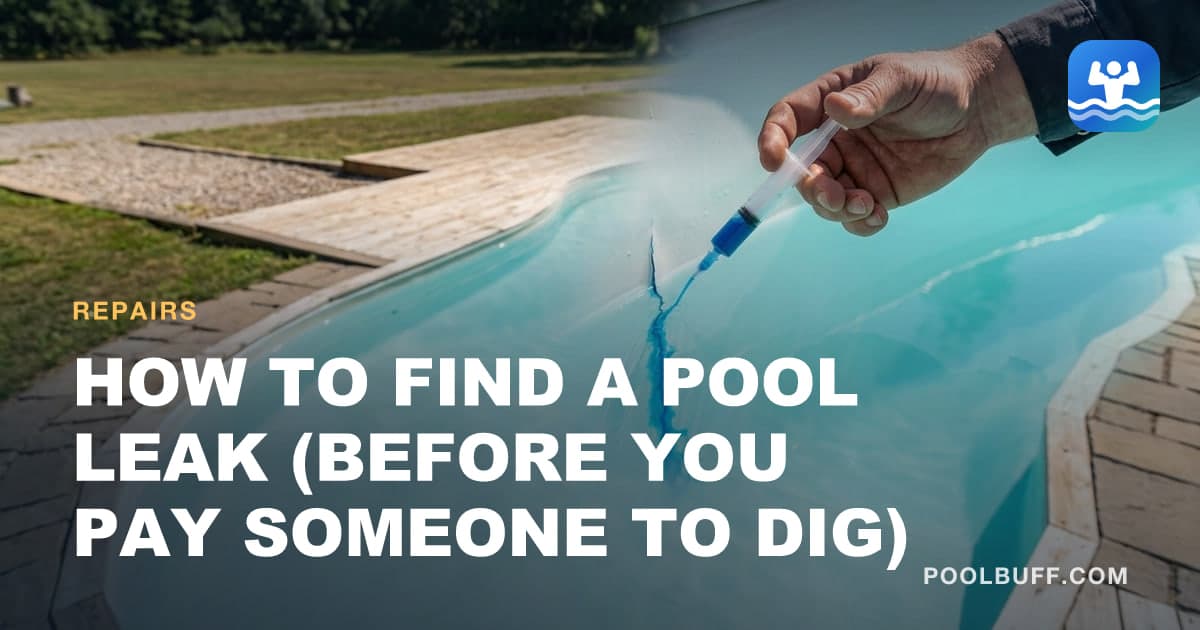
Dye test. Pump off, water dead still, goggles on. Squeeze leak dye near suspect areas and watch for it being drawn in. Priority spots on a liner:
- Around every fitting — returns, skimmer throat, light niche, main drain
- Steps and any corner
- Seams
- Anywhere the ladder sits
- The shallow end floor, where dropped objects land
Feel for it. On a liner you can often feel the draw with your hand before you see it. Move slowly across a suspect area.
Look for the causes. Dropped earrings, a dog's claws, a dragged ladder, a sharp toy, a stone that worked through the floor from underneath.
Patching it
Before you start
- Time
- 30 min
- Difficulty
- Easy
- Cost
- $15-$25
Tools
- Goggles
- Scissors
- Something to weight yourself down
Supplies
- Vinyl patch kit with underwater adhesive
- 1
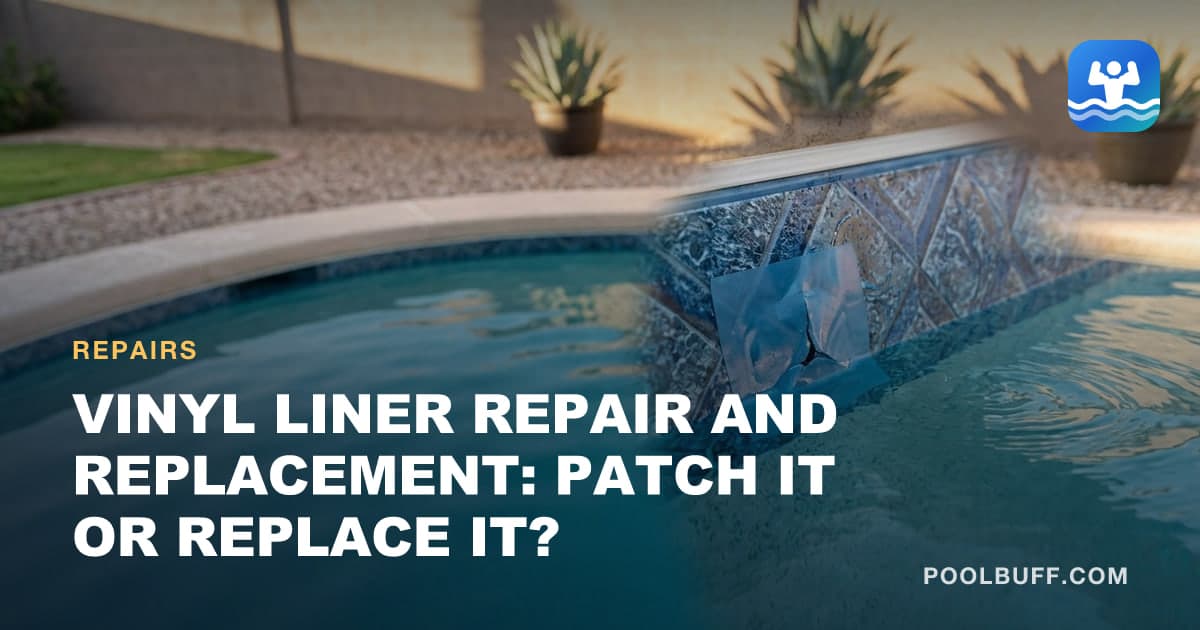
Cut the patch
5 minAt least two inches larger than the hole in every direction, with rounded corners. Square corners peel — this is the single most common reason a patch fails early.
- 2
Apply adhesive and fold
2 minCoat the patch, then fold it in half with the adhesive on the inside. That keeps the water off the glue while you get it down there.
- 3
Position and unfold
5 minTake it to the hole, unfold it against the liner, and center it over the damage.
- 4
Press from the center out
5 minWork outward in every direction to squeeze water and air out from under the patch. Hold firm pressure for a minute or two.
- 5
Leave it alone
24 hrsDon't disturb it for a day. Then check the water level to confirm the loss has stopped.
A good patch on a small hole lasts years. I've seen patches outlive the rest of the liner.
What kills liners
Chronically low pH. The big one. Acidic water degrades vinyl, making it brittle and prone to tearing. A liner in a pool that ran at pH 7.0 for years will be noticeably stiffer than one at 7.5.
Sustained high chlorine — but read that against your stabilizer, not on its own. What fades a pattern and stiffens vinyl is active chlorine, and how much of your free chlorine is active depends on cyanuric acid. Ten ppm on a pool sitting at 30 ppm CYA is genuinely harsh — that is a third of your stabilizer, close to shock territory, held indefinitely. Eleven ppm on a pool at 100 ppm CYA is simply the correct target for that pool and is no harder on the liner than 3.5 ppm would be at CYA 30.
So the thing to avoid is not a number on the test kit. It is running well above the 10–15% of CYA band for weeks on end. Occasional shocking is fine; living at shock level is not.
UV above the waterline. The band above the water gets the most sun and is usually the first to fade and go brittle.
Draining or a very low water level. The liner is held by water pressure. Take that away and it can shrink or pull out of the track.
Groundwater behind the liner. In a high water table, water can push behind the liner and float it, creating large wrinkles. Sometimes fixable, sometimes not.
Sharp objects. Ladders being dragged, dropped tools, dogs.
Wrinkles, and what they mean
A few small wrinkles in a newly fitted liner are normal, and they usually work themselves out as the pool warms and the vinyl relaxes.
Wrinkles appearing in an established liner mean something else, and the cause decides what you can do about it.
Groundwater behind the liner is the common one. Water pushes in from outside, floats the vinyl off the floor, and when it recedes the liner does not lie back down flat. It is the same water-table story that runs through every vinyl pool problem, and it recurs until the drainage around the pool is dealt with.
Chemistry is the other. Very low pH held for a long period causes vinyl to grow slightly, and a liner that has grown has nowhere to go but into folds.
Small wrinkles can sometimes be worked out by lowering the water, letting the sun warm the vinyl, and pushing them toward an edge. Large ones generally cannot, and on an older liner they signal that replacement is nearer than the calendar suggests.
When to replace instead
- Multiple patches that aren't holding. The material has gone brittle.
- Stretched out of the track, especially in corners.
- Large wrinkles that don't respond to reseating.
- Significant fading, particularly at the waterline where it's often accompanied by brittleness.
- A tear more than a few inches, especially at a seam or a fitting.
- It's 12+ years old and something has gone wrong. You're on borrowed time.
Replacement, roughly
$3,000–$8,000 for an inground pool, including liner and installation. Above ground liners are $300–$1,200.
The job:
- Drain — and this needs doing carefully, in stages, with the groundwater situation understood
- Remove the old liner
- Inspect the floor and walls. This is where surprises appear: rusted steel panels, a crumbling vermiculite floor, corroded fittings. Budget for it, because it's common on an older pool
- Repair the substrate
- Fit the new liner, vacuum it into place
- Refill immediately, working wrinkles out as the level rises
- New gaskets on every fitting — never reuse old ones
Get it measured or templated properly. A liner cut from approximate dimensions wrinkles, sits badly and stresses at the seams. Most good installers template rather than working from a size chart, and it's worth insisting on.
Choosing the replacement liner
Since you buy one about every decade, the specification is worth understanding before somebody chooses it for you.
Thickness, quoted in mil or gauge. Twenty mil is common; 27 and 30 mil are available, and the thicker material genuinely resists punctures better. It costs more and is harder to work into tight corners, which is why installers have opinions about it. On a pool with children, dogs or heavy use the upgrade usually earns its money; on a lightly used pool it buys less than it costs.
Note that gauge and mil are different measurements despite being used interchangeably in listings — 25 gauge is thinner than 20 mil, not thicker. If a price looks too good, check which unit it is quoted in.
Bead type, on an above-ground pool. Overlap liners hang over the wall and are held by coping strips; beaded liners clip into a track; unibead can do either. They are not interchangeable, and ordering the wrong one is a common and irritating mistake.
Pattern placement. The tile band at the waterline is printed, not real, and it has to land at your actual waterline. An installer templating properly accounts for that. A liner ordered off a size chart sometimes does not.
Go deeperProve it's a leak firstThe bucket test, and separating a plumbing leak from a shell leak. Go deeperPast the point of repair?What removal costs, partial versus full, and which one leaves buildable land.Frequently asked questions
Can you patch a pool liner underwater?
Yes, and it's the standard method. Vinyl patch kits use an adhesive that cures underwater. Cut a patch with rounded corners, apply adhesive, fold it adhesive-side-in, take it down to the hole and unfold it against the liner, then press from the center outward to squeeze the water out.
How long does a vinyl pool liner last?
Eight to twelve years typically. Water chemistry is the biggest variable — chronically low pH degrades vinyl, and sustained high chlorine fades and stiffens it. A well-managed liner routinely reaches twelve to fourteen years; a neglected one can be done at seven.
How much does it cost to replace a pool liner?
$3,000-$8,000 for an inground vinyl pool including the liner and installation. Above ground liners are far cheaper at $300-$1,200. Add cost if the floor or wall panels need repair once the old liner is out, which is common on older pools.
What causes vinyl pool liners to wrinkle?
A liner that's stretched, shrunk or lost its grip in the track. Common causes are draining the pool, a very low water level for an extended period, groundwater pushing behind the liner, or a liner that was fitted on a cold day and never fully seated.
Can you drain a vinyl liner pool?
Not without care. The liner is held in place by water pressure, and an empty pool can let it shrink, wrinkle or pull out of the track — at which point you need a new liner. If you must drain for a repair, do it in stages, or have a professional handle it.