Here's a call I've taken more times than any other.
"My chlorine's at 3, my pH is 7.5, everything reads fine, and I've got algae."
Then I ask what their cyanuric acid is, and there's a pause, and they say "my what?"
Key takeaways
- Without CYA, direct summer sun destroys unprotected chlorine in well under an hour.
- Every ppm of CYA raises the amount of free chlorine you need. That's the trade.
- Trichlor tabs add about 0.6 ppm of CYA for every 1 ppm of chlorine. Run them all season and you'll hit 100 ppm without trying.
- There's no chemical that removes CYA. Draining and refilling is the fix, and anyone selling you a reducer is selling hope.
- High CYA doesn't make you sick. It makes your chlorine lazy, which is how you end up with algae in water that tests fine.
What CYA actually does
Chlorine and UV don't get along. Put unprotected chlorine in an outdoor pool in July and the sun tears through it fast — the half-life is measured in tens of minutes, not hours. You could dose to 5 ppm at 9 a.m. and read close to nothing by mid-afternoon. It's genuinely that aggressive, and it's the first thing to rule out when a pool won't hold chlorine.
Cyanuric acid grabs onto chlorine and shields it from UV. Add 30–50 ppm and your chlorine survives the day comfortably. That's the whole benefit, and it's a real one — nobody's running an outdoor chlorine pool without it.
But here's the catch nobody mentions when they sell you tablets. That bond isn't free. Chlorine bound to CYA is chlorine that isn't out there killing things. It's in reserve. It releases as free chlorine gets consumed, which is fine, but the rate it can work at drops as CYA climbs.
So the more CYA you have, the more free chlorine you need for the same actual sanitizing power.
The relationship, in one chart

Work the numbers and it gets uncomfortable fast:
- CYA 30 → target free chlorine about 3.5 ppm. Easy.
- CYA 50 → target about 6 ppm. Still fine.
- CYA 80 → target about 9 ppm. Now you're buying a lot of chlorine.
- CYA 100 → target 11–12 ppm, and shock level is 40 ppm. That's an expensive weekend.
That last one is where a lot of pools end up by August, and the owner has no idea why the pool suddenly stopped cooperating.
How CYA creeps up on you
There's really only one way this happens to most people, and it comes in a bucket.
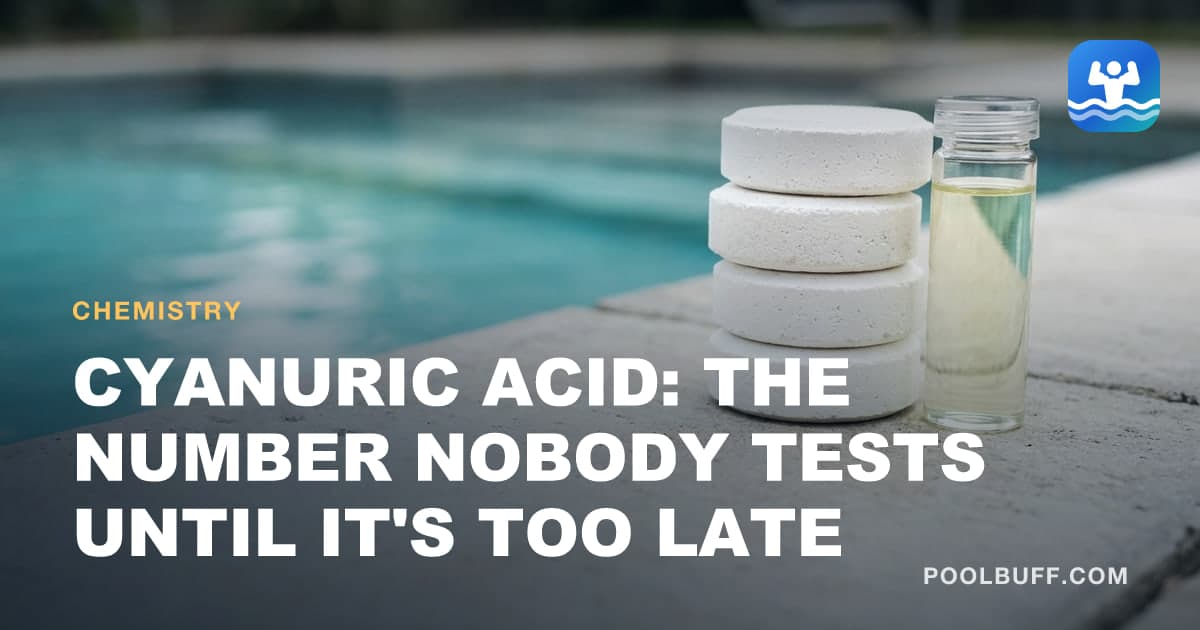
Trichlor tablets. They're about 90% available chlorine, they're cheap, they're convenient, and they add roughly 0.6 ppm of CYA for every 1 ppm of chlorine they deliver. Drop them in a floating dispenser in May, keep topping it up, and by August you're sitting at 90–100 ppm CYA without ever having added a bag of stabilizer.
Dichlor is worse per ppm — about 0.9 ppm of CYA per 1 ppm of chlorine. It's fine as an occasional shock on a pool that needs stabilizer anyway. As a season-long routine, no.
Actual stabilizer, added deliberately. Fine, if you tested first.
And then the thing that makes it sneaky: CYA doesn't leave. Chlorine gets used up. pH bounces around. CYA just accumulates. The only losses are splash-out, backwash, rain overflow, and a slow bit of biological breakdown over a cold winter.
Testing it, and testing it properly
CYA is the most awkward common test, and most people get a wrong answer.
Skip the strips. CYA test pads on strips are the worst pad on the strip, and that's saying something. I wouldn't make a decision based on one.
Use the turbidity test that comes in a decent kit. You mix the sample with reagent, it goes cloudy, and you pour it into a tube until a black dot at the bottom disappears. Read where the water line sits.
Two things people get wrong:
- Temperature. The reagent behaves differently in cold water. Let the sample come to roughly room temperature — around 70–80°F — before testing, or you'll read low.
- Reading angle. Hold the tube at waist height in indirect daylight and glance down at it. Don't stare at it from six inches away in bright sun, and don't do it under a shop light.
If your reading is above about 100 ppm, dilute the sample 50/50 with distilled water, test that, and double the result. Most tubes top out around 100 and everything above is a guess.
Go deeperChlorine dosage calculatorSet your CYA and it'll tell you your real chlorine target and your shock level.Bringing it down
I'll be blunt: this part isn't fun, and there's no clever way around it.
Dilution
Drain water, add fresh water. To halve CYA, you swap about half the volume.
How to do it without wrecking anything:
- Vinyl liner pools: don't drain below the shallow end floor without help. An empty vinyl pool can float the liner or, worse, collapse a wall. Drain and refill in stages — 25% at a time, refilling between.
- Fiberglass and concrete in a high water table: don't fully drain. Ever. Not without a pro checking the hydrostatic relief valve. I've seen a fiberglass shell pop three feet out of the ground and it's a five-figure mistake.
- Cheapest method: drain to waste through the multiport while topping off with the hose at the same time. Slower, but the water level never drops far, so nothing structural is at risk.
Check your local restrictions first. A lot of municipalities have rules about where pool water can go, and some have outright bans during drought.
Reverse osmosis
In Arizona, Nevada, parts of Texas and California, mobile RO services will process your water on site and strip CYA, calcium and TDS without dumping it. Typically $600–$1,200 for a residential pool.
That sounds like a lot until you price 20,000 gallons of municipal water plus the chemicals to rebalance it. In a lot of markets RO comes out even or ahead, and you're not sending 20,000 gallons down the storm drain in a drought.
Alum, as a partial measure
Aluminum sulfate — alum — will pull some CYA out of the water as part of its coagulation process. It's not a CYA remover and nobody should sell it to you as one, but if you're already planning to alum-and-vacuum a cloudy pool, you'll get a modest CYA drop as a side benefit.
Realistically you're looking at maybe 10–20 ppm, not a rescue from 100. Treat it as a bonus, not a plan.
It also demands a slow filter setting, a low pH, and a proper vacuum-to-waste afterward. Skip that last step and you've just stirred the problem back into the water.
Chemical reducers
They exist. Usually an enzyme or a bacterial product, sometimes packaged as a "removal kit" with a filter media component.
In my experience they work slowly, inconsistently, and often not much at all — and they cost real money to try. The ones bundled with a filtration media element do better than the pour-in-a-bottle versions, but you're still looking at weeks and a partial result.
If somebody at a pool store tells you a bottle will drop your CYA from 100 to 40, be skeptical. Ask them what happens if it doesn't.
The special cases
| CYA targetMy default | Why | |
|---|---|---|
| Outdoor chlorine pool | 30-50 ppm | Enough UV protection without pushing chlorine demand up. |
| Saltwater pool | 60-80 ppm | Cell runs continuously and the extra protection reduces cell runtime, which extends cell life. |
| Indoor pool | 0-10 ppm | No UV to protect against. CYA here is pure downside. |
| Hot tub or spa | No more than 100 ppm, or 50 on a Bullfrog with @ease | It only builds up from dichlor. The 100 is from the Spa 56 dichlor label, the 50 from Bullfrog. |
| Commercial pool | Check local code | Many health departments cap CYA at 40-100 ppm and will fail an inspection over it. |
Bullfrog's is the only spa maker's manual I've read that gives a stabilizer limit at all. The hot tub chemistry guide has every maker's other ranges.
What "chlorine lock" actually means
You'll hear this term everywhere, and it's a bit misleading.
Nothing is chemically locked. Your chlorine is still there and still reading on the test. It's just working slowly, because there's so much CYA competing for it that free chlorine can't do much at the level you're holding.
The fix isn't a product. It's either raising free chlorine to match the CYA — expensive, and at 100 ppm CYA you're holding 12 ppm all summer — or lowering the CYA. For most people, dilution is cheaper within about six weeks.
The short version
Test CYA monthly. Keep it between 30 and 50 if you're on liquid chlorine, 60 to 80 on salt. Set your free chlorine at 10–15% of whatever the CYA reads. If it climbs past 80, start planning a partial drain rather than waiting for the algae to tell you.
That's it. It's one test, once a month, and it prevents the single most common expensive summer on a residential pool.
Go deeperHow much water to replaceCYA leaves with the water and no other way. This works out how much has to go.Testing CYA properly
- Check price
Taylor K-2006C test kit
Drop-count titration rather than color matching, and it tests CYA properly.
- Check price
AquaChek Select Connect test strips
Fine for a quick mid-week pH check. Not for decisions that cost money.
Frequently asked questions
What should my cyanuric acid level be?
30-50 ppm for an outdoor chlorine pool. Salt pools generally run 60-80 ppm because the cell produces chlorine continuously and benefits from the extra protection. Indoor pools need essentially none — there's no UV to protect against, and CYA just slows your chlorine down for no benefit.
How do I lower cyanuric acid in my pool?
Dilution. Drain a portion of the water and refill with fresh. To halve your CYA you replace roughly half the water. There are reverse-osmosis services in water-scarce regions that strip CYA without dumping the water, and they're worth pricing out in Arizona and Nevada. Chemical CYA reducers exist and, in my experience, they underperform badly.
Why is my chlorine not working even though the level looks fine?
Nine times out of ten it's high CYA. At 90 ppm CYA, 3 ppm of free chlorine is functionally weak water even though the test reads normal — the minimum for that CYA is closer to 7 ppm. Test CYA, then set your free chlorine target at 10-15% of that number and watch the problem disappear.
Does cyanuric acid go away on its own?
Very slowly. It drops a little through splash-out, backwashing and rain overflow, and some breaks down biologically over a long winter. But nothing about it is fast, and if you're adding stabilized tabs it's going up faster than it's coming down.
Is high cyanuric acid dangerous?
Not directly toxic at pool levels. The danger is indirect — it makes your sanitizer weak, and weak sanitizer is how you get bacteria and algae in water that looks and tests acceptable. Public health codes cap it for exactly that reason.