Cloudy water is the single most common call I get, and it's the one where people have almost always already spent money before they call.
Clarifier. Then more clarifier. Then a "cloudy water treatment." Then something with enzymes. None of it works, because the water's cloudy for a reason and none of those bottles addressed the reason.
So let's work it out properly. It takes about ten minutes.
Key takeaways
- Clarifier is the last thing to try, not the first. It treats the symptom while the cause keeps working.
- Low free chlorine and early algae account for most cloudy water we see in summer.
- If your filter pressure is 8+ psi over baseline, that's your answer before you test anything.
- High pH plus high calcium makes water that goes cloudy and will not clear no matter how long you filter.
- Water that's cloudy after shocking usually just needs more filtration time, not more chemicals.
Work through it in this order
Cheapest and most likely first. That's the rule with any diagnosis.
- 1
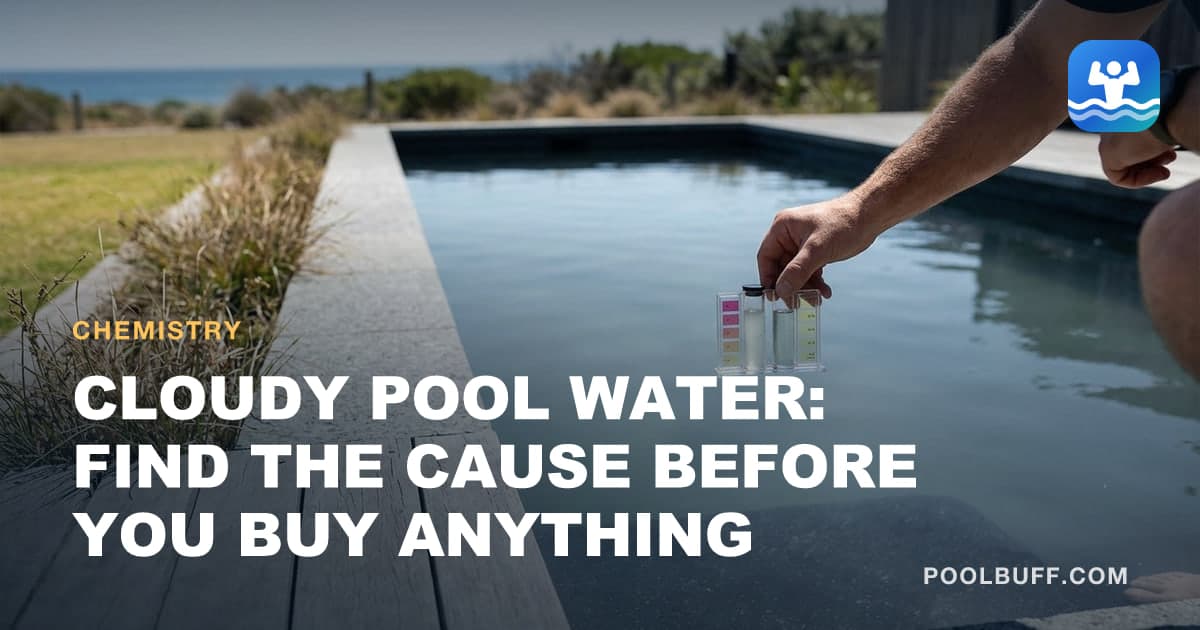
Test free chlorine against your CYA
5 minNot "is there chlorine." Is there enough chlorine for your stabilizer level.
3 ppm is perfectly adequate at 30 ppm CYA. At 80 ppm CYA it's functionally weak water, and weak water goes cloudy before it goes green. Cloudy is often the warning shot before an algae bloom.
If free chlorine is below about 11% of your CYA reading, you've probably found it. Bring chlorine up and give it 24 hours.
- 2
Look at your filter pressure gauge
1 minCompare against the clean baseline. If you're 8 psi or more above it, the filter is restricting flow and doing a poor job, and that alone will leave water hazy.
No baseline written down? Clean the filter, note the pressure, and start keeping one. It's the single most useful number on the equipment pad.
- 3
Check your run time
1 minWater needs a full turnover a day, minimum. On a variable-speed pump at low RPM that's usually 8–12 hours.
People cut run time to save money, water goes cloudy, and then they spend more on chemicals than they saved on electricity. Happens constantly.
- 4
Test pH and calcium
5 minpH above about 7.8 with calcium hardness above 400 is a recipe for calcium carbonate coming out of solution. It shows up as a persistent haze that won't filter out no matter how long you run.
Common in Arizona, Nevada, inland Southern California, and anywhere with hard fill water. If that's you, drop pH into the 7.2–7.4 range and watch it clear.
- 5
Brush and look for algae
10 minBrush a wall in a shaded corner and watch what comes off. Early algae shows as a slight slipperiness underfoot on the steps and a faint green tinge in the shade before the whole pool goes green.
If you find it, dealing with algae properly is a shock-and-hold job rather than an algaecide job.
Also check for a dull, flat look to the water rather than a milky one. Milky is usually chemistry or filtration. Dull and slightly green is biology.
- 6
If it's still a mystery, open the filter
45 minTorn cartridge pleats. A cracked lateral in a sand filter. Channeling in a worn sand bed. Holes in DE grids. Any of those pass fine particles straight through and back into the pool, forever, regardless of what your chemistry says.
This is the one people never check, and it's the answer more often than you'd think — especially on a pool where the water has been "slightly hazy" for months rather than suddenly cloudy last week.
The six causes, and what each one actually needs
| What it looks like | The fixMy default | Time to clear | |
|---|---|---|---|
| Low free chlorine | Milky, developing over days, often worse after heavy use | Raise chlorine to CYA-appropriate level | 24-48 hrs |
| Early algae | Dull, slightly green in shade, walls feel slippery | Shock to 40% of CYA and hold | 2-4 days |
| Filter problem | Persistent haze with perfect chemistry | Clean, repair or replace media | 12-24 hrs after fixing |
| Calcium precipitation | White-ish haze, scale starting at tile line | Lower pH to 7.2-7.4, check LSI | 2-3 days |
| Fine debris | Cloudy after a storm, pollen season, or heavy wind | Clarifier plus extended run time | 24-48 hrs |
| Dead algae | Gray-white cloudiness right after shocking | Keep filtering, brush daily, clean filter often | 2-4 days |
Clarifier vs flocculant
Both exist for a reason. They just get used in the wrong situations constantly.
Clarifier is a polymer that makes tiny particles clump into slightly bigger ones so your filter can actually grab them. Slow, gentle, and it works through your filter. Good for mild haze and post-storm debris. Add it, run the pump, wait a day.
Flocculant drops everything to the floor as a heavy sludge. Fast and dramatic. But then you have to vacuum that sludge to waste — not through the filter, or you're just putting it all back. Which means you need a multiport valve with a waste setting, or a dedicated cleaner line, and you'll lose several inches of water.
Floc on a cartridge filter system with no waste option is a genuinely bad afternoon. I've watched somebody do it and then spend six hours trying to get sludge off a pool floor with a leaf net.
The special case: cloudy after opening
Spring openings come up cloudy so often it's almost expected, and it's usually a combination — winter debris, dead algae, and a filter that's been dry for five months.
The sequence that works:
- Get the pump running and confirm real flow before adding anything
- Test and balance pH and alkalinity
- Shock to CYA-appropriate level and hold it
- Run 24/7 and brush daily
- Clean the filter when pressure climbs, expect to do it two or three times
- Clarifier only at the end, to pick up the last of the haze
Skipping to step 6 is the classic mistake, and it's why some people fight a green-to-cloudy pool for three weeks every April.
Go deeperHow to open your pool without a green messOpening early is worth more than any chemical you can buy in April.When cloudy water isn't your fault
Two situations where you can do everything right and still get haze:
New plaster. A fresh plaster pool leaches calcium hydroxide for months. Expect cloudiness and a stubbornly high pH through the first season. This is normal, and the fix is patience plus a lot of acid, not chemicals aimed at the cloudiness.
Well water with high iron or manganese. This is also the leading cause of metal staining. Fill the pool, add chlorine, and the metals oxidize and cloud the water — sometimes with a brown or purple tint. You need a sequestrant before you chlorinate, not after. If you're on a well, test your fill water for metals before you ever top the pool off.
Stop it happening again
Almost every cloudy pool I've been called to traces back to one of three habits:
- Testing once a week instead of twice, and only in the morning when demand is low
- Never testing CYA, so the chlorine target quietly became wrong
- Cleaning the filter on a calendar instead of on the pressure gauge
Fix those three and cloudy water mostly stops being part of your life.
Go deeperCloudy hot tub, or foam?Different causes, and why antifoam and clarifier are both masks.Worth having on hand
- Check price
Taylor K-2006C test kit
Drop-count titration rather than color matching, and it tests CYA properly.
- Check price
filter cleaner
A hose rinse leaves the oils behind. This is what gets the greasy film.
Frequently asked questions
Why is my pool water cloudy but chlorine is fine?
Check what 'fine' means against your CYA level — 3 ppm is fine at 30 ppm CYA and far too low at 80. If chlorine genuinely is in range for your CYA, look at the filter next: high pressure, a short run time, or a channeled sand bed will all leave water hazy with perfect chemistry.
How long does it take for cloudy pool water to clear?
With the cause actually fixed and the pump running around the clock, most cloudy water clears in 24 to 48 hours. A heavy dead-algae bloom can take three or four days and several filter cleans. If it's been a week with no improvement, you haven't found the cause yet.
Will clarifier fix cloudy pool water?
It'll help your filter catch fine particles it's currently passing, which is genuinely useful once the underlying cause is fixed. It will not fix low chlorine, a dirty filter, or calcium coming out of solution. Used on its own it just delays the real diagnosis.
Should I use flocculant or clarifier?
Clarifier for mild haze you're willing to filter out over a day or two. Flocculant when the water is badly clouded and you want it gone fast — it drops everything to the floor as a sludge that you then vacuum to waste, not through the filter. Floc on a pool with no waste setting is a mistake you only make once.
Why is my pool cloudy after shocking it?
Usually dead algae. You killed it and now it's suspended as very fine particulate that the filter has to catch. Run the pump 24 hours a day, brush daily, and clean the filter as the pressure climbs. This is normal and it resolves in two to four days.
Can a bad pool filter cause cloudy water?
Absolutely, and it's underdiagnosed. Torn cartridges, cracked sand filter laterals, channeling in an old sand bed, DE grids with holes, or simply a filter too small for the pool will all pass fine particles straight back. If chemistry is right and the water stays hazy, open the filter.