The single best thing you can do for your spring opening is do it three weeks earlier than you want to.
Everybody waits for a warm weekend. By then the water's been sitting above 60°F for two weeks, the algae has had a head start under a dark cover, and what should have been an afternoon becomes ten days and $200 of chlorine.
Key takeaways
- Open earlier than feels natural. Algae wakes up around 60°F and you want to be ahead of it.
- Get every drain plug back in before you fill anything. This is the classic opening mistake.
- Clean the cover before you pull it. Dumping winter sludge into the pool doubles your work.
- Run the pump 24/7 for the first few days and expect to clean the filter more than once.
- If it's already green, that's a shock-and-hold job, not a bigger dose of algaecide.
Open before 60°F
Algae becomes active around 60°F. Below that it's dormant, and your winter chlorine — even if it's mostly gone — has been holding a pool that wasn't under much pressure.
Open ahead of that threshold and you're balancing clear water. Open after it and you're clearing a bloom.
In most of the northern US that means March or very early April, which feels absurdly early when it's still cold out. Do it anyway. Cover removal on a cool, still day is also far easier and far less messy.
The job
Before you start
- Time
- 4 hr
- Difficulty
- Easy
- Cost
- $80-$200 in chemicals
Tools
- Cover pump
- Soft broom
- Test kit
- Brush and pole
- Garden hose
Supplies
- Liquid chlorine
- Balancing chemicals
- Silicone lubricant
- Spare o-rings
- 1
Clean the cover first
45 minDo not skip this and do not rush it.
Pump the standing water off with a cover pump. Then sweep or leaf-blow the debris off the surface. You want it as clean as you can reasonably get it before it moves.
Every leaf and every gallon of black winter sludge left on that cover goes straight into your pool the moment you lift it. That's the difference between a clear opening and a two-week project, and it's entirely within your control.
- 2
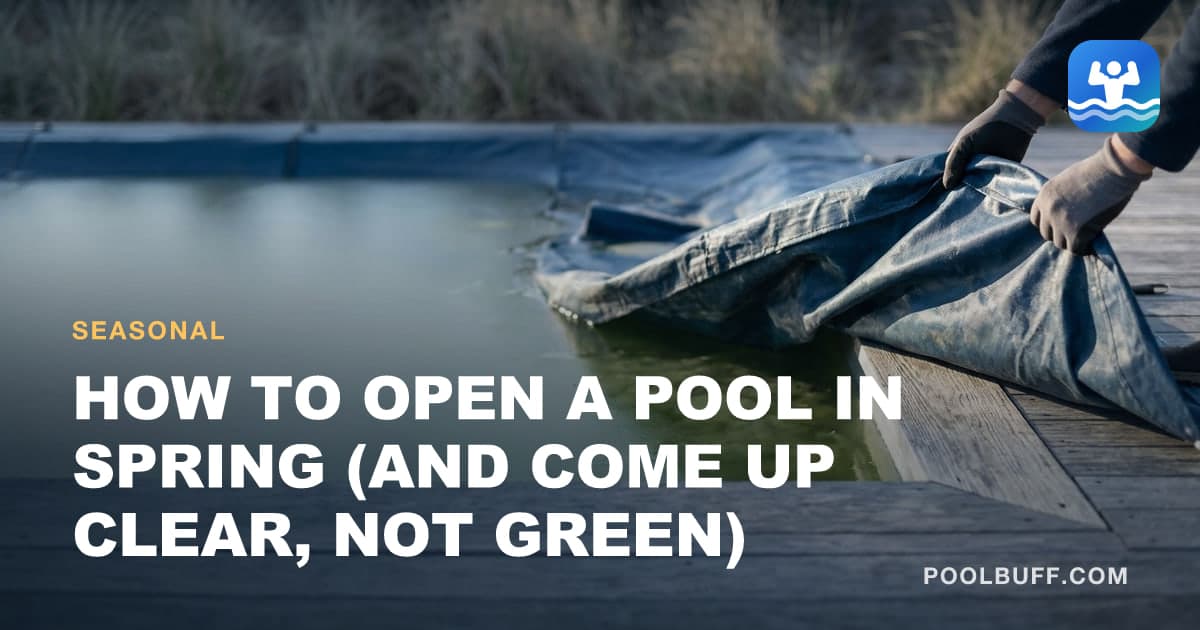
Remove and store the cover
30 minTwo people. Roll it back toward one end, keeping the edges lifted so you're not sluicing the remaining water into the pool.
Then lay it out on the lawn, hose it down properly, and let it dry completely before folding and bagging it. A cover put away damp comes out of the bag in October covered in mildew, and mildew shortens its life considerably.
Store it somewhere rodents can't reach. Mice chew through covers, and they seem to enjoy it.
- 3
Put every drain plug back
30 minThey should be in a bag taped to the pump. If they're not, this is the year you start doing that.
Pump drain plugs, filter drain plug, heater header plugs, chlorinator plugs.
Lubricate every o-ring with silicone lubricant as it goes back. Five months dry makes rubber hard, and a hard o-ring is the reason your pump won't prime an hour from now. Replace any that look cracked, flattened or brittle — they're a few dollars each and it's much easier to do now than after you've filled everything.
- 4
Pull the winter plugs and reassemble
20 minReturn line plugs out, eyeballs back in. Skimmer gizmo out, basket back in. Pump basket in. Filter reassembled with cartridges or DE grids back in place.
Reopen any valves you closed at the pad, including the main drain valve if you air-locked it.
Reinstall the salt cell if you took it indoors, and check the multiport valve is back on FILTER.
- 5
Fill and prime
1-3 hrs mostly waitingBring the water halfway up the skimmer opening.
Fill the pump housing right to the top with a hose, seat the lid, tighten it properly, and start the pump.
Open the filter's air relief valve and leave it open until water comes out in a steady stream with no air, then close it.
If it won't prime, it's almost always a dried-out o-ring somewhere. That's the single most common spring problem and there's a whole diagnostic for it.
- 6
Test, balance, shock
1 hr plus circulationTest everything. Winter water is often strange — pH drifted, alkalinity moved, chlorine at zero.
Order as always: alkalinity, then pH, then shock to your CYA-appropriate level.
Expect the chlorine demand to be higher than you'd guess. Five months of organic load takes some oxidizing.
- 7
Run 24/7 and brush daily
3-5 daysPump on continuously. Brush every surface every day. Clean the filter whenever pressure climbs 8–10 psi — on a messy opening you'll do it two or three times in the first week, and that's normal.
Most pools go from opening to swimmable in three to five days.
If it's already green
It happens, usually because it got closed too warm. Don't panic and don't buy the "green pool kit."
- Get the pump running properly first. Circulation before chemistry, every time. There's no point shocking water that isn't moving.
- Clean the filter before you start, because it's about to work very hard.
- Fish out the big debris with a leaf rake. Don't try to vacuum a swamp — you'll clog everything.
- Test CYA if you possibly can. Green water is hard to test, so if you can't get a reading, assume 30–40 ppm and shock to 16 ppm accordingly.
- Balance pH to about 7.2 so the chlorine works.
- Shock and hold. This is the job. Retest every few hours, top back up to shock level, keep it there until overnight chlorine loss drops under 1 ppm.
- Brush daily. Filter constantly. Clean the filter often.
- Vacuum to waste once the algae is dead and settled — not through the filter.
Budget a week. It'll cost $100–$250 in chlorine depending on size and CYA, and it's entirely avoidable next year by closing below 60°F.
Things worth doing at opening
While everything is apart anyway:
- Replace tired o-rings on the pump lid, filter and unions. A handful of dollars, and it prevents the most annoying failures.
- Test the GFCI on the equipment circuit — press the button, confirm it trips and resets.
- Check the main drain cover and its date stamp. Anti-entrapment covers expire and legally must be replaced.
- Inspect the safety cover anchors and the fence gate self-closer. Do the gate test: open it, let go, confirm it swings shut and latches on its own.
- Note your clean filter pressure on the tank with a marker. New season, new baseline.
- Check the salt cell for scale and clean it if needed.
Twenty minutes of this now saves a lot of mid-season annoyance.
Should you pay for a professional opening?
$200–$450 in most markets, and the full cost comparison covers what that buys against doing it yourself.
Worth it the first year in a new house, particularly if you don't know how the system is plumbed or where the valves should sit. Watch what they do, take photos of the valve positions, and next year you'll manage it yourself in an afternoon.
Opening kit
- Check price
Taylor K-2006C test kit
Drop-count titration rather than color matching, and it tests CYA properly.
- Check price
cal-hypo shock
68% calcium hypochlorite in 1 lb bags, so you dose a bag rather than guess at a scoop.
- Check price
18-inch stainless pool brush
Stainless bristles for gunite and concrete only. It will damage a vinyl liner.
Frequently asked questions
When should I open my pool in the spring?
Before water temperature consistently passes 60°F, which is usually earlier than people expect — often March or early April in much of the US. Algae becomes active around that threshold, and opening ahead of it means balancing clear water instead of clearing a bloom.
Should I drain my pool when I open it?
Almost never. Winter water is usually fine once balanced and shocked. Draining is only worth it if cyanuric acid or calcium hardness has climbed too high to manage, or if total dissolved solids are extreme. Draining also carries real structural risk on vinyl and fiberglass pools.
Why is my pool green when I open it?
Almost always because it was closed too warm. Water above 60°F under a cover stays biologically active and consumes the winterizing chlorine long before spring. The fix is a proper shock-and-hold at your CYA-appropriate level, not more algaecide.
How long does it take to open a pool?
About four hours of actual work, then three to five days of running the pump continuously and adjusting chemistry before it's swimmable. A green pool adds a week.
Do I need to shock the pool when opening?
Yes. Water that's sat for five months has organic load and near-zero sanitizer, and shocking to your CYA-appropriate level resets it. Balance alkalinity and pH first so the chlorine works properly.