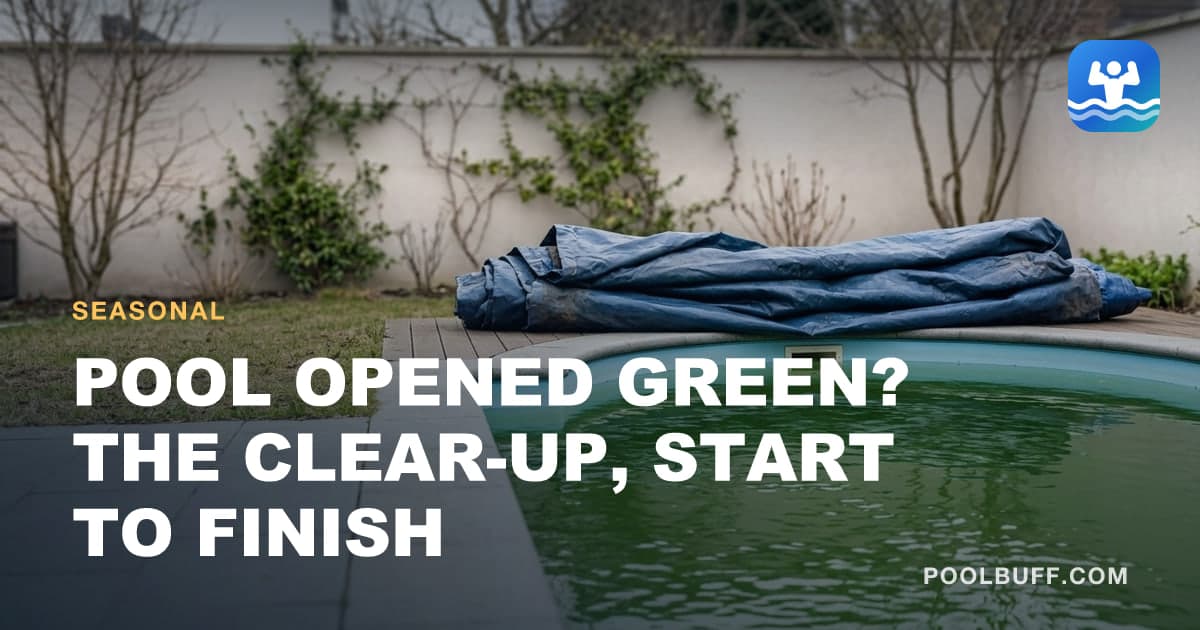
Pulling a cover off green water is demoralizing, and the instinct is to go to the store. That instinct is what turns a four-day job into a two-week one.
There is nothing on the shelf that clears a bloom faster than chlorine held at the right level. The work is in the holding.
Key takeaways
- Test cyanuric acid before you buy anything. It sets the entire chlorine target.
- Holding the level is the job. One big dose that fades by morning achieves nothing.
- Brushing every day matters as much as the chlorine does.
- Chlorine that vanishes within an hour is ammonia, and that is a different fight.
- Sometimes replacing half the water is cheaper and faster than treating it.
Test CYA before you buy anything
Every decision downstream depends on this number, and most people clearing a green pool never take it.
Cyanuric acid decides how much chlorine you need for the same killing power. At 30 ppm CYA you are aiming for about 12 ppm free chlorine. At 80 ppm you are aiming for 32 ppm — nearly three times the chemical for the identical result.
So if CYA came out of the winter high, the cheapest move available is to replace some water before you start. Every ppm you dilute out is chlorine you never have to buy.
What you need
- Check price
Taylor K-2006C test kit
Drop-count titration rather than color matching, and it tests CYA properly.
- Check price
liquid chlorine, 12.5% sodium hypochlorite
Adds no stabilizer and no calcium. Heavy to ship, so local is usually cheaper.
- Check price
filter cleaner
A hose rinse leaves the oils behind. This is what gets the greasy film.
- Check price
18-inch nylon pool brush
Nylon bristles, safe on vinyl, fiberglass and plaster alike. The default choice.
The sequence
- 1
Net, don't vacuum
30 minutesGet the leaves and big debris out. Every solid thing you remove is organic load the chlorine does not have to destroy.
Leave the vacuum alone for now. You cannot see the floor, so you would only stir settled debris back into the water and clog the filter with material that has not been broken down yet.
- 2
Drop pH to about 7.2
20 minutesChlorine's killing power falls off sharply as pH rises. At 8.0 you are getting a fraction of the disinfection you would get at 7.2 from the same reading.
This costs a few dollars of acid and buys you a meaningful share of the clear-up time.
- 3
Clean the filter, then run it continuously
1 hourThe filter clears what the chlorine kills, and it starts this job at a disadvantage. Clean it properly before you begin, then leave the pump running 24 hours a day until the water is clear.
Expect to clean it again partway through. On a bad one, twice.
- 4
Shock to 40% of CYA, in the evening
30 minutesAdd it once the sun is off the water so the first dose is not half destroyed before it does anything. Liquid chlorine is the right product here — you are adding a lot of it, and cal hypo would load calcium while tablets would push CYA higher.
- 5
Hold it. This is the actual job.
3–7 daysTest two or three times a day and bring the level back up every time it has dropped. Brush every surface daily — steps, behind the ladder, the light niche, the shaded wall.
A pool that sits at target for four days clears. A pool that hits target each afternoon and falls to nothing by morning does not, no matter how much chlorine goes into it.
- 6
Finish on the overnight test
1 nightYou are done when the water is clear and free chlorine drops less than 1 ppm overnight. Not when it looks better — when the number holds.
Then vacuum up what has settled, let the chlorine fall back to normal, and rebalance.
Why algaecide doesn't work here
It is worth being blunt, because this is where the money goes.
Algaecide is a preventative. It works by making water inhospitable to algae that has not established itself yet, which is genuinely useful at closing and genuinely useless in April when the bloom is already in front of you.
Poured into an established green pool it produces almost no visible change, costs real money, and — with the copper-based versions — introduces a metal that can stain your surface as the chlorine comes up. The best case is that it does nothing.
Hold chlorine instead. It is cheaper and it works.
Not all of it is green algae
Most spring blooms are ordinary green algae, which is what the sequence above is written for. Two others behave differently enough to be worth recognizing before you start.
Mustard algae is yellow or brownish, usually on shaded walls, and it looks like a dusting of sand or pollen rather than a green tint running through the water. It brushes away easily and comes straight back, which is the tell. It tolerates chlorine better than green algae does, so it wants shock level held longer — and it survives on anything that went in the water. Everything gets treated alongside the pool: pole, brush, net, floats, swimsuits, the vacuum hose. Clear the water and leave a contaminated float in the shed, and you will meet it again in three weeks.
Black algae shows as dark spots with a raised, almost crusty surface, nearly always in plaster on a gunite pool, and firmly anchored rather than drifting. It is not really the same kind of problem: it puts roots into the surface and builds a protective layer over itself, so chlorine in the water never reaches the living part. Clearing it means physically breaking that layer with a stainless brush on every single spot, every day, while holding shock level — and it is genuinely the one case where a specialist product earns its keep, applied after the brushing rather than instead of it.
Both take longer than the three to seven days above. Both return if the brushing was less than thorough. And neither responds to a heavier dose as a substitute for the mechanical work. The four algae types, and what each one actually takes goes through them properly — this page is the opening-day version, where the clock and the cover are part of the problem.
When refilling beats treating
Run the numbers before you commit to the chemical route.
A dark green pool with CYA at 90, sitting on a badly closed winter, can need a genuinely large volume of chlorine to clear. Replacing half the water costs whatever your water costs, takes an afternoon, and drops CYA and the organic load at the same time.
That is not giving up. On a bad enough pool it is simply the cheaper answer, and there is no prize for treating your way through it.
Just do it as a partial exchange rather than a full drain — an emptied shell in saturated spring ground can float, and that turns a chemistry problem into a construction one.
Go deeperNext spring, skip this entirelyOpening before the water passes 60°F costs an afternoon and saves the whole week you just spent.Frequently asked questions
How long does it take to clear a green pool?
Three to seven days for most spring openings, assuming you hold the chlorine level properly and run the pump around the clock. A pool that is dark green with no visible floor takes longer, and a pool with ammonia is a different problem entirely. The single biggest cause of a two-week clear-up is letting the level drop overnight and starting again in the morning.
Will algaecide clear a green pool?
No, and this is the most expensive misunderstanding in pool care. Algaecide is a preventative that stops a bloom starting. It cannot clear an established one — you will spend money, see almost no change, and lose days. Chlorine held at the right level for your stabilizer is what kills algae.
Should I drain a green pool and start over?
Sometimes, and it is worth doing the arithmetic rather than assuming. If cyanuric acid is high, the water is dark, and you would be buying a lot of chlorine, replacing part of the water is often cheaper and much faster — and it resets stabilizer at the same time. Never fully drain one, though, because an empty shell in wet ground can float.
Why is my pool still cloudy after the algae died?
Dead algae is suspended solids, and clearing it is the filter's job rather than the chlorine's. Keep the pump running continuously and clean the filter as pressure climbs — on a bad clear-up that can mean two or three cleanings. If it stays milky for days with clean pressure, the filter media itself is likely finished.
Do I need to vacuum a green pool first?
No, and doing it early wastes effort. You cannot see the floor, so you will stir debris back into suspension and clog the filter with material the chlorine has not broken down yet. Net the big stuff, clear the water, then vacuum what has settled once you can actually see it.