Of everything in a pool closing, this is the step that keeps buried pipe from cracking. Hayward's closing guide says all the water must be drained or blown out so the equipment doesn't freeze and crack, and its next step is blowing out the lines. Pentair's sand filter guide adds that water freezing in the system can damage it and cause flooding and property damage.
It is also a step where the tool you pick matters, and where the manuals don't all agree.
Key takeaways
- Volume of air matters more than pressure. Hayward's manuals call for a low-pressure, high-volume blower, and a shop vac on blow is one.
- Plug each line while air is still coming out of it, not after you switch off.
- Returns first, then the skimmer, then the main drain, which gets an air lock rather than a plug.
- Antifreeze is for the water you couldn't move. WinterProof says water left in the line can still freeze and damage it.
- Solar panels get drained, not blown. FAFCO says blowing won't clear them completely.
Volume, not pressure
The instinct is to reach for a compressor because it sounds like the serious option. The manuals say otherwise.
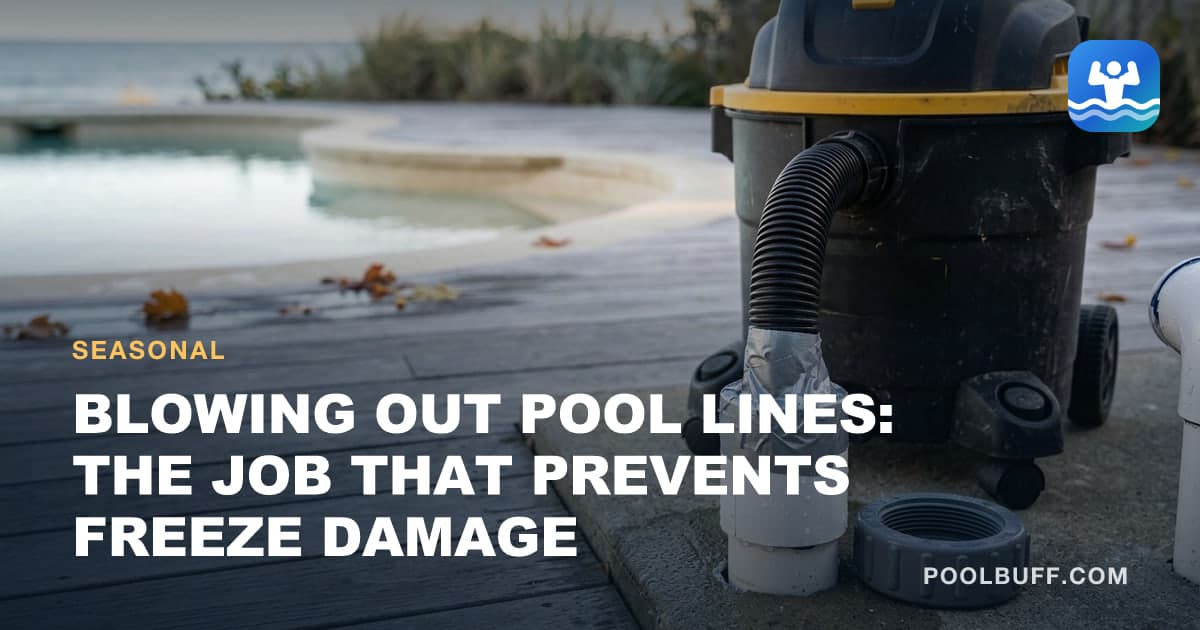
Clearing a line means pushing a column of water out of the pipe. Hayward's pump and filter manuals call for a low-pressure, high-volume blower, under 5 psi, and say never to purge the system with compressed air, because it can make components explode. Pentair's heater manual says the same. A pool dealer whose winterizing process Latham published uses a commercial blower rather than a compressor, and gives the reason: the blower sends a lot of air at lower pressure, and the compressor less air at higher pressure. A wet/dry shop vac on its blower port is the homeowner's version of that blower.
Not every source agrees. Pentair's filter manuals allow compressed air, but only with the filter's air relief valve opened first, so trapped air can't blow the lid off. WinterProof's antifreeze directions say a compressor or a wet/dry vac, at low pressure. I'd go with Hayward's manuals and leave the compressor in the garage.
Drain the equipment before you start
Line blowing does nothing for the water sitting inside your equipment, so that comes first.
Every drain plug comes out: pump, filter, heater, chlorinator. Pentair's pump manual says to open the filter's air relief, pull both drain plugs and keep them in the pump basket. Hayward's says to pull the drain plugs and the strainer cover. Polaris, on its booster pump, says to store the drain plug somewhere safe and not to lose its o-ring. The closing guide goes through each piece of equipment, from the heater's drain to the tablets in the chlorinator.
Then put every plug in a bag, label it, and tape it to the pump. Finding it again is half of next spring's opening.
Where the air goes in
The step everybody skips describing, because whoever wrote the instructions already knew the answer.
WinterProof's directions connect the blower to the pool pump and blow the water out through the skimmer, main drain and return lines. Use whatever port on the pump you can seal a fitting against, with a short length of hose and a threaded adapter.
From there the valves do the work. Closing everything except one return sends the whole volume of air down that single line, which is what clears it. Leave two open and the air takes the easier one while the other stays full.
On a multiport, set it to recirculate. Pentair's sand filter guide describes that setting as water going from the pump through the valve and back to the pool, bypassing the filter, so the air goes the same way, straight to the returns.
Clearing the skimmer line means the air travels the other way, so the connection moves to the suction side. Hayward's closing guide describes the whole route: from the skimmer, through the equipment, and back to the pool. And if you want to keep the water high, Gizzmo's Ultra Gizzmo has a built-in tube for blowing out the skimmer line from the skimmer end, without lowering the water.
The order, and why it matters
- 1
Returns, one at a time
20 minutesIsolate a single return, blow until it bubbles steadily into the pool, and push the winterizing plug home while the air is still flowing. Hayward's guide says to plug the lines at the pool with expansion plugs.
That last detail is my habit, and it's the whole technique. Switch the blower off first and water runs back into the line before the plug is in.
- 2
The skimmer line, then the Gizzmo
15 minutesSame approach. Clear the line, plug it under air, then thread a Gizzmo into the skimmer.
Gizzmo says its air cushion protects the skimmer by absorbing the expansion when it freezes, and that it does that job in the skimmer only. Its instructions say best practice is to lower the water below the skimmer before it goes in. The dealer process on Latham's blog uses one for the same reason, to stop the skimmer cracking.
- 3
The main drain, last and differently
10 minutesYou can't plug a floor drain from the pad, so the dealer process on Latham's blog air-locks it instead, by closing the drain's valve at the filter. I blow it until it bubbles steadily and close the valve while the air is still moving, so the trapped air holds the water out of the line all winter.
Hayward's main drain manual goes further: a floor drain doesn't need winterizing at all. Only a wall-mounted suction outlet with a sump does, and then you blow it out and fit an O-ring plug. That plug has to come out before anyone swims, because Hayward warns that leaving it in is an entrapment hazard.
- 4
Antifreeze where you're unsure
15 minutesAny line where the bubbling never quite got convincing gets a pour of propylene glycol pool antifreeze, then its plug. WinterProof's directions use one to three jugs, depending on the pool and its lines.
Propylene glycol only. Hayward, Pentair and Polaris all say other antifreezes are toxic and can damage the equipment.
The lines people forget
The returns and the skimmer always get done. These are the runs that are easy to miss.
- The cleaner line, on a pressure-side or suction-side cleaner. A separate run to a separate wall port, holding water like any other. Polaris says to drain the booster pump and its piping too.
- Spa lines, on a combination pool and spa. Jets, spa return and spa suction are separate runs.
- Water features, like deck jets, waterfalls and slides. The dealer process on Latham's blog double-checks those lines separately, after the main lines are closed.
- A wall-mounted suction outlet. Hayward says it needs blowing out and an O-ring plug, unlike a floor drain.
- Solar panels on the roof. These get drained, not blown. FAFCO's manual says to open the drain valves, take off the end caps and vacuum relief valve, and let the panels drain for at least an hour, lifting flat-mounted panels to empty them. It says blowing the lines with a shop vac, leaf blower or compressor will not remove all the water.
Walk the pad and count the pipes leaving it. Every one of them goes somewhere, and every one of them holds water.
Antifreeze is the backup, not the plan
The makers don't all frame it that way. Hayward's closing guide offers antifreeze as the alternative: blow the lines, or if you don't, fill them with pool antifreeze following the package directions.
The others put blowing or draining first. Pentair's Sta-Rite modular DE filter manual says to drain the system as far as possible by gravity, then protect the spots that still hold water with non-toxic propylene glycol. WinterProof's directions blow the lines before the antifreeze goes in, and say not to dilute it, because water left in the lines can still freeze and damage them.
That's why I treat antifreeze as cheap insurance on the couple of runs I wasn't sure about. Blow the lines properly first.
Where this fits in the close
Line blowing happens near the end, after the water is balanced and shocked and the equipment is drained, and before the cover goes on. That's the order in Hayward's closing guide, and the full closing sequence has the rest.
If the circulation loop is not something you have a clear picture of yet, read that first. Knowing which pipe goes where turns this from following instructions into understanding what you are doing, and it is a short loop.
Go deeperThe rest of the closeTiming, chemistry, equipment and cover: the full sequence this step sits inside.Frequently asked questions
Can I use a shop vac to blow out pool lines?
Yes. Hayward's pump and filter manuals call for a low-pressure, high-volume blower under 5 psi, and a wet/dry vac on its blower port is exactly that. A pool dealer whose winterizing process Latham published uses a commercial blower rather than a compressor for the same reason: the blower moves more air at lower pressure. WinterProof's directions allow a compressor at low pressure, but Hayward's manuals rule out compressed air altogether.
How much pressure is safe for blowing out pool lines?
Under 5 psi. Hayward's pump and filter manuals and Pentair's heater manual allow only a low-pressure, high-volume blower below 5 psi, and Hayward says not to use compressed air at all, because it can make components explode. Pentair's filter manuals allow compressed air only with the filter's air relief valve opened first, so trapped air can't blow the lid off. Check the manuals for your own equipment before a compressor goes anywhere near it.
Do I still need antifreeze if I blow the lines properly?
Only on lines you couldn't clear. Pentair's Sta-Rite modular DE filter manual says to drain the system as far as possible by gravity and protect any spots that still hold water with non-toxic propylene glycol. WinterProof says to blow the lines first and warns that water left in them can still freeze and damage them. Hayward's closing guide treats antifreeze as the alternative if you don't blow the lines at all. Hayward, Pentair and Polaris all allow only propylene glycol.
What order should I blow the lines in?
Returns first, then the skimmer, then the main drain last. That's the order in the dealer process Latham published: lines into the pool plugged, the skimmer plugged with a Gizzmo, water features checked, and only then the main drain, which gets an air lock rather than a plug.
What happens if I skip blowing out the lines?
Water left in a line can freeze and crack it. Hayward's closing guide says everything must be drained or blown out so the equipment doesn't freeze and crack, and Pentair's sand filter guide warns that water freezing in the system can damage it and cause flooding and property damage. If you don't blow the lines, Hayward's guide says to fill them with pool antifreeze instead.