Every October I have the same conversation.
Somebody wants to close on the first cool weekend because they're done with the pool for the year. The water's still 72°F. I tell them to wait three weeks. Sometimes they wait, and they open to clear water in April. Sometimes they don't, and I get a call the following spring about a swamp.
The rest of the job is procedure, and the people who wrote the procedure are the companies that made your pump, filter, heater, cover and pool. This page is built from their manuals. Where they agree, it just tells you. Where they don't, and on the water level they really don't, it names them, because the maker of your cover or pool is the one who decides a warranty claim.
Key takeaways
- Close by water temperature. Hayward says once the water stays below 65°F, and Clear Comfort says 60 to 65°F.
- Your cover's maker sets the water level, and they differ: Loop-Loc says 15 to 18 inches below the top for mesh, Meyco within 18 inches, Latham within 12 inches of the cover.
- Fiberglass and vinyl pools have their own limits. Fiberglass makers say never below the skimmer, and Loop-Loc says never less than a foot of water in a vinyl pool's shallow end.
- No compressed air on the equipment. Hayward, and Pentair's heater manual, allow only a blower under 5 psi, because compressed air can make parts explode.
- Pull every drain plug, and empty the tablet feeder completely. Hayward and Jandy both say to take out every piece of tablet.
Wait for the water to cool. Genuinely wait.
This is the judgment call, and it's where closings go wrong.
Hayward says you can close once the water stays below 65°F. Its reason is that winter chemicals are used up much faster in warm water, so a pool closed too early often runs out before spring and gets algae and staining. Thursday Pools also says 65°F, and wants the water there before you stop the filtration. Clear Comfort says 60 to 65°F. PHTA's CPO newsletter adds that algae starts growing at temperatures well below what anyone would call comfortable for swimming.
I wait for the low end of that range. Buy a $10 thermometer, and wait for the water, not the air, to sit there for several days running.
The job
Before you start
- Time
- 5 hr
- Difficulty
- Moderate
Tools
- Shop vac on blow, or a blower under 5 psi
- Expansion plugs
- Gizzmo or skimmer plug
- Test kit
- Cover, and a pump for a solid cover
Supplies
- Shock
- Winter algaecide
- Propylene glycol antifreeze
- Silicone lubricant
- 1
Deep clean everything
1-2 hrsBrush every surface and vacuum the floor. Pentair's reason for brushing is to cut the chance of black algae and scale on the walls. Empty the baskets and clean the filter properly, not just a backwash.
Then take out everything that doesn't winter in the pool. Hayward's list is the skimmer baskets, wall fittings, cleaners, solar blankets and ladders, and it says not to coil a cleaner's hose tightly. Pentair adds the booster pump.
- 2
Balance the water
30 min plus circulationpH 7.2 to 7.6 is the range the makers' closing instructions agree on. Clorox, SeaKlear and Kem-Tek all give it, and so does the label of the winter algaecide Clorox sells.
Past pH they don't agree at all. For total alkalinity, SeaKlear gives 80 to 120 ppm, and the Clorox winter algaecide label 125 to 150. For calcium, that same label gives 200 to 275 ppm, while Orenda wants at least 400 in a pool that will freeze, and Thursday Pools wants a fiberglass pool under 120.
What explains the spread is temperature. PHTA's CPO newsletter warns that water balanced at closing can turn aggressive simply because it gets colder, and that aggressive water damages the surface. So whatever ranges you use, run the saturation index calculator at the temperature the water will sit at all winter, not the temperature it's at today. The LSI explainer goes through what to change if it comes out negative.
- 3
Shock, then the winter algaecide
Several hoursPentair says to shock before adding any winterizing chemicals, and the algaecide labels agree on the order. They differ on the wait in between: 30 minutes on the Clorox winter algaecide's short directions, 2 to 4 hours on its full directions and on BioGuard's Banish. Follow your own algaecide's label.
None of the labels I read ties adding the algaecide to the chlorine dropping to a particular level. The "under 5 ppm" rule you'll see belongs to enzyme products: Natural Chemistry's closing kit says the sanitizer should be below 5 ppm before it goes in.
Which algaecide is a choice, and the labels explain it:
- Polyquat labels, like BioGuard's Algae All 60, call it non-foaming. That's what I use.
- Copper algaecides are labeled non-staining at the diluted dose, but BioGuard's Banish label warns that the full-strength product stains porous surfaces, and that metals in the water can stain too. It says to treat with a stain and scale inhibitor first.
- Quat labels vary. The quat sold as Robelle Winter Algaecide warns that it may foam, and not to use it in pools with an attached spa. HTH labels its quat non-foaming.
Not every maker shocks at all. Orenda says normal chlorination is enough and you shouldn't need to superchlorinate, and Thursday Pools says a balanced pool doesn't need a shock at closing.
- 4
Lower the water to your cover's level
1-2 hrsHere the makers really disagree, so use the figure from whoever made your cover, then check it against your pool's own limit below.
- Loop-Loc safety covers: mesh 15 to 18 inches below the top of the pool, solid 12 to 16 inches.
- Meyco safety covers: within 18 inches of the top of the pool, and no lower all winter.
- Merlin safety covers: between 6 and 18 inches from the cover.
- GLI safety covers: no more than 18 inches from the top. A solid cover has to stay suspended above the water.
- Latham safety covers: within 12 inches of the cover.
- Hayward's closing guide: 12 to 18 inches below the skimmer for a mesh cover, 3 to 6 inches below the tile for a solid floating cover. It adds that some covers need no lowering at all.
Notice that Hayward measures from the skimmer and the cover makers from the top of the pool. Eighteen inches below a skimmer is further down than 18 inches below the top, so on a safety cover, the cover maker's figure is the one to use. Going lower voids the warranty with Loop-Loc, Meyco and GLI.
The water is there for a reason. Meyco explains that a loaded cover sinks until it rests on the water, which takes the strain off its springs and webbing.
Your pool sets a limit too.
- Fiberglass: Latham's warranty says its pools are designed to stay full, and requires the water above the skimmer outlet. Thursday Pools says never below the skimmer, and warns that a fiberglass shell drained too low can lift out of the ground where the water table is high.
- Vinyl: Loop-Loc says never less than a foot of water in the shallow end, because the liner can shrink and tear at fittings and corners. Merlin's liner warranty says not to go below 2 feet in the shallow end without your dealer's advice.
If your cover's figure would take a fiberglass pool below the skimmer, the pool's limit wins. Gizzmo makes the Ultra Gizzmo for exactly that case: for keeping the water high, with a tube for blowing out the skimmer line.
- 5
Blow out and plug every line
1-2 hrsThis is the step that keeps buried pipe from cracking. Blowing out pool lines goes through it line by line.
Use low pressure. Hayward's pump and filter manuals say compressed air can make components explode, and to use only a low-pressure, high-volume blower under 5 psi. Pentair's heater manual says the same. A shop vac on blow is that kind of blower.
Not every source agrees. Pentair's filter manuals allow compressed air as long as you open the filter's air relief valve first, because trapped air can blow the lid off. And Hayward's own closing blog says a shop vacuum or a compressor. I'd go with the manuals.
Hayward's closing guide gives the route: blow out the lines from the skimmer through the equipment and back to the pool, then plug them at the pool with expansion plugs. My habit is to plug each return while air is still coming out, so the line holds air rather than water.
The skimmer. A Gizzmo threads into the skimmer and takes the ice expansion there. Gizzmo's own instructions say best practice is to lower the water below the skimmer first, and to use the Ultra Gizzmo if you keep it high.
The main drain. Hayward's main drain manual says a floor drain doesn't need winterizing at all. Only a wall-mounted suction outlet with a sump does, and then you blow it out and fit an O-ring plug. That plug has to come out before anyone swims, because leaving it in is an entrapment hazard. A pool dealer quoted on Latham's blog air-locks a floor drain instead, by closing its valve at the filter. Main drain safety explains why the drain matters.
Antifreeze is for water you couldn't clear. Hayward's guide says to use pool antifreeze following the package directions if you don't blow the lines. Hayward, Pentair and Polaris all say the only antifreeze allowed in the system is propylene glycol, because the others are toxic and can damage the equipment.
- 6
Drain the equipment completely
45 minEvery manual says it, and Hayward and Pentair both exclude freeze damage from their warranties.
- Pump: Hayward's VS pump manual says to pull both drain plugs and the strainer cover, then disconnect the pump and store it dry. Pentair's says to stop the pump, open the filter's air relief, pull both drain plugs and keep them in the pump basket. Cover the motor, but don't wrap it in plastic. Hayward says plastic traps condensation, and Pentair rules out anything airtight.
- Filter: drain plug out, air relief open. A DE filter's grids come out and get cleaned, and Pentair says to store them and the drain plug where they can't freeze. Hayward says to clean a cartridge, and to drain the filter or store it indoors. A multiport valve goes to Winterize, or between two positions if it has no Winterize setting.
- Gas heater: Hayward says to drain it at season's end by pulling the plastic drain plug on the header, or opening the brass drain valve on ASME models. Pentair's ETi 250 drains through the manifold and is blown out at under 5 psi.
- Heat pump: Hayward and Pentair both drain theirs by opening the unions.
- Tablet chlorinator: drain it and take out every tablet and every piece of tablet, which Hayward and Jandy both spell out. Our catalog page for Hayward's CL200 and CL220 has an owner's account of one that pressurized over the winter with tablets left in it.
- Salt cell: Hayward's AquaRite S3 manual says the cell and flow switch freeze like the rest of the plumbing, so drain them with it. The control box stays on the wall.
- Booster pump: Polaris says to drain it and pull its drain plug, and better still, to take it indoors.
Pentair suggests storing the equipment you can move somewhere that stays above about 40°F. Put every drain plug in a ziplock bag and tape it to the pump. I promise you will not remember where you put them in April.
- 7
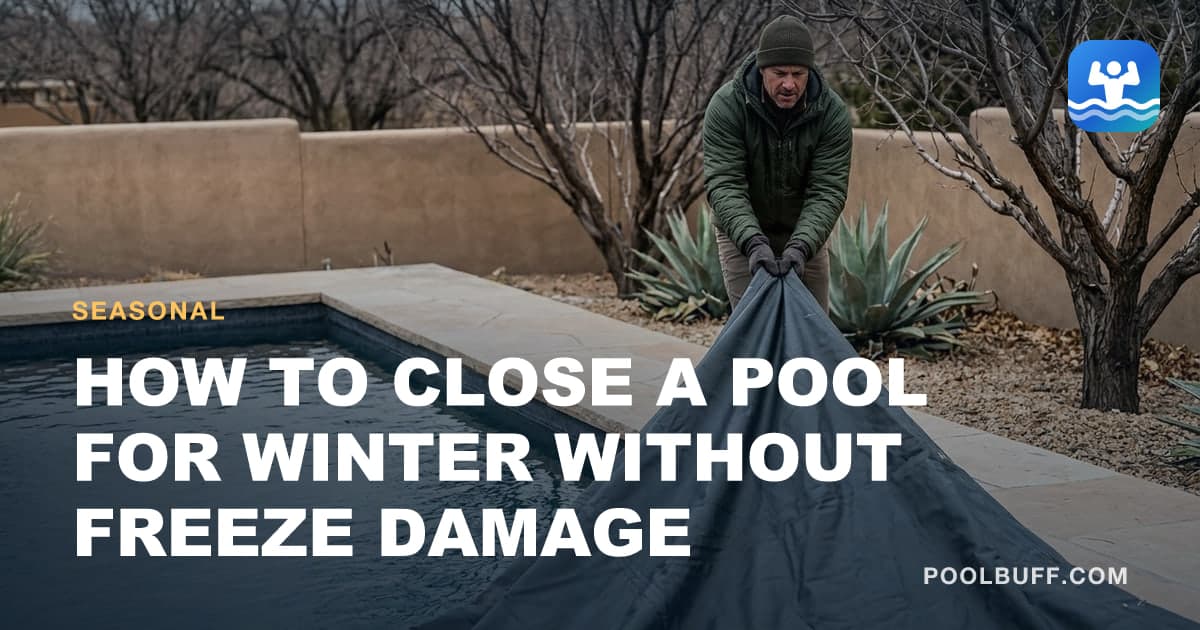
Fit the cover
45 minInstall it the way its maker says, and check what kind of cover it is.
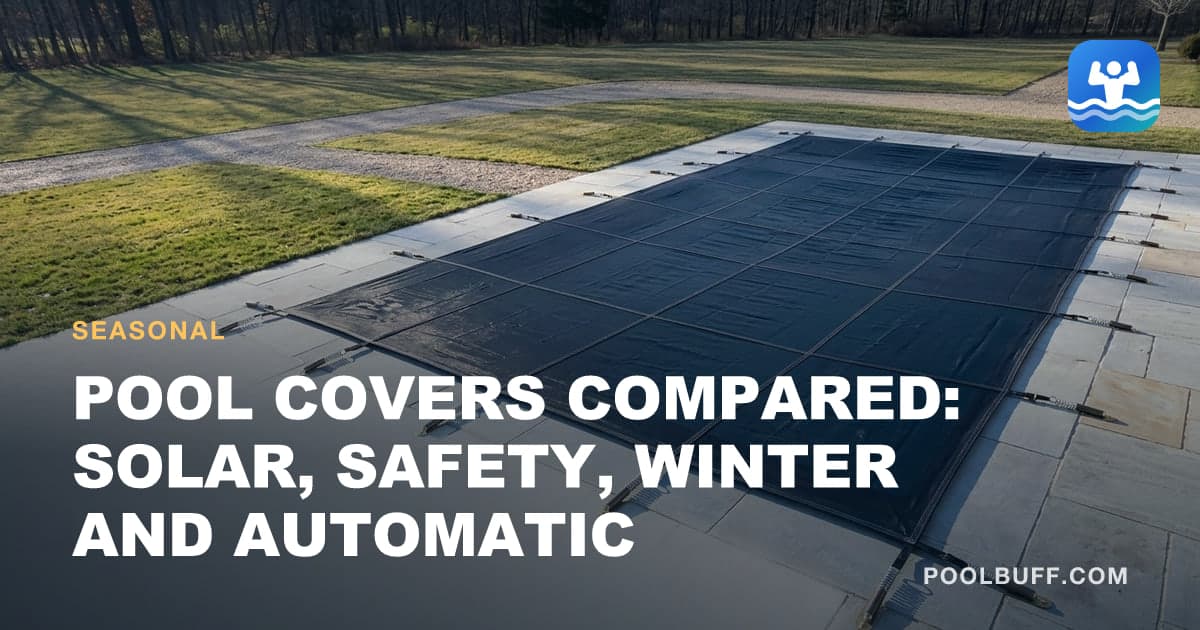
A safety cover meets ASTM F1346, the standard for covers meant to keep children under five out of the water. CPSC says the standard requires a cover to hold two adults and a child, so someone can be rescued off it, and to get rid of water quickly. A plain winter cover meets none of that. Loop-Loc calls a typical solid vinyl cover little more than a tarp.
- Solid safety covers need their pump or a mesh drain panel working all winter. Merlin and Loop-Loc both say that's part of what makes them a safety cover.
- Springs: Meyco wants them compressed 50 to 75%, and Merlin about 50% on mesh and 60 to 75% on solid.
- Standing water is the hazard. CPSC's staff counted 11 children who drowned after walking onto a secured cover and falling into the water collected on it. All but one were under two. CPSC's guidance adds that a young child can drown in just inches of water.
Pool covers compared explains the cover types, and automatic covers covers the motorized kind.
What you need
- Check price
automatic cover pump
Water sitting on a cover is what stretches and tears it. This runs on its own.
Through the winter
Closing isn't quite the end of it.
- Keep water off a solid cover. Loop-Loc, Merlin, GLI and Meyco all say to pump it. A cover pump does it on its own.
- Watch that the pump doesn't empty the pool. Loop-Loc warns that when snow presses a solid cover down onto the water, pool water seeps up through the seams and the cover pump can pump out a lot of the pool. Check the level and add water if it drops. On a fiberglass pool, Thursday Pools says to add water to the pool before you pump water off the cover.
- Pump down a mesh cover only to the maker's level. Loop-Loc says that if the water rises too high under a mesh cover, pump it down, then stop at the proper level.
- Snow: Loop-Loc says there's no reason to clean snow off a mesh cover at any time. Meyco suggests a long-handled broom for excess snow, and Thursday Pools says to clear it as soon as possible. Follow your cover's maker.
- The water: Pentair says to check it monthly and add chlorine to hold about 3 ppm, and PHTA says to check a closed pool at least monthly. If it's visibly green under the cover in a midwinter thaw, a dose of chlorine now saves a much worse April.
What the manuals say goes wrong
| Mistake | What the makers say happens |
|---|---|
| Closed while the water is warm | Winter chemicals are used up and often don't last until spring, leaving algae and staining (Hayward) |
| Water left in the pump, filter or heater | Freeze damage, which Hayward and Pentair don't cover |
| Compressed air on the equipment | Components can explode (Hayward, Pentair's heater manual) |
| Compressed air with the filter's air relief shut | The filter lid can separate violently (Pentair) |
| Water too low under a safety cover | Strain on the cover, and a void warranty (Loop-Loc, Meyco, GLI) |
| A fiberglass pool below the skimmer | The shell can lift where the water table is high (Thursday Pools), and Latham's warranty is void |
| A vinyl pool under a foot of water | The liner can shrink and tear at fittings and corners (Loop-Loc) |
| Tablets left in the feeder | An owner on Hayward's site describes the canister going off with a bang when opened |
| Standing water on the cover | A child can drown in it (CPSC) |
Where the makers disagree
- Closing temperature. Hayward and Thursday Pools say below 65°F, Clear Comfort 60 to 65°F.
- Water level. Every cover maker gives its own figure, from Latham's within 12 inches of the cover to Meyco's within 18 inches of the top. Hayward's closing guide measures from the skimmer instead.
- Below the skimmer or not. Hayward and Gizzmo describe lowering the water below the skimmer. The fiberglass makers forbid it.
- Compressed air. Hayward's manuals and Pentair's heater manual forbid it. Pentair's filter manuals allow it with the air relief open, and Hayward's own blog mentions a compressor.
- Shocking at all. Pentair, Robelle, Clorox and SeaKlear all shock. Orenda and Thursday Pools say a balanced pool doesn't need it.
- Alkalinity and calcium. From 80 to 150 ppm alkalinity, and from under 120 to over 400 ppm calcium, depending on whose instructions you read.
- Snow on a mesh cover. Loop-Loc says leave it. Thursday Pools says clear it as soon as possible.
Should you pay someone?
Hayward recommends using a professional who specializes in pool closings, and Pentair's guide is written for owners waiting on one. Opening and closing costs compared covers what the job costs either way.
Worth it if: you're in a hard-freeze climate and you've never done it, you don't own a shop vac or a blower, or you have complex plumbing with a spa, water features or an in-floor system.
DIY-able if: you're in a mild climate, you've got straightforward plumbing, and you've watched it done once.
If you do pay someone, be there the first time and watch. Next year you'll know whether you want to do it yourself, and you'll know where your plugs go.
Go deeperOpening in spring without a green messThe other half of the job, and why timing matters even more. Go deeperThinking about an automatic cover?What one costs installed, what breaks, and why standing water is the thing that kills them.Frequently asked questions
When should I close my pool for the winter?
By water temperature, not the date. Hayward says you can close once the water stays below 65°F, and Clear Comfort says 60 to 65°F. Hayward's reason is that winter chemicals are used up faster in warm water, so a pool closed early often runs out before spring and gets algae and staining. I wait for the low end of that range.
How far do I lower the water to close a pool?
As far as your cover's maker says. Loop-Loc says 15 to 18 inches below the top of the pool for a mesh cover and 12 to 16 for a solid one. Meyco says within 18 inches, and Latham within 12 inches of the cover. A fiberglass pool shouldn't go below the skimmer, and Loop-Loc says to keep at least a foot of water in a vinyl pool's shallow end. If you keep the water high, Gizzmo makes the Ultra Gizzmo for clearing the lines.
Can I use an air compressor to blow out pool lines?
Not on Hayward equipment. Hayward's pump and filter manuals say compressed air can make components explode, and to use only a low-pressure, high-volume blower under 5 psi. Pentair's heater manual says the same. Pentair's filter manuals allow compressed air if the filter's air relief valve is open first, and Hayward's own closing blog mentions a compressor. A shop vac on blow is the low-pressure option.
Do I need pool antifreeze?
Only for water you can't blow out or drain. Hayward's closing guide says to use pool antifreeze following the package directions if you don't blow the lines. Hayward, Pentair and Polaris all say the only antifreeze allowed in the system is propylene glycol, because the others are toxic and can damage the equipment.
What do I do with the main drain?
Hayward's main drain manual says a floor drain doesn't need winterizing at all, and only a wall-mounted suction outlet with a sump needs blowing out and plugging. That plug has to come out before anyone swims, because leaving it in is an entrapment hazard. Where a floor drain can't be plugged, a pool dealer quoted on Latham's blog air-locks it by closing its valve at the filter.
Should I close my pool at all in a mild climate?
Pentair's pump and filter manuals say that where freezes are brief, you keep the system running through them, all night if needed, rather than shutting it down. Hayward says not to rely on a gas heater for freeze protection. Running a pool year-round is its own routine, covered in our mild climate guide.