Ask a hundred pool owners when they last looked at their main drain cover and you'll get a hundred blank expressions.
There's a date molded into it. It expires. And an expired, brittle or missing cover over an open suction outlet is genuinely dangerous.
Key takeaways
- Anti-entrapment drain covers expire. The date is molded into the cover.
- A single unsplit main drain is the highest-risk configuration. Two drains or an SVRS fixes it.
- Suction entrapment can hold an adult underwater. This is not only a small-child risk.
- Spas need a clearly marked emergency shut-off within reach of the water.
- Long hair entrapment is a real and underappreciated hazard, particularly in spas.
What entrapment actually is
A pump pulling water through a suction outlet creates real force. If that outlet gets blocked — by a body, a limb, hair, clothing — the force concentrates, and it can be enough to hold a person against it underwater.
Five recognized types:
- Body entrapment — the torso covers the outlet and the suction holds it there
- Limb entrapment — an arm or leg drawn into an open pipe
- Hair entrapment — long hair drawn in and tangled
- Mechanical entrapment — jewelry or clothing caught in a cover or grate
- Evisceration — the most severe, from sitting directly on an uncovered outlet
This isn't only a small-child hazard. Suction force at a blocked single main drain can be enough to hold an adult.
Where the name comes from
The Act is named for Virginia Graeme Baker, who drowned in 2002 at seven years old when the suction from a hot tub drain held her underwater. She was a strong swimmer. Two adults could not pull her free — the force holding her down was greater than they could overcome by hand.
That last detail is the part worth carrying away, because it is the one people get wrong about this hazard. Entrapment is not something supervision solves. By the time it is happening, the person watching cannot fix it, and neither can anyone else nearby, without cutting the suction.
The Virginia Graeme Baker Pool and Spa Safety Act became federal law in 2007 and took effect the following December, requiring compliant covers on public pools and a secondary system wherever a single main drain exists. It is the reason every cover sold since carries a standard marking and a date.
The cover
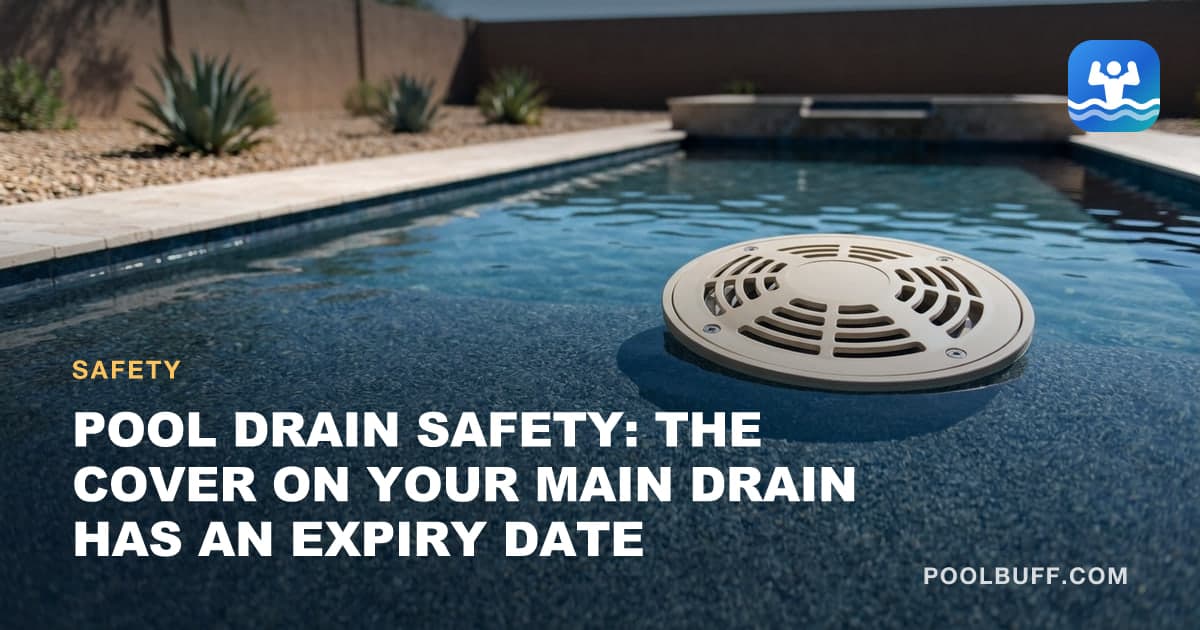
It has a date stamp. Molded into the plastic. Anti-entrapment covers are rated for a service life — commonly five to seven years — because UV and pool chemistry make them brittle.
A brittle cover cracks under load. A cracked cover comes apart. Then you have an open suction outlet.
It should also carry a compliance marking referencing the applicable standard. Since 2019 that standard is ANSI/APSP/ICC-16, which the CPSC incorporated as the successor to the older ASME/ANSI A112.19.8 — so a cover marked only with the old standard is, at the very least, old.
Go and look at yours. Right now if the pool is open. Most people have never checked, and a fair proportion find a cover that's cracked, loose, or well past its date.
Single vs dual drains
A single unsplit main drain is the highest-risk configuration. If the only suction outlet on that line gets blocked, all the pump's suction concentrates there.
The fixes:
Dual main drains, separated by at least three feet and plumbed together. Block one and water still flows through the other, so suction never fully concentrates. This is standard on modern construction.
A safety vacuum release system (SVRS) that detects a blockage and kills the pump or releases the vacuum in a fraction of a second. Retrofittable, and the right answer for an older pool with a single drain where re-plumbing isn't practical.
An unblockable cover — a cover large enough that a body can't fully block it.
Gravity feed to a collector tank, which eliminates direct suction from the pool entirely. Uncommon residentially.
Under the VGB Act, public pools with a single main drain need one of these secondary systems. Residential pools aren't federally mandated the same way, but the physics doesn't care what kind of pool it is.
If you want to look the rules up rather than take my word for them, the model code points at one standard for all of this: ANSI/PHTA/ICC-7, formerly APSP-7, which the International Swimming Pool and Spa Code adopts by reference in Section 310.1 for suction entrapment avoidance. That is where the drain separation distance and the SVRS performance requirements actually live. The cover standard is the separate one above, ANSI/APSP/ICC-16.
Spas need more attention
Spa outlets sit close to where people actually sit, water is warm so people stay longer, and hair is often in the water.
A spa needs a clearly marked emergency shut-off within reach of someone in the water. Not inside the house, not at the equipment pad. At the spa.
Test it occasionally. It's a switch that gets installed and never thought about again.
If someone is caught
Worth knowing before it is needed, because the instinct is the wrong move.
Do not pull. Pulling against suction can cause serious injury and rarely works. That is the lesson from the Baker case and it holds generally.
Cut the suction. Shut the pump off. That is exactly what the emergency switch at a spa is for, and why it has to be at the spa rather than at the equipment pad.
If you cannot reach a switch, break the seal. Slide a hand or a flat object between the body and the outlet to let water in and release the vacuum. It works because entrapment depends on a seal, not on the pump's raw power.
Then get medical attention regardless of how the person seems afterward. Submersion incidents can present badly hours later.
The equalizer line
The checklist mentions it, and it deserves its own explanation, because it is the suction outlet most owners do not know they have.
Older skimmers often carry a second port below the basket, plumbed to a fitting in the pool wall a foot or two down. Its purpose is to let the pump draw through that wall port if the water level drops below the skimmer mouth, so the pump does not lose prime.
The problem is that this leaves an unprotected suction outlet at swimmer depth, on the same line as everything else. Modern practice is to plug the equalizer permanently and manage the water level instead, which a well-run pool does anyway.
If your skimmer has one and it is open, that is worth a conversation with a professional.
What to check, and how often
At every opening, and once mid-season:
Drain safety check
Replacing a cover
Straightforward, and it must be done correctly.
Buy the right one. Covers are rated for a specific flow rate and a specific mounting configuration. A cover rated below your system's flow isn't compliant even though it fits.
Match the fastener pattern, or use a replacement designed for your sump.
Kill the pump before anyone goes in the water to do the work.
If you're unsure what your system flows or which cover suits, this is a reasonable thing to have a professional specify. It's a small job and getting it wrong defeats the point.
Go deeperThe wider safety pictureWhere drain safety fits among supervision, barriers, alarms and rescue readiness.Frequently asked questions
Do pool drain covers expire?
Yes. Anti-entrapment covers carry a molded date stamp and are rated for a service life, commonly five to seven years, because UV and pool chemistry make the plastic brittle over time. A brittle cover can crack under load, and a cracked or missing cover over an open suction outlet is a serious entrapment hazard.
What is the VGB Act?
The Virginia Graeme Baker Pool and Spa Safety Act, US federal law requiring anti-entrapment drain covers on public pools and spas, and a secondary anti-entrapment system where a single main drain is used. Residential pools aren't federally mandated in the same way, but the same standards are what you want on your own pool.
How do I know if my pool drain is safe?
Look at the cover. It should be intact with no cracks, securely fastened, and marked with a compliance standard and a date stamp that hasn't passed. If you have a single main drain with no secondary protection, consider adding a safety vacuum release system or splitting to dual drains.
What is a safety vacuum release system?
An SVRS detects a sudden blockage at a suction outlet and either shuts the pump off or releases the vacuum within a fraction of a second. It's required on some single-drain configurations under the VGB Act and it's worthwhile on any pool with a single unsplit main drain.
Can hair get caught in a pool drain?
Yes, and hair entrapment is one of the recognized entrapment types. It's a particular risk in spas where the outlet is close to where someone sits. Compliant covers are designed to prevent it, which is another reason a damaged or missing cover matters.