Almost nobody pours two pool chemicals together on purpose. The incidents that put people in emergency rooms come from residue, habit and storage — which is why "don't mix chemicals" is true but not actually useful advice.
Here are the specific pairs, and then the five ordinary moments they meet in.
Key takeaways
- Trichlor and cal hypo together can ignite. Trace residue is enough.
- Any chlorine product plus acid releases chlorine gas.
- Cal hypo is a strong oxidizer — keep it away from oil, fuel and rags.
- A shared scoop is the most common way two products actually meet.
- Never top up a feeder or floater with a different type of tablet.
The combinations
| Never together | What happens |
|---|---|
| Trichlor + cal hypo | Violent reaction, fire |
| Any chlorine + acid | Chlorine gas |
| Chlorine + ammonia | Chloramine gas |
| Cal hypo + oil, fuel, rags | Ignition |
| Acid + alkali | Heat, boiling, splashing |
Trichlor and cal hypo is the one that burns sheds down. Trichlor is an acidic organic chlorine; cal hypo is a strong alkaline oxidizer. They are chemically incompatible, the reaction is exothermic, and it does not need much. Trace residue in a scoop is enough to start it.
Chlorine and acid produces chlorine gas. It is immediately hazardous to breathe, and it is heavier than air — so in a shed, a pump room or a garage it pools at floor level, which is exactly where somebody kneeling to reach a bottom shelf has their head.
Cal hypo does not need a second pool chemical to be dangerous. As a strong oxidizer it reacts with organic material: motor oil, fuel, brake fluid, oily rags, sawdust. A pool chemical shelf above a lawnmower is a bad shelf.
Where it actually happens
- 1
The shared scoop
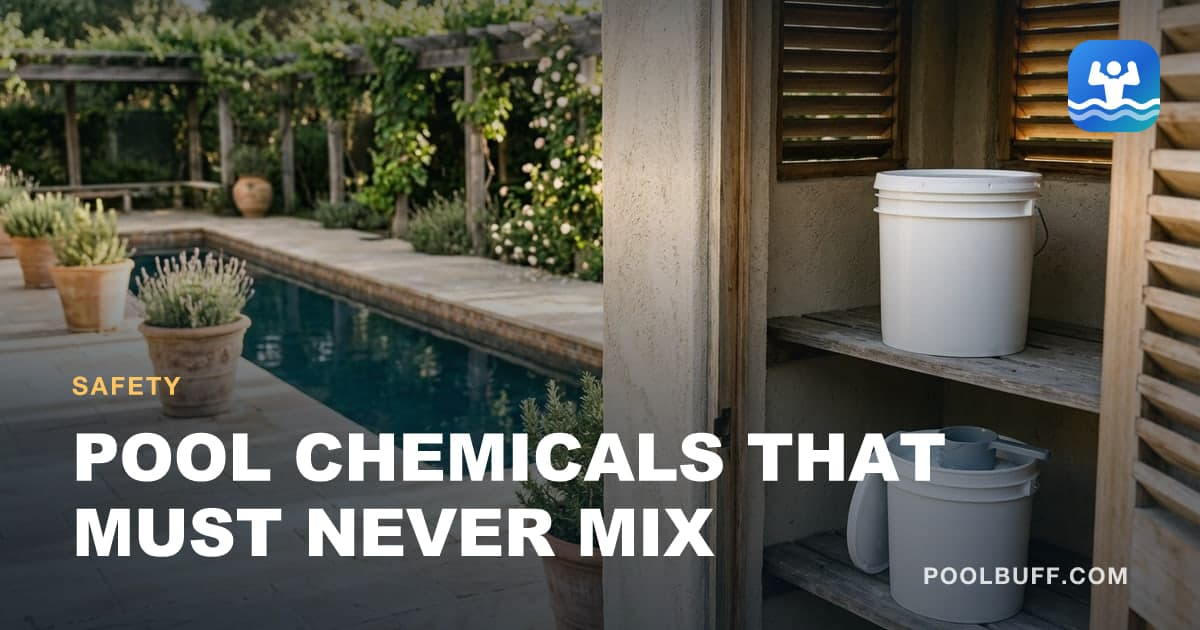
—One scoop, two products, a residue of the first. This is the most common route by a wide margin, and the fix costs nothing: one scoop per container, stored inside that container, labeled.
Same for buckets. One for acid, one for chlorine, never swapped.
- 2
Topping up a feeder or floater
—Somebody runs out of one tablet brand and puts a different type on top of what is left. If one is trichlor and the other cal hypo, that is the dangerous pair in a sealed plastic housing.
Switching products means emptying the feeder completely, rinsing it, letting it dry, then loading the new type.
- 3
A leak on the shelf above
—Liquid chlorine degrading in a hot shed builds pressure and can weep. Acid containers corrode. Whatever is directly below gets it.
Store acids and chlorines apart — different shelves is not enough on its own, different sides of the space is better — and never stack one above the other.
- 4
Sweeping a spill together
—Two spills, one broom, one dustpan. Or a cal hypo spill mopped up with whatever rag was to hand.
Deal with one spill at a time, dry, and dispose of it per the label rather than combining it with anything.
- 5
Dosing one straight after another
—In a full pool the dilution is enormous and this is rarely how people get hurt — but it is still the wrong habit, and it becomes genuinely dangerous the moment somebody does it in a bucket or a skimmer instead.
One product, a few hours of circulation, then the next. Never put anything down the skimmer unless the label specifically says to.
The organic and inorganic split
If you remember one thing rather than a table, remember this line.
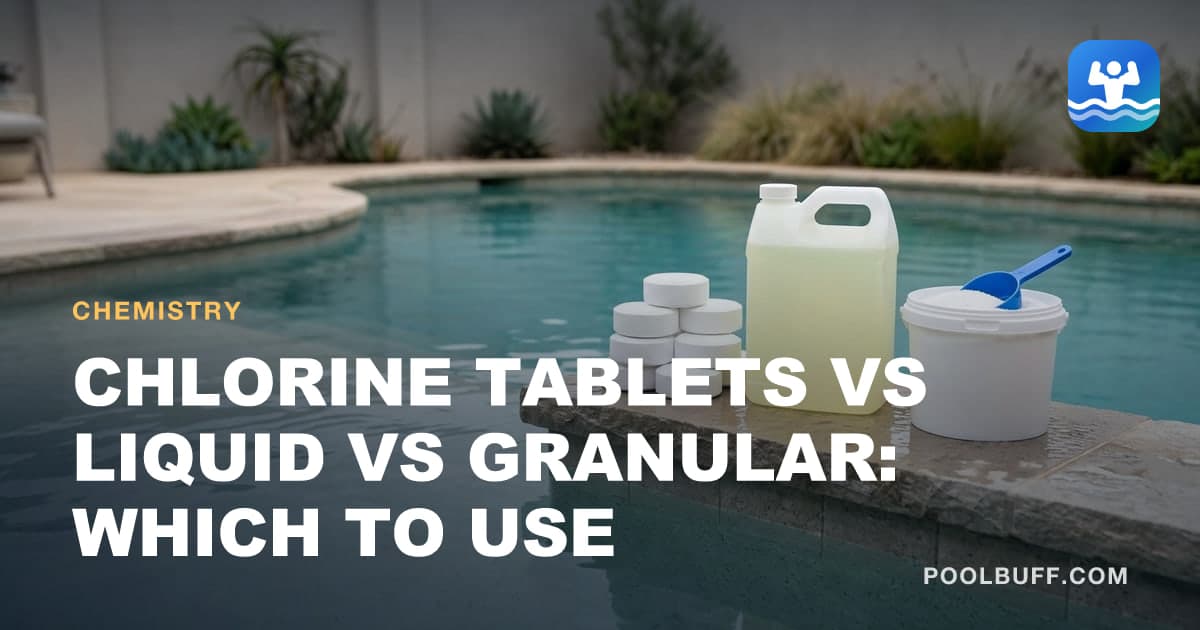
Organic chlorines — trichlor and dichlor — are chlorinated isocyanurates, which is where their stabilizer comes from. They differ in everything else: trichlor is strongly acidic and slow-dissolving, dichlor is near-neutral and dissolves fast. For storage, the shared chemistry is the part that matters. Inorganic chlorines — cal hypo, lithium hypo, and liquid chlorine — are unstabilized and alkaline.
The dangerous combinations sit across that line. Two trichlor products from different brands are not the problem; trichlor meeting cal hypo is. Knowing which side each product you own sits on is most of what you need to store them safely.
Liquid chlorine is the outlier worth noting: it carries no fire risk in the way granular cal hypo does, which makes it the safer product to keep in quantity — though it is still caustic and still must never meet acid.
If it happens anyway
Worth reading before it is needed, because the instinct — go and look at it — is the dangerous one.
Get away, and get everyone else away. Chlorine gas is heavier than air and settles, so downhill and downwind are the wrong directions to move. Upwind, uphill, and out of any enclosed space.
Do not add water. Water on a reacting chlorine mixture accelerates it, and water into acid can spatter. It is the standard reflex and it is wrong here.
Do not try to separate the containers. Whatever is going on is already generating heat, and reaching into it is how people get burned or overcome.
Ventilate from outside. If it is in a shed, open the door and step back rather than going in to open a window.
Call the fire department for anything smoking, hot, or enclosed. That is a call they would far rather take than the one that follows.
Anyone who breathed it needs fresh air and medical attention, even feeling fine afterward. Chlorine injury to the lungs can present hours later, which is exactly why people talk themselves out of going.
What separation actually looks like
Not "on different shelves in the same cupboard."
- Acids in one place, chlorines in another, ideally with real distance between them.
- Nothing stacked above anything else it could leak onto.
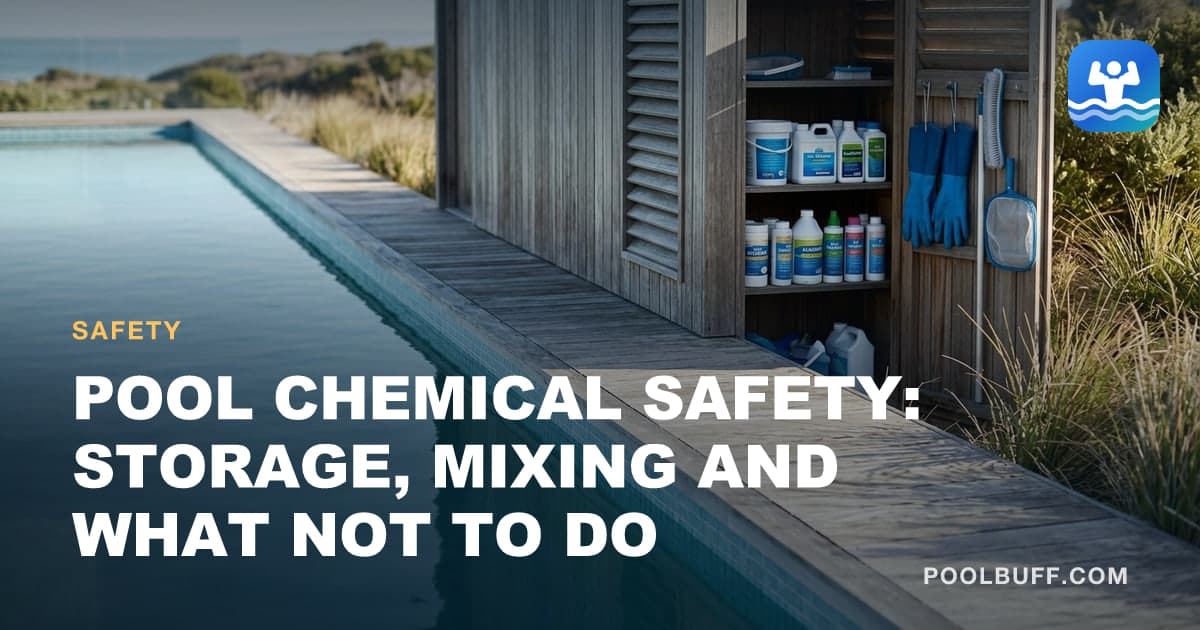
- Original containers, sealed, labels legible, never decanted into unmarked jugs.
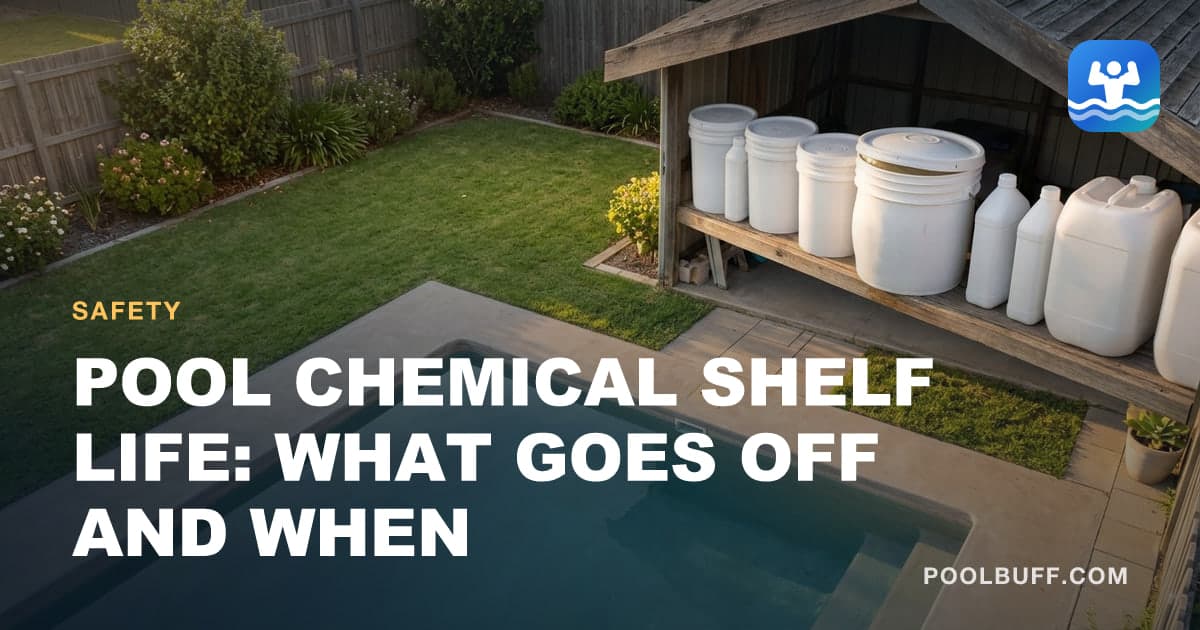
- Off the floor, out of direct sun, somewhere ventilated and as cool as you can manage.
- Away from any pilot light — a gas heater, a water heater, a furnace.
- Nothing oily in the same space. Fuel cans, oily rags and the mower belong somewhere else entirely.
The full safety guide covers handling and what to do when something has already gone wrong. This page is the part that stops it starting.
Go deeperHandling and emergenciesProtective gear, dosing order, and what to do for exposure to skin, eyes or lungs.Frequently asked questions
What happens if you mix trichlor and cal hypo?
The reaction can be violent enough to start a fire, and it is a documented cause of pool shed fires rather than a theoretical risk. Trichlor is an acidic organic chlorine and cal hypo is a strong alkaline oxidizer, and they are chemically incompatible. Trace residue in a shared scoop or bucket is enough, which is why the rule is separate storage and separate equipment rather than just not pouring one into the other.
Can you mix chlorine and muriatic acid?
No. Any chlorine product combined with acid releases chlorine gas, which is immediately hazardous to breathe and heavier than air, so it collects at floor level in a shed or a pump room. This is why the two are never stored on the same shelf and never added to a pool one after the other — give one time to circulate fully before adding the other.
Is it safe to mix two different chlorine tablets?
Not in a container, a feeder or a floater. The dangerous split is between organic chlorines like trichlor and dichlor and inorganic ones like cal hypo. If you are switching products, empty the feeder completely, rinse it, let it dry, and then load the new type — never top one up with the other.
Why can't cal hypo be stored near oil or rags?
Calcium hypochlorite is a strong oxidizer, and oxidizers combined with organic material like oil, fuel, brake fluid or oily rags can ignite. It does not need a flame. This is why pool chemicals do not belong on a garage shelf above the lawnmower, and why a spill gets swept up dry rather than mopped with whatever is to hand.
Is it dangerous to add several pool chemicals at once?
In a full pool the dilution is enormous, so the risk is lower than people fear — but it is still the wrong habit, because the reactions that hurt people happen in buckets, feeders and skimmers where there is no dilution. Add one product, let it circulate for a few hours, then add the next. Never combine them in a bucket first.