Almost everyone shopping for a pool alarm starts at the pool. It is the obvious place to look, and it is the wrong end of the problem.
A common sequence runs: a child is inside, unaccounted for briefly, goes out through a door, crosses a deck, and reaches water. A surface alarm covers the last step of that chain, after every earlier chance to intervene has passed. A door alarm covers the first.
Key takeaways
- The house door is the highest-value alarm. CPSC found 46% of young pool drowning victims were last seen in the house.
- Look for ASTM F2208 certification on surface alarms, and check who certified it. NSF lists the Poolguard units by model.
- An alarm that gets disabled protects nobody. Adult pass-through exists to stop that happening.
- Alarms are a layer, never the barrier. A compliant fence is still the primary protection.
- In-ground and above-ground surface alarms are different products and do not swap.
My picks at a glance
- 1
Poolguard DAPT-2 door alarm
Buy this first · the house door onto the pool deck
- 2
Poolguard GAPT-2 gate alarm
Best for the barrier · the pool fence gate
- 3
Poolguard PGRM-2 in-ground alarm
Best surface alarm · in-ground pools, as the last layer
- 4
Poolguard PGRM-SB Safety Buoy
Best for above-ground · pools where the in-ground unit has nothing to mount to
All four picks are Poolguard units, and the pool alarm pages cover each one's placement, testing and manuals.
Where a pool alarm fits among the layers
The layered approach to drowning prevention is not a slogan — it is an ordering, and alarms sit at specific points in it.
- Supervision. Nothing substitutes for it, and nothing here pretends to.
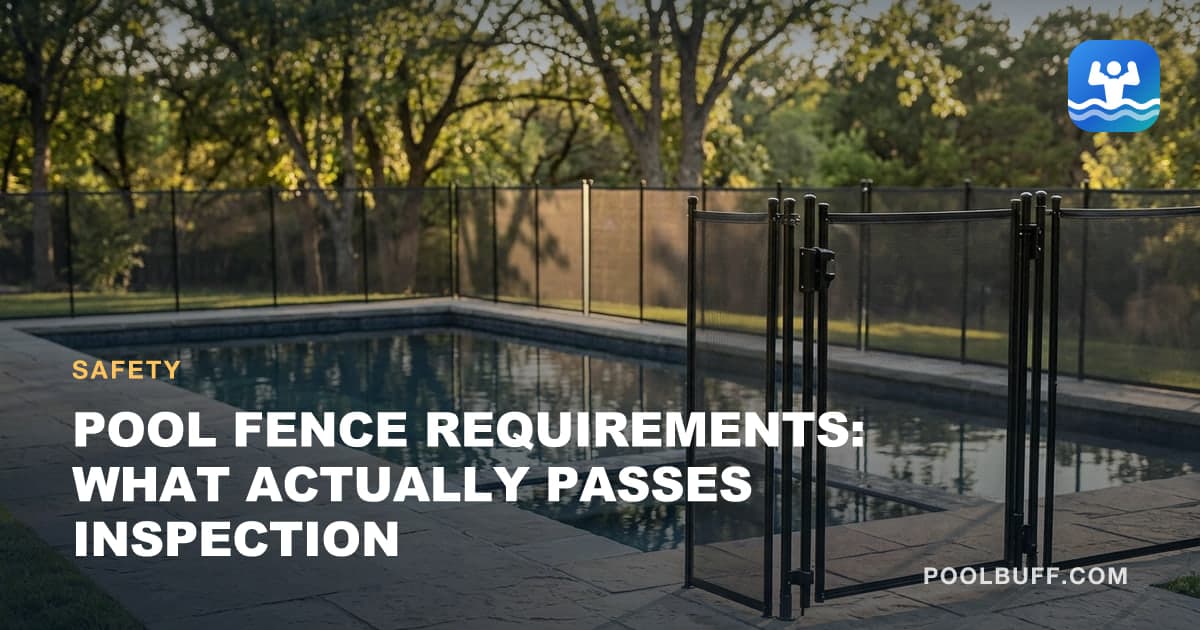
- A compliant barrier. A fence that actually passes inspection is the primary protection, because it prevents access rather than reporting it.
- Door alarms, on every exit from the house toward the pool.
- A gate alarm, on the barrier's weakest point.
- A surface alarm, as the last line.
Alarms exist to catch the failures of the layers above. That framing is worth holding, because it explains both why they are worth buying and why buying one instead of a fence is not a plan.
Poolguard DAPT-2 door alarm
Best for the house door onto the pool deck
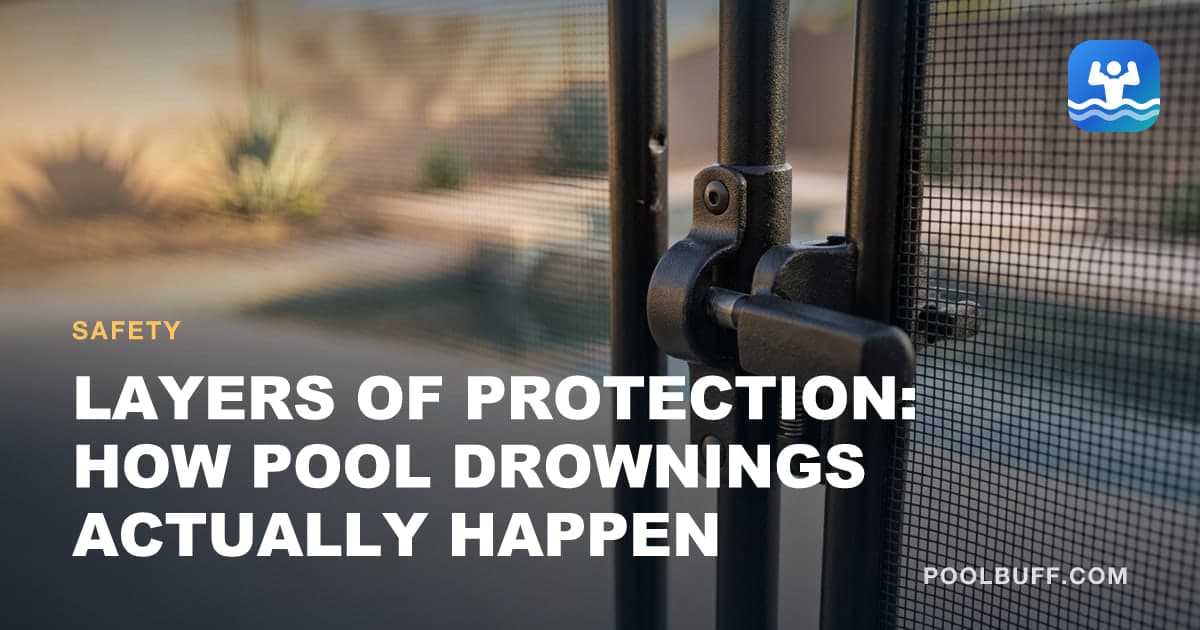
Fits the door a child would actually use to get outside unnoticed, and sounds 7 seconds after it opens unless an adult presses the pass-through switch, even if the door is closed again. That delay and its 54-inch mounting height match what the model code asks of a door alarm. This is the least glamorous product on the page and the one that covers the route out of the house, which is why it is first rather than last.
Strengths
- Covers the way out of the house, where CPSC's study last saw 46% of young victims
- Adult pass-through, so it does not get switched off out of irritation
- Cheap enough to fit on every door to the outside
Trade-offs
- Only covers the doors you actually fit it to
- Battery-powered: Poolguard gives the 9 V battery about a year, and it chirps when low
Poolguard GAPT-2 gate alarm
Best for the pool fence gate
Sounds 7 seconds after the gate opens unless an adult presses the pass-through switch, and keeps sounding even if the gate closes again. Pressing the switch gives a grown-up 14 seconds to go through and close the gate, which is the feature that stops the alarm being taped over by August. Poolguard lists it at $74.95 with a one-year warranty.
Strengths
- Covers the gate, which CPSC calls the weak link in a fence when it fails to close and latch
- Sounds even if the gate is closed again behind the child
- Always on, Poolguard says, and resets itself once an adult passes through and closes the gate
Trade-offs
- Only as useful as the fence it is attached to
- Its sensor is a switch and magnet, so it knows the gate is shut, not that it latched
- It lives outdoors, and neither its manual nor its product page gives a weather rating
Poolguard PGRM-2 in-ground alarm
Best for in-ground pools, as the last layer
Sits on the deck with a sensing throat 2.5 to 5.5 inches into the water, and sounds when the water action from someone entering reaches it. NSF certifies it to ASTM F2208, and an in-house receiver sounds up to 200 feet away. Poolguard's manual says not to use it with any type of pool cover.
Strengths
- ASTM F2208 certified rather than merely marketed as compliant
- Poolguard says its sensing is less prone to false alarms from wind, rain and small objects
- In-house receiver means you hear it where you actually are
Trade-offs
- Rated for pools up to 20 by 40 feet; call Poolguard about larger or irregular pools, water features or more than two returns
- Must be removed before swimming and remembered afterward
- Detects entry, which means the child is already in the water
Poolguard PGRM-SB Safety Buoy
Best for pools where the in-ground unit has nothing to mount to
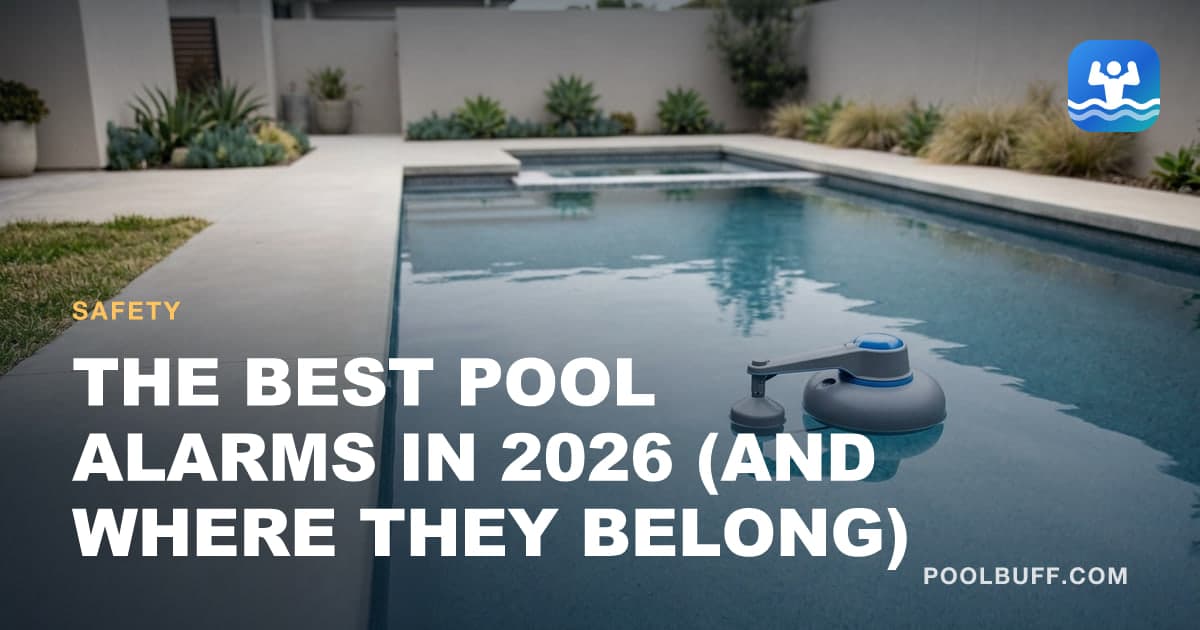
A floating alarm rather than a deck unit. Its manual has it floating in the water on a tether clipped to the pool wall, no more than 5 inches out, and it senses below the surface. The linked listing is this older SB, which its manual rates for above-ground pools up to 30 feet round or 18 by 36 feet, with a one-year warranty. Poolguard now sells the PGRM-SB2 in its place, rated for any pool up to 20 by 40 feet with two years of warranty.
Strengths
- Floats, so it does not need a flat deck at the pool edge
- NSF certified to ASTM F2208, like the in-ground unit
- Tether clip sticks on; no deck mounting to fit
Trade-offs
- The tether clip's adhesive suits smooth surfaces; concrete or wood may need another fixing
- Superseded by the PGRM-SB2, which is not the model this listing sells
- Same limitation as any surface alarm: it triggers after entry
What ASTM F2208 actually tells you
It is the residential pool alarm standard, and the distinction worth understanding is between certified to it and compliant with it.
Certified means an independent lab tested the unit against the standard's detection requirements. Compliant, used loosely in marketing, can mean the manufacturer believes it would pass. On a product whose entire job is detecting a child entering water, that difference is the product.
The detection criterion in the standard is a child one year of age or older entering the water. Poolguard describes the PGRM-2 the same way, as designed to detect intrusions similar to a one-year-old child. It is worth paying for.
The standard defines four types, and knowing which one a product was certified as tells you what was actually tested: Type A surface, floating on the water; Type B subsurface; Type C pool perimeter, detecting movement at or above the surface; Type D personal immersion, worn on the child. A wristband certified as Type D has not been tested to detect anything about your pool.
One wrinkle worth knowing. ASTM now lists F2208-08(2019) as a historical standard, with no successor named in its place. It is still what manufacturers certify to and still what you will see on the box, so it remains the thing to look for — but if you go and look it up, that status is what you will find, and it is not a sign the product is counterfeit.
The types, and what each one actually senses
Door and gate alarms are magnetic contact switches with a bypass button mounted high enough that a small child cannot reach it. That bypass height is the specification to check: Poolguard's door and gate manuals say to mount the alarm at least 54 inches above the threshold, and the DAPT-2 and GAPT-2 pages walk through the rest of the installation. On a gate, remember the sensor reads whether the gate is shut, not whether it latched.
Surface alarms float or sit at the waterline and detect the wave a body makes on entry. Poolguard's PGRM-2 is this kind: it sits on the deck with a sensing throat in the water. Wind that rocks the water up and down the pool wall can set one off, which is the failure mode described above.
Subsurface alarms sense below the waterline rather than at the surface. Poolguard's floating PGRM-SB2 uses sub-surface detection, and Poolguard says it reduces false alarms from wind, rain and small objects. Certification is not tied to either approach: NSF certifies Poolguard's deck unit and its floating units to ASTM F2208 alike.
Wearable alarms are wristbands that sound on submersion. They are the odd one out here, because they protect one particular child rather than the pool, and only while somebody remembers to fit the band. Genuinely useful at a party where you know which children cannot swim. Not a substitute for anything on the layered list above, because the child who wanders out at six in the morning is the child not wearing it.
What alarms cannot do
Worth being blunt, because the packaging is not.
They report; they do not prevent. By the time a surface alarm sounds, a child is already in the water. Everything after that depends on somebody hearing it, understanding what it means, and getting there — which is why the response plan and the placement of the in-house receiver matter as much as the sensor does.
They do not work with a cover on. Poolguard's PGRM-2 manual says not to use the alarm with any type of pool cover, solar covers included, and a child on a cover is a hazard these products were never designed around.
Above-ground pools need the right type. A deck-mounted alarm like the PGRM-2 needs a flat surface at the water's edge. A floating alarm does not, and on an above-ground pool a removable or lockable ladder plus a door alarm on the house still does the most.
They need power. Poolguard's alarms run on a 9 V battery that it says lasts about a year, and each one chirps or beeps about every 10 seconds when the battery is low. Put them on the same annual schedule as the smoke alarms and change the batteries whether or not they have complained. Poolguard's door and gate manuals say to test them weekly.
The practical checklist
Fit the door alarms first, and fit them to every door a child could use, not just the obvious one. They cost little and they cover the part of the chain where you still have time.
Do not let an alarm stand in for a missing drain cover. Alarms address someone entering the water. Entrapment at a suction outlet is a different hazard with a different fix, and no alarm covers it.
Check pool size against the alarm's rating. Surface units are rated by area — the PGRM-2 is rated for pools up to 20 by 40 feet, or 800 square feet. For a larger pool, an irregular shape, water features or more than two return lines, Poolguard's manual says to call its customer service for how many alarms you need and where.
Get the in-house receiver working. An alarm you cannot hear from the kitchen is an alarm for the neighbors.
Test them on a schedule. Poolguard's manuals set it: door and gate alarms weekly, and the PGRM-2 every time it goes back in the pool, with a 4-gallon jug of water pushed in at the far end. Batteries yearly, like the smoke alarms. An untested safety device is an assumption.
Remember to re-arm after swimming. Surface alarms come off to swim, and the moment of maximum risk is the evening everybody forgets to put it back.
Go deeperHow the layers fit togetherSupervision, barriers, alarms and rescue readiness, and what each one is actually for.Frequently asked questions
What is the best type of pool alarm?
A door alarm on the house exit. In CPSC's study of children under 5 who drowned in pools, 46% were last seen in the house, and 69% were not expected to be at or in the pool. Gate alarms come second, surface alarms third. That ordering surprises people, who tend to buy the in-water alarm first — but by the time a surface alarm sounds, a child is already in the pool.
What does ASTM F2208 mean on a pool alarm?
It is the residential pool alarm safety standard, and certification to it means an independent lab tested the unit against it rather than the maker simply claiming compliance. Check who certified it: NSF, for example, lists Poolguard's PGRM-2, PGRM-SB and PGRM-SB2 by model, and notes the pool size they were tested on. It matters most for alarms in the water, because the practical failure is an alarm that gets switched off.
Do pool alarms replace a fence?
No, and no jurisdiction treats them as equivalent. A compliant barrier is the primary protection because it prevents access; an alarm only reports that access already happened. Alarms are the layer that catches the failures of the other layers, which is exactly why they are worth having and exactly why they are not the plan.
Do pool alarms false alarm a lot?
All of them do sometimes, and Poolguard's own manual says so. The causes it names are wind strong enough to rock the water up and down the pool wall, putting the alarm back in too soon after swimming, an automatic cleaner hitting the unit, and water features or returns aimed at it. Most of those are placement and habit, which matters, because the practical failure for pool alarms is not breaking but being switched off.
Can I use an in-ground pool alarm on an above-ground pool?
Check how it mounts. Poolguard's PGRM-2 sits on a flat deck at the pool's edge with its sensing throat 2.5 to 5.5 inches into the water, which an above-ground pool with no deck may not allow. A floating alarm avoids the question: Poolguard markets its PGRM-SB2 for in-ground, above-ground and soft-sided pools and spas.