Poolguard · Gate alarm
Poolguard GAPT-2 Gate Alarm
Poolguard's GAPT-2 gate alarm: the 7-second delay and 14-second pass-through, where the sensor and alarm go, battery life, and why it can't tell if it latched.
MPNGAPT-2
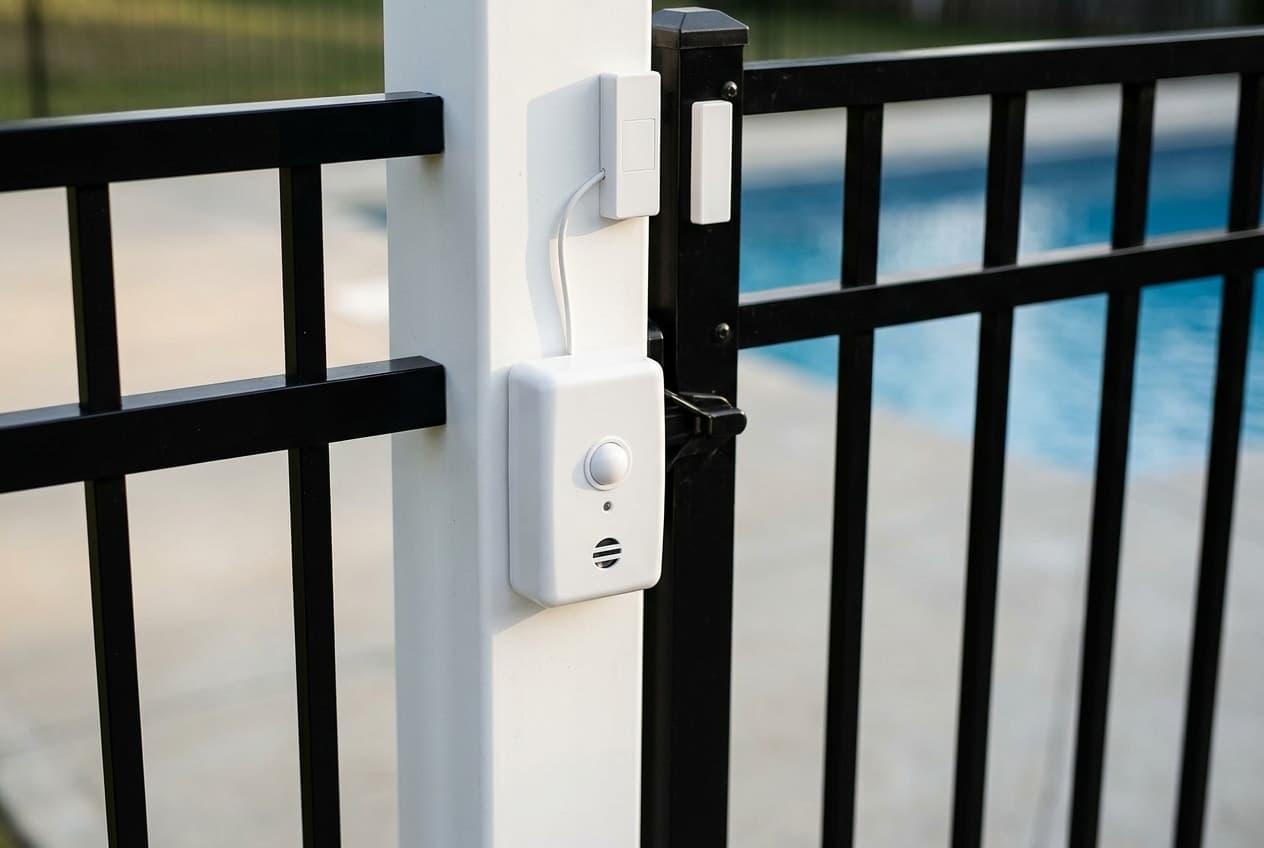
The GAPT-2 is Poolguard's alarm for a pool fence gate. A magnetic sensor on the gate and fence tells the alarm unit, mounted beside the gate, when the gate opens. Unless an adult presses the pass-through switch within 7 seconds, the horn sounds, and it keeps sounding even if the gate is closed again. The manual says it meets UL 2017, the standard for water hazard entrance alarms. Poolguard lists it at $74.95, with a one-year warranty.
Poolguard's product page says it can go on any pool gate, outside door or screen. The manual only covers gates, and Poolguard sells the DAPT-2 for doors.
Like Poolguard's other alarms, its manual calls it a safety alarm system and not a life saving device, to be used alongside the safety equipment you already have.
How it works
The manual describes two delay modes, which it says let you go out and come in through the gate without the alarm sounding:
- The gate opens. The alarm starts a 7-second countdown. Press the pass-through switch within 7 seconds and nothing sounds. Miss it and the horn sounds, whether the gate is open or closed.
- The switch is pressed within those 7 seconds. You now have 14 seconds to go through the gate and close it. Close it in time and the alarm resets itself. Leave it open past 14 seconds and the horn sounds.
To silence it, close the gate, then press the pass-through switch.
If it's been sounding for about 5 minutes and the gate is still open, the horn changes to pulses, 5 seconds on and 5 seconds off, until an adult closes the gate and presses the switch. If the gate has been closed, it resets after about 5 minutes on its own.
A light shows it's working: it flashes once every 10 seconds normally, and once a second while the alarm sounds.
It watches the gate, not the latch
CPSC's drowning prevention guide, Publication 359, calls a gate that doesn't close and latch completely the weak link in even the strongest, highest fence, and it says never to prop a pool gate open. The GAPT-2 covers the propped gate: left open, it sounds within 14 seconds of a pass-through, or 7 seconds without one, and it doesn't stop until an adult closes the gate and presses the switch.
What it can't see is the latch. The manual describes the sensor as two parts, a switch and a magnet that line up when the gate is shut. Nothing in it connects the alarm to the latch, so a gate that swings closed without latching can leave the alarm quiet. The gate still has to be self-closing and self-latching, as our pool fence guide explains, and still needs its hinges and latch tested.
Installing it
The alarm unit:
- Pick the spot. It has to be at least 54 inches above the threshold of the gate. The manual doesn't say which side of the fence it goes on.
- Mark two points 2½ inches apart vertically.
- Drive the two larger screws into the marks, leaving about 5/32 inch of each screw standing out, not counting the head.
- Hang the alarm on the screws and pull it down until they sit in the small end of the hanger holes on its back.
The sensor:
- The sensor switch comes already connected to the sensing wire from the alarm. Poolguard's product page gives the wire as 3 feet long.
- Screw the switch to the stationary part of the fence, usually the frame, on the side near the top of the fence post. Don't put it on the hinged side.
- The switch and the magnet should line up with each other when the gate is closed, and a gap of up to 2 inches between them is acceptable.
- If the gate or the post is steel, the manual says that may limit the gap to 1¼ inches, so test the alarm. If you need the full 2 inches on steel, fit ¼-inch-thick wood or plastic shims under the switch and the magnet.
The battery: remove the assembly screw on the back of the alarm and lift off the top cover. Pull down the battery spring and fit the 9 V battery. If the spring isn't sitting under the battery correctly, the cover won't go back on. The light starts flashing once every 10 seconds. Put the cover back with the assembly screw. The alarm may sound until the sensor is connected properly, so it's easier to mount the sensor first.
Batteries and testing
When the 9 V battery is low, the horn chirps once every 10 seconds. The manual and Poolguard's product page both give the battery life as about a year. The manual names an Energizer No. 522 or Duracell MN1604 alkaline.
The manual says to test the alarm weekly by opening the gate and letting it sound.
How it differs from the DAPT-2 door alarm
The GAPT-2 and the DAPT-2 work the same way: 7 seconds to press the switch, 14 seconds to go through, the same 54-inch mounting height, the same 85 dB horn and 9 V battery, and a one-year warranty on both. The differences, from their manuals and Poolguard's product page:
- The sensor wiring. The gate alarm's switch comes permanently connected to its wire. The door alarm's switch has two screw terminals for the wires.
- The sensor gap. Up to 2 inches on the gate alarm, or 1¼ inches on steel. The door alarm allows 1¼ inches.
- Indoor use. The door alarm's manual says it's for indoor use only. The gate alarm's manual says nothing about weather, and neither does its product page.
- The screen door kit. Poolguard offers one for its door alarms. It lists none for the gate alarm.
- Price. $74.95 for the gate alarm, $63.95 for the DAPT-2.
Where Poolguard's documents disagree
- "Always resets itself." The product page says the alarm always resets itself under all conditions. The manual says that if the gate is left open, the horn pulses after about 5 minutes and keeps going until an adult closes the gate and presses the switch.
- UL 2017. The manual and the product page both say the alarm meets UL 2017. That isn't checked here against UL's own listings.
- Doors and screens. The product page says the GAPT-2 can go on an outside door or a screen. The manual's instructions are written only for a gate and fence post.
Buying it
Poolguard gives the GAPT-2 a one-year warranty and sells it through dealers, which its website lists. The Amazon listing linked here is the GAPT-2. It covers one gate: if the house forms one side of the pool barrier, the doors to the pool need their own alarms, and the DAPT-2 is Poolguard's.
Poolguard GAPT-2 Gate Alarm manuals and documentation
Hosted by the manufacturer. These open on Poolguard’s own servers, so they stay current.
Poolguard GAPT-2 Gate Alarm warranty
1 year parts
One year on defects in parts and workmanship from the date of purchase, so keep the receipt. Call Poolguard's customer service at 1-800-242-7163 before sending anything back: the manual says unauthorized returns are not accepted and that proper repair is only ensured when the unit goes back to the manufacturer. Warranty registration is on Poolguard's website.
Poolguard GAPT-2 Gate Alarm parts
Poolguard publishes no part numbers for the GAPT-2. Its website has no parts or store section: the alarms page, the manuals page and the dealer finder are the pages a buyer would use, and the alarms page's purchase link goes to the dealer finder. Poolguard's product page says the alarm comes with 3 feet of UL-approved hook-up wire, a sensor switch and a sensor magnet designed for gates. The manual says the sensor switch is permanently connected to the sensing wire from the alarm, and mentions two larger screws for hanging the alarm and a screw for the sensor switch. You supply the 9 V alkaline battery: the manual names Energizer No. 522 or Duracell MN1604. For a fault, the manual sends you to customer service at 1-800-242-7163 rather than to a part, because repair is done by returning the unit to the manufacturer.
Buy the pool alarm
One retailer for now. More get added here as their programs are approved, and this becomes a comparison rather than a link.