This isn't the article anyone wants to read, and it's the one I'd most want a new pool owner to read anyway.
Drowning is the leading cause of death for US children aged one to four. It happens fast, it happens silently, and overwhelmingly it happens at a pool the family owns, during a short gap in supervision, when nobody thought the child was near the water.
Key takeaways
- Drowning is silent. There's no splashing and no shouting — that's a film convention, not reality.
- Most young-child drownings happen during a brief lapse, at a pool the family owns and knows.
- A four-sided barrier that isolates the pool from the house cuts risk far more than a three-sided one.
- Designate a water watcher by name. 'Everyone was watching' means nobody was.
- Swim lessons reduce risk and do not remove it. They're a layer, not a solution.
It doesn't look like drowning
The single most useful thing to know.
There's no shouting. There's no waving. A drowning person's arms are instinctively pressing down on the water surface trying to lift their mouth clear, so they can't wave. Their mouth is at water level and they're using every breath to breathe, so they can't call out.
It's quiet, it's vertical, and it looks a bit like someone treading water and looking slightly odd. It typically lasts 20 to 60 seconds before they go under.
Here's the number that should reframe how you think about this. Across 1,270 childhood pool and spa submersion incidents in the US between 2000 and 2017, 80% of the children were alone when it happened, and 94% had no adult actively supervising them. Active supervision was present in about one case in twenty.
Read that the right way round, because it is easy to turn into the wrong lesson. It is not "supervision works, so supervision is enough." It is that a small child reaches water in the gap — the two minutes someone answered the door, took a phone call, went to the bathroom. Nobody supervises every minute, and the record says the fatal minute is the unsupervised one.
That is the entire argument for layers. Supervision is the layer that is guaranteed to have gaps in it, so the barrier has to be the layer that does not.
Which means "I'd hear it" isn't a plan. People have drowned twenty feet from adults who heard nothing at all.
The five layers
Each one catches a different failure. That's the whole design.
1. Active supervision
Not "an adult is present." Someone whose actual job, right now, is watching the water.
Designate a water watcher. By name, out loud. "Sam is watching for the next twenty minutes." No phone, no conversation, no going inside for drinks. When they need to leave, they hand the role to another named adult, also out loud.
It sounds over-formalized until you notice how many incidents happen at gatherings with a dozen adults present, every one of whom assumed someone else was watching.
Stay within arm's reach of any child under five or any non-swimmer. Not across the deck — arm's reach.
2. A compliant barrier
The layer that works when supervision fails, which it eventually does.
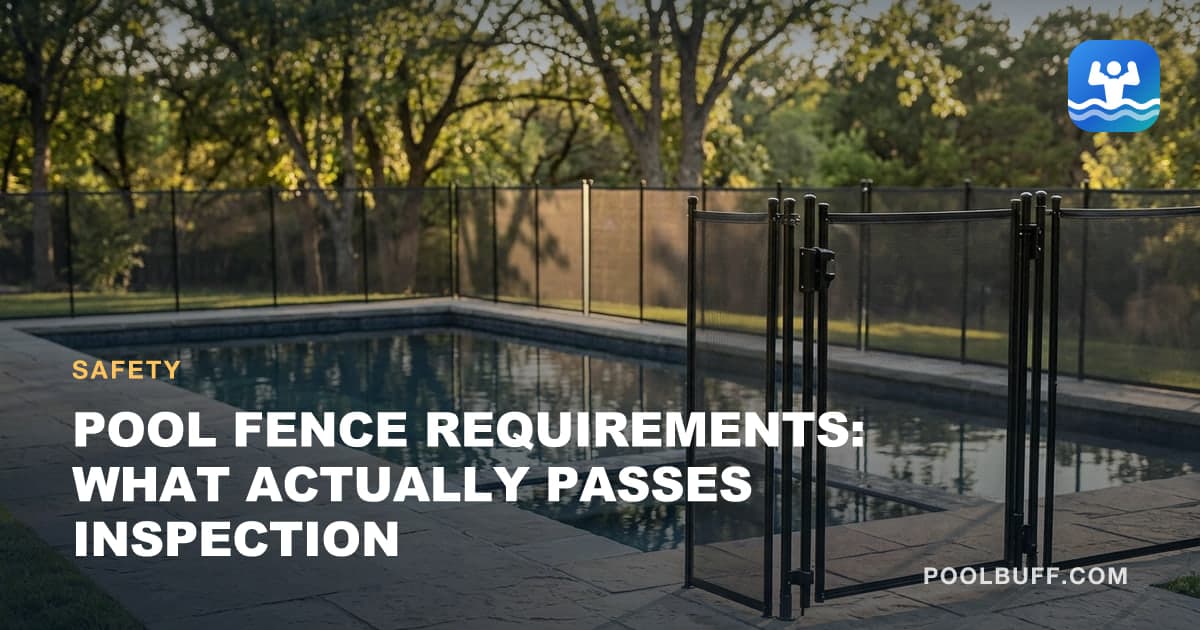
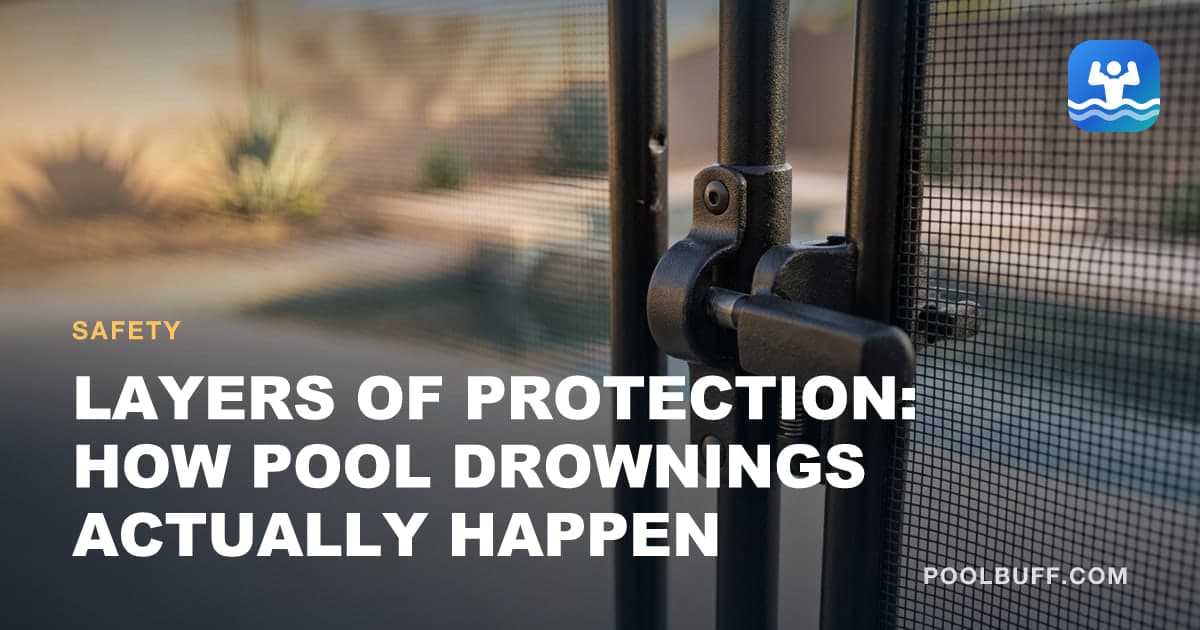
Four-sided isolation fencing — separating the pool from the house as well as the yard — is substantially more effective than a three-sided barrier that uses the house as one side. The reason is straightforward: most young children who drown got to the pool from inside the house, through a door that was supposed to be shut.
If you use the house as a barrier side, every door needs an alarm or self-latching hardware. And pet doors count.
Go deeperPool barrier requirements in detailHeights, gaps, gate hardware and the climbable-surface rule.3. Alarms
Useful. Not sufficient.
- Gate alarms — sound when the gate opens
- Door alarms — required in many jurisdictions where the house forms a barrier side
- Surface wave alarms — float and detect disturbance
- Subsurface alarms — detect displacement, generally fewer false alarms
- Wearable alarms — a wristband that triggers on immersion
The failure mode is human. Alarms with false triggers get muted, then unplugged, then forgotten. If you fit one, check it monthly and pick a type that won't cry wolf in your setup. The alarm pages here cover a door alarm, a gate alarm, a deck-mounted pool alarm and a floating one.
4. Swim competence
Formal lessons reduce drowning risk in young children meaningfully. Get them.
But be clear about what they do. A child who can swim can still be exhausted, injured, entrapped by a drain, or panicked. Competence lowers risk; it doesn't remove it, and a family that treats lessons as the solution has effectively removed a layer rather than added one.
5. Rescue readiness
The layer for when the others have already failed.
- Learn CPR, and refresh it. Bystander CPR before EMS arrives is one of the strongest predictors of outcome.
- Keep a reaching pole and a ring buoy at the poolside. Not in the shed.
- Keep a phone poolside so nobody has to leave the water to call.
- Teach children to reach or throw, not go in. Would-be rescuers drown.
The scenarios that come up most
The gap during a gathering. Lots of adults, diffuse responsibility, nobody actually watching. This is the classic. The water watcher system exists specifically for it.
The child who got out of the house. Slipped out through a door while an adult was in another room. Four-sided fencing and door alarms are the answer.
"They can swim." A competent five-year-old still gets tired, still panics, still hits their head on the step.
Non-swimming adults at a party. Drowning isn't only a child risk. Alcohol plus water plus a deep end is a genuine adult hazard, and it's under-discussed.
Drain entrapment
Rarer than drowning, and horrific when it happens.
Under the US Virginia Graeme Baker Act, public pools require anti-entrapment drain covers and, in some single-drain configurations, a safety vacuum release system. Residential pools should meet the same standard.
Check your main drain cover. Compliant covers carry a date stamp and expire — typically five to seven years — because the plastic becomes brittle. A cracked or missing cover on a single main drain is a serious hazard.
Most homeowners have never looked. Go and look.
Also: long hair can be caught by a drain, and loose-fitting drain covers are a hazard on spas as well as pools. Spas need a clearly marked emergency shut-off.
A short list worth doing this week
- Walk the barrier with a 4-inch ball. Check every gap.
- Test the gate — open it an inch, let go, confirm it closes and latches.
- Look at what's stackable near the fence and move it.
- Check the main drain cover date stamp.
- Find out if anyone in the house currently knows CPR.
- Put a reaching pole and a ring buoy at the poolside, permanently.
- Agree the water watcher rule with your household, out loud.
None of it takes long. All of it works.
Go deeperA cover that is actually a barrierCertified automatic covers hold weight. Solar and winter covers do not.Frequently asked questions
What are the layers of protection for pool safety?
Active adult supervision, a compliant four-sided isolation barrier, door and gate alarms, swim competence appropriate to age, and rescue readiness meaning CPR training and equipment at poolside. Each layer catches a different failure mode, which is why the model works and why any single measure on its own doesn't.
How quickly can a child drown?
The struggle you might see lasts only about 20 to 60 seconds before a child goes under, and once submerged, brain injury can begin within four to six minutes. It's silent — there's no calling out and usually no splashing, because a drowning person's arms are instinctively pressing down on the water to lift the mouth clear.
Do swim lessons prevent drowning?
They reduce risk meaningfully, particularly for children aged one to four, and they don't eliminate it. A child who can swim can still be injured, exhausted, entrapped or overwhelmed. Lessons are one layer among several, not a replacement for barriers and supervision.
What is a water watcher?
One adult, named out loud, whose only job for a set period is watching the water. No phone, no conversation, no cooking. They hand the role to another named adult when they need to leave. The whole point is that it removes the assumption that someone else is watching.
Are pool alarms effective?
As an additional layer, yes. Surface wave alarms, subsurface alarms, gate alarms and wearable alarms all have a role. As a primary defense, no — they fail, they get muted or removed after false alarms, and by the time one sounds a child is already in the water.