An automatic cover is the nicest thing you can add to a pool. Turn a key, hold it, and in under a minute the pool is covered.
It's also the fussiest thing on the pad. It has a motor, a drum, two ropes, pulleys, sliders, a pump and a fabric the makers expect you to replace. Each of those has its own rules in the manual.
Everything below comes from five makers' own manuals, warranties and websites: Coverstar, Cover-Pools, Pool Cover Specialists, Automatic Pool Covers Inc. (APC) and Aquamatic. CPSC and DOE fill in the rest. Where the makers disagree, I say so.
Key takeaways
- Coverstar's $10,000 to $20,000 is the only new-cover price I found from a maker. A larger freeform pool sits near the top of it.
- The tracks need two straight, parallel lines, one on each side of the pool. On a freeform pool, a top track frames it on the deck.
- A cover certified to ASTM F1346 is a safety cover only when it's closed all the way, with its pump on it and the water at its normal level.
- Never run it with water, snow or ice on it. Coverstar says one inch of water on a cover can weigh thousands of pounds.
- Pulleys, sliders and ropes are wear parts. Coverstar compares pulleys and sliders to a car's brake pads.
- Plan it during the build. Latham says putting the tracks and the housing in then turns a week-long job into a half day later.
How it works
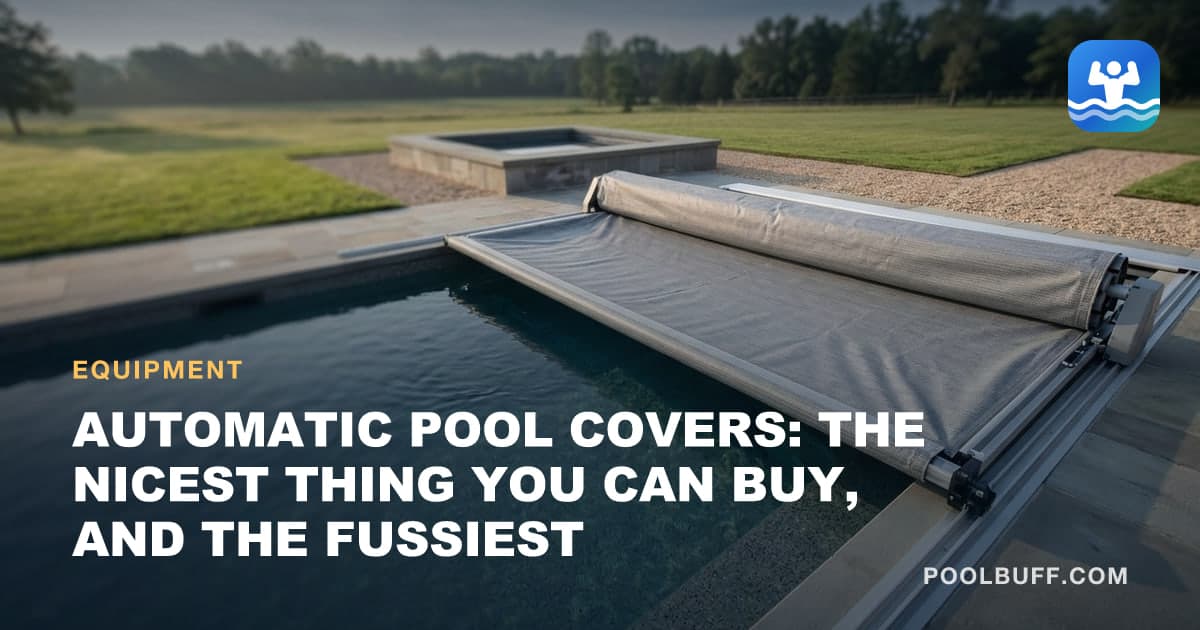
DOE describes automatic covers as permanently mounted reels that cover and uncover the pool at the push of a button. The parts diagrams in the manuals come down to six pieces:
- Two tracks run along opposite sides of the pool. They mount under the coping, flush in the deck, or on top of it. Coverstar's top track sits half an inch proud of the deck.
- The fabric is vinyl, with webbing along its edges that rides in the tracks.
- A drum sits at one end. The fabric rolls onto it when the cover opens.
- Two ropes, one in each track, pull the front edge of the cover across the pool to close it. Rope reels at the drum end wind them in.
- The drive is an electric or hydraulic motor in a housing at the drum end, recessed under a lid or sitting on the deck.
- A pump sits on top of the closed cover and removes rainwater.
Coverstar, Pool Cover Specialists and APC all say their covers open or close in under a minute. Aquamatic says its cover travels about a foot per second.
The switch is part of the safety design. Coverstar says safety covers must have a momentary switch, one you hold down for the motor to run. Aquamatic's manual says the cover stops when you let go, and that the key should come out of the switch so children can't run it.
What it costs
Coverstar's site says an automatic cover costs $10,000 to $20,000. A larger freeform pool may be closer to $20,000, and a smaller or rectangular one may cost less. Latham, which makes Coverstar, gives the same range on its price guide but calls it the average starting cost. Neither page says whether installation is included, or when the figure was set.
Latham says installation takes a professional and a licensed electrician. It lists what moves the price:
- The pool's size and shape. A basic rectangle with an aluminum lid sits at the low end.
- The track. A top track mounts on the deck. Recessed and under-track systems look cleaner but take extra labor, and an under track on a freeform pool costs more than many top tracks.
- Features around the pool. An infinity edge, beach entry, tanning ledge or jumping rocks can need custom work.
- The wiring route. Retaining walls, paths and plant beds can make the electrical run harder.
No other maker I read publishes a price. APC says every cover is built to fit its pool, so there isn't a one-size-fits-all price.
Replacing the fabric later. Latham says a replacement cover can start at around $2,000. The final figure depends on size and shape, travel charges and any repairs the tracks need.
New pool or existing pool
On a new pool, the tracks can hide. Coverstar's under track mounts to the underside of the coping, and Coverstar calls that type ideal for new pools or deck resurfacing. A recessed track sits flush with the deck, and Latham suggests considering it during construction.
On an existing pool, the makers' answer is a track on the deck. Coverstar's is a screw-down track set in a channel cut into the deck, or a standard top track on the surface. Cover-Pools uses its low-profile SnapTop track. Pool Cover Specialists says an existing pool can't have an under track.
The mechanism can still be hidden. Cover-Pools says it can be recessed if there's room to cut into the deck. Pool Cover Specialists describes building a full vault, or a partial one with a step deck over it. It also says that for most people adding a cover to an existing pool, the mechanism sits on top of the deck. Latham calls adding a cover so it can be hidden "a somewhat invasive process."
The shape question
The tracks have to run straight and parallel. Pool Cover Specialists puts it simply: if two straight lines can go one on each side of the pool, it can put a cover on it. Cover-Pools says the same about tracks running parallel on opposite sides. Coverstar says the tracks must form a rectangle around the pool.
That doesn't rule out a freeform pool. It means the rectangle goes around it:
- A top track on the deck can frame a freeform pool, and Coverstar calls its top track ideal for one. Aquamatic notes that on a non-rectangular pool, you'll need to sweep water off any fabric resting on the deck.
- Pool-in-pool. Latham says an under track can serve a freeform pool built this way, at a higher installation cost.
- Two covers. For L-shaped pools, Pool Cover Specialists suggests two separate mechanisms.
Size has limits too. Coverstar's Atom is designed for covers up to 20 by 50 feet. APC's Three Sixty Five, a cover-and-pool system for vinyl-lined pools, tops out at 24 by 50.
Aquamatic's HydraLux slat cover can be cut to any converging shape. But Aquamatic says it is "solely an energy pool cover and not a safety cover."
When it counts as a safety cover
The standard is ASTM F1346. CPSC sums up two of its demands: a cover must hold the weight of two adults and a child, so someone who falls onto it can be rescued, and water must come off it quickly. CPSC says a power safety cover properly in place "provides a high level of safety for children under 5 years old." Where the house forms part of the pool barrier, CPSC lists one as an alternative to door alarms.
All five makers say their safety models meet F1346, and each cites UL. The conditions they attach matter as much as the label:
- Closed all the way. Coverstar says never to leave the pool partially covered. APC and Cover-Pools both warn that entrapment is possible.
- Pump on the cover. Coverstar: "The cover is not a safety cover unless the pump is in place." Pool Cover Specialists says the same.
- Water at its normal level. Cover-Pools says that in many cases the cover won't support itself over a low or empty pool.
- A switch in view of the pool. Coverstar says mounting the key switch where all of the pool is visible is mandatory under the ASTM standard. Pool Cover Specialists and Cover-Pools say the same.
- A safety model. Not every motorized cover is one, as the HydraLux shows.
The front edge. Cover-Pools offers a latching strap for the leading edge, and its manuals say why: "In some circumstances a young child may be able to force their way under the cover by pulling or pushing on the leading edge." It says weight on the cover, from water, snow or a person, can also push that edge open.
Walking on it. Coverstar says its covers are built to hold the weight of several adults. It doesn't recommend walking on them except in an emergency or to clear debris.
Whether your local code accepts a cover in place of a fence is up to your building department, so ask before you count on it.
Go deeperHow the layers actually stackFence, cover, alarm and supervision, and why no single one of them holds.Water on the cover
Every Coverstar system comes with a pump that senses water and removes it, and Cover-Pools and Pool Cover Specialists supply one too. It stays on the cover whenever the cover is closed.
The reason is weight as much as safety. Coverstar warns that one inch of water on a cover can weigh thousands of pounds, and that a few inches can pull the cover and tracks into the pool. Cover-Pools does the arithmetic: eight pounds a gallon, so a few inches of rain quickly comes to a ton.
Standing water is also a drowning hazard on its own. Coverstar says a cover with water on it "poses the same safety hazard as an open pool." Aquamatic's manual says it in capital letters.
Three rules from the manuals:
- Never run the cover with water on it. Cover-Pools says damage can occur to the fabric and the mechanism.
- Never open it to dump the water into the pool. Pool Cover Specialists says so directly.
- Get it off fast. Pool Cover Specialists says the pump must clear rain within 30 minutes of it stopping.
Replacing the pump. Cover-Pools and Pool Cover Specialists don't warranty the pump; it carries its own maker's warranty. APC's manual says a replacement must be UL or ULC approved and meet ASTM safety specifications, so ask your cover dealer which pumps it accepts. Little Giant's APCP-1700 is one option. Its manual says it is certified for use on pool covers, and its float switch starts it in 2 inches of water. Its spec sheet rates it at 1,745 gallons an hour at one foot, the same figure APC gives for the pump it sells.
What wears out
The makers publish warranties, not lifespans. Here is what each one covers:
| Fabric | Mechanism | Motor | Tracks | |
|---|---|---|---|---|
| Coverstar | 7 years, prorated after 3 | 20 years (Eclipse, Atom); 10 (CS3000) | 5 years | 3 years |
| Cover-Pools | 7 years, prorated after 2 | Life, to the first owner | 3 years | 7 years |
| Pool Cover Specialists | 7 years, prorated after 3 | Life, to the first owner | 3 years | Life, as part of the mechanism |
| APC | 5 years, prorated after 3 | 10 years | 3 years (electrical parts) | Not listed separately |
| Aquamatic | 7 years; terms not published | 20 years | Not published | Not published |
Coverstar, Cover-Pools, Pool Cover Specialists and APC all leave labor out. After the full-coverage years, a prorated warranty pays a shrinking share of the replacement each month.
Pulleys, sliders and guides. Coverstar and APC leave pulleys and guides out of the mechanism warranty. Pool Cover Specialists exempts sliders, wheels and guides, and Aquamatic calls ropes, sliders, guides and pulleys consumables. Coverstar compares pulleys and sliders to brake pads. Cover-Pools says pulleys usually last about three years, and Aquamatic says to replace all of them every two to three. Pool Cover Specialists says bad pulleys can wear out and break ropes.
Ropes. No maker I read gives a replacement interval. APC says to inspect them for fraying and have them replaced before they break. Coverstar covers its Powerflex rope against breakage for two years. It also says a common cause of broken ropes is rodents, which the warranty doesn't cover. Aquamatic says ropes may need replacing before the fabric does.
Webbing. Coverstar says webbing worn through by debris in the tracks is "easily preventable and is not covered under the warranty." Hosing out the tracks is the fix.
The fabric. Latham says owners may need to replace it every five to eight years, and that it lasts longer in a cool climate with less sun than in a hot, dry one. Cover-Pools says to think about replacing it near the five-to-seven-year mark, or sooner if it's fraying, fading, bunching or stiff. Chemistry shortens it. Pool Cover Specialists calls chlorine abuse "a major cause of pool cover degradation," and says long-term imbalance or swinging pH can ruin the vinyl "in just a season or two."
The motor and the housing. Coverstar doesn't cover damage from standing water or long submersion, and says failing to keep the housing draining voids the mechanism warranty. An overfilled pool can flow into the housing and flood the mechanism, it says. APC says to clean out the box the cover rolls into at least once a year, and Cover-Pools says to keep the housing drain clear.
Living with one
Water level. Coverstar and Pool Cover Specialists say mid-skimmer. Pool Cover Specialists and Aquamatic both say at least 85 percent of the fabric should touch the water. Cover-Pools says to hold the same level all year, and warns that ice or snow on the cover can make a low level look normal.
Chemistry. Cover only water you'd swim in: Coverstar, Cover-Pools and Aquamatic all say so. Some chlorine shocks take 12 to 24 hours to come back down, they say, so the cover stays open until the water tests swimmable. Coverstar, Cover-Pools and Pool Cover Specialists suggest a non-chlorine shock, which lets you close the cover in about 30 minutes. After a chlorine shock, Aquamatic says to wait until chlorine is down to 5 ppm.
Coverstar and Pool Cover Specialists say not to float a chlorinator under the cover. When the pool will stay covered a long time, Coverstar, Cover-Pools, Pool Cover Specialists and Aquamatic all say to turn down ozone generators and chemical feeders. Pool Cover Specialists adds salt systems to that list.
Tracks. Hose them out with plain water. How often, and whether to lubricate them, are both in the disagreements below. My habit is spring and fall at least, and again after any windy, dusty spell.
Service. Pool Cover Specialists recommends an annual inspection and tune-up. APC says a trained technician should service the system "either annually or bi-annually." Cover-Pools says to inspect the components at least two to three times a year.
Closing it by hand. If the power fails with the pool open, Coverstar, Cover-Pools, Pool Cover Specialists and APC each describe closing the cover manually. Coverstar says it is "not easy to do," and Cover-Pools says it takes two strong people. Aquamatic's Hydramatic manual doesn't describe a procedure. Read yours before the evening you need it.
Where the makers disagree
- Fabric warranty. Coverstar, Cover-Pools, Pool Cover Specialists and Aquamatic give 7 years; APC gives 5. Cover-Pools' 2024 warranty card gives its Pro-Coat fabric 7 years in one sentence, then prorates it over years three through five in the next. Its 2021 fabric sheet gives Pro-Coat the full 7.
- When the warranty clock starts. Coverstar counts full fabric coverage from the date of manufacture, and proration from the date it ships. APC counts from when it ships the fabric to the dealer, and Pool Cover Specialists from purchase. Cover-Pools says purchase on one sheet and installation on another.
- The pump in deep cold. Coverstar, Cover-Pools, Pool Cover Specialists and Aquamatic say the pump can stay on the cover all winter, and Coverstar and Cover-Pools say it freezes into the ice without damage. APC says that when it's too cold to melt the ice, take the pump off and keep it somewhere warm. Little Giant's APCP-1700 manual says not to let the pump freeze, and to keep it plugged in if it's left out in freezing weather.
- Running it in the cold. APC and Aquamatic say not below 40°F, and Aquamatic says the cold can crack the vinyl. Coverstar, Cover-Pools and Pool Cover Specialists give no temperature limit.
- Using it as a winter cover. Cover-Pools allows it if the water can stay at its normal level, and says to take the cover off the pool if it can't. Coverstar's guide says the cover will survive any normal winter with its precautions. Coverstar Central, Coverstar's distributor, says the cover won't last as long used that way, and that winter damage isn't warranted. Aquamatic says to open the cover completely in areas of high snowfall.
- The winter water level. Coverstar says mid-skimmer. APC allows 1 to 2 inches below the skimmer, and says closing the cover more than 6 inches below it could cause damage. Aquamatic says within 1 to 2 inches of normal, and to keep the cover rolled up if you lower it. Coverstar Central says no more than 5 inches below normal.
- How long after chemicals. Coverstar, Cover-Pools and Aquamatic say some chlorine shocks take 12 to 24 hours to come back, and Pool Cover Specialists says up to 24. APC's manual says to leave the cover open "(up to 60 minutes)" after adding chemicals, and only with an adult watching. Wait for the water to test swimmable.
- Chlorine and salt. Cover-Pools and Aquamatic give 1 to 5 ppm chlorine; Pool Cover Specialists recommends 0.6 to 1.5 ppm free chlorine. Pool Cover Specialists lists salt at 3,000 ppm. Aquamatic says to keep it below 3,000 to 3,200, and doesn't warranty its metal parts against salt-water corrosion.
- Lubricating the tracks. Aquamatic says to hose them out monthly and spray in water-based silicone. Cover-Pools says to use nothing but water on the tracks and no silicone, and Pool Cover Specialists says never to use lubricants on the ropes, webbing or tracks.
- How often to clean the tracks. Coverstar says as often as needed, Cover-Pools twice a season, APC twice a year, and Aquamatic monthly.
- Washing the fabric. Coverstar suggests mild dish soap every three to six months, and Aquamatic dish soap or a biodegradable cleaner. Cover-Pools and Pool Cover Specialists say never to use detergents.
- How fast the water must come off. Pool Cover Specialists says the pump must clear rain within 30 minutes. Aquamatic's manual says pump removal may take up to several hours.
- Which edition of the standard. Every maker I read cites ASTM F1346-91, the 1991 edition, some of them as approved again in 2010. ASTM's current edition is F1346-23.
Is it worth it?
DOE called automatic covers the most expensive option, and the most convenient. It also said covering a pool when it isn't in use is the single most effective way to cut heating costs, with savings of 50 to 70 percent possible. But a cover saves nothing if it stays off, and EPA cites a 2016 study that found only 15 percent of pool owners have a cover and use it regularly.
That's the case for an automatic one. My view is that a cover you close with a key is a cover that actually gets closed.
On a rectangular pool, with young children around and heated water, I think it's the best money you can spend on the pad. It's a barrier, a heat cover and a debris cover in one, as long as you live by the manual.
On a freeform pool, or where you rarely heat, the case is weaker. A mesh safety cover does the barrier job over the off-season with no motor. A solar cover holds heat in season, though it holds no one.
Either way, budget it as ongoing rather than one-time. Latham's estimate is new fabric every five to eight years. Add pulleys every two or three, ropes when they fray, and a service visit once a year.
Go deeperAll four cover types, comparedSolar, safety, winter and automatic: what each one does, and which hold weight.Frequently asked questions
How much does an automatic pool cover cost?
Coverstar's site says $10,000 to $20,000, closer to the top for a larger freeform pool. It doesn't say whether that includes installation, and Latham's price guide calls the same range an average starting cost. Latham says a replacement cover can start at around $2,000. None of the other makers I read publishes a price.
Do automatic pool covers count as a safety cover?
A model certified to ASTM F1346 does, and all five makers I read say their safety models are. It only counts when it is closed all the way, with its pump on the cover and the water at its normal level. Aquamatic's HydraLux slat cover is not a safety cover, so check the model.
How long does an automatic pool cover last?
The makers publish warranties, not lifespans. Fabric is warranted for 7 years by Coverstar, Cover-Pools, Pool Cover Specialists and Aquamatic, and for 5 by APC, all prorated where the terms are published. Latham says the fabric may need replacing every five to eight years. Mechanisms are warranted for 10 years to life. Cover-Pools says pulleys usually last about three years.
Can you put an automatic cover on any shape pool?
The tracks need two straight, parallel lines, one on each side. A freeform pool can take a top track on the deck that frames it, or an under track built as a pool-in-pool. Pool Cover Specialists suggests two covers with two mechanisms for L-shaped pools.
What happens if water sits on the cover?
It makes the cover a hazard: Coverstar says a cover with water on it is as dangerous as an open pool. It is also heavy. Coverstar says one inch can weigh thousands of pounds, and a few inches can pull the cover and tracks into the pool. Keep the pump on the cover, and never run the cover with water on it.
Can you walk on an automatic pool cover?
Coverstar says its covers are built to hold the weight of several adults, but it doesn't recommend walking on them except in an emergency or to clear debris. Cover-Pools warns that weight on the cover can push the leading edge open enough for a child to slip through.
Can you leave an automatic cover closed all winter?
It depends on the maker. Cover-Pools allows it if you can keep the water at its normal level. Aquamatic says to open it completely where snowfall is heavy. Coverstar's distributor says winter damage isn't warranted. APC and Aquamatic both say not to run the cover below 40°F.