Automation gets sold as a lifestyle upgrade. What it really does is manage complexity.
If your pool is a pump, a filter and a light, you don't have much complexity to manage, and a variable-speed pump's own scheduler will do nearly everything a controller would.
If you've got a spa that shares equipment, a heater, three water features and color lighting, automation stops being a luxury and starts being the thing that makes you actually use any of it.
Key takeaways
- Automation earns its money on complexity. Simple pool, simple timer, save your cash.
- Valve actuators for a pool-spa combination are the single most useful piece of automation.
- pH and ORP controllers are genuinely useful and genuinely need maintenance to stay accurate.
- Stay inside one manufacturer's ecosystem. Cross-brand integration is where the frustration lives.
- Cloud dependence is a real risk. Ask what still works when the internet is down.
What it actually does
Pump scheduling. Different speeds at different times, plus a boost for cleaning or spa jets. Most variable-speed pumps do this on their own panel already.
Valve actuators. Motorized heads on existing valves that switch flow between pool, spa and features. This is the genuinely transformative one for a pool-spa combination — instead of walking outside and turning two valves by hand, you press "spa" on your phone twenty minutes before you want it.
Heater control. Set the temperature, set a schedule, and warm the pool up from your phone before you get home. On a gas heater with a spa, this is most of the value.
Lighting. On/off, color selection, synchronized shows across pool and landscape lights.
Sanitizer. Salt cell output tied into pump run time, so output adjusts with schedule changes.
Chemistry. Controllers that read your water continuously and dose acid or sanitizer on their own.
When it's worth it
Yes, clearly:
- Pool with an attached spa sharing equipment. The valve automation alone justifies it.
- Heated pool you use on impulse.
- Multiple water features on separate valves.
- Color lighting you'd actually use.
- A rental or vacation home, where you need to see what the pool is doing from somewhere else.
- Large or commercial pools where chemistry drift is expensive.
Probably not:
- Simple pool: one pump, one filter, one light. The pump's scheduler is enough.
- Somewhere you only swim two months a year.
- If you're already fighting basic maintenance. Automation doesn't fix a pool that isn't being tested; it just gives you a nicer interface to the same problem.
What to look for
Stay in one ecosystem. The big manufacturers each have a controller platform, and their own pumps, heaters, lights and salt systems integrate cleanly. Mixing brands is where the frustration lives — you'll end up with two apps and a relay doing something crude. There is one documented exception worth knowing about: Hayward sells a communication board, HLPMPCONV, that gives an Omni controller full speed control of up to three Pentair variable-speed pumps. Not a relay switching power — actual scheduling and speed setting on a competitor's pump. If your pad already has Pentair pumps and the controller is what died, that changes the arithmetic.
Ask what works offline. This is the question people forget. Good systems keep the schedule on the controller itself. The internet only lets you reach it from your phone. Some newer cloud-first products lose real function when the connection drops, and a heater you can't turn on because a server is down is a genuinely irritating way to discover this.
Check the wiring reality. Low-voltage control wiring has to reach every actuator, sensor and relay. On a new build that's trivial. On a finished pool with a stamped concrete deck it might be the biggest line item in the quote.
Room to grow. Buy a controller with more spare channels than you need. Adding a water feature in three years is easy if there's a spare channel and expensive if there isn't.
Chemistry controllers
Worth their own note, because they're the most useful and most misunderstood part.
pH controller with an acid feeder holds pH in a narrow band automatically. On a salt pool that climbs constantly, this eliminates a genuinely tedious weekly job.
ORP controller. ORP stands for oxidation-reduction potential, which is a mouthful for a simple idea: a live reading of how hard your sanitizer is actually working. The controller watches that number and adjusts output to hold it steady.
They need maintenance. Probes drift and need calibrating — monthly is realistic, quarterly is the minimum. A drifted probe confidently dosing acid into a pool that doesn't need it is worse than no controller at all. Probes also have a life of one to three years and cost $100–$300.
They don't replace testing. You still test with a kit and verify what the controller thinks it's doing. What they replace is the manual dosing.
Freeze protection, and what happens when the power goes
Two behaviors worth checking on any controller, because they are the ones that matter when nobody is watching.
Freeze protection overrides the schedule and runs the pump when air temperature falls below a set point, because moving water resists freezing and still water in a pipe does not. Every modern controller has it. Not every installer turns it on, and the default threshold is sometimes lower than it ought to be — 37 to 40°F leaves margin, and the sensor wants to be somewhere reading actual air rather than heat radiating off a wall.
Not every controller reads a sensor for it. Pentair's guides say its smallest controller, the IntelliConnect, takes the temperature from an internet weather service once an hour, so its freeze protection stops working when the Wi-Fi does. Jandy's smallest, the AquaLink TCX, has its own air sensor.
On a pool with a spa and water features, check whether freeze protection also cycles the valves. A system that protects the pool loop while leaving the spa plumbing static is protecting half the pipework and calling it done.
Power loss and restore is the other. Ask what the controller does when power comes back: resume the schedule, or sit in a default state waiting to be told? Some return to a safe idle, which is fine right up until an outage on a freezing night leaves the pump off for the remainder of it.
And ask where the schedule lives. A controller holding its own program keeps running through an internet outage and merely becomes unreachable from your phone. One that depends on a server stops being a pool controller the moment the server does.
Retrofitting
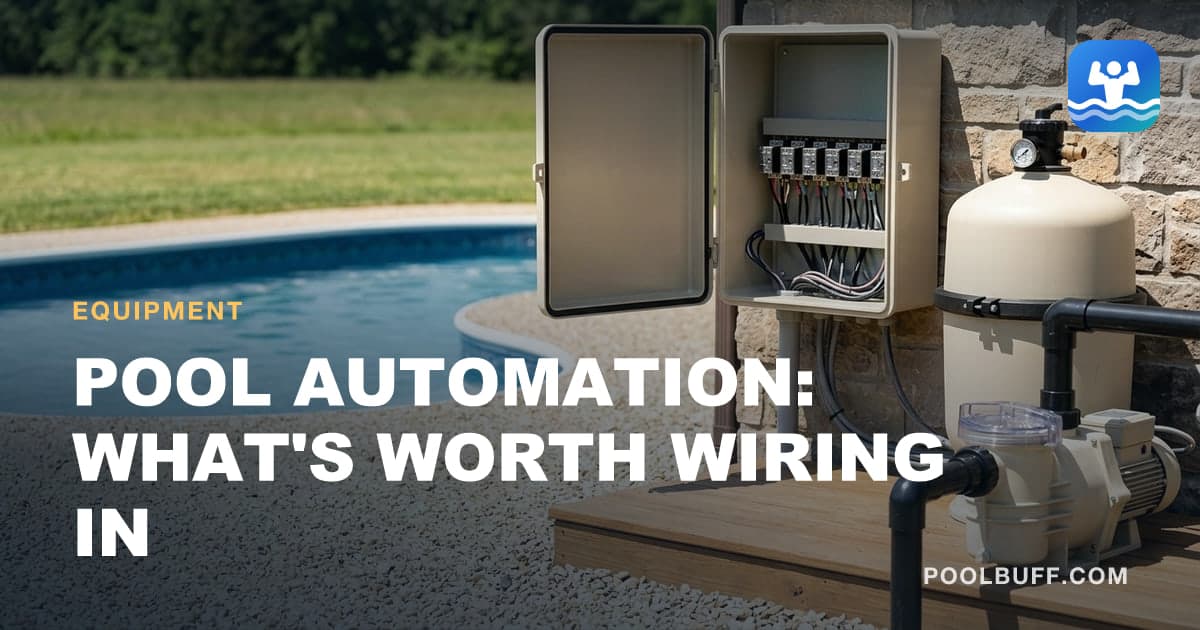
Usually possible. The controller and relays mount at the equipment pad, actuators fit onto existing valves, and the pump and heater connect over their manufacturer's control protocol.
The cost driver is wiring. Accessible pad, straightforward. Everything buried under a finished patio, expensive.
Budget $1,500–$4,000 for a decent retrofit with a few actuators, more if the electrical needs upgrading.
If a controller is already on the wall, check whether it is still supported before spending anything. Pentair discontinued the EasyTouch in September 2023 and the IntelliTouch two months earlier, and publishes upgrade kits that put current boards into the load center you already have — which is a good deal cheaper than a full retrofit, and cheaper again than discovering the part you need no longer exists. Hayward has done the same with the ProLogic, and gone further — its remotes, its network module and its relay are all formally discontinued, so on that system the part you need may already be the thing that no longer exists. What you would be upgrading into is Pentair's IntelliCenter, where every system is the same board plus a card, and where a 2026 consolidation cut the lineup from twenty-two items to six — so the part numbers in an older quote may no longer be orderable. Jandy's AquaLink RS is the most configurable of the three, at the price of fourteen different system boards to choose between. Every controller with a page here says whether it is still current, with its parts and manuals.
Where it goes wrong
Buying more than you'll use. Sixteen relays on a pool with a pump, a heater and one light. Ask what each channel will actually do.
Cross-brand integration. Two apps, a workaround, and a system nobody in the house understands but you.
Neglecting the probes. A chemistry controller with a two-year-old probe nobody has calibrated does more harm than no controller at all.
Assuming it replaces knowing your pool. It doesn't. It automates the doing, not the understanding. You still need to test, still need to look at the filter pressure, still need to brush the steps.
Go deeperThe actuators doing the switchingHow to set the travel and cams, and how to spot a stripped gear train. Go deeperOr just a timer?What a mechanical dial does well, and the one job it genuinely cannot do.Frequently asked questions
Is pool automation worth it?
If you have a heater, a spa, water features or multiple valves, yes — being able to switch modes from your phone genuinely changes how much you use the pool. On a basic pool with one pump and one filter, a variable-speed pump's built-in scheduler already does most of it and a full automation system is hard to justify.
How much does pool automation cost?
A basic controller runs $500-$1,200. A full system with valve actuators, heater control, lighting and sanitizer integration is $1,500-$4,000 installed. Retrofitting is more expensive than including it in a new build, mainly because of the wiring runs.
What does a pool automation system control?
Typically pump speed and schedule, heater on/off and setpoint, valve actuators for switching between pool and spa or water features, lights including color effects, salt cell output, and sometimes chemical dosing through pH and ORP controllers.
Do pool automation systems work without internet?
The good ones do — schedules and local control run on the controller itself, and the internet only adds remote access. Some newer cloud-first products lose meaningful functionality when offline. Ask this specific question before buying, because it's the difference between an outage being an inconvenience and being a cold pool.
Can I add automation to an existing pool?
Usually yes. The controller and relays go at the equipment pad, and valve actuators fit onto existing valves. The main cost is running new low-voltage control wiring, which is straightforward if the pad is accessible and awkward if everything is buried under a finished deck.