Hayward · OmniLogic
Hayward OmniLogic
The top of Hayward's Omni range — how the four Omni systems differ, and the board that lets it run Pentair pumps.
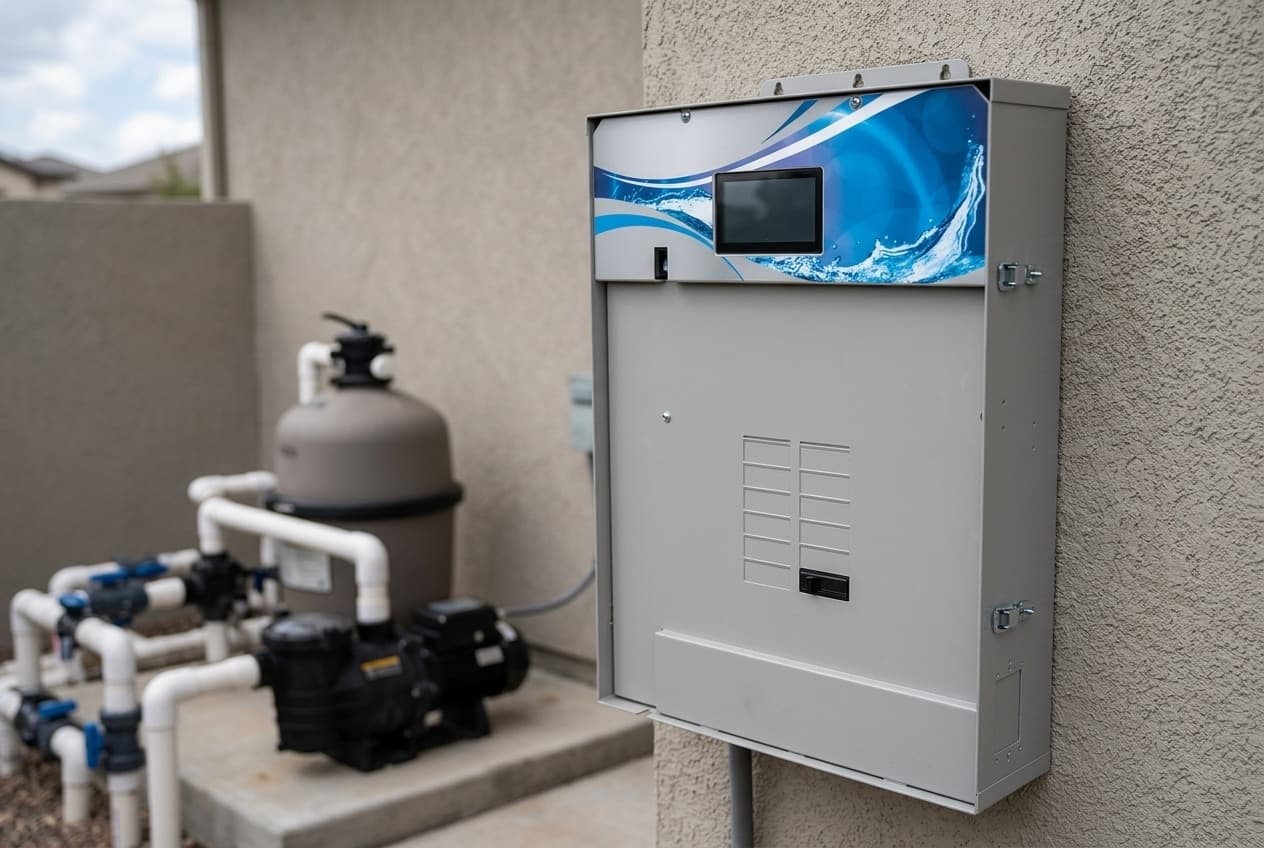
Hayward sells four things called Omni, and the names do not tell you which one you need. That is the first problem to solve, and Hayward's own 2026 configuration guide solves it.
What actually separates the four
The guide's opening instruction is the useful part: start with the panel, because all of them control variable-speed pumps without additional relays — and then the numbers diverge sharply.
OmniLogic, HLBASE — the premium one:
- 4 relays, scalable to 20
- 4 valve controls, scalable to 16
- 16 variable-speed pumps
- Subpanel taking up to 12 breakers, 100 A
- Salt ready, cell sold separately
OmniPL — five variants, all sharing:
- 4 relays, scalable to 8
- 4 valve controls
- 8 variable-speed pumps
- Subpanel of up to 8 breakers, on the versions that have one
OmniHub, HLOMNIHUB — for adding control to a pool that has none:
- 1 relay, scalable to 3
- 2 valve controls
- 3 variable-speed pumps
- No subpanel
So the OmniLogic is not a slightly bigger OmniPL. It carries two and a half times the relays, four times the valves and twice the pumps, and it is the only one in the range with real headroom.
The letters in an OmniPL number mean something
Five OmniPL SKUs, and the differences are all in the suffix:
- HLPRO4W — subpanel, no sanitization
- HLPRO4SW — S for salt ready, cell still sold separately
- HLPLUS4W — PLUS means the cell is in the box, a TCELL340
- HLPRO4NW — N for no subpanel
- HLPRO4NSW — no subpanel, salt ready
Two of those distinctions cost real money later. N means there is nowhere to put breakers, so the system needs a separate panel fed to it, which is an electrician's line item rather than a checkbox. And S is readiness, not a cell — only the PLUS ships with one.
It will run Pentair pumps
The most surprising thing in Hayward's accessory list, and the reason to read this page even if you own another brand's equipment.
HLPMPCONV is a communication board with a cable and an enclosure. Hayward's own installation manual: it will allow full control of up to 3 Pentair variable speed pumps by Omni Control products. The Omni Control can turn the pump on and off as well as vary speeds based on schedules and speed settings.
That is not a relay switching power to a pump. It is speed control over a communication bus, on a competitor's hardware, sold by the manufacturer of the controller.
The practical consequence is worth spelling out. A pad with Pentair variable-speed pumps and a dead controller usually presents as a choice between replacing the controller with the same brand or replacing the pumps too. On the Hayward side that is not the choice — up to three of those pumps keep working, properly, under an Omni system.
The automation guide advises staying in one ecosystem, and that is still the right default: one app, clean integration, nobody guessing. This is the documented exception to it.
Four valve controls is four outputs
The specification counts what the board can drive, not what arrives in the box, and the footnote is easy to miss: valve control requires a GVA-24 valve actuator, sold separately.
So "4 included, scalable to 16" means sixteen valves the system can command and sixteen actuators you buy. On a backyard with a spa, a spillway, solar and a water feature, that adds up quickly and it belongs in the quote from the start. What an actuator does and how it fails is worth reading before deciding how many valves genuinely need automating.
Expansion, and where each piece goes
Three ways to grow an OmniLogic, and they are not interchangeable:
- HLIOEXPAND plugs directly onto the base unit and adds four valve outputs, four low-voltage relays and four temperature sensor inputs
- HLEXPAND adds a second subpanel with the same capabilities as the base
- HLRELAYBANK adds four relays, and can be fitted to the base and to an HLEXPAND
An OmniPL expands differently — two HLRELAY boards inside the base unit, or two HLH485RELAY modules, each in its own wall-mountable enclosure and talking over the RS-485 bus. That last one is the answer when the enclosure is full but the wall is not.
Two generations, and Hayward dates the split
A small thing that reflects well on Hayward, and it is easier to appreciate having looked at the alternative.
Hayward publishes two complete sets of manuals for the OmniLogic: installation and operation for pre-2023 systems, and installation and operation for 2023 onward. Four documents, clearly labeled by date.
Set that against the EasyTouch, where roughly half the parts list forks on a "change date" that Pentair never states anywhere on the sheet. Both manufacturers changed their hardware mid-life. Only one of them tells you when.
If you are working on an OmniLogic, establish which side of 2023 it came from before you open the right manual — and the manuals are the place to check, because the differences are real enough to warrant two of them.
Three years, from the right dealer
Hayward advertises 3+ year parts and labor warranties on the Omni range, with an asterisk: when sold by a Totally Hayward Partner.
That is the same shape of channel condition Jandy and Pentair run, and it produces the same outcome — a cheaper price from the wrong source costs more the first time something fails. Parts and labor is the part worth noticing, because labor is most of the bill on a wall-mounted control system.
This is dealer-installed equipment regardless. Subpanel wiring, valve actuators and pump communication are licensed work, and the warranty condition mostly formalizes what the installation already required.
What carried over from the ProLogic
Two part numbers in the current accessory list give away the lineage.
The fuse is GLX-F4A-PAK10, and GLX is the prefix from the ProLogic and AquaLogic generation. The liquid chlorine feed system is AQL-CHEM4-CHLOR, and AQL is AquaLogic.
That is a small kindness to anyone maintaining both. The systems are otherwise unrelated — the ProLogic's remotes and relay are discontinued and its configuration lives on a board with no backup — but the consumable end of the parts list did not start over.
Which model do you have?
The model number is on the control system label. Everything else in the range is shared — these are the parts that change with it.
| Model | SKU | Relays | Valve controls | Variable-speed pumps | Subpanel | Salt cell | Note |
|---|---|---|---|---|---|---|---|
| OmniLogic | HLBASE | 4, scalable to 20 | 4, scalable to 16 | 16 | — | — | The scalable one. Four valve controls expanding to sixteen, four relays expanding to twenty, sixteen variable-speed pumps, and room for twelve breakers at 100 amps. Salt ready, with the cell sold separately. |
| OmniPL, with subpanel | HLPRO4W | 4, scalable to 8 | — | 8 | Up to 8 breakers | — | Four relays expanding to eight, four valve controls, eight variable-speed pumps, eight breaker spaces at 100 amps. No sanitization. HLPRO4SW is the same with salt readiness added. |
| OmniPL with cell included | HLPLUS4W | 4, scalable to 8 | — | — | Up to 8 breakers | TCELL340 included | The same OmniPL, shipping with a TCELL340 in the box rather than salt readiness you have to buy into. PLUS in the name is the cell. |
| OmniPL, no subpanel | HLPRO4NW | 4, scalable to 8 | — | 8 | Not included | — | The N is no subpanel — same relays, valves and pump control, but nothing to put breakers in, so it needs a separate panel to feed it. HLPRO4NSW is the same with salt readiness. |
| OmniHub | HLOMNIHUB | 1, scalable to 3 | 2 | 3 | — | — | The small one, for adding control to a pool that has none. Two valve controls, one relay expanding to three, three variable-speed pumps, no subpanel. The wall-mount remote does not work with it. |
Hayward OmniLogic parts, and what goes wrong
Read off the manufacturer’s parts list and checked before it ships. Open a row for what a bad one actually does — or start from the symptom and work down, which is the cheaper order.
What is it doing?
A communication board, a cable and an enclosure that give an Omni control full command of up to three Pentair variable-speed pumps — on, off and speed by schedule, not just a relay switching power. It is the reason a Hayward controller can go onto a pad full of Pentair pumps without replacing them, and very few manufacturers sell anything like it.
Live pricing arrives when the retailer programs are approved.
Plugs straight onto the base unit and adds four valve actuating outputs, four low-voltage relays and four temperature sensor inputs. The cheapest way to grow an OmniLogic, and it goes inside the enclosure already on the wall.
Live pricing arrives when the retailer programs are approved.
A second subpanel with the same capabilities as the base unit — the step beyond HLIOEXPAND, and what takes an OmniLogic toward its ceiling of twenty relays and sixteen valves.
Live pricing arrives when the retailer programs are approved.
Four additional relays, and it can be fitted to the base unit and again to an HLEXPAND — so a fully expanded system carries two of them. Relays are the thing people run out of first, usually after adding lighting.
Live pricing arrives when the retailer programs are approved.
A relay in its own wall-mountable enclosure, talking to the controller over the RS-485 bus rather than sitting inside the base unit. Listed as the OmniPL expansion route, and useful anywhere the enclosure is full but the wall is not.
Live pricing arrives when the retailer programs are approved.
The catch behind the specification. Four valve controls included means four outputs, not four actuators — every valve you intend to automate needs a GVA-24, and they are sold separately. On a system advertised as scaling to sixteen valves, that is sixteen actuators to budget for.
Live pricing arrives when the retailer programs are approved.
The handheld, and waterproof rather than merely splash resistant — which on a control people carry to the spa is the specification that decides how long it lasts.
Live pricing arrives when the retailer programs are approved.
The panel at the spa itself. It mounts in a mud box, HLMUDBOX, which is a separate part and the thing people forget to order with it on a new installation.
Live pricing arrives when the retailer programs are approved.
The indoor panel, and the one compatibility exception in the range worth knowing: Hayward states it is not compatible with OmniHub systems. On an OmniLogic or an OmniPL it is fine.
Live pricing arrives when the retailer programs are approved.
The cheapest thing to check, and note the part number — GLX is the ProLogic generation's prefix. Hayward carried some of the small parts across, so a service van stocked for the old system is not starting from nothing on the new one. It is cataloged as an Open Line part with no manual of its own, so the listing is the only place Hayward documents it.
Live pricing arrives when the retailer programs are approved.
For a pool dosing liquid chlorine instead of running a cell, with ORP measurement driving the dosing. The AQL prefix is another piece of AquaLogic inheritance sitting in the current accessory list.
Live pricing arrives when the retailer programs are approved.
The rough-in enclosure the spa-side remote mounts into. Cheap, easy to leave off an order, and awkward to add once the deck is finished.
Live pricing arrives when the retailer programs are approved.
If you are doing the job anyway
The specification counts outputs, not hardware. Valve controls need actuators, salt readiness needs a cell, and the spa-side remote needs a box to sit in — all sold separately.
Automating the valves
Four valve controls means four outputs. Each valve you actually intend to turn needs its own actuator, and they are not in the box.
- Valve actuatorGVA-24
- Input and output expansion, direct to base unitHLIOEXPAND
Running out of relays
Two routes depending on where the space is. The relay bank goes inside the enclosure; the RS-485 relay goes on the wall beside it when the enclosure is full.
- Four-relay moduleHLRELAYBANK
- RS-485 smart relayHLH485RELAY
Keeping the pumps you have
The converter board and a spa-side control cover the two things that usually force a full replacement — pumps of the wrong brand, and a remote that does not carry over.
- Variable-speed pump communication board, other brandsHLPMPCONV
- Wired spa-side remoteHLSPASIDE
Hayward OmniLogic manuals and documentation
Hosted by the manufacturer. These open on Hayward’s own servers, so they stay current.
- Installation manual, 2023 onward (1002784 Rev. D)manual
- Operation manual, 2023 onward (1002785 Rev. A)manual
- Installation manual, pre-2023 (092472 Rev. M)manual
- Operation manual, pre-2023 (092473 Rev. M)manual
- Omni configuration guide, 2026 (LITOMNIGD26)spec
- Variable-speed pump communication board installation manual (092757 Rev. A)manual
- Liquid chlorine feed system owner's manual (AQLTCHLOR Rev. E) — the AQL-CHEM4-CHLORmanual
- Omni family brochure (LITOMNIFAM23)spec
Hayward OmniLogic warranty
3 years parts
The configuration guide advertises 3+ year parts and labor when the system is sold by a Totally Hayward Partner, and the warranty sheet is more precise: three years parts and one year field labor, the standard Expert Line term. Two Omni items beat it — the OmniPL Retrofit Kit and the OmniX Module each carry three years parts and one year field labor as replacement parts, where an ordinary electrical replacement part carries one year and a plastic one six months. Control accessories are the trap: three years parts and one year labor when they are part of an original system, but only one year parts when bought individually. That is the same shape of channel condition Jandy and Pentair run, and it is the reason a cheaper online price can cost more later. Establish who you are buying from before you compare numbers — this is a dealer-installed product either way, since valve control, subpanel wiring and pump communication are all licensed work.
Manufacturer’s termsHayward OmniLogic complete parts list
Every part number the manufacturer lists for this equipment, from its own documents. Marked rows are the ones covered above with a symptom and a diagnosis.
21 parts
| Part | Description |
|---|---|
| HLBASE | OmniLogic base system — 4 relays and 4 valve controls, scalable |
| HLPRO4W | OmniPL, 4 relays, subpanel, no sanitization |
| HLPRO4SW | OmniPL, 4 relays, subpanel, salt ready |
| HLPLUS4W | OmniPL, 4 relays, subpanel, TCELL340 included |
| HLPRO4NW | OmniPL, 4 relays, no subpanel, no sanitization |
| HLPRO4NSW | OmniPL, 4 relays, no subpanel, salt ready |
| HLOMNIHUB | OmniHub — 1 relay scalable to 3, 2 valve controls, 3 variable-speed pumps |
| HLIOEXPAND | Expansion, direct to base — 4 valve outputs, 4 relays, 4 sensor inputs what goes wrong |
| HLEXPAND | Expansion subpanel, same capability as the base unit what goes wrong |
| HLRELAYBANK | Four-relay module, base unit and expansion subpanel what goes wrong |
| HLRELAY | Relay, installs inside the OmniPL base unit |
| HLH485RELAY | RS-485 smart relay in a wall-mountable enclosure what goes wrong |
| HLPMPCONV | Communication board for up to three Pentair variable-speed pumps what goes wrong |
| GVA-24 | Valve actuator — required for every automated valve, sold separately what goes wrong |
| HLWIRELESS | Wireless waterproof remote what goes wrong |
| HLSPASIDE | Wired spa-side remote what goes wrong |
| HLWALLMOUNT | Wired wall-mount remote — not compatible with OmniHub what goes wrong |
| HLMUDBOX | Spa-side mud box what goes wrong |
| GLX-F4A-PAK10 | Fuse, 4 A, pack of 10 what goes wrong |
| AQL-CHEM4-CHLOR | ORP dispensing liquid chlorine feed system, 120 V what goes wrong |
| HLPROUPG | OmniPL retrofit kit — for replacing a ProLogic |