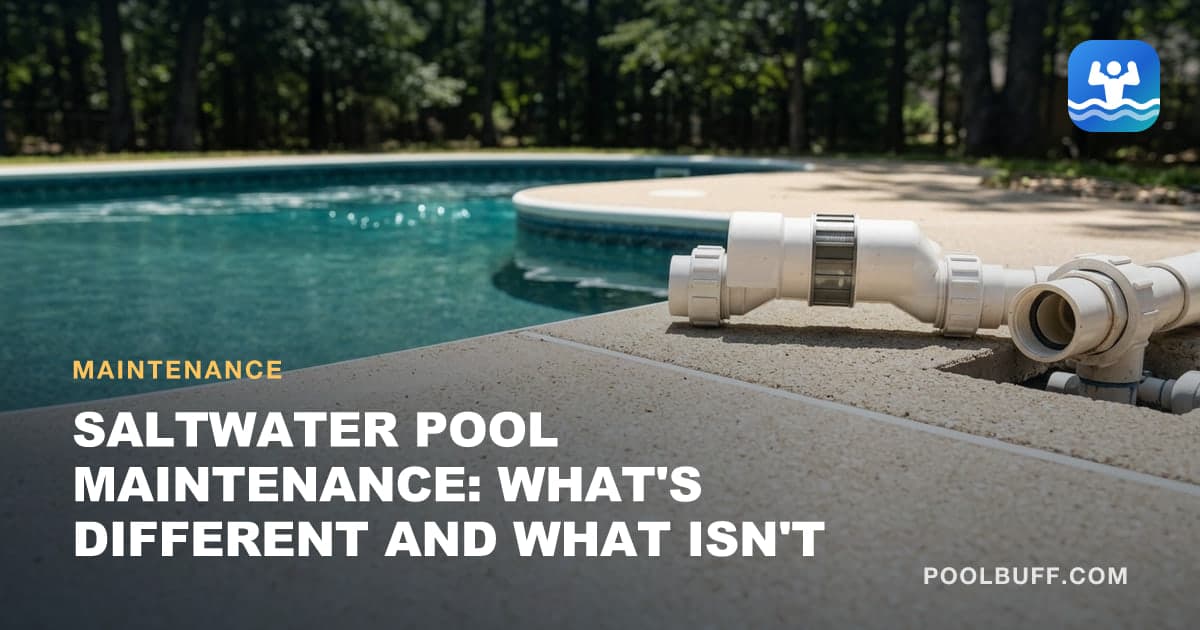
Let's clear up the big one first: a saltwater pool is a chlorine pool.
I've had this conversation on a lot of decks with people who bought a salt system specifically because they were told it was chlorine-free. It isn't. It generates chlorine continuously from dissolved salt. Same sanitizer, different delivery.
That's not a criticism. It's genuinely a nicer way to run a pool. It's just not what a lot of people think they bought.
Key takeaways
- Saltwater pools are chlorine pools. Anyone telling you otherwise is selling something.
- Salt level is typically 2,700-3,400 ppm, about a tenth of seawater. You can just barely taste it.
- Cells last 3-7 years and cost $450-$1,500 — aftermarket to genuine. Budget for it like a consumable.
- Salt pools push pH up constantly. Expect to add more acid than a liquid chlorine pool.
- Run CYA higher, around 60-80 ppm — it lets the cell work less for the same result.
What the cell does
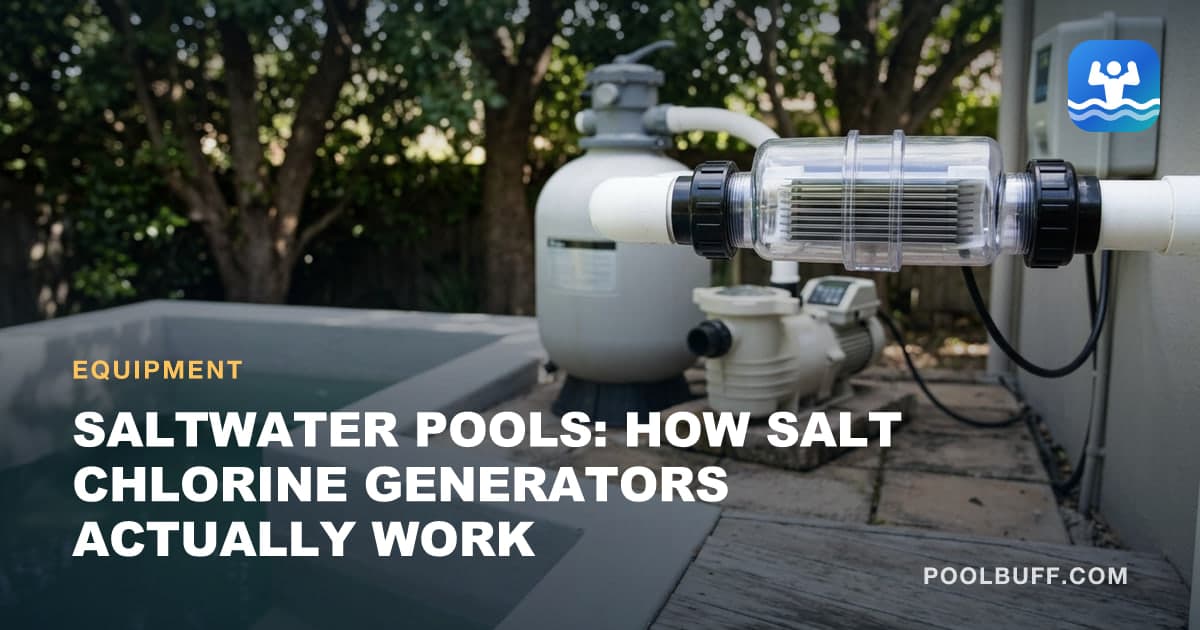
Salt in water is sodium chloride. Pass a current through it and electrolysis splits it, producing hypochlorous acid — which is exactly what you get when liquid chlorine dissolves in water.
The chlorine sanitizes, reacts with organics, and eventually reverts back to chloride. Which then goes through the cell again. It's a loop, which is why salt levels stay pretty stable and you're not constantly adding more.
You lose salt to splash-out, backwashing, rain overflow and draining. Not to evaporation, and not to the process itself.
What it's actually like to own
The good:
- Water genuinely feels softer. Less of the dry-skin, tight-hair feeling.
- No weekly chlorine handling. No jugs, no storage, no burning a hole in your shorts.
- Chlorine level is steadier because it's produced continuously rather than in spikes.
- Chemical cost drops noticeably — salt is $8–$12 a bag and you add it a couple of times a year.
The less good:
- pH climbs constantly. Hydrogen gas from the cell aerates the water at the return, which drives off carbon dioxide and pushes pH up. You'll add acid regularly. This is normal, not a fault.
- Cells are consumables. $450–$1,500 every three to seven years — the Pentair IntelliChlor IC40, Hayward T-Cell-15 and Jandy AquaPure are the ones most systems take.
- Salt is mildly corrosive over time to natural stone, untreated metal and some older heater exchangers.
- Cold water kills output. Cells stop entirely at a threshold that is the manufacturer's rather than a rule of thumb — 50°F on a Hayward, 52 on a Pentair, 60 on a Jandy — so in a shoulder season you'll be back to liquid chlorine.
Getting the setup right
Salt level: 2,700–3,400 ppm typically, but check your specific unit — and check it properly, because the spread between brands is wider than that range suggests. Pentair's own manual for the IntelliChlor asks for 3,600 ppm, which is above the top of the usual quoted range. Hayward's AquaRite S3 spreads it further again: the base unit's manual says the cell makes chlorine anywhere from 1,200 to 8,000 ppm with 3,200 optimal, while its own water chemistry table asks for 2,700 to 3,400, and the S3 Omni adds a Low Salt mode that runs at 1,200 to 1,800. Hayward's AquaRite 100 accepts anything from 1,500 to 4,500 ppm, and it has no salt readout at all, so a test kit is the only number you get. Too low and output drops; too high and you'll get a fault code and accelerate cell wear.
CYA higher than usual: 60–80 ppm rather than 30–50. Sounds counterintuitive, but the extra stabilizer protects the chlorine your cell is making, which means the cell runs at a lower output percentage, which means it lasts longer. This is one of the most useful salt pool adjustments and hardly anyone does it.
Alkalinity at the low end: 70–80 ppm. Less buffer means less carbonate for the CO₂ to escape from, so pH climbs slower and you buy less acid.
Run time over output percentage. If chlorine's low, the instinct is to turn the output up. Better move is usually more pump hours at lower output — the cell only makes chlorine while water's flowing through it, and running at 100% is what shortens cell life. When one does finally need replacing, our salt cell picks cover the current model for each major system.
Go deeperWhy CYA runs higher on a salt poolThe stabilizer relationship, and why it extends cell life.The week-to-week routine is covered in saltwater pool maintenance.
Cell care
Inspect it every few months. Kill the power, unplug the cell, and look inside at the plates. Clean plates are dark gray. White crusty deposits are calcium scale.
Clean scale with dilute acid, briefly and carefully — aggressive cleaning kills a cell faster than the scale would have. The full procedure is on the troubleshooting page, along with how to tell scale from a worn-out cell, which is the distinction that decides whether you are cleaning something or replacing it.
Better still, don't let it scale. Scale is a chemistry problem. Keep pH in range and calcium hardness sensible, and many cells go their whole life needing only occasional rinsing. Self-cleaning cells reverse polarity to shed scale, which helps but doesn't eliminate the need to look.
Expect 3–7 years. Track the install date. When output drops and cleaning doesn't restore it, the plate coating is spent and no amount of acid brings it back.
Output percentage, and why it is not a dose
The setting people misread most often on the panel.
The output percentage is not a strength. It is a duty cycle — the share of the time the cell is energized while the pump is running. Set to 50%, the cell produces at full rate for half of every cycle and nothing for the other half.
That has one consequence that trips everyone up: output and pump run time multiply. A cell at 60% running eight hours makes roughly the same chlorine as the same cell at 40% running twelve. Cut your pump schedule to save electricity without raising output and you have cut your chlorine production by the same proportion, which is one of the most common ways a salt pool quietly slips behind in July.
The practical habit is to change one at a time. If chlorine is low, work out whether you are short on run time or short on output before adjusting either. And if you find yourself pushing output above about 80% to keep up, the answer is usually more pump hours, a check on cyanuric acid, or a cell that is undersized — not a higher setting, which mostly just wears the plates.
The corrosion question
At 3,000 ppm, salt is mild — about a tenth of seawater. But it's not nothing over ten years.
Natural stone coping is the main casualty. Travertine and limestone can spall and pit where splash-out evaporates and leaves salt behind. Rinse the coping with fresh water regularly, especially in hot dry climates. Sealing helps.
Metal fixtures — ladders, rails, light rings — want to be quality stainless. Cheap fittings will show it.
Heaters should have a cupronickel heat exchanger rather than standard copper if you're running salt. If you're adding a salt system to a pool with an older heater, check what's in it.
Concrete deck and shell are fine. The stone-and-metal worry is real; the structural worry isn't.
Is it worth it?
| Salt systemMy default | Liquid chlorine | |
|---|---|---|
| Upfront cost | $1,200-$2,500 installed | $0 |
| Annual chemical cost | $100-$250 (salt + acid) | $400-$900 |
| Cell replacement | $450-$1,500 every 3-7 yrs | None |
| Weekly effort | Test and adjust pH | Test and dose chlorine |
| Water feel | Noticeably softer | Standard |
| Cold weather | Stops producing below ~60°F | Works year-round |
If you're on the fence: the honest reason to go salt is that the water is more pleasant to swim in and you stop handling chlorine jugs. The financial case is real but modest. If you do go salt, every salt system with a page here is listed with its parts and manuals.
Go deeperHow much salt to addPounds and bags for your volume, or gallons to swap if you have overshot. Go deeperWhat converting actually costsInstalled price, the cell replacement nobody budgets for, and the honest payback math.Frequently asked questions
Is a saltwater pool chlorine free?
No. A salt chlorine generator makes chlorine from dissolved salt by electrolysis, so the water contains chlorine exactly like any other chlorine pool. The difference is that it's generated continuously at a low level rather than dosed in batches, which is why the water often feels gentler.
How much salt does a saltwater pool need?
Typically 2,700-3,400 ppm depending on the manufacturer, which is roughly a tenth of seawater. Check your specific unit's target. Salt doesn't evaporate, so you only add more after splash-out, backwashing, heavy rain overflow or a partial drain.
How long does a salt cell last?
Three to seven years, and how you run it matters more than the brand. A cell running at 100% output all season wears out much faster than one at 50%. If you're constantly turning the output up, the real fix is usually longer pump run time or a higher CYA level, not more output.
Why does my saltwater pool have high pH?
It's inherent to how the cell works. Electrolysis produces hydrogen gas that aerates the water at the return, driving off carbon dioxide and pushing pH up. It's not a fault. Run total alkalinity toward the lower end, 70-80 ppm, so pH has less to climb on, and expect regular acid additions.
Are saltwater pools cheaper to run?
On chemicals, usually yes — salt is cheap and you're not buying chlorine weekly. Factor in the cell replacement every few years and the extra acid, and the saving is real but more modest than the sales pitch. Most owners choose salt for how the water feels rather than the running cost.
Will salt damage my pool or equipment?
At 3,000 ppm it's mild, but it's still corrosive over time to some materials. Natural stone coping can spall, untreated metal fixtures corrode, and older heaters with standard copper exchangers wear faster. Rinse stone coping regularly and specify a cupronickel heat exchanger if you're on salt.