Pentair · IntelliChlor
Pentair IntelliChlor
Pentair's salt cell — which model your pool needs, and the salt level its own manual disagrees with itself about.
Superseded. Replaced by the IntelliChlor PLUS and LT, which Pentair names as the recommended replacement. Everything on this page still applies to the units already installed.
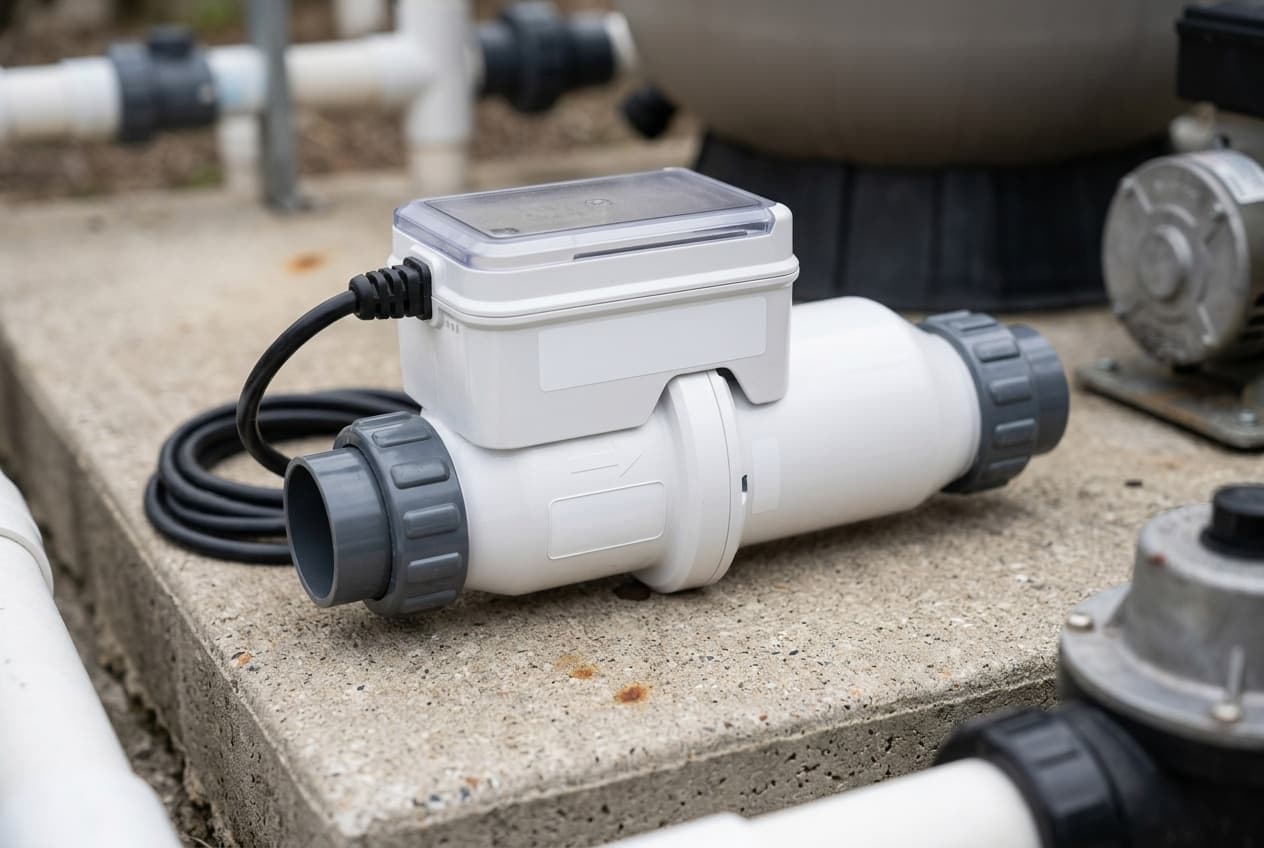
Two different product lines carry the IntelliChlor name, and the cells do not swap between them.
IntelliChlor IC15, IC20, IC40 and IC60 is the long-running line, and the one this page is mostly about. The cell plumbs inline and — on everything except the IC15 — runs off a separate PC100 power center.
IntelliChlor PLUS and LT is the newer line: PLUS30, PLUS40, PLUS60, LT15 and LT25, with their own controller assemblies and their own cell numbers in the 5237xx range. They share the union kit and the PC100 with the old line. The PLUS40 and PLUS60 are the same length as this cell; the shorter LT15, LT25 and PLUS30 come with a retrofit adapter, 523101, to fill plumbing cut for an IntelliChlor.
So "an IntelliChlor cell" is not a thing you can order. The model on the label is.
Sizing it, and why bigger is the normal answer
Pentair rates each cell two ways, and the second one is the useful one:
- IC15 — 15,000 gallons, 0.60 lb of chlorine per 24 hours
- IC20 — 20,000 gallons, 0.70 lb per 24 hours
- IC40 — 40,000 gallons, 1.40 lb per 24 hours
- IC60 — 60,000 gallons, 2.0 lb per 24 hours
Those pound figures assume 24 hours of continuous pump run time, which nobody does. Run eight hours and you get a third of it.
That is the whole argument for fitting a cell rated well above your pool. An IC40 on a 20,000 gallon pool is not oversized — it is a cell that will hold the pool at a lower output percentage, which is the setting that decides how long the cell lasts. Cells wear by generating, so the same chlorine made at 40% output costs less cell life than at 90%. The extra money at purchase buys years at the other end.
The salt calculator works out what to add to reach a target, and the wider salt system guide covers the trade-offs of going salt at all.
Pentair's manual disagrees with itself about salt
This one is worth knowing because it explains why owners get contradictory advice, and the contradiction is inside a single Pentair document.
The English water chemistry table in the IntelliChlor manual gives 3,600 to 4,500 ppm, ideal 3,600. The Spanish table on a later page of the same manual gives 3,000 to 4,500 ppm, ideal 3,400. Same document, P/N 520589 Rev. R.
Meanwhile the cell's own salt LEDs describe a third band: green for 2,800 to 4,500, red below 2,800, and the cell shuts off entirely below 2,600 ppm.
For a US owner reading the English section, 3,600 ppm is the number to aim at — and it is higher than the 2,700 to 3,400 range quoted for salt systems generally, including elsewhere on this site. If your cell is Pentair, use Pentair's figure rather than the general one.
Two practical notes from the same manual. The cell's salt reading is accurate to ±500 ppm, so it is a guide rather than a test kit. And after adding salt, run the pump 24 hours before testing — readings taken before the salt has dispersed are meaningless and are the usual reason people overshoot.
It stops making chlorine every winter, on purpose
The temperature sensor switches the cell off below 52°F, plus or minus 3°F, lights the COLD WATER indicator, and produces nothing until the water warms.
This is protection, not a fault. Generating in cold water damages the cell. But it catches people out every spring and fall: the pool is open, the pump is running, the cell shows a light, and chlorine is not appearing. In shoulder season, a salt pool needs liquid chlorine — the cell is not going to do it, and no setting will override the cutoff.
It also means a cold-water light showing in July is a real fault, and the temperature sensor lives in the same assembly as the flow switch, which is the part to replace.
Cyanuric acid: what Pentair says, and what this site says
Worth setting out plainly, because the two differ and the difference is deliberate rather than an error on either side.
Pentair's manual says to keep cyanuric acid between 30 and 50 ppm when using an IntelliChlor. That is the manufacturer's instruction for this cell, and if warranty conversations matter to you, it is the number in writing.
This site's general salt guidance suggests 60 to 80 ppm on a salt pool, on the reasoning that more stabilizer protects the chlorine the cell makes, so the cell runs at a lower output percentage and lasts longer. That reasoning is sound and widely used, and it is not what Pentair prints.
Both positions are defensible. What is not defensible is following one without knowing the other exists, so: the manufacturer says 30 to 50, the longevity argument says higher, and the trade is cell life against staying inside the printed spec. Do not use cyanuric acid at all in an indoor pool — on that, there is no disagreement.
Fit it in the right place, and run the dummy cell first
Two installation rules from the manual that are easy to get wrong and expensive to fix.
At least 5 feet from the inside wall of the pool, which is an electrical safety requirement rather than a plumbing preference. And at least 3 feet downstream of the heater outlet, because water leaving a heater is hotter than the cell is built to sit in.
On a new pool, fit the pass-through cell, 520588, for the first thirty days. It completes the plumbing and generates nothing, so plaster dust and construction debris go past the cell rather than through its blades. The real cell goes in afterward. People skip this because the cell they paid for is sitting in a box on the pad, and it is a costly thirty days to save.
When output drops, check three things before buying a cell
The cell is the expensive part, and it is not usually the first thing that has failed.
The usage hours meter, which is built into the unit and reports lifetime hours. A cell at the end of its service life and a cell that is merely scaled look identical from the deck, and the meter tells them apart.
Scale on the blades. The cell self-cleans by reversing its polarity on a cycle, which limits calcium buildup rather than preventing it. On hard water it still needs an acid clean by hand, and the kit — 520670 — is a cap that lets you stand the cell in solution. Wear gloves and eye protection, add acid to water and never the reverse.
The flow and temperature switch. One assembly, both sensors, and the single most common thing that stops a healthy cell working. Pentair publishes a replacement guide for it, and the kit is a fraction of a cell.
If all three check out and the salt is genuinely at 3,600, then it is the cell.
Which model do you have?
The model number is on the salt cell label. Everything else in the range is shared — these are the parts that change with it.
| Model | SKU | Rated pool size | Chlorine per 24 hr | Power | Note |
|---|---|---|---|---|---|
| IC15 | 520888 | 15,000 gal | 0.60 lb | Own supply, included | Rated to 15,000 gallons, 0.60 lb of chlorine per 24 hours of run time. The odd one out: it runs off its own power supply rather than the PC100 power center, and that supply ships with the cell. |
| IC20 | 520554 | 20,000 gal | 0.70 lb | PC100 power center | Rated to 20,000 gallons, 0.70 lb per 24 hours. Needs a PC100 power center, which is sold separately. |
| IC40 | 520555 | 40,000 gal | 1.40 lb | PC100 power center | Rated to 40,000 gallons, 1.40 lb per 24 hours, and the size most often sold — usually onto pools well under 40,000 gallons, which is the right instinct. See the sizing note below. |
| IC60 | 521105 | 60,000 gal | 2.0 lb | PC100 power center | Rated to 60,000 gallons, 2.0 lb per 24 hours. The largest residential cell, and the one to fit on a big pool or a heavily used one rather than on a normal pool for longevity alone. The English table in Pentair's manual prints this as 520105; its Spanish table, its product page and its transition sheet all give 521105, which is the number to order. |
Pentair IntelliChlor parts, and what goes wrong
Read off the manufacturer’s parts list and checked before it ships. Open a row for what a bad one actually does — or start from the symptom and work down, which is the cheaper order.
What is it doing?
The consumable, and most of what an IntelliChlor costs. Check the built-in usage hours meter before deciding a cell is dead — it reports lifetime hours, and a cell near the end of its life is a different problem from one that is scaled or reading low on salt.
Live pricing arrives when the retailer programs are approved.
One assembly carries both the flow sensor and the temperature sensor, so a single failure can present as either no flow or a stuck cold-water lockout. This is the repair that saves a cell purchase, and Pentair publishes a dedicated guide for it. The kit includes four watertight splice connectors because the old switch is cut out rather than unplugged.
Live pricing arrives when the retailer programs are approved.
Two o-rings, two couplers and two nuts. The cell comes in and out of the plumbing every time it is cleaned or replaced, so these get handled far more than a normal union and the o-rings are what eventually weep. Cheap, and worth having on the shelf before the cell is out.
Live pricing arrives when the retailer programs are approved.
Supplies power and carries the communication to and from the cell, for the IC20, IC40 and IC60. Sold separately from the cell, which surprises people replacing a whole system. The IC15 does not use it — it has its own supply.
Live pricing arrives when the retailer programs are approved.
A dummy body that completes the plumbing without generating anything. Pentair recommends running it for the first thirty days on a new pool so plaster dust and construction debris go past rather than through the cell's blades. Fitting the real cell on day one is a common and expensive mistake.
Live pricing arrives when the retailer programs are approved.
A cap, o-ring and washer that seal one end of the cell so a diluted acid solution can be poured in and left to stand against the blades. The cell self-cleans by reversing polarity, which limits scale rather than preventing it — on hard water it still needs doing by hand.
Live pricing arrives when the retailer programs are approved.
The spacer that goes in with an LT15, LT25 or PLUS30 when one replaces this cell. Those three are the length of Pentair's iChlor, shorter than an IntelliChlor, so the adapter fills the gap in the plumbing; Pentair supplies it with each. The PLUS40 and PLUS60 are the same length as the IntelliChlor and need none, and Pentair gives both lines the same unions and threads.
Live pricing arrives when the retailer programs are approved.
If you are doing the job anyway
These get replaced together. Doing them in one pass costs a few dollars more and saves taking the same thing apart twice.
Cell replacement, IC40
The cell comes out through the unions, and the o-rings in that kit have been handled every time the cell was ever cleaned. Doing them together costs a few dollars and avoids finding the weep after the new cell is in and the pump is running.
- IC40 cell520555
- Union kit, two520595
It stopped producing
Before buying a cell, rule out the two things that stop a healthy one working: the flow and temperature switch, and scale on the blades. Between them they account for most no-output calls, and together they cost a fraction of a cell.
- Flow and temperature switch kit520736
- Acid cleaning kit520670
New pool start-up
Thirty days of plaster dust goes through the pass-through cell instead of the real one, and the unions get fitted once. Pentair recommends exactly this sequence and people skip it because the cell is sitting in the box.
- Pass-through cell520588
- Union kit, two520595
Pentair IntelliChlor manuals and documentation
Hosted by the manufacturer. These open on Pentair’s own servers, so they stay current.
- IntelliChlor product page — the current order numbers, US and Canadianspec
- Installation and user's guide, IC15 / IC20 / IC40 / IC60manual
- Power center installation guide, IC20 / IC40 / IC60manual
- Flow and temperature switch replacement kit guideguide
- EasyTouch PL4 and PSL4 replacement parts — the IntelliChlor power cablediagram
- IntelliChlor PLUS and LT guide, with the newer parts listmanual
Pentair IntelliChlor warranty
2 years parts
Two years for an IntelliChlor without a power center, which Pentair also exempts from its professional-installation requirement. The newer cells are measured in hours as well: an IntelliChlor Plus runs three years or 10,000 hours, whichever comes first, and an IntelliChlor LT two years or 6,000. IntelliChlor is a Pentair TradeGrade product, so where it was bought decides the coverage. Through a dealer it carries the full product warranty; the EC-prefixed item numbers are the online-sale versions, and Pentair's warranty page puts e-commerce products on one year, parts only, with labor not covered on internet purchases. A salt cell is a consumable with a life measured in years, so the gap matters more here than on most equipment — and the cell is the expensive part.
Manufacturer’s termsPentair IntelliChlor complete parts list
Every part on the manufacturer’s exploded diagram, in their numbering. Marked rows are the ones covered above with a symptom and a diagnosis.
24 parts
| No. | Part | Description |
|---|---|---|
| — | 520888 | IC15 cell, with power supply |
| — | 520554 | IC20 cell |
| — | 520555 | IC40 cell what goes wrong |
| — | 521105 | IC60 cell |
| 5 | 520556 | PC100 power center kit — IC20, IC40 and IC60 what goes wrong |
| 4 | 520595 | Union kit, 2 off — o-rings, couplers and nuts what goes wrong |
| — | 520736 | Flow and temperature switch replacement kit what goes wrong |
| — | 520588 | Pass-through cell — new pool start-up, and spacer for PLUS40 and PLUS60 what goes wrong |
| — | 520670 | Acid cleaning kit — cap, o-ring and washer what goes wrong |
| — | 520724 | Power cable for IntelliChlor SCG systems |
| 1 | 523770 | Controller assembly, IntelliChlor PLUS |
| 1 | 523775 | Controller assembly, IntelliChlor LT |
| 2 | 523764 | Cell assembly, PLUS30 |
| 2 | 523765 | Cell assembly, PLUS40 |
| 2 | 523827 | Cell assembly, PLUS60 |
| 2 | 523767 | Cell assembly, LT15 |
| 2 | 523768 | Cell assembly, LT25 |
| 3 | 523769 | Sensor module kit, PLUS and LT |
| 6 | 523753 | Power pack, LT15 |
| 7 | 523103 | Acid cleaning kit, PLUS and LT |
| 8 | 523101 | Retrofit adapter, LT15, LT25 and PLUS30 what goes wrong |
| — | 523102 | Spacer cell, LT15, LT25 and PLUS30 |
| — | 523216 | PC100 cover detection board |
| — | 523759 | Accessory kit — controller cover, retaining clip, sensor module screws and o-ring |