Pentair · IntelliChem
Pentair IntelliChem
Pentair's pH and ORP controller: the three kits, why it stops feeding chlorine above pH 7.8, the sensor care it needs, and where its documents disagree.
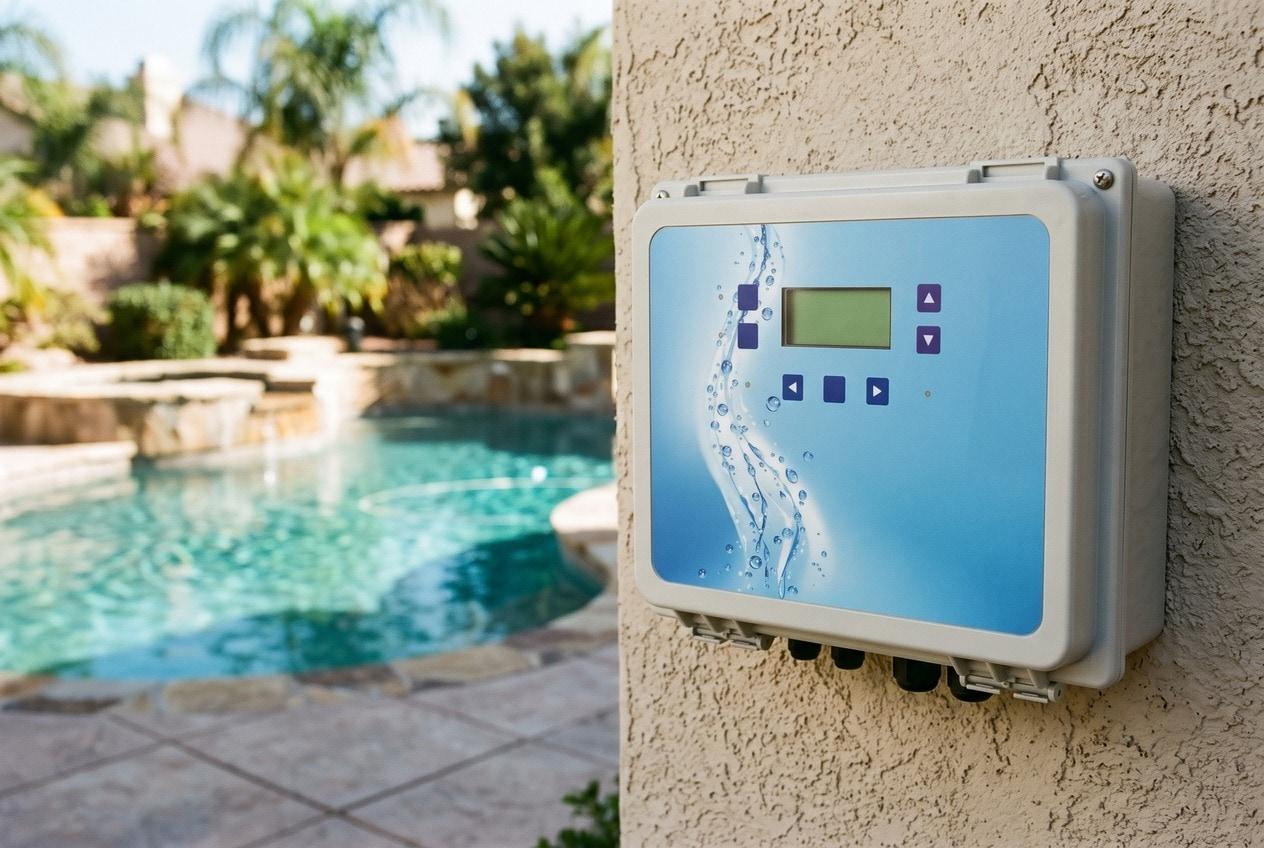
IntelliChem is Pentair's pH and ORP controller. Water from the filter line runs through a small flow cell, where two sensors read the pH and the ORP, a measure of how hard the chlorine is working. The controller feeds acid, or CO2, to hold the pH, and liquid chlorine or bromine to hold the ORP. With a salt system, it can tell an IntelliChlor cell when to make chlorine instead. It works on its own or through EasyTouch, IntelliTouch and SunTouch, and Pentair's page lists it as current, through dealers.
The automation guide covers where a chemistry controller fits in a whole system.
Three kits
- 521357: the controller, flow cell and sensors, with no tanks.
- 522621: the same, with a 4-gallon acid tank and a Stenner pump mounted on it.
- 522622: both an acid tank and a chlorine tank, each with its own pump.
Pentair added the tank-mounted pumps in 2016. Older controllers can take them with two upgrade kits: 522474 puts a pump on an older container, and 522478Z adds the board the pumps plug into.
Balance the water first
The controller only reads pH and ORP. It doesn't measure alkalinity, calcium or stabilizer, so the manual says to test and balance those by hand before you start. You enter them for its saturation index, which checks whether the water is scaling or corrosive. The manual's targets, also printed on the faceplate:
- pH 7.2 to 7.6
- ORP 650 to 750 mV
- Total alkalinity 80 to 120 ppm
- Calcium hardness 200 to 500 ppm
- Cyanuric acid, the stabilizer, under 30 ppm
Keep testing by hand. The manual says to check the display for alarms every day and to test pH and chlorine with your own kit now and then. A dirty, worn or broken sensor reads wrong, and the controller doses to the wrong reading.
Why it stops feeding chlorine
Above pH 7.8, IntelliChem stops feeding chlorine. That's the pH lockout, adjustable from 7.7 to 8.2. The manual's reasoning: above 7.8, the ORP reading is suppressed, so it can't be trusted to dose by. Bringing the pH down raises the ORP by itself. So when the chlorine seems to have stopped, look at the pH, and the acid supply, first.
It holds back near the set point, too. On the default Low sensitivity, it only gives a full pH dose when the reading is 0.5 or more from the set point. Stuck 0.3 away, it's only giving three-fifths of a dose. The manual's fix is High sensitivity, a full dose from 0.2 away, or Off. A bigger dose, a higher daily limit and a shorter mixing time do the same thing.
An ORP overshoot can be stabilizer. The manual says cyanuric acid holds the ORP down in sunlight and releases chlorine at night, so an overshoot may be nothing more than that. A dose too big for its mixing time causes one too.
Calibrating it
Pentair calls calibration a tweak. For pH, take several readings with a test kit, average them, and tweak the controller's reading by up to 0.3 to match. For ORP, get the pH to its set point first, and keep the chlorine above 1.0 ppm, then tweak by up to 50 mV.
Flow, and the chemicals
Nothing feeds without flow. The flow switch in the flow cell is a safety device. Never bypass it: feeding acid and chlorine into still water can make dangerous gas. After the pump starts, the controller waits out a flow delay before it reads, because the manual says the water needs at least 15 minutes to settle. A service tech can skip the wait by holding the Up button for 3 seconds.
Never mix chlorine and muriatic acid. Where the two injection points sit close together, the Dose Priority setting makes it feed one at a time. Pentair recommends diluting full-strength muriatic acid 1:1, always adding acid to water, never water to acid, and storing it below 80°F.
Installing it
The manual wants a licensed electrician or pool professional to install it. The points an owner can check:
- The controller is at least 10 feet from the pool or spa wall, on a solid vertical surface, away from chemical fumes and below 110°F.
- Its power comes from the pump side of the filter pump relay, so it can only feed with the pump running, on a dedicated GFCI circuit.
- The flow cell is within 2 feet of the controller, mounted vertically, out of direct sun. It takes no more than 25 psi.
- The water to the flow cell comes from after the filter and before the heater, and any solar valve. It returns after the heater. Don't put the return before the pump: the manual says the vacuum can damage the sensors.
- Chemicals inject into the return line after all the equipment. Acid never goes into the flow cell.
- The tanks are within 10 feet of the controller and of the return line.
- If the pad sits below the pool's water level, the manual wants a check valve after the heater, or a Hartford loop.
Looking after the sensors
The manual says the sensors may need cleaning weekly or monthly, depending on swimmers. Turn the controller off at its GFCI, unscrew the sensors, and scrub the tip and the white ring at the bottom with a soft toothbrush and dish detergent. A pH sensor that's still slow gets a 10 to 20 second swirl in 5 parts water to 1 part muriatic acid. Rinse, check each sensor's O-ring, and hand-tighten them back in.
- Keep them wet. Out of the flow cell for more than an hour, they go in their storage caps, or in a cup of clean water.
- Never swap the caps. The manual says the solution in one destroys the other kind of sensor. The pH sensor's cable has blue bands, the ORP sensor's red.
- Never polish the glass, drop them, or let them freeze. Breakage isn't covered by the warranty.
Pump tubes: Pentair's catalog recommends replacing the tank pumps' tubes every 6 months. The internal pump head: the manual says every year.
Winter
Take the sensors out and store them where they won't freeze, and drain the flow cell and its plumbing. Pentair sells a winterizing kit, 521622.
Troubleshooting, in the manual's order
- Run the meter self-test.
- Run the open-probe test.
- Clear the pH and ORP tweaks.
- Clean the sensors.
- Check the chemicals and the feed system.
- Have the water tested for stabilizer and alkalinity, check the saturation index, and balance it.
- Replace the sensors.
- Start again from the top.
Where you buy it
Pentair sells all three kits through dealers, and they're on its TradeGrade list. Pentair's warranty page gives all its automation equipment one year, and the manual says the same of the controller. The sensors have their own one-year warranty, and Pentair counts them as consumables.
Where Pentair's documents disagree
- The pump head. The manual's yearly-replacement line says 521384Z. Its parts list and drawing say 521348Z.
- The flow jar and its O-ring. The manual calls 754000340 the O-ring and 754000350 the jar. The catalog says the opposite.
- The ORP sensitivity. The manual's menu map gives a full dose at 50 mV below the set point on Low and 20 on High. Its ORP menu page says 30 and 15.
- The ORP alarm delays. The defaults table says 5 minutes. The menu map says an hour for high and two for low.
- The power-on delay. The defaults table says 14 minutes. The menu map says 15.
- The relay rating. Five amps either way, but at 250 VAC on one page and 120 VAC on another.
- Stabilizer with an IntelliChlor. This manual says under 30 ppm. The IntelliChlor's own manual, as the IntelliChlor page sets out, says 30 to 50.
- The parts sheet. The one Pentair's page links is the commercial IntelliChem's, with a different circuit board, 523004Z. The residential parts and prices here come from the 2025-2026 catalog.
Which model do you have?
The model number is on the chemical controller label. Everything else in the range is shared — these are the parts that change with it.
| Model | SKU | Acid tank | Chlorine tank |
|---|---|---|---|
| Controller only | 521357 | Not included | Not included |
Note on Controller only: The controller, flow cell and sensors, with no tanks. The manual calls this configuration NSF approved. | |||
| With acid tank | 522621 | 4 gal. with pump | Not included |
Note on With acid tank: Adds a 4 gal. acid tank with a Stenner 50 GPD pump mounted on it, which plugs into the controller's board. | |||
| With acid and chlorine tanks | 522622 | 4 gal. with pump | 4 gal. with pump |
Note on With acid and chlorine tanks: Adds both tanks, each with its own Stenner 50 GPD pump. | |||
Pentair IntelliChem parts, and what goes wrong
Read off the manufacturer’s parts list and checked before it ships. Open a row for what a bad one actually does — or start from the symptom and work down, which is the cheaper order.
What is it doing?
The sensor with blue bands on its cable. The manual says slow response, frequent recalibration and inconsistent readings mean it needs cleaning: soft toothbrush and dish detergent on the tip and the white ring, then, for the pH sensor only, a 10 to 20 second swirl in 5 parts water to 1 part muriatic acid. Never rub the glass hard or polish it. If a clean sensor still won't settle, replace it. $235.77 US list, with its own one-year warranty.
The sensor with red bands on its cable, its tip a precious metal such as platinum or gold. Clean it like the pH sensor, without the acid dip. Calibrate it only with the pH at its set point and the chlorine above 1.0 ppm. The manual says an overshoot can simply be stabilizer, which holds the ORP down in the sun and releases chlorine at night. $332.02 US list, with its own one-year warranty.
The peristaltic tubes in the Stenner pumps on the 522621 and 522622 tanks. Pentair's catalog recommends replacing them every 6 months. $89.54 US list; the repair kit for the pump itself is 522386 at $183.73.
The flow cell's switch: closed means flow, open means none, and with no flow nothing feeds. Before blaming it, the manual's checklist is the pump on, the valves set right and enough water reaching the flow cell. Never run the controller with the switch bypassed: it's the safety device that keeps chemicals from feeding into still water. Priced on request; the magnet alone is 754000410 at $27.49.
Run the self-test first, from Configuration, Diagnostics. It checks the display, lights, buttons, flow switch input, doser motors, relays, the RS-485 link and the meter, and a fail gives a code: 01H display, 02H backlight, 04H lights, 08H buttons, 10H flow switch, 20H outputs, 40H RS-485 loopback, 80H meter. The test runs the dosing pumps, so make sure the tubing is safe first. $1,102.16 US list.
The controller takes its power from the pump side of the filter pump relay, so it's dark whenever the filter pump is off. Check that first, then the GFCI and the controller's own circuit breaker, 8520031Z at $71.95. $355.48 US list.
The manual says to replace it every year. With the power off at the breaker and the filter pump stopped, swap the outlet tube to the new head first, keeping the old tube pointing up so chemical doesn't spill, then the inlet tube, then the two screws. Its parts list and drawing give 521348Z; the bold line telling you to replace it yearly prints 521384Z.
If you are doing the job anyway
Numbers carry the Z the 2025-2026 catalog prints where it lists the part.
New sensors
Replacing the sensors is the last step on the manual's troubleshooting list, after cleaning them. Both sit in the same flow cell and carry the same one-year warranty.
- pH sensor522186
- ORP sensor522187
Pentair IntelliChem manuals and documentation
Hosted by the manufacturer. These open on Pentair’s own servers, so they stay current.
- IntelliChem water chemistry controller installation and user's guide (P/N 521363 Rev. L, 10/30/23)manual
- IntelliChem product page: the three kits, the tanks and the upgrade kits, dealer onlyspec
- Pentair Pool 2025-2026 product catalog, sanitizer parts: IntelliChem on pages 480 and 481, with US list pricesdiagram
- IntelliChem replacement parts sheet, the one Pentair's page links: it's the commercial controller'sdiagram
- IntelliChem firmware upgrade kit user's guidemanual
- Pentair pool and spa equipment warranty informationspec
Pentair IntelliChem warranty
1 year parts, Included when bought from a store, builder or service company and professionally installed labor
One year: Pentair's warranty table gives all automation equipment that term, and the manual says the same of the controller. The pH and ORP sensors carry their own one-year warranty, and the manual calls them and the pump head wear items, outside any extended coverage; Pentair's warranty page lists pH and ORP probes as consumables. The manual says sensor breakage isn't covered at all, and that a flow switch from another maker voids the warranty and the UL listing. All three kits are on Pentair's TradeGrade list, revised October 23, 2026. Bought online, even from an authorized online reseller, it's one year, parts only.
Manufacturer’s termsPentair IntelliChem complete parts list
Every part on the manufacturer’s exploded diagram, in their numbering. Marked rows are the ones covered above with a symptom and a diagnosis.
54 parts
| No. | Part | Description | Note |
|---|---|---|---|
| 1 | 521465Z | Top half: lid with overlay and wiring diagram | $510.05 US list |
| 2 | 521319Z | Controller circuit board what goes wrong | $1,102.16 US list |
| 3 | 8520031Z | Circuit breaker | $71.95 US list |
| 4 | 521348Z | Pump head with Jaco fitting, tube and screws what goes wrong | The manual; replace yearly |
| 4 | 521384Z | Pump head, as the manual's replace-yearly line prints it | The manual's parts list gives 521348Z |
| 5 | 521466Z | Jaco fitting | The manual |
| 6 | 521467Z | Enclosure mounting brackets | The manual |
| 7 | 521338Z | Pump motor | The manual |
| 8 | 521468Z | Strain relief kit | The manual |
| 9 | 521335Z | Transformer with mounting plate what goes wrong | $355.48 US list |
| — | 522478Z | Upgrade kit: board for tank-mounted pumps | For controllers older than the tank pumps. $87.46 US list |
| 1 | 522186 | pH sensor what goes wrong | One-year warranty. $235.77 US list |
| 2 | 522187 | ORP sensor what goes wrong | One-year warranty. $332.02 US list |
| 3 | 754000310 | Flow cell with flow switch | Priced on request |
| 4 | 521342Z | Controller parts bag | $437.51 US list |
| 5 | 754000440 | Flow switch with magnet what goes wrong | Priced on request |
| — | 754000410 | Magnet for flow switch | $27.49 US list |
| 5 | 523481 | Cap plug | The manual |
| 5a | 522623Z | Low flow switch, 3 ft. | The manual |
| 5b | 522624Z | Low flow switch, 10 ft. | The manual |
| 6 | 744000290 | Cable, pH sensor, 3 ft. | The manual |
| 7 | 744000360 | Cable, ORP sensor, 3 ft. | The manual |
| — | 744000280 | Cable, pH sensor, 10 ft. | Priced on request |
| — | 744000350 | Cable, ORP sensor, 10 ft. | Priced on request |
| 8 | 754000340 | O-ring for the flow jar, per the manual | The catalog calls 754000340 the jar |
| 9 | 754000350 | Flow jar, per the manual | The catalog calls 754000350 the O-ring |
| — | 522010Z | Inline strainer, 1/4 in. female NPT | $35.85 US list |
| — | 522347Z | Bypass saddle clamp | Two in the kit |
| — | 606000100Z | Fitting, 3/8 in. tube x 1/4 in. NPT | $7.36 US list |
| — | 620000040Z | Plug, 1/4 in. NPT | The manual |
| — | 622000080Z | Ball valve, 1/4 in. NPT | Three in the kit. $41.38 US list |
| — | R172032Z | Fitting, 3/8 in. tube to bypass clamp | $9.41 US list |
| — | R172033Z | Rubber gasket for bypass clamp | $4.04 US list |
| — | R172036Z | O-ring lubricant | $15.53 US list |
| — | 620000130Z | Nipple, 1/4 in. NPT | $3.17 US list. Printed 62000130Z in the manual's kit list |
| — | 521814 | Tubing, 3/8 in. black, 20 ft. | Priced on request |
| — | 522472 | Acid tank with tank-mounted pump | Priced on request |
| — | 522473 | Chlorine tank with tank-mounted pump | Priced on request |
| — | 521378 | Acid container, needs a separate pump | Priced on request |
| — | 521397 | Chlorine container, needs a separate pump | Priced on request |
| — | 522474 | Upgrade kit: pump for an older container | $455.54 US list |
| — | 522446 | Tubing, 1/4 in. black, for chemical injection, 100 ft. | Priced on request |
| 1 | 522386 | Repair kit for the tank-mounted pump | $183.73 US list |
| 2 | 522480 | Pump tubes for the tank-mounted pump, 2-pack what goes wrong | Replace every 6 months. $89.54 US list |
| 3 | 521895 | Kit: ball, spring and saddle clamp parts | Priced on request |
| 6 | 522513Z | Injection check valve | $51.79 US list |
| 7 | 521505 | Lid for acid container | $106.72 US list |
| 7 | 521506 | Lid for chlorine container | $106.72 US list |
| 8 | 521507 | O-ring for container lid, 5-pack | $127.05 US list |
| 9 | 521508 | Suction fitting, black | $50.78 US list |
| 10 | 521509 | Vent fitting, gray | $55.85 US list |
| — | 714000070 | CO2 kit with diffuser, solenoid and regulator | $1,717.38 US list, on the catalog's commercial IntelliChem page |
| — | 521622 | Winterizing kit | Priced on request |
| — | 521498 | Flash programming kit | Pentair's product page |