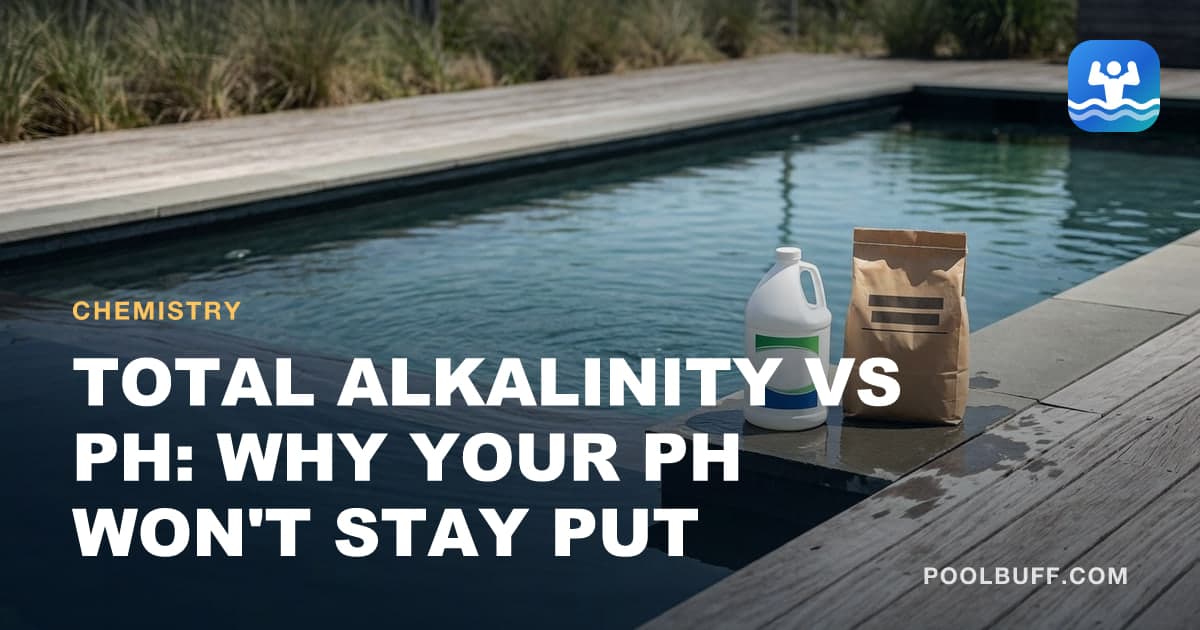
If you're adding acid to your pool every three days, stop. You don't have a pH problem.
You've got an alkalinity problem, and you're treating the symptom. It's a bit like taking painkillers for a stone in your shoe.
Key takeaways
- pH that won't stay put is almost always an alkalinity problem, not a pH problem.
- Baking soda raises alkalinity. Muriatic acid lowers both alkalinity and pH together.
- You can't lower alkalinity without lowering pH. The trick is acid, then aerate, then repeat.
- Salt pools and pools with water features drive pH up constantly. Run alkalinity at 70-80 so it has less to push against.
- Low alkalinity is more damaging than high. Water below 60 ppm gets aggressive and starts eating plaster and grout.
What alkalinity actually is
Forget the chemistry textbook version for a second.
Total alkalinity is how hard your water resists changing pH. That's it. High alkalinity, pH barely moves no matter what you throw at it. Low alkalinity, pH swings all over the place — you add a cup of acid and it drops half a point, then a rainstorm sends it back up.
Think of pH as a ball sitting in a bowl. Alkalinity is how deep the bowl is. Deep bowl, the ball stays put. Shallow bowl, it rolls around every time somebody bumps the table.
Which means the number you're actually managing is alkalinity. pH is the reading you watch to see whether you got alkalinity right.
The ranges, and when to break them
The book says 80–120 ppm. Real pools are more nuanced than that.
| Test | Target | Why it matters |
|---|---|---|
| General range | 70-120 ppm | Works for most pools most of the time. |
| pH keeps rising | 70-80 ppm | Salt pool, waterfall, spa spillover, or new plaster. Less buffer means less carbon dioxide to drive off, so pH climbs slower. |
| pH keeps falling | 100-120 ppm | Usually trichlor tablets, which are strongly acidic. More buffer absorbs more of that. |
| Vinyl liner pool | 80-120 ppm | No plaster to protect, but low alkalinity still corrodes metal wall panels and fittings. |
| Below 60 ppm | Fix it now | Aggressive water. It will etch plaster, wash out grout and corrode metal. This is the damaging direction. |
Raising it
Easy. Baking soda — sodium bicarbonate — about 1.5 lbs per 10,000 gallons to move alkalinity 10 ppm.
Buy it in a 13 lb bag from a pool store or a warehouse club. Don't pay pool-store prices for a branded box labeled "Alkalinity Increaser." It's the same chemical at four times the price. I've watched people pay $18 for two pounds of baking soda and it's hard to watch.
Broadcast it over the deep end with the pump running. It dissolves quickly, it won't hurt anything, and it bumps pH up slightly on the way.
Go deeperpH and alkalinity calculatorDoses for acid, bicarb and soda ash, scaled to your actual pool volume.Lowering it — the annoying one
Here's the part people get stuck on, and I understand why. It's genuinely counterintuitive.
Every acid lowers both alkalinity and pH. There's no product that lowers only alkalinity. So you can't just "add alkalinity reducer" and be done. If pH is the number actually bothering you, lowering pH on its own is a different job with a different technique.
The technique is this:
- 1
Add acid
10 minMuriatic acid, roughly 26 fl oz of 31.45% per 10,000 gallons per 10 ppm of alkalinity you want gone. Dilute into a bucket first — acid into water, never the reverse — and pour slowly into the deep end with the pump running.
Your pH will drop with it. Down to 7.0 or a bit below is fine and expected. Don't panic and don't chase it back up with soda ash, because that puts the alkalinity right back where you started.
- 2
Aerate
A few hours to overnightNow drive the pH back up without touching alkalinity. Aeration does that for free.
Point the return eyeballs up so they break the surface. Run a waterfall, a fountain, a spa spillover, a deck jet — anything that agitates water. If you've got nothing, an aerator that screws onto a return costs about $25 and works fine.
Carbon dioxide leaves the water, pH climbs, alkalinity stays where you put it.
- 3
Test, and go again
Repeat 2-3 timesWhen pH is back around 7.4–7.6, retest alkalinity. If it's still high, repeat.
A pool going from 180 ppm to 100 ppm usually takes two or three cycles over four or five days. That's normal. Anyone promising faster is selling you the same acid.
Why your pH climbs on its own
This one confuses everybody, and it's worth understanding because it changes what you do about it.
Anything that agitates the water surface drives carbon dioxide out. Less CO₂ in the water means higher pH. No chemicals involved.
The usual culprits:
- Salt chlorine generators. The cell produces hydrogen gas as a byproduct, which aerates the water at the return. Salt pools climb constantly. It's not a fault.
- Water features. Waterfalls, sheer descents, deck jets, bubblers. Beautiful, and they'll have you buying acid by the case.
- Spa spillovers running all day.
- New plaster, for roughly its first year. It leaches calcium hydroxide and pushes pH up hard. Expect to add a lot of acid that first season and don't assume something's broken.
- Returns pointed at the surface. Free fix — angle them down.
If your pH climbs constantly, the useful move isn't more acid. It's dropping alkalinity to the 70–80 range so there's less carbonate in the water for CO₂ to escape from. The pH climb slows down noticeably. If it still climbs after that, borates add a second buffer that can't gas off, at the price of a chemical that only leaves when you replace water.
The mistake that costs plaster
Low alkalinity is worse than high alkalinity, and people don't take it seriously enough.
Below about 60 ppm, water is aggressive. It's short on the minerals it wants, so it goes and gets them from whatever's available. On a plaster pool that's the plaster — you get etching, roughness, and a surface that felt fine at year four and feels like a cheese grater at year six.
On any pool, it's the grout, the metal fittings, the ladder anchors, and eventually the heat exchanger inside your heater. A copper heat exchanger in aggressive water can fail in three or four years instead of fifteen, and that's a $900–$1,800 part.
I've replaced heat exchangers on pools where the owner had been dutifully keeping pH at 7.5 for years and had never once tested alkalinity. pH was perfect. Water was still eating the heater.
Signs alkalinity is too low
Signs alkalinity is too high
Getting the order right
The reason alkalinity comes before pH in the balancing sequence is now hopefully obvious.
Set pH first in badly buffered water and it won't stay there. You'll be back with the acid jug in three days, and you'll assume you did something wrong.
Set alkalinity first and pH becomes something you check on the weekly round and adjust occasionally. That's the whole difference between fighting a pool and owning one.
For adjusting pH and alkalinity
- Check price
Taylor K-2006C test kit
Drop-count titration rather than color matching, and it tests CYA properly.
- Check price
pH increaser
100% soda ash, so you know exactly what you are adding.
Frequently asked questions
What is the ideal total alkalinity for a pool?
70-120 ppm for most pools. If your pH climbs constantly — salt pool, waterfall, spa spillover, aggressive returns — aim for the low end at 70-80 ppm. If pH keeps sinking instead, which happens on trichlor tablets, run higher at 100-120 ppm.
How do I raise total alkalinity?
Sodium bicarbonate, which is just baking soda. About 1.5 lbs per 10,000 gallons raises alkalinity roughly 10 ppm. Broadcast it over the deep end with the pump running. It nudges pH up a little too, which is usually welcome since low alkalinity and low pH tend to show up together.
How do I lower alkalinity without lowering pH?
You can't do it in one step — every acid lowers both. The standard method is to add acid, which drops alkalinity and pH, then aerate the water to bring pH back up without raising alkalinity. Repeat until alkalinity lands in range. Expect two or three cycles over several days.
Does high alkalinity cause cloudy water?
It can. High alkalinity plus high pH plus high calcium is the classic recipe for calcium carbonate coming out of solution, which shows up as cloudy water that no amount of filtering clears, and eventually as scale on the tile.
Why does my pH rise but my alkalinity stays the same?
Aeration. Anything that agitates the surface — waterfalls, fountains, spa spillovers, returns pointed up, salt cell gas bubbles — drives carbon dioxide out of the water. That raises pH without touching alkalinity. It's also the free way to raise pH when you want to.