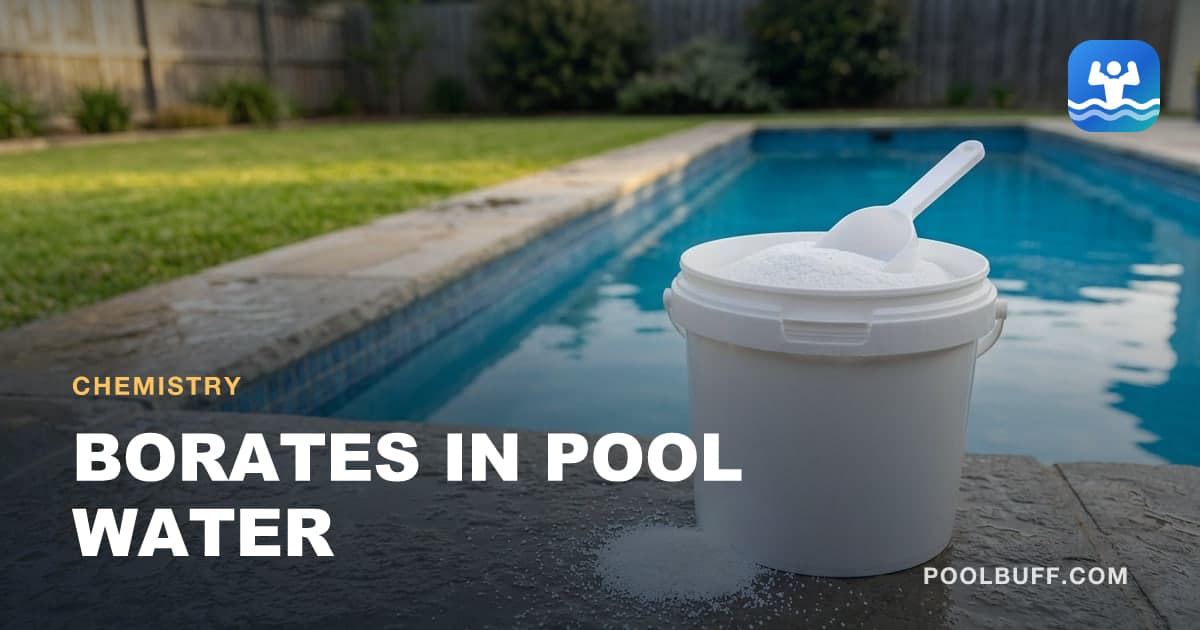
Borates are one of those products that pool stores love and forums argue about. The honest version sits in between. They do one thing well, they carry label claims that are softer than the marketing around them, and they have a catch that nobody mentions until you're adding acid for the third time in a day.
Key takeaways
- At pool pH, about 98% of the borate you add sits in the water as boric acid. That is what lets it hold pH down as it tries to rise.
- The borate products on pool store shelves are sodium tetraborate pentahydrate, and their labels put 2 lb per 1,000 gallons at about 35 ppm.
- Adding them pushes pH up. Both labels tell you to follow with acid, and ProTeam's amounts work out to converting nearly all of it to boric acid.
- They are registered to suppress algae, not to sanitize. BioGuard's own label says its product does not replace a weekly algaecide.
- Sunlight and chlorine do not use borates up. They leave with splash-out, backwashing and dilution, so the only way to lower them is to replace water.
What borates actually are
When you put any borate in a pool, you end up with boric acid. It's a very weak acid. PubChem gives its dissociation constant at 25°C as a pKa of 9.24, and that one number explains most of what borates do.
At a pH of 7.5, only about 1.8% of it is the borate ion. The other 98% sits in the water as boric acid, doing nothing much. But that share grows as pH climbs: about 3.5% at 7.8, and about 5.4% at 8.0. Every bit of boric acid that turns into borate releases hydrogen ions, which pulls pH back down. So the buffer engages harder the further pH tries to go.
The products sold for pools aren't boric acid, though. BioGuard's Algae Optimizer Plus and ProTeam's Supreme both list one active ingredient on their EPA labels: sodium tetraborate pentahydrate, 100%. That's a salt of boric acid, and it's alkaline, which matters in a minute.
A note on the numbers. When these labels say 35 ppm of borates, they mean 35 ppm of boron. BioGuard's label says 2 lb per 1,000 gallons gives about 35 ppm. Sodium tetraborate pentahydrate is 14.85% boron by weight, and 2 lb of it in 1,000 gallons is 240 mg/L of product, or 35.6 mg/L of boron. The label's number is boron.
What they do to pH
Your pH climbs for one main reason: carbon dioxide leaving the water. Waterfalls, spillovers, returns aimed at the surface and a salt cell's gas bubbles all speed it up. Total alkalinity is carbonate, and carbonate is exactly what that CO₂ comes out of.
Borates are a buffer that can't gas off. There's no boron version of CO₂ escaping at the surface. So in a pool with borates, the same aeration pushes pH up more slowly, because the boric acid gives up hydrogen ions to resist it.
Two things they don't do:
- They don't fix pH that's already high. A buffer resists change in both directions. If pH is at 8.0 when you add borates, bring it down with acid first, and expect the acid to take a little more than it used to.
- They don't replace running alkalinity low. The usual advice for constant pH climb, dropping alkalinity to 70 to 80 ppm, still works, and it works alongside borates rather than instead of them.
One thing borates add that nobody warns you about: a few ppm on your alkalinity reading. The borate ion present at pool pH titrates along with carbonate. At 50 ppm of borates, that's about 4 ppm at pH 7.5 and about 8 ppm at 7.8. It's small enough to ignore, but it's why your alkalinity may creep up a notch after treatment.
The catch: they push pH up on the way in
Sodium tetraborate is a base. ProTeam's safety data sheet gives a 3% solution of Supreme a pH of 9.3. Put 40 lb of that in a pool and pH jumps.
Both labels plan for it:
- BioGuard: add the dose in three parts, at least 8 hours apart. An hour after each one, bring pH back to 7.2 to 7.6. Don't add the next part until pH is back in range. The label says every 2 lb of product will take about 1 lb of pH decreaser.
- ProTeam: add the dose in two halves, at least 8 hours apart. For each pound of Supreme, the label calls for ¾ lb of sodium bisulfate or 10 oz of muriatic acid, mixed into a bucket of water first. After a turnover, adjust pH to 7.4 to 7.6 with an acid demand test.
ProTeam's 10 oz per pound isn't arbitrary. Converting a pound of sodium tetraborate pentahydrate all the way to boric acid takes about 114 g of hydrogen chloride, which is about 10.5 fl oz of 31.45% muriatic acid. The label is telling you to neutralize nearly all of it.
So budget the acid along with the borates. At ProTeam's rate, a 20,000-gallon pool dosed at 2 lb per 1,000 gallons is 40 lb of Supreme, and 40 × 10 = 400 fl oz of muriatic acid, a little over 3 gallons.
If that sounds like a lot of acid, it is. ProTeam sells Supreme Plus for exactly this reason. Its maker says there's no need to adjust pH afterward, though total alkalinity may rise slightly. The safety data sheet lists boron oxide at 40 to 50% and a trade-secret ingredient at 40 to 50%, and it names carbon dioxide as a decomposition product, which fits an alkalinity bump.
The algae claim, read off the label
Both products are EPA-registered pesticides, and that's where the algae claims come from. What the labels actually say is measured:
- BioGuard calls Optimizer Plus an algae suppressant and says it helps keep water clear. The same label also says it doesn't replace a weekly preventative algaecide.
- ProTeam says Supreme provides long-lasting algae suppression, controlling all types of algae found in pools. One of its optional label statements is that a registered sanitizer is required alongside it.
Neither is a sanitizer, and neither label says it is. Chlorine does the killing. If your pool goes green, the answer is still chlorine against your stabilizer level, not more borates.
Beyond algae, the labels carry softer claims: water that feels softer, improved clarity, reduced eye irritation. ProTeam's website goes further and says Supreme improves sanitizer efficiency 35 to 50%. That figure isn't on the EPA-accepted label, and ProTeam doesn't publish the data behind it. I'd treat the feel-of-the-water claims as real but subjective, and the percentage as marketing until someone shows the test.
How much to add
Start from your pool volume, and dose from the product's label rather than a forum post. The label rate on both products is 2 lb per 1,000 gallons, which lands at about 35 ppm in any size of pool. The acid column uses ProTeam's 10 oz of muriatic acid per pound:
| Pool size | Borate product at 2 lb per 1,000 gal | Muriatic acid to follow |
|---|---|---|
| 10,000 gallons | 20 lb | about 1.6 gallons |
| 15,000 gallons | 30 lb | about 2.3 gallons |
| 20,000 gallons | 40 lb | about 3.1 gallons |
| 30,000 gallons | 60 lb | about 4.7 gallons |
A few label rules that are easy to skip:
- Broadcast it over the surface with the pump running. BioGuard's label says not to add it through the skimmer or a dispensing device. Brush any that settles on the floor.
- Clean or backwash the filter and balance the water first. BioGuard's label starts there, and ProTeam's product page does too.
- Test within 10 days, BioGuard says, to see whether you reached the level you wanted. Then monthly.
ProTeam's website adds a heavier option, 3.5 lb per 1,000 gallons "for the softest water". By the same arithmetic that's about 62 ppm, above the 30 to 50 ppm its own label says to maintain. I'd stick with the label.
Boric acid and borax from the hardware store
Plenty of owners skip the pool products and use plain boric acid or laundry borax. Neither is labeled for pool use, so there are no directions to follow. You're doing your own math and your own pH correction.
It's the same boron, in different amounts per pound:
- Boric acid is 17.5% boron. For 50 ppm in 10,000 gallons that's about 24 lb, or about 14 lb for 30 ppm. It's a weak acid, so it barely moves pH on the way in.
- Borax is sodium tetraborate decahydrate, 11.3% boron. For 50 ppm in 10,000 gallons that's about 37 lb, or about 22 lb for 30 ppm. It raises pH the same way the pool products do, so budget acid.
Whichever you use, add it in stages, keep it out of the skimmer, and check the ingredients list says sodium tetraborate or boric acid and nothing else.
Testing borates
A standard drop kit doesn't test borates. Neither does a 7-way strip. You need a borate-specific test or a pool store that runs one.
The simplest is a strip. LaMotte's Insta-TEST borate strips, code 3017-G, read 0, 15, 30, 50 and 80 ppm. That scale is coarse, but the target range sits right on it, which is what matters. Dip for 5 seconds, don't shake off the water, and read after 15 seconds in daylight.
After opening a pool in spring, BioGuard's label says to run the circulation for 48 hours before sampling. Test the day after you add borates and you'll read water that hasn't mixed.
How long they last, and how to lower them
This is the part to think about before you add a single pound.
BioGuard's label says the product is stable in pool water and not degraded by sunlight. It leaves only through splash-out, backwashing and dilution from heavy rain. ProTeam's label says Supreme is lost only through filter backwash and splash-out. Chlorine doesn't consume it, and neither does algae.
That makes borates like cyanuric acid and salt: easy to add, and only removed by replacing water. Overshoot to 80 ppm and the way back to 50 is draining and refilling about 37% of the pool.
Before you drain, both labels now say to contact your local sanitary sewer and storm drain authorities and follow their discharge instructions. Don't let treated water reach a gutter, storm drain or natural water body unless your state and local authorities allow it. BioGuard's label adds: keep it out of lakes, ponds and streams.
Handling the dry product
Both EPA labels carry the signal word WARNING. The powder causes substantial but temporary eye injury and is harmful if swallowed. BioGuard adds that the dust irritates the nose and throat. Wear goggles or safety glasses and rubber gloves, and don't breathe the dust as you broadcast it.
ProTeam's safety data sheet for Supreme goes further. It classes the dry product as a reproductive toxin, category 1B, with the hazard statement "may damage fertility or the unborn child". That's a classification for handling the product, but it's a good reason to broadcast it with the wind at your back, keep kids and pets away while you do, and store the pail locked up, which the data sheet also says.
BioGuard's label also says don't mix it with other chemicals. Add borates on their own, and add the acid separately.
Borates in a salt pool
A salt pool is the case where borates make the most sense. The cell's gas bubbles drive CO₂ out every time it runs, so pH climbs steadily, and you spend the season adding acid. A buffer that doesn't gas off slows that down.
BioGuard's label includes the optional claim that Optimizer Plus is suitable for pools with saline chlorine generators, and ProTeam markets Supreme for salt pools. The Hayward and Pentair salt system manuals behind our salt cell roundup don't mention borates either way. So there's no cell maker's rule to break, and no cell maker's number to aim for either.
Are they worth it?
For a salt pool, or any pool where you're adding acid every few days even with alkalinity at 70 to 80 ppm, yes, usually. One treatment lasts until you replace water, and a slower pH climb means less acid and fewer swings.
For a pool on trichlor tablets, where pH drifts down rather than up, there's much less to gain. For a pool that holds pH fine already, you'd be paying for a buffer you don't need, and adding a chemical you can only remove by draining.
What I wouldn't do is buy borates to fix algae. If a pool keeps going green, the chlorine is losing, and the labels themselves agree that a borate product is a suppressant, not the thing doing the work.
Go deeperWhy your pH won't stay putThe carbon dioxide behind a climbing pH, and why running alkalinity low is the first fix to try.Frequently asked questions
What borate level should a pool have?
30 to 50 ppm. That is the range ProTeam's EPA label says to maintain, and LaMotte's borate test strips read 0, 15, 30, 50 and 80 ppm, so the useful part of the scale sits right on it. The ppm on these labels is ppm of boron: BioGuard's label puts 2 lb of sodium tetraborate pentahydrate per 1,000 gallons at about 35 ppm, which is exactly what that much boron works out to.
Do borates raise pH?
The products sold for pools do, when you add them. They are sodium tetraborate, which is alkaline, and both BioGuard's and ProTeam's labels tell you to bring pH back down with acid afterward. Once they are in and pH is adjusted, they do the opposite job: they resist pH rising. Plain boric acid barely moves pH on the way in, and ProTeam sells a Supreme Plus formula that its maker says needs no pH adjustment.
Do borates replace chlorine?
No. The products are registered as algae suppressants, not sanitizers, and ProTeam's label carries the optional statement that a registered sanitizer is required alongside it. BioGuard's label goes further and says its product does not replace a weekly preventative algaecide. Keep your chlorine where your stabilizer level says it should be.
Can I use borax from the grocery store instead?
People do, but a laundry box carries no pool directions, so the dose and the pH correction are on you. Borax is sodium tetraborate decahydrate, about 11.3% boron against 14.8% for the pentahydrate pool products, so it takes about 37 lb to reach 50 ppm in 10,000 gallons. It raises pH the same way the pool products do. Check the box lists sodium tetraborate and nothing else.
How do you lower borates in a pool?
Replace water. Borates are not broken down by sunlight or used up by chlorine; BioGuard's label says they are lost through splash-out, backwashing and dilution from heavy rain, and ProTeam's says filter backwash and splash-out. To take 60 ppm to 40, you drain and refill about a third of the pool. Check with your local sewer and storm drain authorities before you drain, which both labels now require.
Can I use borates in a salt pool?
Yes. BioGuard's label includes the optional claim that its product is suitable for pools with saline chlorine generators, and ProTeam markets Supreme for them. A salt pool's pH climbs steadily from the cell's gas bubbles, which is the problem a second buffer helps with. None of the Hayward or Pentair salt system manuals on our product pages mention borates either way, so there is no cell maker's number to follow.