Shock works. When it doesn't, something got in its way, and another bag poured on top won't tell you what.
Every cause on this page is one I've run into on a real pool, and I've used every fix here. HTH and Latham, who both sell pool chemicals, list most of the same causes on their own pages. So before you buy more chlorine, find out which one you've got.
Key takeaways
- Shock is a level, not a bag. At 80 ppm of stabilizer, Trouble Free Pool's shock level is 32 ppm, so a bag that took the pool to 10 ppm wasn't close.
- Hitting the level once isn't shocking. HTH says to shock again the next evening if algae is still visible, and the forum's finish line is a pool that loses 1 ppm or less overnight.
- Water that went clear green, teal or aquamarine as the shock went in is usually copper or iron. Orenda says more chlorine makes metal-green water worse, so test before you add any.
- A strip that reads to 10 ppm can't tell you whether you reached a shock level, and Taylor says chlorine over 10 ppm can bleach a DPD color test to a false low.
- Every bag of dichlor adds stabilizer, about 0.9 ppm for each 1 ppm of chlorine, and every ppm of stabilizer raises the shock level the pool needs.
Start with what the water looks like
The color and the clarity narrow it down before you test anything.
| What it usually means | Where to look | |
|---|---|---|
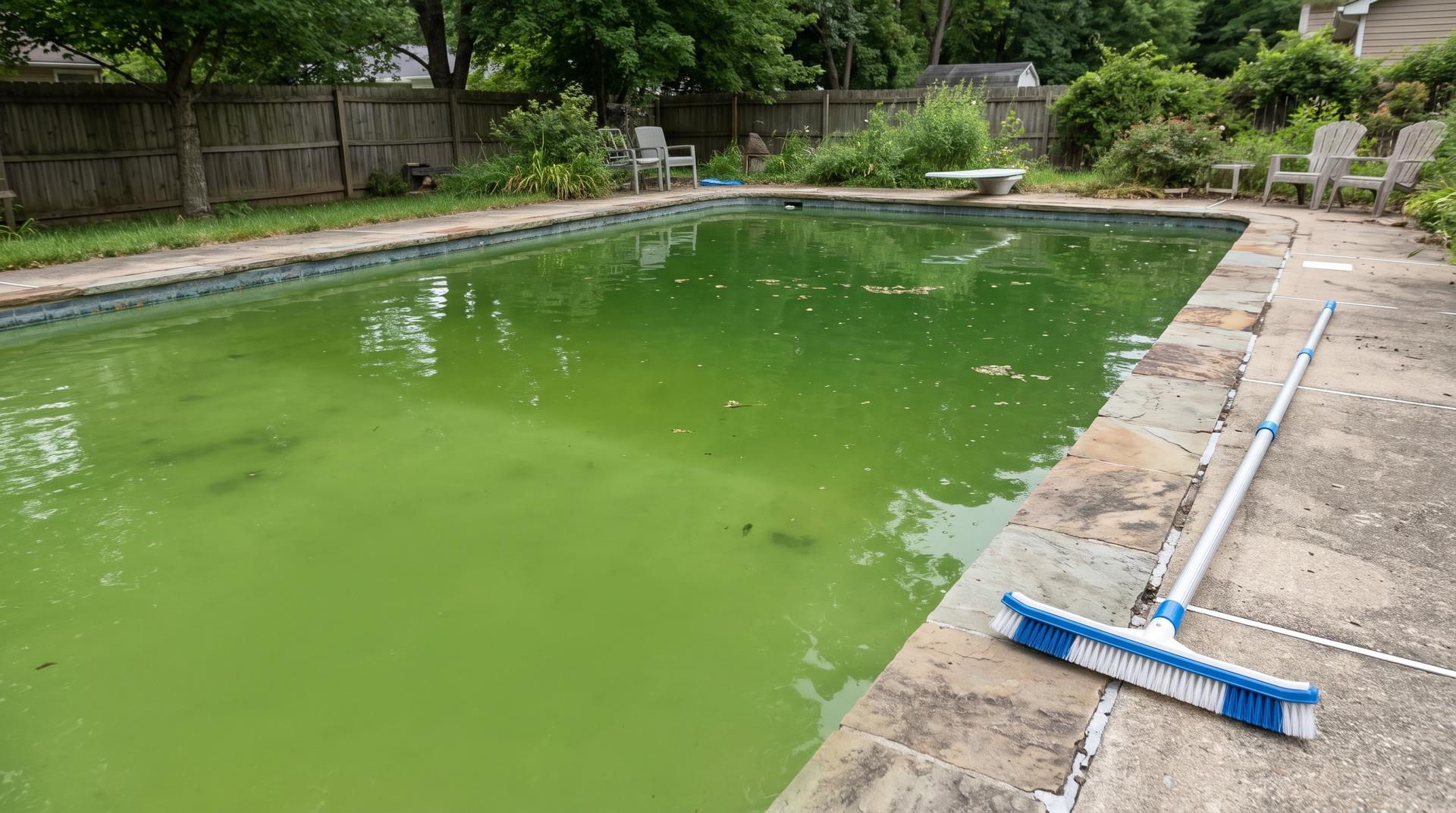
| Cloudy green, slippery steps | Live algae. HTH lists slippery steps and ladders among its signs | The test, the stabilizer, and whether the level was held |
| Clear green, teal or aquamarine, changing as the shock went in | Metal. Copper goes blue-green or aquamarine; iron can go green or brown | The white bucket test, before any more chlorine |
| Turning gray or white, still hazy | Dying algae, by HTH's account, or calcium coming out of solution, by Orenda's | The filter, and pH |
| Clear, but yellow dust on shaded walls that comes back | Mustard algae, which BioGuard calls a chlorine-resistant form of green algae | Algae the chlorine never reached |
If the color says metal, go to the metal section before you add anything else. Orenda says shocking a copper-green pool oxidizes the copper and makes it worse.
Check the test before the pool
You may have had more chlorine in there than you think. Or a lot less.
Taylor says free chlorine above 10 ppm can bleach a DPD test, partly or completely, to a false low reading. The pink comes up pale or not at all, the test says 1 ppm, and a pool that was sitting at 20 gets shocked again. Taylor's fix is to dilute the sample, retest and multiply: for a 1:1 dilution, double the reading.
Strips have a different problem. AquaChek's Chlorine 4-in-1 strip reads free chlorine from 0 to 10 ppm. A couple of its strips go to 20, and only its high range strip reads past that. A shock level of 16 to 40 ppm is off the scale of the strip most owners have.
The test that reads it is FAS-DPD, where you count drops until the pink clears instead of matching a color. Taylor says it reads as high as 20 ppm and that its end point removes the worry about bleaching. In a K-2006 kit each drop is 0.2 ppm on the large sample or 0.5 ppm on the small one. Taylor says that past 50 drops the error gets too large, so retest with the small sample. The test kit guide goes through which kits include it.
Was the shock big enough for your stabilizer?
This is one I've run into, and the makers name it too. HTH lists stabilizer above 100 ppm as one of the reasons a shock fails. Latham says that once pH and the filter are ruled out, high stabilizer may be what's stopping the chlorine.
Cyanuric acid, the stabilizer, shields chlorine from the sun. It also slows chlorine down. The stabilizer guide explains why, but the short version is that the more of it there is, the more chlorine the same kill takes.
The bag doesn't adjust for that. KIK's liquid chlorine label says to shock to 5 to 10 ppm, and HTH says to use 2 to 3 times the normal dose on a green pool. Neither moves with your stabilizer.
The shock level this site uses does. It's about 40% of your CYA reading, the figure from Trouble Free Pool, a pool owners' forum. No maker, agency or journal publishes one tied to stabilizer, so treat it as a rule of thumb.
| Your CYA | Shock level |
|---|---|
| 30 ppm | 12 ppm |
| 50 ppm | 20 ppm |
| 80 ppm | 32 ppm |
| 100 ppm | 40 ppm |
So a pool at 80 ppm that got a bag's worth, 10 ppm, got under a third of what it needed. The algae lost some ground overnight and took it back.
If it's high, decide before you buy. At 100 ppm you're holding 40 ppm of chlorine for days. Latham says to dilute the water or drain and refill, and HTH calls a partial drain the only fix. I've done partial drains for exactly this. Whether that beats the chlorine depends on what water costs you: the shock calculator runs both routes on your own prices, and the CYA reduction calculator works out how much to replace.
One honest caveat. The research on stabilizer and algae is thinner than the forum's numbers make it look. A 1982 lab study of three pool algae found cyanuric acid had a relatively minor effect on how well chlorine killed them, and CDC's pool code annex says peer-reviewed data on algae is lacking. The makers' own lists and what I've seen on pools still point at it.
Was it held, or hit once?
A shock that went in once and was left alone is another I've run into. In a green pool the algae use chlorine up fast. Reach shock level at dusk and it can be near nothing by morning, with plenty of algae still alive.
HTH's opening guide says to check the water the next morning, and if algae is still visible, to shock again the next evening. It says not to move on until all of it is visibly dead. Trouble Free Pool's process goes further: test and top up at least three or four times a day.
When I've had a pool that wouldn't clear, the fix was holding it. Back up to shock level every time it dropped, until it held overnight.
That overnight number is how you know you're done:
- Free chlorine at dusk, and again at first light, with no sun on the water in between.
- A loss of 1 ppm or less is Trouble Free Pool's pass.
- Clear water, and combined chlorine under 0.4 ppm, Taylor's line, at the same time.
Lose more than that and keep going, however good the water looks. The overnight loss test walks through it.
Add the chlorine once the sun is off the water. HTH says UV burns off the chlorine you're adding, and Latham says to shock at night for the same reason.
Was the pH too high?
I've had pools where high pH was part of it. HTH lists pH above 7.6 as one of the reasons a shock fails, and Latham names pH first.
HTH's green water steps bring pH to 7.2 to 7.4 and then wait at least an hour before shocking. Orenda lowers it to about 7.5 first, for more efficient chlorination, and says it has measured green pools above 10.3. CDC says chlorine kills germs less effectively as pH rises, especially above 8.0, though Pickens found pH matters far less once there's stabilizer in the water.
Watch the shock itself, too. PHTA says cal hypo can raise pH, so a pool that's had bag after bag of it can drift up while you work. Test pH every time you test chlorine. Lowering pH has the acid doses.
The pump and the filter
The chlorine kills the algae. The filter is what takes it out of the water, and it can only do that while the pump runs.
A pump left on its short summer timer during a cleanup is one of the mistakes I see most. HTH, Clorox Pool&Spa and Latham all say to run it continuously, and HTH says at least 24 hours after a shock. How long to run the pump covers normal hours. This isn't normal.
HTH also lists a dirty filter that couldn't remove the dead algae as a reason a shock fails. Start the job with a clean filter, then clean it again as the pressure climbs:
- Sand: HTH says to backwash 24 hours after shocking to flush out dead algae. Orenda says to expect to backwash more than once.
- Cartridge: HTH says to pull it and hose it down at 24 hours, because dead algae clogs the pleats and the pressure spikes.
- DE: Orenda shuts circulation off for several hours, preferably overnight, after the first heavy dose, because the pressure can build enough to damage the grids.
A filter that climbs and climbs during a cleanup is doing its job. High filter pressure covers the one that's high for other reasons.
Algae the chlorine never reached
Not brushing is the third of the mistakes I see most. Orenda says piles of leaves and debris protect algae from chlorine, and tells you not to skip brushing. On a live demonstration, its rep forgot to brush, and the pool turned blue but stayed cloudy for four days instead of the usual 24 to 36 hours.
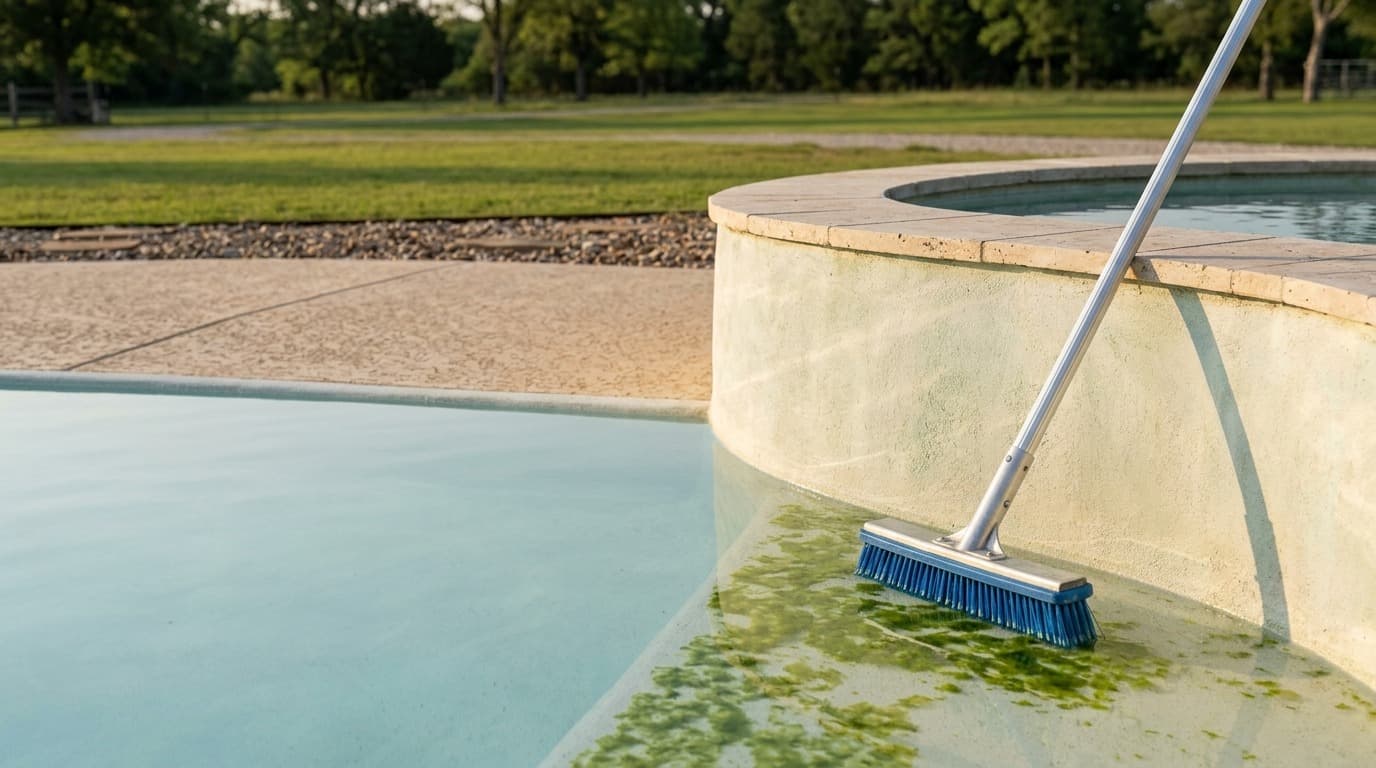
Hidden algae is the other version. I've found it behind lights, in steps, in skimmers, and in a cleaner that kept bringing it back. Look where the water doesn't move and the brush doesn't go:
- Under the lips of the steps, and in their corners
- Behind ladder rails, and around the light niche
- The skimmer throat, and the shaded wall
- The cleaner, the pole, the brush and the toys, which can carry it back in
CDC's pool code annex calls step areas and other recessed spots likely dead zones. For mustard algae, Latham says to put the vacuum hose, head, pole and brushes in the pool during the treatment. HTH says to wash the swimsuits and equipment that were in the water.
Brush every surface every day of the cleanup. HTH says to brush every 8 to 12 hours to break up the dead algae for the filter. Match the brush to the surface: the algae guide covers stainless and nylon, and when each one damages a finish. If what you're fighting is dark spots that cling to plaster, that's black algae, and it takes more than chlorine.
Algaecide and clarifier aren't chlorine
I've seen owners keep pouring algaecide or clarifier into a green pool instead of enough chlorine. Neither one does the chlorine's job.
HTH says clarifier won't clear green water by itself, because it only helps the filter catch fine particles. Treat the algae first. Algaecide labels give a dose for light or just-visible algae, and say heavy growth has to be cleaned out first. HTH says its Algae Guard 10 isn't strong enough to clear an existing bloom on its own.
A copper algaecide brings a bigger problem with it: copper. That's how Orenda's worst case below started.
When the green is metal
I've had pools that went green from metal, and the fix there is different. More chlorine makes it worse.
LaMotte says a high chlorine dose can turn copper-bearing water aquamarine, and iron-bearing water green or brown. Its handbook says this color is translucent at first, and often shows up after a first fill or a shock. HTH's own list puts clear blue-green water down to excess copper, and dark green or brown to iron.
Orenda describes a brand new pool, plastered the week before. The owner added a quart of algaecide, then 2.5 gallons of liquid chlorine moments later. The water went yellow, then green, greener as the day went on. The algaecide was copper-based, and part of the fill had come from a well whose water ran green from the tap.
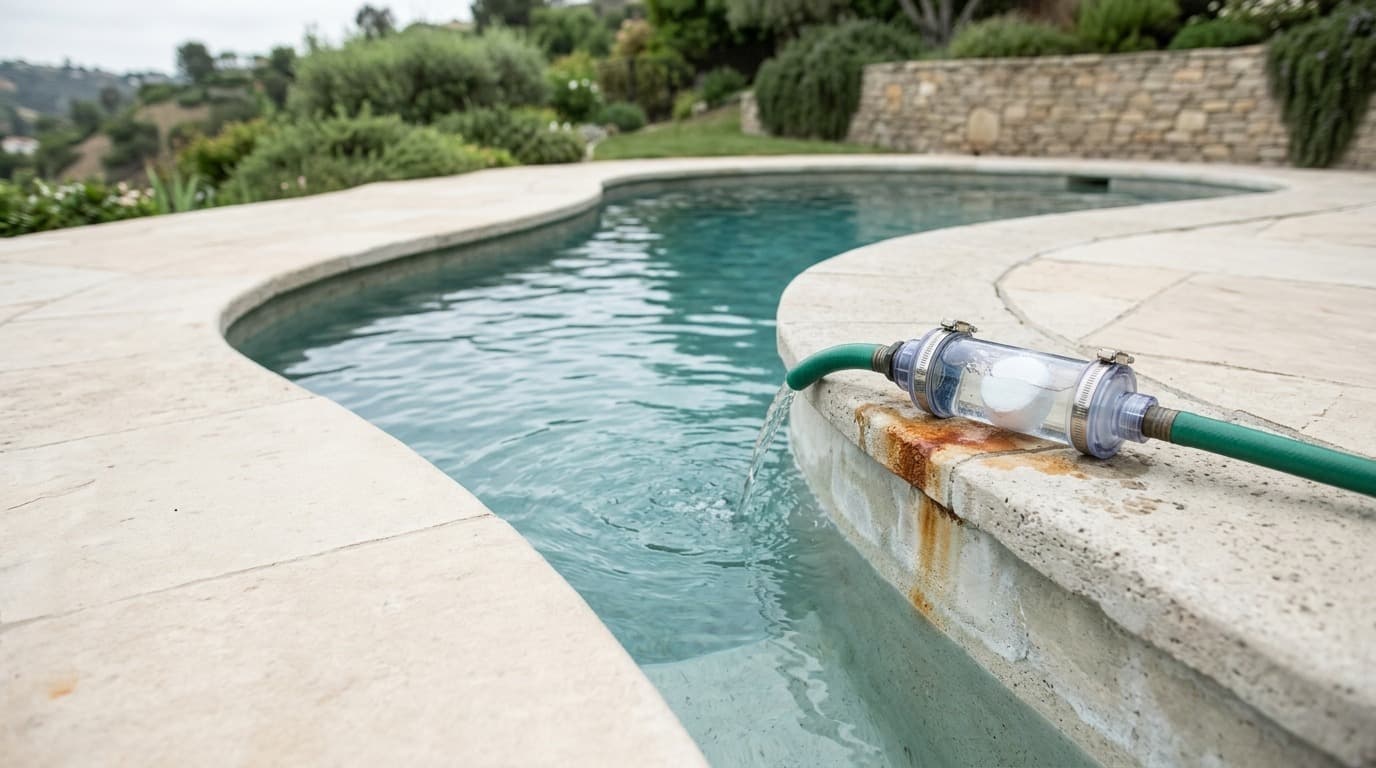
Orenda lists where copper comes from: tap water, copper algaecide, a corroding heater heat exchanger, and a mineral system or ionizer. It says green water with high chlorine usually means copper.
The white bucket test
Orenda's test takes a minute and settles it.
- 1
Fill a white bucket
1 minAt least half full of pool water. Note the color, or take a photo.
- 2
Add a little chlorine
1 minTwo or three ounces of liquid chlorine, stirred in.
- 3
Watch for 30 seconds
30 secClears up: algae, or organics like tannins. Goes darker: metal. No change: Orenda says to test alkalinity and calcium hardness.
If it's metal, stop shocking. Have the water tested for copper and iron, which LaMotte says a pool store can do. Then deal with the metal, which is what I've done on these pools: a sequestrant or a metal remover, by its label.
Know what each one does. Orenda says its own sequestrant chelates metal but doesn't take it out of the water. In its case the owner used a metal-removal product with more sequestrant, and after 48 hours and some backwashing the pool was no longer green. The metals guide covers sequestrants, and where copper comes from inside the system, including low pH eating a heater.
When the algae is dead and the water isn't clear
Dead algae doesn't leave on its own. HTH says it has to be physically removed. I've seen pools where the shock had worked and the owner thought it hadn't, because the water was still hazy.
HTH says that with a shock first, green turns gray or white within 12 to 24 hours, and the pool is typically clear in 24 to 72 hours. Orenda reads a light white or gray haze differently: calcium coming out of solution, because the pH wasn't lowered enough. The two aren't exclusive. Test pH before you decide which you've got.
Then get it out, one of three ways:
- Filter it out. Pump running around the clock, filter cleaned as the pressure climbs, brushing every day.
- Clarifier. HTH says to wait 4 to 12 hours after the shock if the water is still hazy, then add its clarifier, which helps the filter catch fine particles. It's slower than floc and works through the filter.
- Floc and vacuum to waste. When the dead algae won't filter out fast enough, I've flocked it and vacuumed to waste. HTH's directions: turn the filter off and let it settle, then vacuum to waste. That needs a valve with a waste setting, and HTH says robotic cleaners and mesh-bag vacuums won't work for it.
Clarifier vs flocculant covers the choice, and why floc on a cartridge filter without a waste line is a bad afternoon.
Go deeperPool shock calculatorSets the shock level from your CYA, and weighs holding it against a partial drain on your own prices.What finds the cause
- Price at Amazon: Taylor K-2006C test kit
Taylor K-2006C test kit
Drop-count titration rather than color matching, and it tests CYA properly.
- Price at Amazon: liquid chlorine, 12.5% sodium hypochlorite
liquid chlorine, 12.5% sodium hypochlorite
Adds no stabilizer and no calcium. Heavy to ship, so local is usually cheaper.
- Price at Amazon: 18-inch stainless pool brush
18-inch stainless pool brush
Stainless bristles for plaster, concrete and gunite. Brush makers label them not for vinyl or fiberglass.
Frequently asked questions
Why is my pool still green after I shocked it?
Usually the shock was too weak for the pool's stabilizer, or it was hit once and not held. HTH's list of reasons a shock fails is high pH, too small a dose, a dirty filter and stabilizer above 100 ppm, and Latham names pH, the filter and stabilizer. Test cyanuric acid, pH and free chlorine with a drop kit, then check the filter and the pump hours before adding more chlorine.
Why did my pool turn green right after I shocked it?
That's usually metal, not algae. LaMotte says copper can turn water aquamarine after a high chlorine dose, and iron can turn it green or brown. Orenda's white bucket test tells them apart: add a little chlorine to a bucket of pool water, and if it clears it's algae, and if it darkens it's metal. Orenda says not to shock a copper-green pool, because the chlorine makes it worse.
My pool went from green to cloudy gray after shocking. Did it work?
Probably. HTH says that after a shock, green algae turns gray or white within 12 to 24 hours, and the pool is typically clear in 24 to 72 hours with the filter running. Orenda adds that white or gray haze can also be calcium coming out of solution because pH wasn't lowered enough, so check pH too.
How many times should I shock a green pool?
Not a set number. HTH says to check the next morning and shock again the next evening if algae is still visible, until all of it is visibly dead. The finish line this site uses is Trouble Free Pool's: clear water, combined chlorine under Taylor's 0.4 ppm, and 1 ppm or less of free chlorine lost overnight.
Should I add algaecide if the shock didn't work?
Not as the fix. Algaecide labels give doses for light algae and say heavy growth must be cleaned out first, and HTH says its Algae Guard 10 isn't strong enough to clear an existing bloom on its own. Find out why the chlorine fell short instead. A copper algaecide can also put copper in the water, which can turn green when it meets chlorine.