Lowering pH is one of the easiest jobs in pool care and one of the most repeated, which should tell you something.
If you are adding acid every few days, you are not managing pH. You are treating a symptom, and the thing causing it is sitting one line up on your test kit.
Key takeaways
- Muriatic acid is cheaper and faster; dry acid is easier to handle and adds sulfates.
- Always add acid to water. Never add water to acid, and never pour it near a skimmer.
- Wait one full turnover before retesting. Most over-corrections come from testing early.
- pH that climbs back within days is an alkalinity problem, not a pH problem.
- Aeration drives pH up on its own — waterfalls, spa jets and salt cells all do it.
First, check it actually needs lowering
The target is 7.4 to 7.6, and the acceptable band is 7.2 to 7.8.
Anything inside that band is fine and does not want touching. Chasing 7.6 down to 7.4 achieves nothing except moving your alkalinity and using up acid, and it is how people end up on the weekly acid treadmill.
Above 7.8 is worth acting on, and for two reasons rather than one. Chlorine loses effectiveness as pH rises — the same reading sanitizes noticeably less at 8.0 than at 7.4 — and scale starts forming on surfaces and inside the heater. Below 7.2, the water is aggressive and eating your plaster, grout and equipment.
Which acid
Two products do this, and the choice is mostly about handling rather than chemistry.
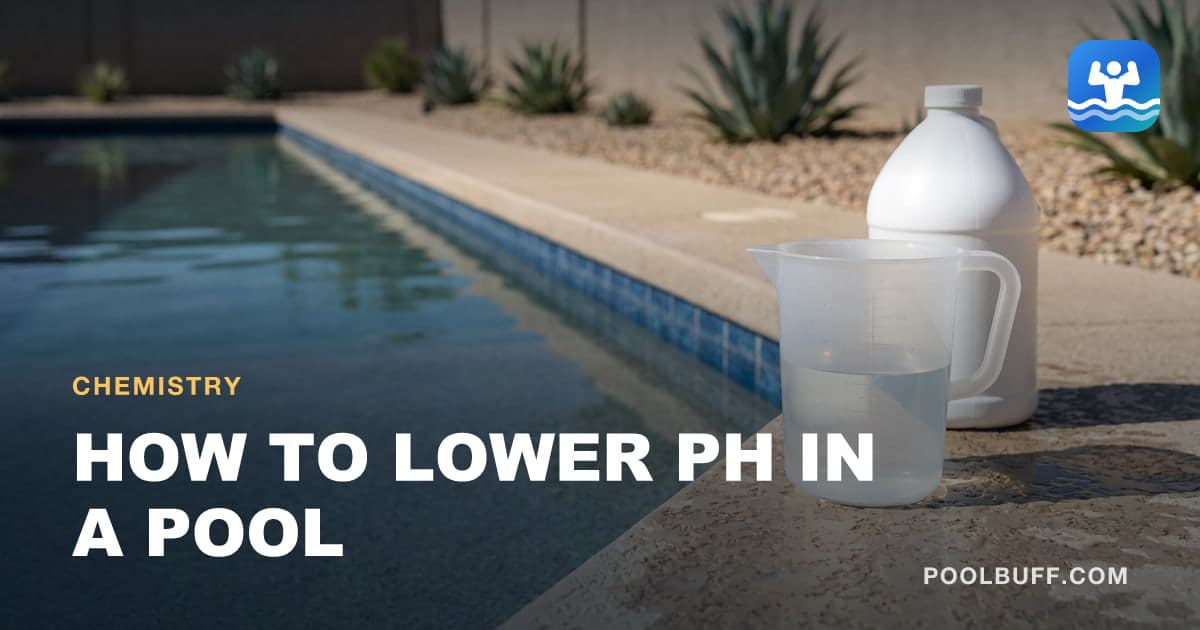
Muriatic acid is hydrochloric acid at around 31%. It is cheap, it works immediately, and it is the standard in the trade. It is also genuinely nasty to handle — the fumes corrode metal on the shelf around it, and a splash is a burn.
Dry acid is sodium bisulfate, sold as pH decreaser or pH minus. It is a granular product, so nothing sloshes and nothing fumes, which makes it the sensible choice for anyone storing chemicals in an attached garage or handling them nervously. The trade is that it costs more per unit of effect and adds sulfates to the water, which accumulate and can attack plaster over years in a pool that is never diluted.
For most owners: muriatic if you are comfortable with it and can store it away from anything metal, dry acid if you are not.
On a salt pool, read the cell's manual before choosing. Pentair's IntelliChlor Plus and LT manual says never to adjust pH with dry acid, because its by-products build up and damage the cell.
How much
The honest answer is that it depends on your volume, your starting pH and your alkalinity, and that any number printed on a label is a starting point rather than an instruction.
For scale: on a 20,000 gallon pool, roughly a quart of muriatic acid moves pH about 0.2 to 0.3 from the high 7s. A gallon is a big correction and should be split rather than added at once.
Two rules make this reliable without arithmetic:
Add half of what you think you need. You can always add more. Pulling pH back up means adding soda ash, which raises alkalinity, which pushes pH up again — you end up chasing it in both directions and moving further from where you started.
Use the pH and alkalinity calculator rather than the back of the bottle, because the bottle does not know your volume.
How to add it
- 1
Pump running, and leave it running
—Acid added to still water sinks and pools on the floor, where it can etch plaster in a patch you will be looking at for years. Circulation is what turns a dose into a treatment.
- 2
Pour slowly into the deep end
2 minutesAlong the wall, away from the skimmer, in a thin steady stream rather than all at once. The deep end gives it the most water to disperse into.
Never into the skimmer. That sends undiluted acid through the pump, the filter and the heat exchanger.
- 3
Wait a full turnover
6–12 hoursThis is the step people skip, and skipping it is the single most common cause of an overshoot. Testing an hour later gives you a reading from partly mixed water, which reads low, which prompts a second dose you did not need.
Same-day retesting is fine on a pool that turns over in eight hours. Just make it eight hours, not one.
- 4
Retest, and take alkalinity too
5 minutesAcid lowers both. If alkalinity has come down along with pH, that is not a side effect to correct — on most pools it is the actual fix.
Why it keeps coming back
This is the part worth more than everything above, because it is the difference between a job you do occasionally and a job you do every weekend.
Total alkalinity is the buffer that holds pH where it is. High alkalinity does not just resist change, it actively pushes pH up and holds it there. So a pool at 160 ppm alkalinity will climb back to 8.0 within days no matter how much acid you add, and you can repeat that cycle all summer without ever fixing anything.
Bring alkalinity down to 80 to 120 ppm and pH becomes stable almost by itself. The relationship between the two is the single most useful thing in pool chemistry to actually understand, and it is why the balancing order is alkalinity first, then pH.
Three other things push pH up on their own:
Aeration. Anything that agitates the surface drives carbon dioxide out of the water, and losing carbon dioxide raises pH. Waterfalls, spa jets, bubblers, and returns aimed up at the surface all do it continuously. If your pool has a water feature running all day, expect to be adding acid — that is the feature's running cost.
Salt cells. The electrolysis process itself is aerating, and salt pools are known for climbing pH relentlessly. It is normal, not a fault, and it is a large part of why a salt pool uses more acid than a chlorine one.
New plaster. A fresh interior leaches calcium hydroxide for roughly its first year and drives pH up hard. That settles on its own and is not worth fighting beyond keeping the water in range.
Go deeperThe relationship underneath all of thisWhy alkalinity moves pH, which to set first, and how to lower one without wrecking the other.Frequently asked questions
What lowers pH in a pool?
Acid. In practice that means muriatic acid, which is hydrochloric acid at around 31%, or dry acid, which is sodium bisulfate sold as a granular pH decreaser. Both work and both also lower total alkalinity as a side effect, which is usually welcome because high alkalinity is what pushed pH up in the first place.
How much acid do I need to lower pH?
It depends on volume and on how far you are moving it, but a useful starting point is that roughly a quart of muriatic acid moves a 20,000 gallon pool about 0.2 to 0.3 pH units from the high 7s. Add half of what you think you need, circulate for a full turnover, then retest. Overshooting into acidic water is harder to undo than adding a second dose.
Can I use vinegar or lemon juice to lower pool pH?
Not usefully. They are weak acids at low concentration, so it takes an impractical volume to shift a pool at all, and they add organic material that consumes chlorine. Muriatic acid costs a few dollars a gallon and does the job properly, which is why nobody in the trade uses anything else.
Why does my pool pH keep rising?
Almost always high total alkalinity, which is the buffer holding pH up. Fix alkalinity and pH stops fighting you. The other common causes are aeration — waterfalls, spa jets, aimed-up returns and salt cells all drive off carbon dioxide, which raises pH — and new plaster, which leaches for its first year.
Is it safe to swim after lowering pH?
Once the acid has circulated for a full turnover and pH tests between 7.2 and 7.8, yes. What you should not do is swim while undiluted acid is still working through the system, or add acid with people in the pool. Add it, let the pump run, test, then swim.