Pentair · IntelliChlor
Pentair IntelliChlor Plus and LT
Pentair's current salt cells: which of the five fits your pool, fitting one where an old IntelliChlor was, and the acid ratio its own manual misprints.
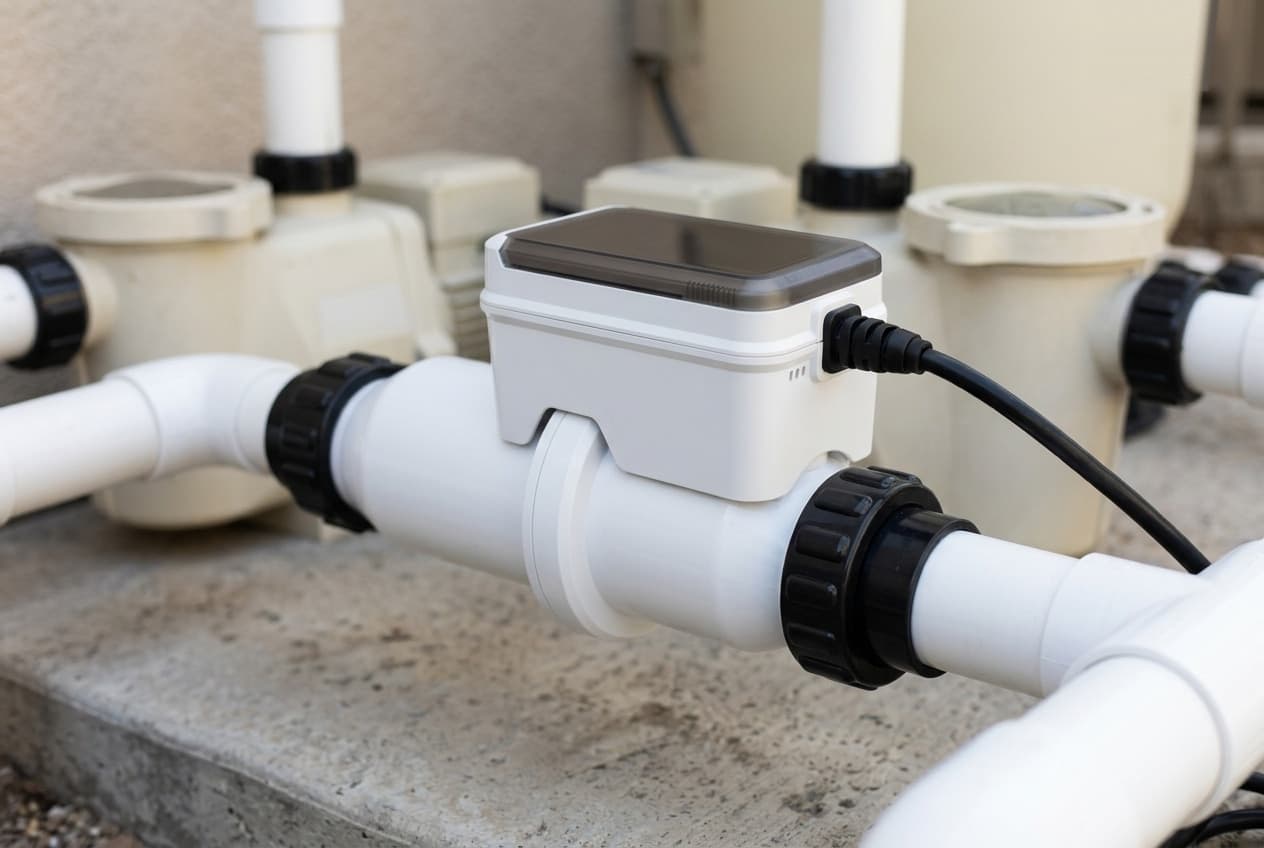
The IntelliChlor Plus and IntelliChlor LT are Pentair's current salt cells, the line that replaced the original IntelliChlor. There are five sizes, from the LT15 for a 15,000-gallon pool to the PLUS60 for 60,000 gallons. Each cell carries its own controller, with a small display and buttons, on top of the cell body.
Pentair designed them to go where its older cells were. They fit the same unions, plug into the same PC100 power center, and talk to the same Pentair automation.
Which size
- LT15 — 15,000 gallons, 0.65 lb of chlorine a day, on its own power pack or a PC100
- LT25 — 30,000 gallons, 0.9 lb a day, PC100
- PLUS30 — 30,000 gallons, 1.1 lb a day, PC100
- PLUS40 — 40,000 gallons, 1.4 lb a day, PC100
- PLUS60 — 60,000 gallons, 2.0 lb a day, PC100
The volumes and chlorine figures are from the manual, and the chlorine is at 100% output around the clock. Pentair's product page calls the LT25 the "25K" cell, while its manual gives it the same 30,000 gallons as the PLUS30.
The cell's output setting is a percentage of pump run time. At 80%, it makes chlorine for 80% of the time the pump runs and rests for the other 20%. A bigger cell on a normal pool simply runs at a lower percentage.
Fitting one where an old cell was
- PLUS40 and PLUS60 are the same length as the original IntelliChlor and drop into its plumbing.
- LT15, LT25 and PLUS30 are the length of Pentair's iChlor, shorter than an IntelliChlor. Each comes with a retrofit adapter, 523101, to bridge the gap in plumbing cut for the longer cell.
- The thread size and unions are the same across the IntelliChlor, iChlor, Plus and LT, per Pentair's FAQ.
- Every model plugs into a PC100 with the same connector as the older cells.
- The LT15 can also run on its own power pack, 523753, which plugs into a 110 V GFCI outlet. Never connect it to an older IntelliChlor or iChlor power pack: Pentair says that permanently damages the cell's electronics.
Installing it
The manual wants a qualified professional to install it, and several of its rules decide whether the cell works at all.
- Wire the power center or pack to the load side of the pump timer, switch, relay or automation, so the cell only gets power when the pump runs. Wired wrong, it can make chlorine gas with no water moving.
- At least 5 feet from the pool wall, and at least 3 feet past the heater outlet. The cell goes after the filter and heater.
- Chlorine or bromine feeders go after the cell. Upstream, they permanently damage it.
- On a pool and spa, put the cell before the pool/spa return valve.
- Vertical is best, with water flowing upward through the cell and the power cord pointing down. The manual says a vertical cell with the flow going the other way voids the warranty. Horizontal, the control panel faces up.
- 12 to 18 inches of straight pipe into the inlet, for the flow sensor.
- At least 25 GPM through the cell. Above 80 GPM, plumb it in a bypass loop with a flow control valve.
- Check that the crosshair is in the cell inlet, seat the union o-rings, and don't overtighten the unions.
- Mount the power supply on a wall within 15 feet of the cell.
- Indoor pools need ventilation for the hydrogen the cell gives off.
On a new pool, run a spacer cell until the plumbing is flushed and the water balanced. The manual wants the pool filled for at least a month with salt stable at 3,600 ppm before the cell runs, and new plaster left to cure for a month before any salt goes in.
Salt
Pentair's ideal is 3,600 ppm, with a range of 2,600 to 4,500. The display shows ADD SALT below 3,000, and the cell shuts off below 2,600. Above 4,500 it shows HI SALT; drain some water and refill to bring it down. Pentair warns that above 6,000 ppm, equipment corrodes faster and pool surfaces can discolor.
- Use at least 99.8% pure sodium chloride, ideally evaporated, granulated and food quality, with no iodine or additives.
- Not rock salt, not salt with anti-caking agents, and never calcium chloride, sodium bromide or potassium chloride.
- Pour it around the edge of the pool, never into the skimmer, brush the floor, and give it 24 hours to dissolve.
- Check the reading with a separate test as well as the cell's display.
The cell checks salinity when it powers up and every 2 hours after that, and the display always shows the most recent reading.
Setting the output
Pentair's target is 2 to 4 ppm free chlorine. Below 2, raise the output; above 4, lower it. After any change, wait 24 hours before testing.
- Test at the right moment and place. The manual has you press Boost so the test catches the cell making chlorine, and take samples near a return and 18 inches deep away from it. The return sample should read higher.
- Boost runs the cell at 100% for the next 24 hours of cell operation. The countdown pauses whenever the cell isn't making chlorine. Hold the button to cancel.
- At start-up, shock the pool with a bought shock treatment, then wait for free chlorine to fall back to 2 to 4 before running the cell.
- Connected to Pentair automation, the cell's own buttons stop working and the output is set from the automation.
- SmartSense flow detection watches an IntelliFlo pump over RS-485. It needs a PC100, not the LT15 power pack, and doesn't work when automation is connected.
- SmartSense pool cover detection needs the 523216 board in the PC100. When the cover closes, output defaults to 0%; you can still raise it, up to a maximum of 50%.
Chemistry the manual rules out
- Never adjust pH with dry acid (sodium bisulfate). Pentair says its by-products build up and damage the cell. Use muriatic acid.
- Never use trichlor or dichlor with the cell, and don't use bromide products.
- Cyanuric acid: 0 to 50 ppm outdoors where local rules allow, and none indoors. The original IntelliChlor manual gave 30 to 50. This site's salt guidance argues for more on a salt pool; Pentair's written figure is the one above.
Maintenance
Weekly: pH at 7.4 to 7.6, alkalinity 80 to 120 ppm, free chlorine 2 to 4.
Monthly: salt, a pool store water test, cyanuric acid, calcium hardness at 200 to 400 ppm, metals, total dissolved solids, and the saturation index, which Pentair wants between -0.3 and +0.3.
Every two months: take the cell out and look at the blades.
- Turn off the pump, automation and cell at the breaker, and disconnect the cell from its power supply.
- Close the suction and return lines, and open the filter's air relief until the pressure is gone.
- Take the cell out and spray both ends with a garden hose on its jet setting.
- No pressure washer, and no screwdriver or brush. Either can damage the blade coating.
- A little scale is normal. Heavy scale means an acid clean.
Never separate the two halves of the cell body. Pentair says opening it voids the warranty.
The cell also runs an automatic cleaning cycle to slow scale, and Pentair's FAQ says the polarity reverses every 3 hours.
Acid cleaning, and a misprint
Every cell comes with an acid wash stand. It threads onto the cell's inlet, so the acid goes inside the cell and the outside stays dry.
- Power off, and wait at least 60 seconds for stored charge to drain.
- Pry off the retaining clip and lift the controller straight up off the cell. Rocking it side to side can damage the terminals.
- Wearing rubber gloves and eye protection, somewhere well ventilated, mix 4 parts water to 1 part muriatic acid, pouring the acid into the water.
- Thread the stand on, set it level, and pour the solution into the cell until the blades are covered. Never submerge the whole cell.
- Let it foam until it stops, no longer than 30 minutes, then rinse the cell thoroughly. No foaming means the blades probably didn't need it.
- Repeat if scale is still visible, then refit the controller and the cell.
The misprint. Pentair's table, in the manual and the kit sheet alike, gives 800 mL of water and 200 mL of acid for the LT15, LT25 and PLUS30, and 1.4 L of water and 350 mL of acid for the PLUS40 and PLUS60. Those are 4 to 1. The US figures printed beside them are 0.8 quart of water with 27 ounces of acid, and 1.5 quarts with 47 ounces. 27 fluid ounces is about 800 mL, more acid than water. Go by the ratio or the metric volumes, not the ounces.
What the display tells you
- WAITING FOR FLOW: under 25 GPM. Clean the filter, pump basket and skimmers, raise the pump speed, and check for air in the plumbing. After that, look for a flow switch paddle loose from the sensor module, or a damaged switch.
- ADD SALT / LOW SALT: under 3,000 / under 2,600 ppm. If LOW SALT persists after adding salt, Pentair replaces the sensor module.
- HI SALT: over 4,500 ppm. Drain and refill.
- LOW TEMP: the water is below 52°F. See below.
- CHK CELL / INSPECT: the blades need cleaning. Pentair's FAQ says a CHK CELL that is still there after an acid clean means the blades are worn out.
- OVERLOAD: debris touching the blades, or scale. Clean them.
- SENS ERR: a bad connection between sensor module and controller, or a failed sensor module.
- Low chlorine with no message: output too low, pump not running long enough, a heavy load from rain, leaves or swimmers, nitrates, phosphates or metals, dirty blades, or low stabilizer. For a temporary drop, Pentair suggests 24 hours of Boost, then shock if it's still low.
Cold weather and winter
The cell shuts off below 52°F, give or take 3°F, and shows LOW TEMP until the water warms. Use another form of chlorine until it does. Pentair's FAQ adds a LOW TEMP warning below 60°F, before the shutoff, which the manual doesn't mention.
Against freezing, Pentair gives two options: run the pump continuously, or drain the plumbing and replace the cell with a spacer cell. That's 523102 for the LT15, LT25 and PLUS30, and 520588 for the PLUS40 and PLUS60.
Replacing a part
- Sensor module: power off, wait 60 seconds, and lift the controller off. Remove the six T20 screws, fit the new o-ring and module, and tighten the two side screws first, then zig-zag. Coat the three connections with the kit's dielectric grease and refit the controller. The new module picks up the cell's history automatically.
- Controller: a new controller shows SPARE and pairs itself. One that shows RESET HMI was used on another cell and has to be reset first: hold INFO and BOOST for 10 seconds at SYS OFF / SENS ERR, then cycle the power.
- Cell, when the blades are worn: fit the new cell assembly, reset the old controller the same way before it goes on, and pick the model at SET TYPE.
Warranty and where to buy
The warranty runs on years or hours, whichever comes first. The Plus gets 3 years or 10,000 hours, the LT 2 years or 6,000. The cell keeps a run-time meter, under INFO, of the hours it has spent making chlorine. Those terms need the cell bought from a pool store, builder or service company and professionally installed.
Bought online, including Pentair's EC- numbers, it's one year parts only with no labor. The EC versions Pentair lists are 523735-EC (PLUS40), 523747-EC (LT25) and 523744-EC (LT15 with power pack).
Where Pentair's documents disagree, or are unclear
- LT25 pool size. The product page calls it the 25K cell. The manual rates it for 30,000 gallons.
- Sensor module screw torque. The manual gives 15 inch-pounds. Pentair's FAQ gives 18 to 20.
- Maximum flow. The manual says the cell takes 25 to 105 GPM and needs a bypass loop above 80. The FAQ calls 80 GPM the maximum.
- The cold warning. The FAQ shows a LOW TEMP warning below 60°F before the 52°F shutoff. The manual only lists LOW TEMP at 52°F.
- Acid volumes. The ounce figures don't match the 4 to 1 ratio or the metric volumes beside them, in both the manual and the kit sheet.
- Spacer cell 523102. The parts list gives it to the LT15, LT25 and PLUS30. The winterizing section says "LT15/30 and PLUS30".
- Cyanuric acid. The manual's chemistry table and troubleshooting say to add stabilizer when it's low. Pentair's FAQ lists both low and high cyanuric acid as causes of low chlorine.
- Page references. The troubleshooting chart twice sends you to Cell Disassembly on page 27; it's on page 25.
- A dimension. The drawings label the same 7.2-inch measurement 183 mm on the smaller cells and 193 mm on the larger ones.
- The retrofit adapter. The manual calls it a retrofit adapter and, a line later, a spacer adapter. Its English parts table numbers it 523101, the number retailers carry; the French table in the same manual gives 523099.
Which model do you have?
The model number is on the salt cell label. Everything else in the range is shared — these are the parts that change with it.
| Model | SKU | Pool volume | Chlorine per 24 hours | Power | Cell assembly | Controller assembly | Spacer cell | Note |
|---|---|---|---|---|---|---|---|---|
| PLUS40 | 523735 | 40,000 gal | 1.4 lb | 186 W | 523765 | 523770 | 520588 | Sized, like the IC40, for 40,000 gallons, and the same length as the original IntelliChlor, so it fits that cell's plumbing. Pentair sells it online as 523735-EC. Needs a PC100 power center. |
| PLUS60 | 523738 | 60,000 gal | 2.0 lb | 206 W | 523827 | 523770 | 520588 | The largest. Same length as the PLUS40 and the old IntelliChlor. Needs a PC100 power center. |
| PLUS30 | 523730 | 30,000 gal | 1.1 lb | 129 W | 523764 | 523770 | 523102 | 523733 is the cell with a PC100 power center. The shorter body of the three smaller cells, the length of Pentair's iChlor; the retrofit adapter in the box fills the gap left by an old IntelliChlor. |
| LT25 | 523747 | 30,000 gal per the manual; 25,000 per the product page | 0.9 lb | 109 W | 523768 | 523775 | 523102 | 523750 is the cell with a PC100 power center, and Pentair sells the cell online as 523747-EC. Pentair's product page calls it the 25K cell; the manual rates it for 30,000 gallons, the same as the PLUS30, with less chlorine per day. Short body, retrofit adapter in the box. |
| LT15 | 523741 | 15,000 gal | 0.65 lb | 63 W | 523767 | 523775 | 523102 | The only one that can run without a PC100. 523744 is the cell with its own LT15 power pack, sold online as 523744-EC; the pack plugs into a 110 V GFCI outlet. Never connect it to an older IntelliChlor or iChlor power pack, which permanently damages the cell. Short body, retrofit adapter and flexible hose connectors in the box. |
Pentair IntelliChlor Plus and LT parts, and what goes wrong
Read off the manufacturer’s parts list and checked before it ships. Open a row for what a bad one actually does — or start from the symptom and work down, which is the cheaper order.
What is it doing?
One module holds all three sensors, conductivity, temperature and flow, according to Pentair's FAQ. The manual replaces it for a damaged flow switch, for a LOW SALT warning that persists after salt is added, and for a failed sensor behind SENS ERR. Try the cheaper fixes first: clean debris out of the cell, check that the flow switch paddle hasn't come loose from the module, and look for debris in the connector between module and controller. The module comes out from under the controller on six T20 screws. Tighten the two side screws first, then work in a zig-zag. The kit includes the o-ring, and the new module syncs the cell's history on its own.
Live pricing arrives when the retailer programs are approved.
The cell body and blades for a PLUS40; the other sizes are 523767 (LT15), 523768 (LT25), 523764 (PLUS30) and 523827 (PLUS60). Pentair's FAQ says a CHK CELL warning that survives a proper acid clean means the blades are worn out. The controller moves across to the new cell, but a used one has to be reset before it goes on, or it keeps the old cell's run-time history. With it off the cell, power it up until it shows SYS OFF / SENS ERR, hold INFO and BOOST together for 10 seconds, and cycle the power. Coat the three sensor connections with the dielectric grease in the kit, clip it on, and choose the model at SET TYPE.
Live pricing arrives when the retailer programs are approved.
The acid wash stand and its o-ring, which come in the box with every cell. The stand threads onto the cell inlet so the acid goes inside the cell and never around it; Pentair says submerging the cell damages it and voids the warranty. Mix 4 parts water to 1 part muriatic acid, adding acid to water, and leave it no more than 30 minutes. The metric volumes in Pentair's table follow that ratio, but the ounce figures beside them don't. See the cleaning section below.
Live pricing arrives when the retailer programs are approved.
The unions that hold the cell in the plumbing, the same size as the older IntelliChlor and iChlor. Pentair's cell replacement steps start by inspecting the union o-rings for debris or damage and cleaning or replacing them. The unions are rated to 50 psi at 70°F, and the manual says not to overtighten them.
Live pricing arrives when the retailer programs are approved.
The power supply every model can use, and the only one for the LT25 and all three PLUS cells. Before blaming it, the manual has you check the fuse on its circuit board, that the pump timer is actually sending it 110 or 220 V when on, and that the transformer leads match the diagram inside the cover. It has to be wired to the load side of the pump timer, switch, relay or automation, so the cell only has power when the pump runs.
Live pricing arrives when the retailer programs are approved.
If you are doing the job anyway
Replacing a worn-out cell handles every seal and clip at the top of the cell.
Cell swap, PLUS40
The new cell goes into the old unions, and Pentair's steps start by checking their o-rings. The controller comes off by its retaining clip and moves to the new cell, and the accessory kit carries a new clip, controller cover, sensor module screws and module o-ring.
- Cell assembly, PLUS40523765
- Union kit, two unions520595
- 523759523759
Pentair IntelliChlor Plus and LT manuals and documentation
Hosted by the manufacturer. These open on Pentair’s own servers, so they stay current.
- IntelliChlor Plus and LT installation and maintenance guide (P/N 523854 Rev. B, 2025)manual
- Replacement parts, in the installation and maintenance guidediagram
- Cell assembly replacement kit instructions (P/N 523874 Rev. A)guide
- Sensor module replacement kit instructions (P/N 523875 Rev. A)guide
- Controller replacement kit instructions (P/N 523751 Rev. A)guide
- Acid cleaning kit instructions (P/N 17900 Rev. C)guide
- LT15 power pack replacement kit instructions (P/N 523832 Rev. B)guide
- IntelliChlor Plus and LT product page — the item numbers and Pentair's FAQspec
- Pentair warranty page — the hours-based cell termsspec
Pentair IntelliChlor Plus and LT warranty
Plus: 3 years or 10,000 hours. LT: 2 years or 6,000 hours.
Pentair's warranty page gives the IntelliChlor Plus three years or 10,000 hours of operation, whichever comes first, and the IntelliChlor LT two years or 6,000 hours. Both are TradeGrade products, and Pentair's standard terms cover parts and labor when one is bought from a pool store, builder or service company and professionally installed. Pentair's warranty page exempts an IntelliChlor without a power center from professional installation, but its Plus and LT rows don't carry that exemption, and the manual says a qualified professional should install and service them. A product that needs professional installation and doesn't get it drops to one year parts only. Bought on the internet, including the EC- numbers from Pentair's authorized online resellers, it is one year parts only with no labor, and it can't count toward the three-year bundle. The manual voids the warranty for a vertical installation where the water doesn't flow upward through the cell, for separating the two halves of the cell assembly, and for submerging the cell in acid.
Manufacturer’s termsPentair IntelliChlor Plus and LT complete parts list
Every part on the manufacturer’s exploded diagram, in their numbering. Marked rows are the ones covered above with a symptom and a diagnosis.
| No. | Part | Description | Note |
|---|---|---|---|
| 1 | 523775 | Controller assembly, LT | LT15 and LT25 |
| 1 | 523770 | Controller assembly, PLUS | PLUS30, PLUS40 and PLUS60 |
| 2 | 523767 | Cell assembly, LT15 | |
| 2 | 523768 | Cell assembly, LT25 | |
| 2 | 523764 | Cell assembly, PLUS30 | |
| 2 | 523765 | Cell assembly, PLUS40 what goes wrong | |
| 2 | 523827 | Cell assembly, PLUS60 | |
| 3 | 523769 | Sensor module kit what goes wrong | Conductivity, temperature and flow sensors, with o-ring |
| 4 | 520595 | Union kit what goes wrong | Two unions |
| 5 | 520556 | PC100 power center what goes wrong | |
| 6 | 523753 | Power pack, LT15 | LT15 only |
| 7 | 523103 | Acid cleaning kit what goes wrong | |
| 8 | 523101 | Retrofit adapter | Supplied with the LT15, LT25 and PLUS30, for plumbing cut for an older IntelliChlor. The French parts table gives 523099 |
| — | 523102 | Spacer cell, LT15, LT25 and PLUS30 | |
| — | 520588 | Spacer cell, PLUS40 and PLUS60 | |
| — | 523216 | PC100 cover detection board | Needed for SmartSense pool cover detection |
| — | 523759 | Accessory kit | Controller cover, controller retaining clip, sensor module screws and sensor module o-ring |
Where to buy
- AmazonThe listing reads 523735-EC, Pentair's online-sale version of the PLUS40, cell only. It needs a PC100 power center, which an IC40 installation already has. Bought online it carries one year parts only, against three years or 10,000 hours from a pool store with professional installation. Check the listing still reads 523735-EC before ordering.
- AmazonThe listing reads 523744-EC: the LT15 cell with its own power pack, for pools up to 15,000 gallons, in Pentair's online-sale version. One year parts only, against two years or 6,000 hours from a pool store. Check the listing still reads 523744-EC before ordering.