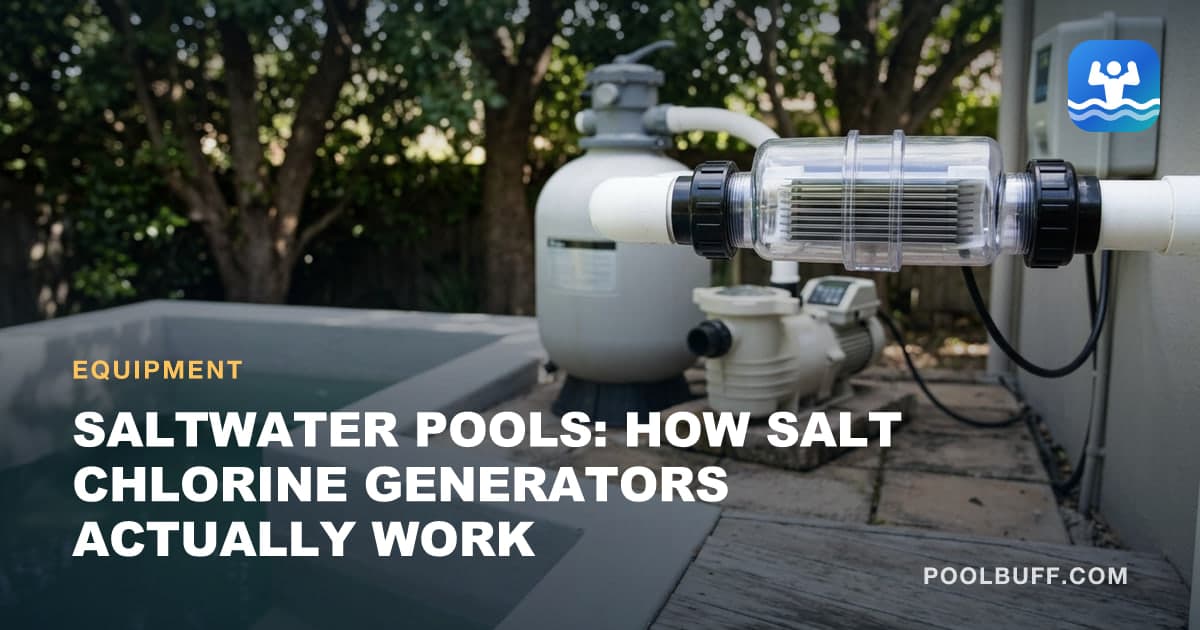
The first thing to get straight, because half the disappointment with salt pools starts here.
A saltwater pool is a chlorine pool. The cell splits salt into chlorine on its way past. You are not switching away from chlorine, you are switching from carrying it to making it. Everything you already do — testing, balancing, brushing, filtering — carries on exactly as before.
What you actually buy is not having to handle jugs. That is worth real money to a lot of people. It is just worth being honest that it is what you are buying.
Key takeaways
- A salt pool is a chlorine pool. The cell makes the chlorine — it does not replace it.
- Cell replacement is the cost people miss. Budget for it from day one, not year five.
- Payback lands somewhere around the life of the first cell. Convert for convenience, not savings.
- Oversize the cell. One rated at your exact volume runs flat out and dies early.
- Check your heater, coping and deck materials first. Salt is harder on some of them than fresh water.
What it costs
| Typical | What moves it | |
|---|---|---|
| Salt chlorine generator | $500-$2,500 | Brand, capacity, and whether it talks to your automation |
| Installation | $300-$900 | Plumbing the cell into the return line, mounting the power supply |
| Electrical | $300-$1,000 | Only if there is no suitable circuit. Bonding is not optional |
| Salt, initial fill | $110-$170 | About 13 bags for a 20,000 gallon pool from zero |
| Total, installed | $1,200-$3,500 | The wide end is a large pool with new electrical |
What you will need on the day
- Check price
pool salt
Plain 40 lb sodium chloride. Never rock salt or anything with anti-caking agents.
- Check price
AquaChek Select Connect test strips
Fine for a quick mid-week pH check. Not for decisions that cost money.
Salt is the cheap part. A 20,000 gallon pool starting from zero needs roughly 530 pounds to reach 3,200 ppm — around thirteen 40 lb bags. Our salt calculator does the arithmetic for your volume and current reading.
Use plain pool salt. Not rock salt, not water softener salt with anti-caking additives, and nothing with iodine in it.
The cost nobody budgets for
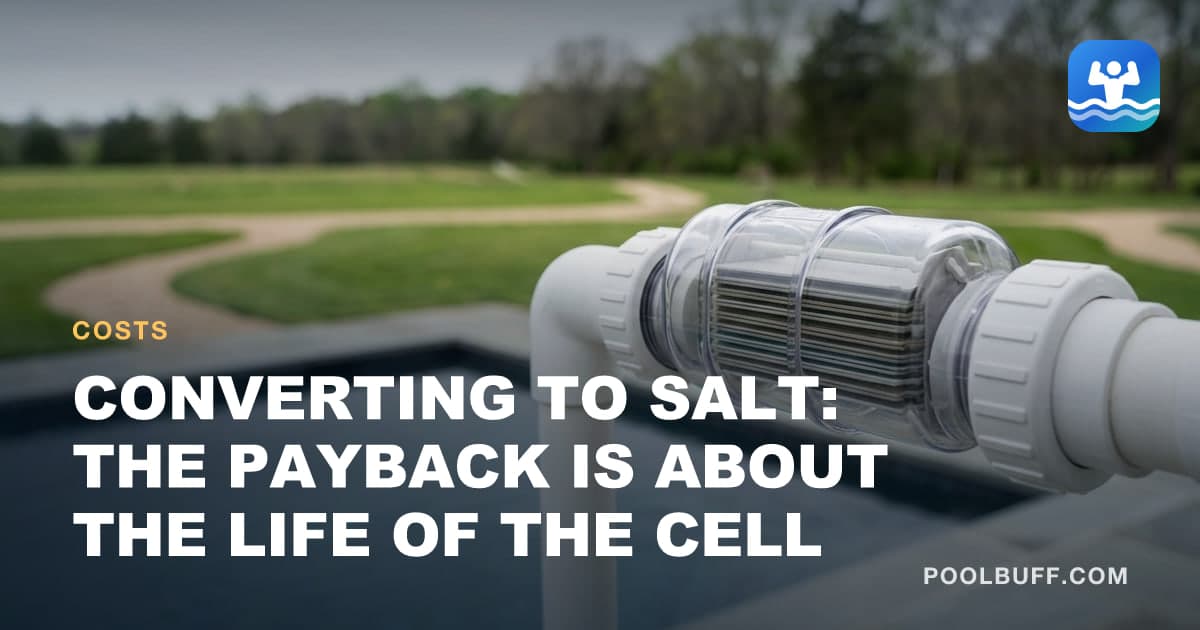
The cell is a consumable. It has plates with a coating that wears out, and when it goes, output drops and no amount of cleaning brings it back.
Three to seven years, and $450 to $1,500 to replace.
That spread is not vagueness, it is the actual choice. An aftermarket cell sits near the bottom of it; a genuine Pentair IC40 sits at the top, with Hayward's own TurboCell between them. Which you buy, and how long it lasts, is the single biggest variable in whether this was a good financial decision — and it is almost never in the sales conversation.
Amortized, that runs from about $65 a year (an aftermarket cell that lasts seven years) to about $500 a year (a genuine cell that lasts three). The whole time, it works quietly against your chemical savings.
Go deeperWhat actually kills cells earlyRunning at high output, low CYA, and scale. All three are avoidable.The honest payback math
Take a typical 20,000 gallon pool.
What you save: most of your chlorine spend. Call it $300 to $500 a season for a pool that was buying liquid chlorine weekly.
What you spend instead:
- More acid, because pH climbs constantly on a salt pool. Perhaps $50 to $100 a season.
- Cell replacement, amortized. $65 to $500 a year, per above.
- A little electricity for the cell. Small, but not nothing.
Net result: anywhere from about $350 a year saved to about $300 a year lost.
That is an uncomfortably wide answer and it is the honest one, because the cell dominates it. Buy aftermarket cells that reach their rated life and you save real money. Buy genuine cells that die at three years — which is what happens to a cell run at full output on a pool with low stabilizer — and the salt system costs you more every year than the chlorine it replaced.
Against an installed cost of around $2,000, that is a payback of about six years at best, and never at worst.
Oversize the cell
The single most useful decision in the whole conversion, and it costs very little at purchase.
Cells are rated by pool volume. A cell rated at exactly your volume has to run at or near 100% output to keep up, and running flat out is what wears the plate coating off. A cell rated well above your volume runs at 40 or 50% and lasts substantially longer.
Buy for at least one and a half times your actual volume. The price difference between capacity steps is usually a couple of hundred dollars. A cell replacement is three to nine hundred. The math is not close.
Go deeperHow the cell actually worksPlates, gas, scale, and why the panel reading is not your salt level.Doing the install yourself, and what you cannot
The job splits cleanly into a plumbing half most people can manage and an electrical half most people should not.
The plumbing is straightforward. The cell goes into the return line after the filter and after the heater — after the heater specifically, because chlorine generated upstream of a heat exchanger is chlorine concentrated against copper. It wants a straight run either side so the flow sensor reads properly, unions so it can come out for cleaning, and the orientation the manufacturer specifies. Two hours, some PVC, a couple of unions.
The electrical is not homeowner work. The power supply needs a dedicated circuit with GFCI protection, and it has to be tied into the same equipotential bonding grid as everything else on the pad. That grid is what stops a voltage difference existing across a swimmer, and adding equipment to a pad without bonding it in is exactly the kind of quiet mistake that stays quiet until it does not.
So the sensible split — and the one that lands people at the bottom of the cost range — is to buy the unit, do the plumbing, and pay an electrician for a couple of hours. That is a genuinely different number from a turnkey install, and it is not a corner cut.
One thing to check before ordering: whether your existing timer or automation can control it. A generator wired to run whenever the pump runs is fine. One that expects to be told when to run, on a system that cannot tell it, means either a separate timer or an upgrade you had not budgeted for.
Check these three things first
Your heater. Modern cupronickel heat exchangers handle salt fine. Older units with plain copper are less happy about it. Worth identifying what you have before you commit.
Coping and decking. Salt is hard on some natural stone, and on unsealed limestone in particular. Splash-out over years leaves a visible edge. Sealed concrete and most pavers are fine.
Anything galvanized or with exposed metal fixings. Ladders, rails and handrail anchors all live in the splash zone.
None of these are usually dealbreakers. They are all things that are cheaper to know about now than to discover in year three.
What conversion does not change
- You still test the water, and just as often
- You still balance pH, alkalinity and calcium
- You still need CYA, and salt pools want it higher — 60 to 80 ppm
- You still shock with liquid chlorine when something goes wrong
- In cold water the cell stops producing and you are back to liquid for the shoulder season — the threshold is the manufacturer's, not a rule of thumb: Hayward stops below 50°F, Pentair below 52, and Jandy sets 60 as a warranty condition
If someone has sold you a salt pool as a pool that looks after itself, that is the part to push back on.
So should you?
Yes, if you are tired of storing and pouring chlorine, you want steadier sanitizer levels, you like how the water feels, and you go in understanding that you are buying convenience rather than savings.
Probably not, if the pitch that convinced you was the running cost, your pool is only open three months a year, or your heater and coping are the kinds that would rather you did not.
Go deeperWhat you are actually spending nowMonthly running costs by line item, so you can check the saving against your own numbers.Frequently asked questions
How much does it cost to convert a pool to saltwater?
Typically $1,200 to $3,500 installed. The generator itself is $500 to $2,500 depending on brand and capacity, installation adds $300 to $900, and a dedicated electrical circuit is another $300 to $1,000 if you do not already have one. Salt for a 20,000 gallon pool runs about $110 to $170.
Is a saltwater pool cheaper to run?
On chemicals, yes — you stop buying chlorine, which is most of a typical chemical bill. Against that you buy more acid because pH climbs constantly, and you replace the cell every three to seven years. Net savings are real but modest, and the payback period is roughly the life of the first cell.
How long does a salt cell last?
Three to seven years for most residential cells. What shortens it is running at high output constantly, which usually means the cell was sized to the pool rather than oversized, or that CYA is too low so chlorine is burning off as fast as the cell makes it.
Can any pool be converted to saltwater?
Most can, but check three things first. Older heaters with copper heat exchangers, natural stone coping and some deck materials all handle salt less well than fresh water. On a newer pool, check whether conversion affects any surface or equipment warranty.
Do you still need chlorine in a saltwater pool?
You still need chlorine — the cell just makes it on site instead of you carrying jugs. You will still keep liquid chlorine around for shocking, for clearing algae and for cold months when the cell stops producing — a threshold the manufacturer sets, and one that ranges from 50°F on a Hayward to 60°F on a Jandy.