The number on the box is the least useful number in this whole exercise.
People price an above ground pool by looking at pool kits, decide it is affordable, and then discover that the electrician, the fence and the deck between them cost more than the pool. None of that is hidden exactly. It is just never on the same page as the price.
Here is the whole page.
Key takeaways
- The pool kit is usually the smallest line on the bill. Decking alone often costs more than the pool.
- Electrical and fencing are code requirements, not upgrades. Price them before you commit, not after.
- Cost per year of ownership matters more than sticker price. A cheap pool that lasts five years is not cheap.
- Budget for a liner every six to twelve years. It is the recurring cost almost nobody plans for.
- Removal costs money too, and it lands at the worst possible time — when you have already decided you are done.
The kit, by type
The sets these prices describe
- Check price
Intex Ultra XTR 18ft x 52in round pool set
Comes with a sand filter rather than a cartridge, which is the difference that matters.
- Check price
Intex Ultra XTR 18ft x 9ft x 52in rectangular set
Rectangular, for a narrow yard where a round pool will not fit.
Three tiers, and they are genuinely different products rather than the same thing at different prices.
| Kit price | Realistic life | Who it suits | |
|---|---|---|---|
| Soft-sided / inflatable ring | $200-$1,500 | 2-5 years | Trying the idea out, or small children |
| Steel wall, round | $1,500-$3,500 | 7-15 years | The default. Most above ground pools sold |
| Steel wall, oval | $3,000-$6,000 | 7-15 years | Narrow yards. Needs a buttress or strap system |
| Resin or hybrid | $4,000-$9,000 | 15-20+ years | Staying put. Resists corrosion far better |
Ovals cost more than they look. A round pool holds its shape through hoop tension. An oval has to be braced, usually with a buttress frame or strap system that sits outside the pool and eats yard space. That hardware is why an oval of similar water volume costs noticeably more.
Installation and prep
| Typical | What moves it | |
|---|---|---|
| Professional installation | $1,500-$4,000 | Ovals cost more than rounds. Access matters |
| Site prep and base material | $500-$3,000 | Flat ground is cheap. A slope is not |
| Electrical for the pump | $600-$2,000 | Distance from the panel is most of it |
| Fencing or barrier compliance | $1,000-$5,000 | Depends entirely on local code |
| First fill and startup chemicals | $150-$500 | Water is cheap. Startup chemistry is not free |
Site prep is the line that surprises people. If your yard is close to level, it is a day with a shovel and some sand. If it slopes more than a few inches across the pool footprint, you are into cut-and-fill, retaining, or a compacted base that costs real money. Get someone to look at the actual ground before you budget.
Electrical is not optional. The pump needs a proper circuit, and code will want it protected and bonded. Bonding — tying the metal parts together electrically — is the part people have never heard of and inspectors care about most.
Fencing depends entirely on where you live. Some jurisdictions accept the pool wall itself as the barrier when it is tall enough and the ladder can be removed or locked. Others want a fence regardless. This single question is the difference between zero and five thousand dollars, and you can answer it with one phone call before you buy anything.
Go deeperWhat actually passes inspectionHeights, gaps, gate hardware, and where above ground pools sit in the rules.Decking, which is usually the biggest number
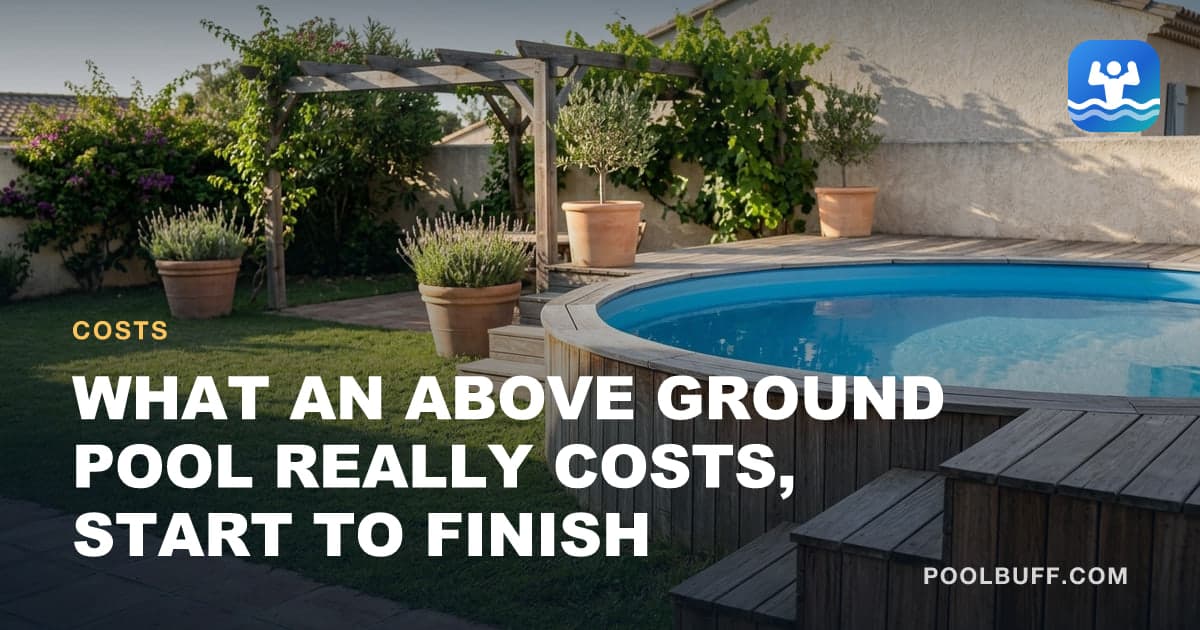
A deck around an above ground pool runs $2,000 to $15,000 and upward, and on a lot of installs it costs more than everything else combined.
It is also the thing that turns an above ground pool from something you climb a ladder into, to something that feels like part of the house. Plenty of people consider it the point of the exercise.
Worth knowing before you commit: a deck built to the pool wall makes liner changes and eventual removal harder and more expensive. Building it freestanding, with a gap, costs a little more now and saves you later.
Running costs
Smaller water volume than an inground, so everything is cheaper — but not proportionally, because the chemistry moves faster in a small pool.
| Typical | Notes | |
|---|---|---|
| Chemicals | $20-$50 per month | In season. Small volume means small doses and frequent testing |
| Electricity | $15-$40 per month | Smaller pumps than an inground, shorter run times |
| Water | Under $50 a year | Top-ups and the occasional partial drain |
| Liner replacement | $400-$1,500 | Every 6-12 years. The recurring cost nobody plans for |
| Winter cover | $100-$400 | Every 3-5 seasons in a cold climate |
The number that actually matters
Sticker price is a bad way to compare these, because the cheap options do not last.
Take total spend divided by realistic years of use:
- A $1,000 soft-sided pool that lasts three seasons is around $330 a year, and you get a pool you cannot really put a deck around.
- A $7,000 steel-wall install lasting twelve years is about $580 a year, and it is a proper pool the whole time.
- A $12,000 resin install lasting twenty years is around $600 a year, and years fifteen through twenty are still good ones.
The gap between those is much smaller than the sticker prices suggest. Which means the honest question is not "what is cheapest" but "how long am I staying, and how much do I want to enjoy it while I am here."
Removal, eventually
Every above ground pool comes down at some point, and it costs money at exactly the moment you have stopped wanting to spend any on it.
$500 to $2,500 for professional removal and disposal, driven by size, whether there is decking to dismantle, and access to the yard. Doing it yourself is disposal fees only — but a steel wall under tension is sharp and unforgiving, and it deserves more caution than it usually gets.
You will also have a large circle of dead grass and compacted base material to deal with. Budget a weekend and some topsoil.
Against an inground
Not close, and it should not be.
An inground pool starts at roughly ten times the installed price of a comparable above ground. Over decades the gap narrows slightly — an above ground needs liners and eventually replacing, while a well-built inground does not — but it never comes close to closing.
What you buy with the difference is permanence, depth, a shape you chose, and something that reads as part of the property rather than an object in the yard. Whether that is worth the multiple is a question about how long you are staying and what you want from the space.
Go deeperWhat the other option costsReal installed costs by type, what sits inside a quote, and the allowances that blow budgets.The used pool question
Secondhand above-ground pools appear constantly on local listings, often free to whoever takes them down. Whether that is a bargain depends almost entirely on what you are actually being given.
The liner is not reusable. Once a liner has been fitted and filled it has stretched to that pool on that base, and it will not go back the same way. Budget for a new one — $300 to $1,200 — and treat any liner that comes with the pool as packaging.
Steel walls are the risk. Rust at the bottom of the wall, where it met damp ground for a decade, is common and is not repairable. Inspect the outside of the wall at ground level before agreeing to anything, and walk away from anything flaking.
You are taking it down as well as putting it up. That is a full day, sometimes two, and dismantling a pool badly bends the top rails and uprights that make it round.
The base is still the whole job. Everything on the installation page applies, and it is the same cost whether the pool cost nothing or three thousand dollars.
A sound resin-framed pool with good uprights is genuinely worth collecting. A ten-year-old steel wall is usually worth exactly what is being asked.
A realistic all-in budget
Three honest scenarios, everything included:
Doing it yourself, flat yard, no deck. Kit, base material, a simple ladder, startup chemicals, and an electrician for the circuit. $3,000 to $5,000.
Professionally installed, basic prep, no deck. The common case. $5,000 to $10,000.
Installed with a full deck, fencing and a heater. $15,000 to $30,000, which is genuinely inground territory in some markets and worth pausing over before you commit.
If that last number surprises you, it is the reason this article exists. The pool was never the expensive part.
Go deeperDoes it add to the house?Above ground almost never does. Here is what actually moves resale value. Go deeperAnd taking it out againAbove ground removal is cheap. Inground is a different conversation.Frequently asked questions
How much does an above ground pool cost installed?
For a decent 18ft round with professional installation and basic site prep, expect $5,000 to $10,000 before any decking. The kit is $1,500 to $3,500 of that, installation $1,500 to $4,000, and site prep $500 to $3,000 depending on how level your ground already is.
Is an above ground pool cheaper than an inground?
Dramatically, up front. An inground pool starts around ten times the price of a comparable above ground. Over a long enough period the gap narrows a little, because an above ground needs liners and eventually replacing while a well-built inground does not, but it never closes. Above ground is the cheaper pool by a wide margin.
What are the hidden costs of an above ground pool?
Electrical for the pump, fencing or barrier compliance, site prep if your ground is not level, and decking. Those four routinely add more than the pool itself. After that it is liner replacement every six to twelve years and eventual removal.
How long does an above ground pool last?
A soft-sided pool is two to five years. A steel-wall pool is seven to fifteen. A quality resin or hybrid pool can pass twenty with good care. The base it sits on and how you handle winter matter more than the price on the box.
How much does it cost to remove an above ground pool?
Five hundred to $2,500 for professional removal and disposal, depending on size, decking and access. Doing it yourself costs disposal fees only, but a steel wall coming down is genuinely sharp work and worth respecting.