Fiberglass prices behave differently from every other pool, and it is worth understanding why before you read a single quote.
A gunite pool is built from nothing in your yard. Every quote is a different set of assumptions about labor, steel, concrete and finish, which is why three quotes for the same pool can be twenty thousand dollars apart.
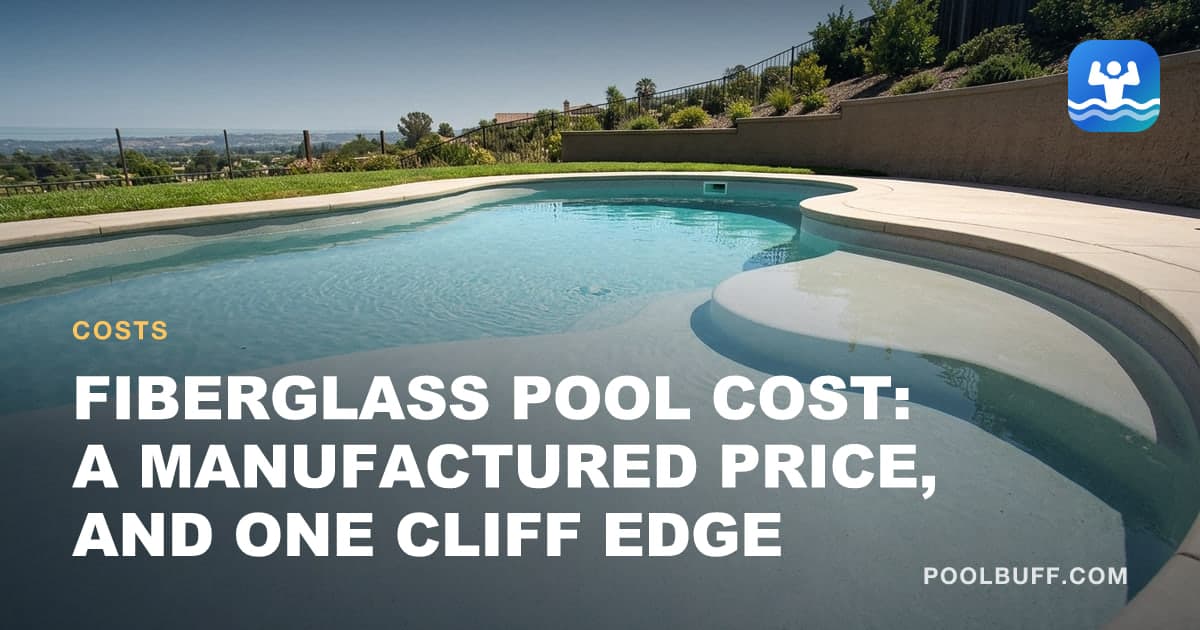
A fiberglass pool starts as a shell that came off a mold in a factory at a price the builder paid. That anchors the whole number.
Key takeaways
- The shell is a factory product, so the price band is genuinely tighter than gunite.
- Access is the cliff edge. If a truck and machine cannot reach the hole, a crane can add five figures.
- Road transport caps shell width at roughly 16 feet. Want wider, and you are building gunite.
- The real saving is over twenty years: no liner replacements and no replastering in that window.
- It is not automatically the cheapest option. On a small simple pool, vinyl usually still wins on price.
Where the money goes
| Typical share | Notes | |
|---|---|---|
| Shell, delivered and set | $45,000-$65,000 | The manufactured part. Priced by model and size |
| Excavation and base | $4,000-$12,000 | Soil conditions and spoil removal drive this |
| Plumbing and equipment | $5,000-$12,000 | Pump, filter, and the pipe runs to the pad |
| Electrical and bonding | $1,500-$4,000 | Not optional, and inspected |
| Backfill and compaction | $2,000-$6,000 | Done in layers as the pool fills, to keep the shell supported |
| Decking | $5,000-$25,000+ | Rarely included beyond a minimum band. Often the biggest variable |
The cliff edge: access
This is the fiberglass-specific risk, and it is worth checking before you fall in love with a model.
The shell arrives in one piece, on a truck. It then has to get from the street into a hole in your back yard.
If an excavator can reach the yard, the shell is walked or lifted in with the machine and this is a normal day.
If it cannot — a narrow side gate, a neighbor's wall, a steep drop, a mature tree in the wrong place — the answer is a crane lifting the shell over the house. That is not exotic, it happens constantly, and it costs real money. A crane lift can add anywhere from a few thousand dollars to well over ten, depending on reach, size and how long the road has to be closed.
And on some sites it simply cannot be done. Overhead power lines, no crane standing position, no street frontage. At that point fiberglass is off the table regardless of budget, and gunite — which arrives as a hose and a crew — becomes the only inground option.
Go deeperThe other questions to ask before signingVerifying the license, reading three quotes that disagree, and the equipment line nobody reads.The size ceiling nobody mentions up front
Fiberglass shells travel by road. That sets a hard limit.
Around 16 feet wide is the practical maximum. Beyond that you are into oversize load permits, escort vehicles and route planning, and most manufacturers simply do not make them wider.
Length is far less constrained — 40 feet and beyond is available. So the shape you can have is long and relatively narrow, in whatever forms the manufacturer molds.
If you want wider than that, a genuinely custom shape, a vanishing edge, or a depth profile nobody offers, you are building gunite. That is not a criticism of fiberglass; it is just where the boundary sits, and it is better known early.
The twenty-year math
This is fiberglass's real financial argument, and it gets made badly.
The up-front price often lands close to gunite, and sometimes above vinyl. What differs is what happens afterward.
| Fiberglass | Gunite | Vinyl | |
|---|---|---|---|
| Surface life | 15-25 years of gelcoat | 7-12 years of plaster | 8-12 years per liner |
| Surface renewal cost | $8,000-$18,000 refinish | $6,000-$20,000 replaster | $3,000-$8,000 per liner |
| Times in 20 years | Once, maybe none | Twice | Twice |
| Surface porosity | Non-porous | Porous — holds algae, uses more chlorine | Non-porous |
A non-porous surface is not a marketing line. Algae gets a grip in the pores of plaster in a way it cannot on gelcoat, which means less brushing and lower chemical demand year on year. It is a small monthly difference that compounds over two decades.
Go deeperWhat surface renewal actually costsHow long each finish lasts, what it costs by material, and the signs it is genuinely overdue.What actually goes wrong with a fiberglass shell
The twenty-year math above assumes the gelcoat behaves. Mostly it does, but three failure modes are worth knowing before you commit, because they shape what a warranty is actually worth.
Spider cracking — fine surface crazing in the gelcoat, usually around steps, benches, and wherever the shell was supported in transport or when it was set. Cosmetic at first and repairable, but matching gelcoat color on a cured shell is genuinely difficult and repairs frequently show.
Osmotic blistering — small raised blisters where water has worked through the gelcoat into the laminate beneath. Uncommon on modern shells built with a vinyl ester barrier coat, which is a specification worth asking about by name. Where it does happen it is a manufacturing issue rather than an owner one, which is precisely why who made the shell matters more here than in any other pool type.
Fading and chalking. Gelcoat is a pigmented surface and UV works on it. A pool in intense sun loses some depth of color over fifteen years, most visibly in darker finishes, and the waterline band goes first.
Warranties here are usually split in two: a structural warranty on the shell, often lifetime and sometimes transferable, and a much shorter surface warranty on the gelcoat — commonly three to fifteen years, sometimes prorated. Read them as two separate documents. The structural number is the one that gets advertised, and the surface number is the one you are far more likely to use.
When fiberglass is not the cheaper answer
Worth saying plainly, because the twenty-year argument gets over-applied.
On a small, simple pool, vinyl usually still wins on total cost. A modest rectangle with a liner replaced twice in twenty years can come in below a fiberglass shell that never needed touching.
On a difficult site, the crane can erase the advantage in a single line item.
If you are moving in five years, the twenty-year math is somebody else's. Judge it on up-front price and on what sells in your market.
If you want something unusual, the shell catalog is the constraint and gunite is the answer.
Go deeperThe three types, side by sideBuild time, real lifespan, running costs, and what you cannot change later.Getting comparable quotes
Because the shell is a known product, you can compare fiberglass quotes more directly than any other pool type — as long as you make them line up.
- Same model, same manufacturer. Two different shells are two different pools.
- Crane in or out? If one quote assumes machine access and another prices a lift, they are not comparable.
- How much decking is included? Usually a minimum band, and this is where quotes diverge most.
- Is the equipment specified by model? A cheaper quote often has a single-speed pump and a marginal filter in it.
Get those four aligned and fiberglass quotes tend to land within a few thousand dollars of each other. When one is dramatically lower, something on that list is different.
Frequently asked questions
How much does a fiberglass pool cost installed?
Most land between $55,000 and $95,000 installed in 2026. Smaller shells on easy sites come in lower, and large shells with difficult access or extensive decking push higher. The shell delivered and set is typically $45,000 to $65,000 of the total.
Why are fiberglass pool quotes so similar to each other?
Because the shell is a manufactured product. A builder buys it from a manufacturer at a known price, so the part of the job that varies is excavation, plumbing, electrical, backfill and decking. Gunite is built on site from scratch, which leaves far more room for quotes to diverge.
What is the biggest hidden cost with a fiberglass pool?
Access. The shell arrives on a truck in one piece and has to be lifted into the hole. If a machine can reach the yard it is straightforward. If it cannot, a crane lift over the house can add anywhere from a few thousand dollars to well over ten, and on some sites it simply is not possible.
How big can a fiberglass pool be?
Around 16 feet wide is the practical ceiling, because the shell travels by road in one piece and wider loads need special permits and escorts. Lengths of 40 feet or more are available. If you want a pool wider than that, or a genuinely custom shape, you are looking at gunite.
Is a fiberglass pool cheaper than gunite over time?
Usually, yes. The gelcoat surface typically runs 15 to 25 years before it needs refinishing, where plaster wants redoing every 7 to 12. Add lower chemical demand from a non-porous surface and the twenty-year picture favors fiberglass, even where the up-front prices are close.