There's exactly one test that matters when choosing a pool deck, and showrooms are designed so you never perform it.
Get a sample. Put it outside in full sun. Come back at two in the afternoon in August and stand on it barefoot.
That's it. That's the test.
Key takeaways
- Color matters more than material for surface temperature. Light beats dark, every time.
- Wet grip and cool underfoot usually come together, because both come from a porous textured surface.
- Concrete is cheapest to install and the most likely to crack. Pavers can be lifted and reset.
- Salt pools are hard on natural stone. Rinse it, or choose accordingly.
- Budget for the expansion joint and its sealant. It's the detail that protects the whole deck.
The comparison
| Barefoot in full sun | Wet grip | Installed $/sq ft | Maintenance | |
|---|---|---|---|---|
| Travertine | Coolest. Genuinely comfortable | Excellent | $15-$30 | Seal every 3-5 yrs |
| Shell-blend pavers | Very cool | Excellent | $14-$28 | Low |
| Concrete pavers (light) | Comfortable | Good | $12-$25 | Re-sand joints occasionally |
| Broom-finish concrete (light) | Warm but tolerable | Good | $8-$15 | Seal, watch for cracking |
| Stamped concrete | Depends on color, often hot | Varies with the stamp | $12-$22 | Re-seal every 2-3 yrs |
| Porcelain tile | Hot in dark colors | Check the slip rating | $18-$35 | Very low |
| Composite decking | Very hot in dark colors | Good | $20-$40 | Very low |
| Natural stone (dark) | Painful | Good | $20-$45 | Seal, and rinse on salt pools |
| Wood decking | Comfortable | Poor when wet and mossy | $15-$35 | High — annual |
Color beats material
The thing people get wrong: they choose a material for temperature when they should be choosing a color.
A light porcelain tile is cooler than a dark travertine. A charcoal concrete paver is hotter than white broom-finish concrete. Within any material, the light version is dramatically cooler than the dark version.
Dark decks look fantastic in photographs, and in Phoenix in July they're unusable barefoot. If you love the look, use dark material in shaded areas and light material where the sun hits.
To put numbers on it: a light-colored deck in full summer sun typically sits somewhere around 110 to 125°F, while a dark one in the same conditions can pass 150. Skin starts registering pain in the low 120s, which is the whole difference between a deck people walk across and a deck people hop across.
Wet grip
Second most important thing, and it correlates with temperature for the same reason: porous, textured surfaces both shed heat and grip well.
Porcelain has a slip rating. Ask for it. There's a huge range, and a polished porcelain that looks superb indoors is genuinely dangerous around a pool.
Sealers can reduce grip. If you seal travertine or concrete, use a penetrating sealer rather than a topical film-forming one. Film sealers look glossy and get slick.
Wood and moss is the worst combination on this list. If you have wood decking anywhere shaded, expect to be cleaning it regularly.
Drainage decides more than the material does
A deck that does not shed water is a problem no material solves.
The requirement is a slope away from the pool — about a quarter inch per foot, enough to move water and shallow enough that nobody notices it underfoot. The direction matters as much as the slope: a deck pitched toward the water carries dirt, fertilizer and lawn chemical straight into it, and a deck pitched toward the house carries all of that somewhere worse.
Where the yard makes that impossible — a deck against a rising bank, or a pool cut into a slope — you need a drain, and a channel drain along the high edge is the usual answer. Designing one in costs a few hundred dollars. Retrofitting one into finished concrete is a saw, a dust cloud and a bad week.
Two failures follow from getting this wrong, and both take years to show. Water standing on a deck grows algae down in the texture, which is slippery and takes on a gray-green cast that washing never entirely lifts. And water running under a paver deck washes out the bedding sand, so the pavers settle in a pattern that traces exactly where the water has been going.
Coping is a separate decision
Worth separating out, because it usually appears as one line on a quote and does a different job.
Coping is the edge — the piece capping the pool wall, taking loads the deck field never sees. People sit on it, push off it and drag equipment across it, and it lives under splash more or less permanently.
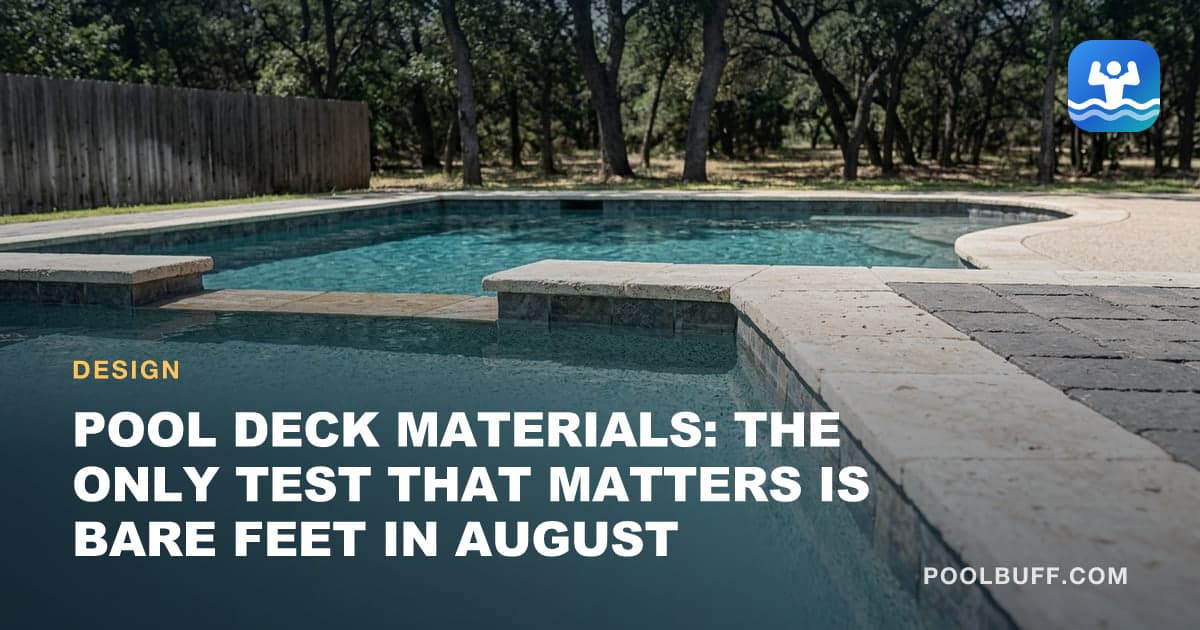
You can pair almost any coping with almost any deck, and matching them exactly is a stylistic choice rather than a technical one. Contrast is common and reads well: a light bullnose travertine coping against a darker deck field gives the edge definition and keeps the hottest surface away from where feet actually land.
What matters technically is the profile. Bullnose is rounded, and it is the most comfortable to sit on and the easiest to grab from in the water. Square-edge looks sharper in photographs and is less forgiving of elbows and knees. Cantilevered concrete, poured out over the shell edge, is the cheapest option and ties the coping to the deck — which is fine right up until the deck moves, at which point the two move together and the tile line pays for it.
Poured concrete vs pavers
Poured concrete is cheapest, fastest, and it will crack. Not might — will, eventually, because concrete moves. Control joints manage where it cracks. When it does crack, repair is visible.
Pavers cost more and are laid on a compacted base with sand joints. When the base settles you lift the affected pavers, correct the base, and put them back. Nothing is visible afterward.
That reset-ability is why pavers are worth the premium on any site with settlement risk, near a new pool where backfill will settle, or where you might want to run plumbing or conduit later.
The expansion joint
The unglamorous detail that protects everything else.
There has to be a flexible gap between the pool shell and the deck, filled with mastic sealant. It lets the deck and the shell move independently.
When it fails — and the sealant does degrade, typically in five to ten years — deck loads transfer into the coping and the tile line, and you get cracked tiles and lifted coping.
Put mastic replacement on your list. It's a few hundred dollars and it prevents a several-thousand-dollar problem.
Salt pools
Salt is mildly corrosive and it concentrates where splash-out evaporates on the deck.
Natural stone suffers most. Travertine and limestone can spall and pit over years of salt exposure. Rinsing the coping and the splash zone with fresh water regularly makes a real difference, and sealing helps.
Concrete and porcelain handle it well.
If you're on salt and set on natural stone, budget for sealing and get into the habit of rinsing. It's not a reason to avoid stone, it's a reason to look after it.
Sizing the deck
More useful than choosing the material, honestly.
- Three feet is access. You can walk around the pool.
- Six feet takes a single row of loungers with a walkway behind.
- Eight to ten feet on one side is where a deck becomes a place people sit and spend an evening.
Better to have ten feet on one side and three on the others than six all the way round. Concentrate the space where you'll use it.
Go deeperLayout in a small yardWhere to put the deck when you can't have it everywhere.Frequently asked questions
What is the coolest pool deck material?
Travertine and shell-blend pavers are consistently the coolest underfoot, because they're light colored and porous enough to shed heat. Light broom-finished concrete is next. Dark porcelain, dark composite decking and dark natural stone can reach genuinely painful surface temperatures in direct sun.
What is the best pool deck material?
For most people, light-colored travertine or concrete pavers. They stay cool, grip well when wet, look good, and individual pieces can be lifted and reset if the base settles. Poured concrete is cheaper and the trade-off is that a crack is a repair rather than a reset.
How much does a pool deck cost?
Broom-finished concrete runs $8-$15 per square foot installed. Concrete pavers $12-$25, travertine $15-$30, porcelain $18-$35, and composite decking $20-$40. A typical 600-800 square foot deck therefore ranges from roughly $6,000 to $28,000.
Do you need an expansion joint around a pool?
Yes. The flexible gap between the pool shell and the deck absorbs ground movement. Without it, deck loads transfer into the coping and tile line and crack them. The mastic sealant in that joint is a maintenance item and needs replacing every five to ten years.
Is composite decking good around a pool?
It's low maintenance and looks good, and dark colors get very hot in direct sun. If you want composite around a pool, choose the lightest color available and check the manufacturer's surface temperature data. In a hot climate it's often the wrong choice regardless of color.