Almost every pool problem is a plumbing problem wearing a costume.
The pump won't prime, the heater faults, the skimmer barely pulls, filter pressure reads wrong. In each case what's actually happening is water not moving the way it should through a loop. Air blowing out of the returns is the same story with a visible symptom.
Understanding the loop makes all of those readable instead of mysterious. It's a short loop.
Key takeaways
- Suction side pulls, pressure side pushes. A leak on one sucks air, a leak on the other drips water.
- The chlorinator goes after the heater. Put it before and you corrode the heat exchanger.
- Two-inch pipe moves about 65% more than inch-and-a-half at the same water speed.
- Unions at every piece of equipment turn a two-hour job into a twenty-minute one.
- Head loss is what your pump fights. Every elbow, valve and foot of undersized pipe adds to it.
The loop
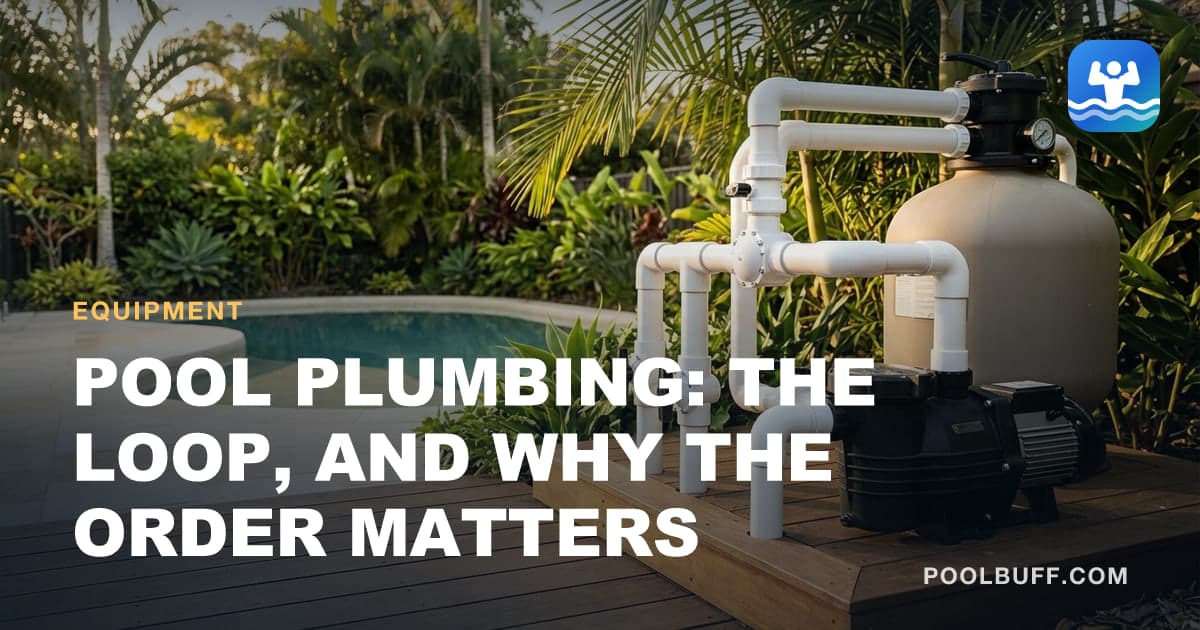
Out of the pool through two openings. The skimmer takes the surface, where floating debris and most of the oils are. The main drain takes from the bottom, keeping the deep end circulating. A valve blends them.
Through the pump. A basket catches what the skimmer missed, then the impeller does the work.
Through the filter. Everything downstream is now clean water, which is the point of that ordering.
Through the heater, if you have one.
Through the tablet chlorinator or salt cell.
Back to the pool through return jets.
That's it. Six stops.
Suction side and pressure side
This is the distinction worth actually internalizing, because it tells you where to look for half of all pool faults.
Suction side: everything from the pool to the pump. Under vacuum. The pump is pulling.
Pressure side: everything from the pump onward. Under pressure. The pump is pushing.
They fail in opposite ways.
| Suction side leak | Pressure side leak | |
|---|---|---|
| What escapes | Nothing. Air gets pulled in | Water gets pushed out |
| What you see | Bubbles in the pump basket and at the returns | A wet patch, a drip, sometimes a spray |
| When it shows | Only while the pump runs | Only while the pump runs |
| Water loss | Little or none | Real, and measurable |
| How hard to find | Hard. Nothing to see | Usually easy. Follow the wet |
So: bubbles in the basket means look before the pump. A puddle means look after it. That one rule sends you to the right half of the system every time.
Go deeperNarrowing a leak downBucket test first, then work out which side and roughly what depth.Why the order matters
Two pieces of the sequence are not negotiable.
Filter before heater. Debris that reaches a heat exchanger either blocks it or scours it. The filter is what stops that. Nobody plumbs it the other way on purpose, but it does turn up on jobs where someone rearranged a pad.
Chlorinator after heater. This one gets done wrong regularly and it's expensive.
A chlorinator or salt cell produces highly concentrated chlorine right at its outlet. If it sits before the heater, that concentrated slug goes straight through the heat exchanger — usually copper or cupronickel. It will corrode it, and heat exchangers are one of the most expensive parts on the pad.
Put it last. And put a check valve between the heater and the chlorinator, because when the pump shuts off, water in the plumbing wants to run backward. Without that check valve, chlorinated water drains back into the heater and sits there overnight, every night.
Pipe size
Residential pools are plumbed in 1.5 or 2 inch PVC, and it makes a real difference.
At the same water velocity, 2 inch carries about 65% more flow than 1.5 inch, because area scales with the square of the radius. In practice, running to the usual design limits, that's somewhere around 40 to 50 gallons per minute for 1.5 inch and 70 to 80 for 2 inch.
The design limits are velocities, not flows. The ISPSC caps residential pool piping at 8 feet per second on both suction and return; public pools get a tighter 6 fps on suction, and that lower figure is the one most designers aim at on a residential suction line too. Past that you get noise, turbulence, and friction loss that climbs steeply.
Why it matters more now: variable-speed pumps only save you money if the system will move enough water at low RPM. Low RPM means low pressure, and low pressure only works if the plumbing isn't fighting you. Undersized pipe is what forces people to run a variable-speed pump at 2,600 RPM and wonder where the savings went.
Go deeperSizing the pump to the plumbingWhy most pools are running a pump two sizes bigger than they need.Head loss, briefly
Head loss is the resistance your pump has to overcome. It comes from:
- Pipe friction, which rises fast in undersized pipe
- Fittings. Every 90-degree elbow costs meaningfully more than a sweeping bend
- Equipment. A dirty filter is a large and rising chunk of it
- Height, if the equipment sits below the pool
You don't need to calculate it. You need to know it exists, and that it's why two identical pumps on two identical pools can deliver very different flow.
Practical version: fewer elbows, bigger pipe, clean filter, and a filter with plenty of area.
Unions, and why they're worth arguing for
A union is a threaded coupling that unscrews, letting you lift a piece of equipment out without cutting anything. Its o-ring wants silicone lubricant and never petroleum grease, which swells the rubber and turns a seal into a leak.
Every pump, filter and heater should have one on each side. Without them, replacing a pump means sawing pipe, buying couplings, gluing, and waiting for cure time — turning a twenty-minute swap into an afternoon.
Same argument for isolation valves. If you can't shut the water off either side of a piece of equipment, every service job begins by draining plumbing onto your shoes.
If your pad has neither, adding them is a genuinely good weekend project. You'll be glad the first time something fails.
Go deeperWhich valve does whatMultiport, diverter, ball and check valves, and the one that shreds spider gaskets.Rigid pipe, flex pipe, and what is under your deck
Worth knowing what your pool is plumbed in, because it changes what a repair looks like.
Rigid PVC — Schedule 40, the white pipe with printing along it — is the standard and the right answer. It is cheap, it glues into a permanent joint, and it is repairable by anyone with a saw and a coupling.
Flexible PVC looks like a thick gray hose and was used widely because it bends around corners without fittings, which saves labor on a curved pool. It has two problems. It is considerably more attractive to burrowing insects and rodents than rigid pipe, and there are regions where that is a genuine and well-documented cause of leaks. And it cannot be located as easily, because it wanders rather than running straight between two points.
Black poly pipe appears on some older and above-ground installations, joined with barbed fittings and clamps rather than glue. The clamps are the wear item.
If you are having work done, specify rigid PVC for anything new. And if you have flex under a deck and a slow leak nobody can find, that combination is worth mentioning to whoever is looking for it.
Freeze protection
Water expands when it freezes, and PVC doesn't stretch.
In a climate that freezes, plumbing either gets drained and plugged for winter, or kept moving. Equipment has drain plugs for exactly this — pump, filter, heater — and a closing routine is mostly about getting water out of things that will crack.
In a mild climate where you never close, freeze protection usually means the automation running the pump when temperature drops near freezing, because moving water is much harder to freeze than still water.
Go deeperGetting the water outBlowing lines, plugging returns, and the order that avoids freeze damage.Frequently asked questions
What order should pool equipment be plumbed in?
Pump, then filter, then heater, then chlorinator or salt cell, then back to the pool. Filter before heater so debris never reaches the heat exchanger, and chlorinator last so concentrated chlorine is not sitting against expensive metal. A check valve between heater and chlorinator stops backflow when the pump shuts off.
What is the difference between the suction side and the pressure side?
Everything between the pool and the pump is the suction side, under vacuum. Everything from the pump onward is the pressure side. It matters because they fail differently: a suction leak pulls air in and never drips, while a pressure leak sprays or drips water where you can see it.
Should pool plumbing be 1.5 inch or 2 inch?
Two inch if you have the choice. At the same water velocity it carries about 65% more flow than inch-and-a-half, which means much lower head loss. That matters most with a variable-speed pump, because low head is what makes running at low speed actually work.
How fast should water move through pool pipes?
The ISPSC allows 8 feet per second on residential suction and return piping alike. Public pools are held to 6 fps on suction, and that is the sensible target on a residential suction line too. Past that you get noise, turbulence and rapidly rising friction loss. In practice that puts inch-and-a-half pipe somewhere around 40 to 50 gallons per minute and two inch around 70 to 80.
Why does my pool plumbing need unions?
So equipment can be removed without cutting pipe. A union is a threaded coupling that unscrews, so a pump or heater lifts out in minutes. Without them, every service job starts with a saw and ends with new fittings and a cure time.