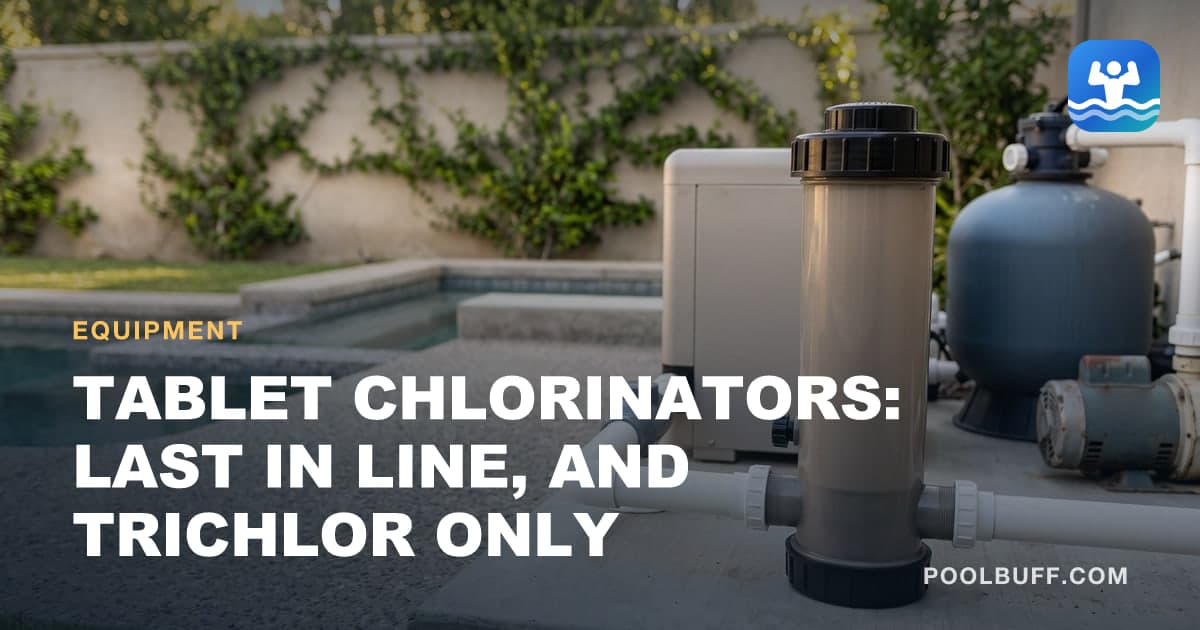
If you use tablets, this is where they belong. Not the skimmer basket, and not a floater drifting around the shallow end. A chlorinator holds a few days of tablets out of reach, doses them into the return, and lets you turn the rate up or down with a knob.
It's a simple device. A tub, a lid and a valve. The ways it goes wrong are about where it sits and what goes in it, and one of them can hurt you.
This guide is built from Hayward's and Pentair's feeder manuals, the heater manuals that tell you where a feeder is allowed to go, and Hayward's support team's answers on its product pages.
Key takeaways
- It goes after everything, heater included. Hayward, Pentair and the heater makers all put it last, with a check valve so strong chlorine can't back up into the heater when the pump stops.
- Slow-dissolving trichlor only. Hayward and Pentair both warn that calcium hypochlorite in a trichlor feeder can cause a fire or an explosion.
- The dial isn't a dose. On Hayward's CL200, the halfway mark gives a little over a quarter of full output, so move it one step at a time and test daily.
- Pentair's gallon ratings assume a daily chlorine demand and a pump that runs all day. Its 320 covers 26,800 gallons at 2.5 ppm a day and 6,700 at 10, and a third of either on an 8-hour turnover.
- Every tablet adds stabilizer. A feeder makes tablets effortless, which is exactly how stabilizer climbs past 100 by late summer.
Inline or offline
Both kinds do the same job. The difference is how the water gets in.
Inline feeders go straight into the return pipe. The full flow passes through the base, and a share of it is turned up through the tablets. Hayward's CL200 and Pentair's Rainbow 320 are built this way, and so are two of Jandy's three TruChlor models. Pentair calls the 320 a permanent installation.
Offline feeders stand beside the plumbing and connect to it with two small tubes. You drill two holes in the pipe, clamp a saddle fitting over each and run tubing to the canister. Hayward's CL220, Pentair's Rainbow 300 and the off-line TruChlor work like this, and Pentair says the 300 is meant for pools where cutting into the return line isn't practical. That makes it the retrofit option. And it's one or the other: an owner asked Hayward whether the CL220 could go inline instead, and Hayward Support said no.
| Type | Holds | Connects with | |
|---|---|---|---|
| Hayward CL200 | Inline | 9 lb of tablets | 1½-inch female threads. The CL2002S version has 2-inch slip ports |
| Hayward CL220 | Offline | 9 lb | Two tubes on saddle fittings, through 3/8-inch holes |
| Hayward CL100 and CL110 | Inline and offline | 4.2 lb | The smaller versions of the two above |
| Pentair Rainbow 320 | Inline | 11 three-inch or 98 one-inch tablets | Glues into 2-inch PVC, or 1½-inch with the bushings supplied |
| Pentair Rainbow 300 | Offline, freestanding | 11 three-inch or 98 one-inch tablets | Two tubes on saddle clamps, through 3/8-inch holes |
| Jandy TruChlor | Inline, or offline on its own base | Nine 3-inch tablets or 5 lb of 1-inch | Inline on 2 or 2½-inch Jandy unions. Offline on two lines from clamps over 3/4-inch holes |
My view: if the pad's plumbing is being redone anyway, go inline. It's one canister in the pipe, with no tubing to look after. If the pipes are glued and you'd rather not cut them, offline is the sensible answer. Just know the tubing is a wear part. Pentair says to inspect it at every refill and replace it yearly if it needs it.
An inline feeder also adds a little resistance to the return. Hayward gives the CL200's loss as 2.01 psi at 50 gallons a minute. That's small, but it's worth knowing if the pump was sized with no headroom.
It goes last. After the heater
Every feeder manual says this, and so do the heater manuals.
Hayward says to always install the chlorine feeder after the heater, or after the filter if there's no heater, because concentrated chlorine flowing through them can damage both. Pentair's 320 manual lists the heater, pool cleaner and valves, and says the feeder goes after all of them. It warns, in capitals, that highly chlorinated water flowing through a heater can damage it.
Here's why. While the pump runs, the feeder adds a steady trickle of chlorine to a lot of moving water. When the pump stops, water sits in and around the canister with tablets in it, and it gets very strong. Pentair's equipment sheet adds that most pool plumbing isn't airtight, and the air and chlorine mix that collects when nothing is flowing is highly corrosive to metal. With water moving, Pentair says, there's no chance of that.
So the heater makers draw a hard line too. Pentair's MasterTemp manual wants the feeder downstream of the heater and lower than the heater outlet, with a positive-seal, corrosion-resistant check valve between them. It names the part: R172288. It says back-siphoning is most likely right when the pump stops. The same instruction is in the manuals for Hayward's H-Series heaters and the Raypak 406A, and Raypak's warranty won't cover corrosion from a feeder that's out of adjustment.
The check valve. Hayward's CL200 manual says an inline, positive-seal, corrosion-resistant check valve should be installed ahead of the feeder. Pentair's 320 has one built into its base and sells R172288 for the pipe. The offline feeders put theirs on the outlet. Hayward's CL220 ships with one, sold now with its inlet adapter as CLX220EA, and Pentair's 300 has a check valve built into its outlet elbow.
A heater needs a fireman's switch. Pentair's feeder manuals say one must be installed if there's a heater, to protect the check valve and anything else heat can damage. It's a set of contacts on the time clock that turns the heater off before the pump, and the MasterTemp manual wants at least 15 minutes between them. Pool timers explained covers how it's wired.
No copper. Both makers say never to put a feeder into copper plumbing. Pentair's manual starts with the word "STOP" in capitals if your pool has it. Hayward says to ask your dealer first if you have brass or bronze valves, and Pentair says to mount the feeder as far from any metal equipment as practical, because the fumes corrode it.
Trichlor only. Never cal hypo
This is the part that can hurt you, so here it is plainly.
Both manuals carry a DANGER notice. Hayward's says to use only slow-dissolving trichlor tablets, never fast-dissolving ones, and never to mix trichlor with calcium hypochlorite or any other form of concentrated chlorine. Fire or explosion may result. Pentair's says the same, adds "clean" tablets only, and says calcium hypochlorite is not to be used in any form.
That matters because both products live on the same shelf. Calcium hypochlorite is sold as shock, and in tablet form for feeders built for it. How the chlorine types differ covers what each one is. In a trichlor feeder, it's the wrong one.
The rest of the rules are about keeping anything else out of the canister:
- Shocking. Pentair says to turn the feeder off or take the tablets out until the shock has fully dissolved in the pool. Granules getting into the canister are the danger. Once the shock is dissolved in the water, it's safe with the tablets.
- The lid O-ring. Never grease or oil. Pentair warns oil in contact with trichlor may cause a fire, and wants silicone lubricant only. Hayward says no petroleum lubricants, and names Jack's 327. Its manual gives the part as SP032712, and its site and feeder chart as SPX0327.
- A feeder that came with the house. If you don't know what's been in it, Pentair says to flush it thoroughly with fresh water before you load it.
- Bromine. Pentair's feeders take bromine tablets instead, as long as you don't mix them. Hayward sells a separate brominator, the CL220BR.
- Unstabilized tablets. Hayward Support says the CL2002S can't take them, and that Hayward doesn't make a chlorinator that can.
What the numbers on the dial mean
Not a dose. Higher numbers feed more, and that's about all either maker promises. Pentair's example is 2 in winter and 3 in summer. Both makers tell you to test daily and adjust from there. Pentair wants you to test every day for the first five days and to make small changes.
Hayward's specification table shows why small changes matter. Fully open, the CL200 is rated at 2.3 pounds of chlorine a day on a pool. At half, it's 0.63. So the halfway mark gives a little over a quarter of full output, not half.
To put that in pool terms: 2.3 pounds of chlorine a day in a 20,000-gallon pool is about 14 ppm a day. The halfway setting is still close to 4. Start low and work up.
Pentair rates its feeders by how many gallons they can raise by a given amount in a day. The product page says the 320 treats 6,500 to 27,000 gallons, and the sell sheet shows what sits behind that range:
- At 10 ppm a day: 6,700 gallons
- At 5 ppm a day: 13,400 gallons
- At 2.5 ppm a day: 26,800 gallons
So the big number only holds if your pool burns about 2.5 ppm a day. A hot, busy pool in full sun burns more, and the same feeder covers less water. The offline 300 runs higher: 11,900, 23,800 and 47,600 gallons at the same three rates.
And every one of those figures assumes the water circulates for 24 hours. The sizing chart in Pentair's 2025-2026 catalog says to divide by 3 for an 8-hour turnover, which puts a 320 at under 9,000 gallons even at 2.5 ppm a day.
Those ratings use 1-inch tablets. Bigger tablets dissolve more slowly. Pentair's commercial 300-29X manual says 3-inch tablets produce less than 40% of what 1-inch tablets do. If a 320 can't keep up on 3-inch tablets, Pentair's first fix is to switch to 1-inch ones. Its second is a top-feed conversion, and it warns that top feed can over-chlorinate in normal conditions.
One more number. Both manuals say to start the feeder in water that's balanced and already holding 1.0 to 1.5 ppm of chlorine. Treat that as a place to start, not a target. How much free chlorine you actually need depends on your stabilizer. The floor is 7.5% of your cyanuric acid reading, so a pool at 30 ppm needs at least 2.25. Get it there with the chlorine dosage calculator first, then let the feeder hold it.
Refilling without a face full of gas
Hayward's manual warns the feeder may be under pressure, and both makers warn about the fumes. Wear eye and skin protection, and keep your face back when the lid comes off. Hayward's order:
- Turn off the pump and any timers.
- Turn the feeder's valve to OFF.
- Check the return to the pool is open.
- Wait a minute for the pressure to bleed off.
- If the feeder sits below water level, close the valves that isolate it.
- Take the lid off and refill with slow-dissolving trichlor.
- Lid back on, isolation valves open, dial back to its setting, pump on.
Pentair does it differently. Close the valve, stop the pump and wait a minute for the water and fumes to drain out of the feeder. Then turn the pump back on with the valve still closed, and open the cap. Its built-in check valve keeps water out while the cap is off. Two designs, two procedures, so follow the one for the feeder you own. A Pentair feeder mounted below water level needs a drain valve, or it splashes strong chlorinated water at you when you open it.
A lid that won't come off. Hayward Support's answer: make sure there's no pressure on it, then lube the O-ring with a silicone lubricant like Jack's 327 so it comes off easier next time. A stretched or flattened O-ring gets replaced: CLX200K on the CL200 and CL220, and R172009 on Pentair's 300 and 320.
Backwashing and vacuuming. Hayward's manual says to set the dial to zero before you stop the flow, keep backwashes short, and keep swimmers out until full flow is back. When you vacuum, close the feeder's valve so sediment doesn't clog it.
Empty it for winter
Hayward says to drain the feeder, take out every tablet and every piece of tablet, rinse it out, and put the cover and drain plug back.
Here's why "every piece" matters. An owner told Hayward that their CL220 went off like a muffled gunshot when they tried to open it, a few weeks after closing the pool. They'd left some half-dissolved tablets inside, and thought those had clogged the ports. Hayward Support agreed. Chlorine gas had built up and pressurized the canister because it had no way out. Nobody was hurt, and that was luck. It's a step worth adding to how to close a pool for winter.
When it stops dissolving
A feeder full of dry, untouched tablets isn't getting water. Work through it in this order:
- Residue in the passages. Hayward Support says trichlor tablets are formed with calcium carbonate, and its residue builds up in the feeder's small passages until it restricts flow in or out.
- Debris in an offline feeder. Hayward takes the CL220's inlet from just after the pump, where pressure is highest. That water hasn't been filtered yet, so debris can block the inlet tube or pass through and block the outlet.
- A stuck check valve. Hayward's is marked with a dot and has a ball inside that should click when you shake it. If it doesn't, it needs cleaning or replacing. If it clicks rapidly in service, Hayward Support says the pump's pressure is fluctuating.
- Plumbing at a Pentair 320. An elbow right at the inlet makes turbulence that stops water being scooped into the feeder, so Pentair wants at least 6 inches of straight pipe first. If any equipment on a 2-inch system has smaller fittings, Pentair wants its 1½-inch bushings in the feeder's inlet to build pressure.
- Tablet size. Big tablets are slow. See the 40% figure above.
The makers don't agree on where an offline inlet goes. Hayward puts it between the pump and filter. Pentair's 300 manual puts it between the filter and heater when there's a heater, and between the pump and filter when there isn't. Pentair's own check valve sheet then says the pump-and-filter spot gives more flow. Jandy's TruChlor manual says after the pump and filter, and its drawing takes the inlet between the filter and heater. Follow your feeder's manual.
The stabilizer bill
Here's the catch with doing tablets properly. A chlorinator makes them so easy that nobody thinks about them.
Trichlor adds about 0.6 ppm of stabilizer for every 1 ppm of chlorine it delivers. A pool using 2 ppm a day picks up about 36 ppm a month, and nothing but dilution takes it back out. The tablet trap walks through the arithmetic. Test your stabilizer monthly, and switch to liquid chlorine as it gets near 50.
Tablets are acidic, too. They pull pH and total alkalinity down over time. Pentair warns that some in-floor cleaning systems aren't built for a low-pH trichlor feeder, so check with that system's maker if you have one.
If you're tired of fighting stabilizer, a salt chlorine generator makes chlorine without adding any. Hayward's AquaRite is one. It costs far more up front and needs its own care, but it ends the stabilizer climb.
Parts worth knowing
- CLX200K — lid O-ring, Hayward CL200 and CL220
- CLX200PA — control valve assembly, Hayward CL200 and CL220
- CLX220EA — check valve and inlet adapter, Hayward CL220, CL110 and CL100. The manual lists the check valve alone as CLX220CV
- SPX0327 — Jack's 327, Hayward's O-ring lubricant. The manual's number is SP032712
- R172009 — cap O-ring, Pentair 300 and 320
- R172248 — the check valve built into the Pentair 320
- R172288 — Pentair's 1½ to 2-inch corrosion-resistant check valve, the one its heater manuals name
Hayward's product pages give the CL-series a one-year parts warranty and no labor coverage. The CL200 and CL220 page has the full parts list, and the numbers that have changed since the manual.
Frequently asked questions
Where should an inline chlorinator be installed?
Last on the pad. Hayward and Pentair both say after the heater, or after the filter if there's no heater, and Pentair adds booster pumps and valves to the list of things it goes after. Put a corrosion-resistant check valve between the heater and the feeder. Pentair's MasterTemp heater manual names the part, R172288.
What number should I set my pool chlorinator on?
There isn't one right number, because it depends on your pool's chlorine demand. Pentair's example is 2 in winter and 3 in summer. Both makers say to test the water daily at first and adjust from there. Pentair says to test daily for the first five days and make small changes, one step at a time.
Can I put shock or cal hypo tablets in my chlorinator?
No. Hayward and Pentair both say to use only slow-dissolving trichlor, and never to mix it with calcium hypochlorite or any other chlorine, because it can cause a fire or an explosion. Pentair also says to turn the feeder off or take the tablets out when you shock, until the shock has fully dissolved in the pool.
Why is my chlorinator not dissolving the tablets?
Usually not enough water is getting through it. Hayward says tablet residue builds up in the small passages and restricts flow, and on an offline feeder the inlet water hasn't been filtered yet, so debris can block the tubes. Check that the check valve rattles freely, clear the tubing, and remember that 3-inch tablets dissolve much more slowly than 1-inch ones.
Can I just put chlorine tablets in the skimmer?
The heater makers say no. When the pump stops, the water around the tablets gets very strong, and Pentair's MasterTemp manual says that concentrated chlorine can reach the heater and corrode its heat exchanger. A chlorinator plumbed after the heater, with a check valve, exists to stop exactly that.
Do I need to empty my chlorinator for the winter?
Yes. Hayward says to drain it, take out every tablet and every piece of tablet, and rinse it before closing. An owner whose offline feeder burst when they opened it after a few weeks shut had left partly dissolved tablets inside, and Hayward Support agreed that chlorine gas had built up with nowhere to go.