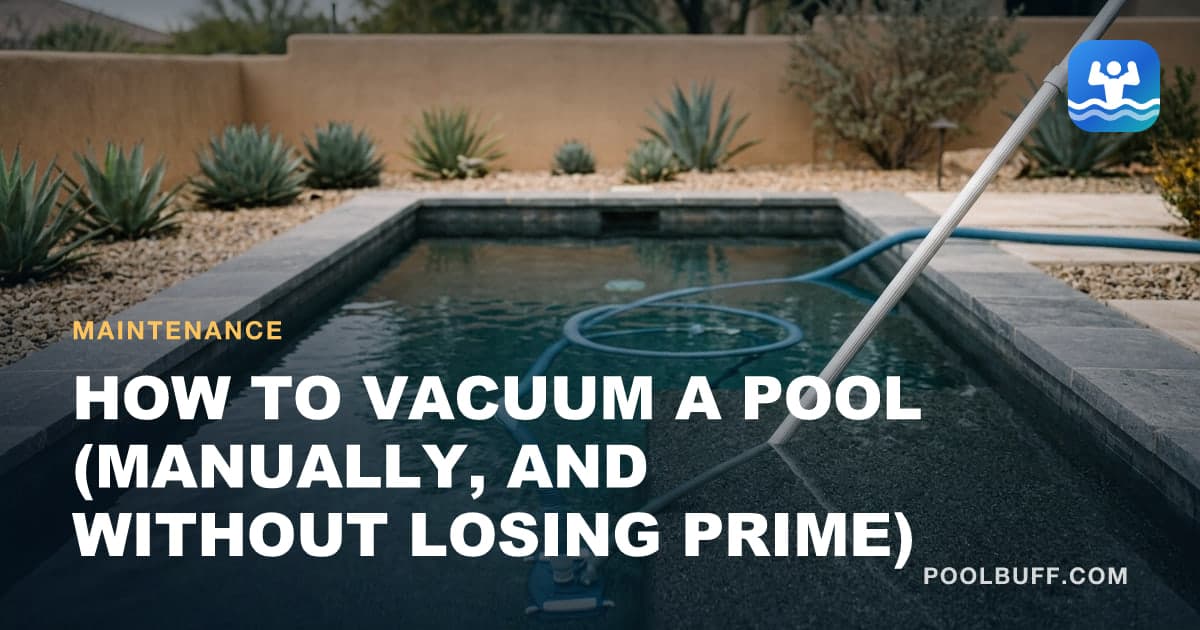
Manual vacuuming is one of those jobs that looks like it can't possibly be done wrong, and then people do it wrong in three specific ways every time.
They don't purge the hose. They move too fast. And they send algae through the filter and wonder why the pool's cloudy again by evening.
All of it is harder with the wrong kit, so it is worth reading our pool vacuum picks and the wider cleaning tool picks before you replace a head or a pole.
Key takeaways
- Purge the air out of the hose before connecting it, or you'll lose the pump's prime.
- Move slowly. Fast passes just lift silt into the water where it takes a day to settle again.
- Vacuum to waste for algae and fine sediment. Sending it through the filter just recirculates it.
- Vacuuming to waste drops your water level fast — keep the hose running and watch the skimmer.
- If the head keeps sticking to the floor, you've got too much suction. Crack a valve or use a relief.
Brush first, then wait
Brushing knocks settled dirt and biofilm off the walls and into the water. If you vacuum first and brush after, you've just made the floor dirty again.
Brush everything, then go make a coffee. Twenty to thirty minutes lets the debris settle where the vacuum can get it.
Purging the hose — the step that saves your pump
This is the one that matters mechanically.
A hose full of air, connected to the suction side, sends a slug of air straight into the pump. Best case it loses prime and you have to re-prime it. Worst case it runs dry for a few minutes, cooks the mechanical seal, and now you've got a drip and a repair.
How to purge it properly: lower the head, pole and hose into the water. Hold the free end of the hose right over a return jet. Water pushes through the hose and out the vacuum head, forcing the air out. Keep it there until you see a steady stream and no more bubbles coming up from the head.
Then, keeping that end underwater the whole time, connect it to the skimmer.
The moment you lift it out of the water, you've let air back in.
Where you connect it, and what that costs you
The hose has to attach to something on the suction side, and the options are not equivalent.
A dedicated vacuum line is the best case: a separate port in the wall on its own suction, so the skimmer carries on skimming while you vacuum. If you have one, use it — and close or throttle the other suction lines so the flow concentrates where the head is.
Through the skimmer, with a vacuum plate. The usual arrangement. The plate seats over the basket and seals the throat so the pump draws only through the hose. Two things matter here: the basket stays in place under the plate, because it is now catching everything you vacuum before it reaches the pump, and the plate has to genuinely seal. A warped or wrong-size plate pulls air, and you will spend an hour chasing a prime problem that is sitting under your hand.
Through the skimmer with no plate — hose pushed straight into the suction port beneath the basket — works, and is worse. It bypasses the basket entirely, so leaves and grit head for the pump instead, and the seal is whatever the hose fitting happens to manage.
On an above-ground pool there is usually only the skimmer, so vacuuming stops surface skimming for its duration and the water level wants watching closely. There is no main drain to fall back on if the level drops.
Vacuum slowly
Long, slow, overlapping passes. Overlap by about a third. Start shallow and work toward the deep end.
Move fast and the head pushes a bow wave ahead of it that lifts fine silt into suspension. You'll pick up the leaves and leave the silt hanging in the water, where it takes a day to settle and then you're vacuuming again.
If you're leaving a cloud behind the head, slow down.
When to vacuum to waste
Vacuuming through the filter is normal. But some material shouldn't go through the filter at all.
Vacuum to waste for:
- Dead algae after a shock treatment
- Fine silt or sand on the floor
- Anything after a flocculant treatment
- A pool that's been sitting green and neglected
Fine particulate either passes straight through the media and back into the pool, or clogs the filter within minutes. Either way you're wasting your time.
How to do it: on a multiport valve, pump off, valve to WASTE, pump on. Water goes out the waste line instead of through the filter.
Watch the water level. Vacuuming to waste dumps water fast — you can drop three or four inches in twenty minutes. Run the fill hose the whole time and keep an eye on the skimmer. If the level drops below the skimmer mouth, the pump sucks air and you're back to a prime problem.
Cartridge filters have no waste setting. Options are: vacuum through the filter and accept you'll be cleaning it, use a vacuum-to-waste adapter that discharges through a hose, or rent a portable trash pump for a big cleanup.
Common problems
Head sticking to the floor. Too much suction. Crack the main drain valve open to split the flow, or drop the RPM on a variable-speed pump. Some heads have a relief hole you can open.
Losing suction mid-job. Air getting in. Check the vacuum plate is seated over the skimmer basket, check the pump lid o-ring, and check the hose for cracks — hold suspect sections underwater and look for bubbles being drawn in.
Head floating or tipping. Weights are missing or the hose is dragging it. Some heads take add-on weights; a hose that's too short pulls the head off the floor at the far end of the pool.
Filter pressure spiking mid-vacuum. Stop, clean the filter, resume. Continuing means you're pushing water through a clogged filter and back into the pool without it being filtered.
Do you need to vacuum at all?
If you've got a working robotic cleaner and you brush weekly, honestly, not often.
Manual vacuuming earns its place:
- After a storm dumps debris
- During fall leaf drop
- After an algae treatment
- When fine sediment has settled that the robot is pushing around rather than picking up
- On the steps and the shallow shelf, which most robots handle badly
That's maybe six to ten times a season for most people, rather than weekly.
Go deeperRobotic cleaners, testedWhich ones are worth it, which are repairable, and what actually fails at year three. Go deeperTired of doing it by hand?Suction, pressure and robotic cleaners, and what each one does to your filter.What you need
- Check price
telescopic pole
Everything else attaches to this, so buy one that does not flex.
- Check price
leaf skimmer net
Debris lifted out today is not debris vacuumed off the floor next week.
Frequently asked questions
Should I vacuum my pool to waste or through the filter?
Through the filter for normal debris. To waste for algae, fine silt, sand, or anything after a flocculant treatment. Sending dead algae or fine sediment through the filter mostly just puts it back in the pool a few minutes later.
Why does my pool vacuum keep losing suction?
Usually air in the system. Check that the hose was fully purged, that the vacuum plate is seated properly over the skimmer basket, and that the pump lid o-ring is in good shape. A cracked vacuum hose also lets air in — hold each section underwater and watch for bubbles.
How long does it take to vacuum a pool?
Twenty to forty-five minutes for a typical residential pool done properly. If you're finishing in ten minutes you're moving too fast to pick anything up, and you'll see it as a cloud that settles overnight.
Can I vacuum a pool with a cartridge filter to waste?
Not directly — cartridge filters have no waste setting. Your options are to vacuum through the filter and clean it afterward, use a dedicated vacuum-to-waste adapter that discharges through a hose, or rent a portable pump for a heavy cleanup.
Why does my vacuum head stick to the pool floor?
Too much suction, usually because the skimmer is the only open suction line. Crack the main drain valve open slightly to split the flow, or fit a relief hole in the vacuum head. On a variable-speed pump, just drop the RPM.