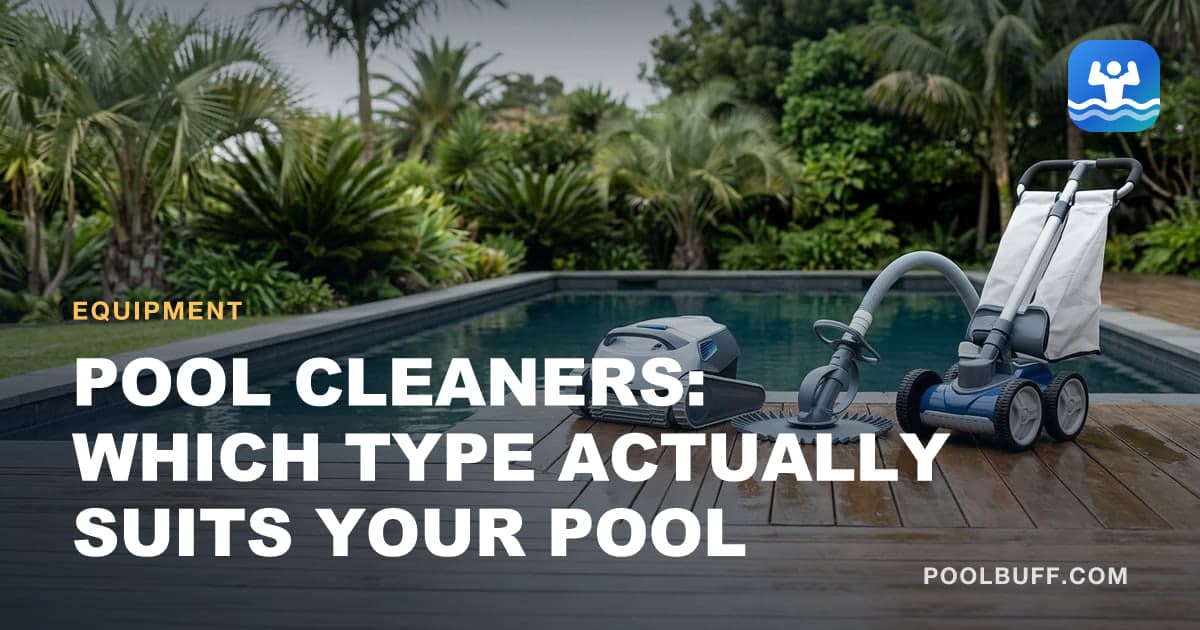
Everyone asks which cleaner is best. Wrong question.
They're three different machines that happen to share a job. One of them is probably obviously right for your pool once you know what separates them, and it usually comes down to what falls in the water and whether you already have the plumbing.
Key takeaways
- The real difference is where the dirt ends up. Suction sends it to your filter, pressure and robotic keep it in their own bag.
- A robot uses roughly 150 to 200 watts. A booster pump for a pressure cleaner pulls closer to a thousand.
- Suction cleaners are the cheapest to buy and the most likely to leave you cleaning the filter more often.
- If your pool has no dedicated cleaner line, a pressure cleaner means new plumbing. That changes the math.
- Fine silt is the honest test. Leaves are easy. Almost anything picks up leaves.
The short version
| Suction | Pressure | Robotic | |
|---|---|---|---|
| Runs off | Your pump, suction side | Return side, usually a booster pump | Its own motor, wall outlet |
| Debris goes | Into your filter | Into its own bag | Into its own cartridge |
| Typical price | $200-500 | $500-900 plus booster | $600-2,500 |
| Power per cycle | Pump must run | Pump plus about 1,000W booster | About 150-200W, pump off |
| Fine silt | Passes to filter | Often through the mesh | Held, with a fine cartridge |
| Climbs walls | Some models | Some models | Yes, and scrubs the waterline |
| Moving parts | Very few | Several | Motors, tracks, electronics |
Suction cleaners
The cheapest way to automate the floor.
It hooks to your skimmer or a dedicated suction port and your pump drags it around. No motor of its own, barely any parts. Some are little more than a disc, a hose and a flapper that makes them shuffle. Pentair's Kreepy Krauly Kruiser is the extreme case of that: its flapper is the only moving part in the machine.
Where they shine: small to medium pools, smooth surfaces, mostly fine debris, and owners who want something cheap that just works.
The catch is your filter. Everything the cleaner picks up goes into your pump basket and then your filter. Run one daily through leaf season and you'll be cleaning the filter noticeably more often. That's not a fault, it's how the design works — but it's a real cost people don't count.
They also need flow. A suction cleaner takes a share of your pump's suction, and on a pool that's already marginal it can leave the skimmer barely pulling. If you run a variable-speed pump low to save power, check the cleaner's minimum flow before you buy. Hayward's The PoolCleaner ships with interchangeable inlets for this, with a small one for small or variable-speed pumps, though Hayward warns low flow may keep it off the walls. If one that used to work has slowed down, a pool cleaner that won't move goes through the flow checks each maker lists.
Wheels, tracks or bristles is the split inside the category, and it decides what the cleaner climbs rather than what it picks up. Tracked units — Hayward's TracVac, Zodiac's MX6 and the larger MX8 — hold a wall better, and all three are driven by a turbine or engine inside the body, so what stops one is usually debris jammed in there rather than a part that has worn out. Pentair's Dorado does it a third way, riding on bristles with a lift brush that tips it over to turn — which is why Pentair says never to store it resting on that brush, because the bristles collapse and it stops turning as designed. Its above-ground ’Lil Shark rides on bristles too, two rings of them, and turns in clockwise circles by design, with a brush ring adjuster that sets how tight.
Pressure cleaners
These connect to the return side. Water coming back to the pool pushes them along, and a venturi lifts debris up into a mesh bag they carry.
The bag is the whole point. Debris never reaches your filter. On a pool under trees, that's a genuine difference — you're emptying a bag instead of stripping a filter.
They also handle big debris better than anything else. Acorns, twigs, gum nuts, the stuff that jams a suction cleaner and clogs a robot's intake. For the manual end of the same job, see our pool vacuum picks.
Read the manual on that before counting on it, though. Hayward's for its TracJet says to net large debris out by hand before the first run, and not to use the cleaner to remove large debris from a new pool.
The cost is the booster pump. Most pressure cleaners need a dedicated pump just to drive them, and that's typically around 3/4 horsepower pulling somewhere near a thousand watts whenever the cleaner runs. Two hours a day, every day, adds up to a real number on the bill. Pentair's Kreepy Krauly Platinum is a current example of the arrangement: it needs a ¾ HP booster on its own dedicated cleaner line, and neither comes in the box.
Some models are built to run on return pressure alone, no booster. The Polaris Vac-Sweep 360 is the clearest example — mechanically the same cleaner as the booster-driven 380, but plumbed into a dedicated return line instead. Those are worth seeking out if your pool doesn't already have the plumbing for a second pump.
Robotic cleaners
Completely independent. Plug it into a GFCI outlet, drop it in, and it runs on its own motor with its own filter cartridge. Your pool pump can be off the entire time.
Three things they do better:
Filtration. A fine cartridge catches material that goes straight through a sand filter. This is the thing people notice first — the water gets clearer, not just the floor.
Coverage. Good robots climb walls and scrub the waterline, which is where the grease ring and the early algae live. No suction or pressure cleaner does that as well.
Running cost. Roughly 150 to 200 watts for a cycle, versus running your pump, versus running a pump and a booster. It's not close.
The trade-offs are real, though. They cost the most up front. You have to lift a wet robot out of the pool, which is heavier than it sounds. And when one breaks, it's specialist repair — you can't fix a drive motor with a screwdriver and a trip to the hardware store the way you can rebuild a suction cleaner. Though most robot faults are not the motor — diagnosing one by symptom usually lands on brushes, a basket or the power supply.
Go deeperWhich robot, specificallyWhat to look for on filtration, warranty and parts availability before you spend.Manual vacuuming
The fourth option, and the only one everybody ends up owning regardless of what else they buy.
A vacuum head on a telescopic pole, connected to the skimmer or a dedicated vacuum line, and moved by you. It costs a fraction of anything automatic and it is the only method that lets you decide where the effort goes — a specific corner, a specific mess, right now.
Two things it does that no automatic cleaner can:
Vacuum to waste. Setting a multiport valve to waste sends what you pick up straight out of the system rather than through the filter. After an algae treatment that is the difference between clearing dead algae in one pass and pushing it through a filter you then have to strip. No automatic cleaner offers this.
Deal with a specific problem now. A storm drops a branch in the deep end and no robot helps. Manual is the tool for the discrete mess rather than the routine.
What it costs you is twenty minutes and a bit of technique — slow passes, head kept down, overlapping rows. Rushing it stirs debris into suspension rather than removing it, which is why doing it properly is worth learning once.
The honest framing is that manual is not a competitor to the others. It is the baseline, and the automatic cleaners are what stop you doing it every week.
How to actually choose
Answer these four in order. The answer usually falls out.
- 1
What falls in your pool?
Big leaves and twigs point to pressure or a robot with a large intake. Fine silt and dust point hard at a robot with a fine cartridge. Not much of anything, and a cheap suction cleaner is plenty.
- 2
What shape is the pool?
Steps, benches, tight corners and a deep end that drops away all favor a robot, because it navigates deliberately rather than wandering. A simple rectangle is fair game for anything.
- 3
What plumbing do you already have?
A dedicated cleaner return line and a booster pump already installed makes a pressure cleaner much more attractive. Nothing but a skimmer makes it much less.
- 4
How much do you run it?
Daily use makes running cost the biggest number over five years, which favors a robot. Twice a week in a mild season and the up-front price matters more.
The mistake I see most
Buying for leaves.
Leaves are the visible problem, so that's what people shop for. But almost every cleaner handles leaves. What separates them is fine silt — the fine gray film that settles overnight and puffs up in a cloud when you walk through it.
Suction cleaners send it to your filter. Pressure bags let a lot of it through the mesh. A fine robot cartridge actually holds onto it.
If your pool goes dusty rather than leafy, that's the deciding factor, and it points one direction.
What none of them do
Every automatic cleaner misses things. Tight step corners, the area right under the ladder, behind the light niche, the sharp inside corner of a freeform shape.
Plan on manual vacuuming a few times a season regardless. A cleaner turns a weekly chore into an occasional one. It doesn't delete it.
Go deeperVacuuming by hand, properlySlow overlapping passes, and how not to lose prime doing it.Running cost, roughly
Take a pool running a cleaner two hours a day through a six-month season.
- Robot: its own motor, pump off. Pennies a cycle.
- Suction: no extra motor, but your pump has to run, and your filter gets dirty faster.
- Pressure with booster: your pump plus roughly a kilowatt of booster, every cycle.
Over five years that gap gets big enough to cover the price difference between a cheap cleaner and a good robot, with change left. Worth running your own numbers at your own power rate before you decide on up-front price alone.
Frequently asked questions
What is the difference between suction and pressure pool cleaners?
A suction cleaner connects to the suction side and is pulled along by your pump, sending debris into the pump basket and filter. A pressure cleaner connects to the return side and is pushed along by water coming back to the pool, collecting debris in its own bag. Pressure cleaners keep debris out of your filter. Suction cleaners do not.
Are robotic pool cleaners worth the money?
For most pools, yes, on running cost alone. A robot runs on its own low-wattage motor and does not need the pool pump on at all, so a cycle costs pennies. It also filters finer than most pool filters and scrubs the waterline. The catch is the up-front price and the fact that repairs are specialist work.
Do pressure pool cleaners need a booster pump?
Most do, but not all. Several models are built to run on return pressure alone. A booster pump is a dedicated pump just for the cleaner, and it is the single biggest running cost of a pressure setup, so check which type you are buying.
Which pool cleaner is best for fine silt and sand?
A robotic cleaner with a fine cartridge. Silt is what separates cleaners. A suction cleaner will pick some up and send it to your filter, a pressure bag lets a lot of it straight through the mesh, and a fine robot cartridge actually holds it.
Can a pool cleaner replace manual vacuuming?
Mostly, but not entirely. Every automatic cleaner has spots it misses — tight steps, sharp corners, under the ladder. Expect to vacuum by hand a few times a season even with a good robot.