Valves are the cheapest parts on the pad and they decide everything.
Where the water comes from. Where it goes. Whether you can change a pump basket without draining half the plumbing onto your shoes. Most people never touch them until something goes wrong, and by then they're guessing at handle positions.
Here's what each one does.
Key takeaways
- Turning a multiport valve with the pump running is the fastest way to shred a spider gasket. Pump off, every time.
- A three-way diverter is not on or off. It blends, and where you set it decides how much water comes from the skimmer versus the main drain.
- Gate valves seize shut and snap their stems. If you still have them, replace them with true union ball valves.
- A check valve is what stops a chlorinator draining back into your pump. Cheap part, expensive failure.
- A valve that is hard to turn is telling you something. Forcing it is how a handle ends up in your hand.
The valves on a normal pool
Walk the pad and you'll usually find them in this order.
Suction side, before the pump: a valve on the skimmer line, a valve on the main drain line, often combined into one three-way. This is where you control what the pump pulls from.
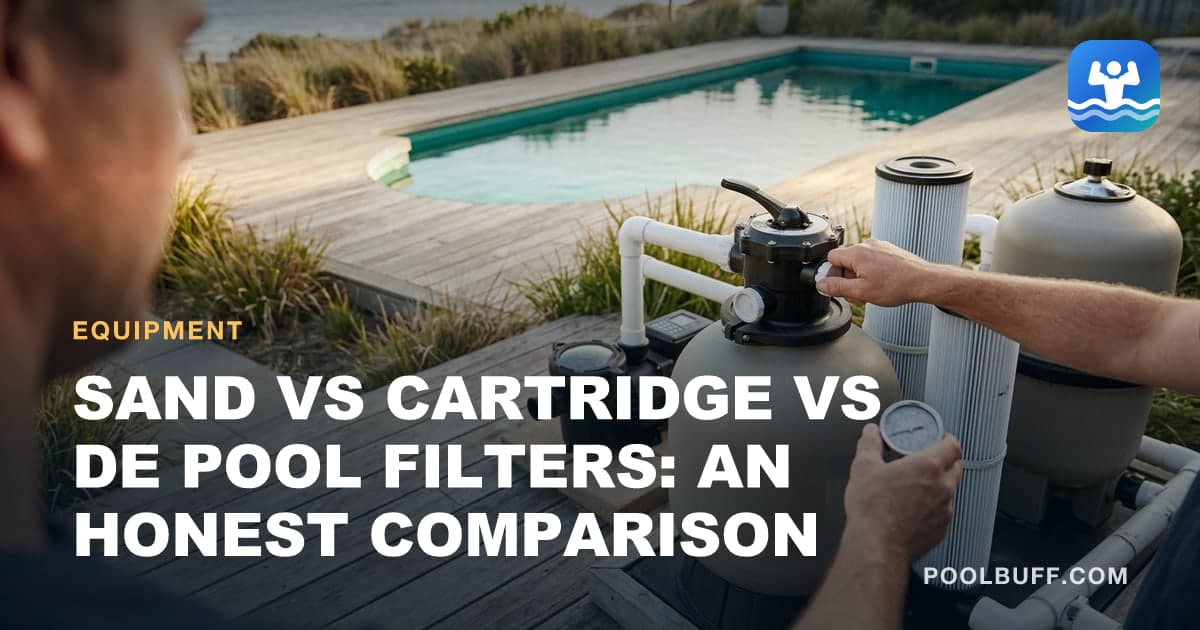
On the filter: a multiport valve or a push-pull. Sand and DE filters have one. Cartridge filters don't, which is one of their quiet advantages.
Pressure side, after the filter and heater: valves splitting flow between returns, a spa, a waterfall, a cleaner line.
Check valves: usually one before a chlorinator, sometimes one after the heater, sometimes one on the suction line of a pump mounted above the water.
That's it. Everything else is plumbing.
The multiport valve
This is the one with six or seven positions and a handle you push down and rotate.
Inside is a rotor with a rubber face — the spider gasket — that seals against ports cast into the valve body. Turn the handle and you're sliding that rubber across the ports to open a different path.
Which is exactly why you don't do it under pressure.
What each position does
| Where the water goes | When you use it | |
|---|---|---|
| Filter | Down through the media, back to the pool | Normal running. This is where it lives. |
| Backwash | Up through the media, out to waste | Sand and DE only, when pressure climbs 8 to 10 psi over clean, or the figure your filter manual gives |
| Rinse | Down through the media, out to waste | After every backwash, for the time your filter manual gives, to resettle the bed |
| Waste | Straight out, bypassing the filter | Vacuuming heavy debris, or dropping the water level |
| Recirculate | Past the filter, back to the pool | Circulating while the filter is opened up or broken |
| Closed | Nowhere | Service only. Never run the pump against it. |
Rinse is the position people skip. After a backwash the sand bed is unsettled and the filter still holds dirty water. Rinse resettles the bed and sends that water to waste instead of the pool. How long varies by brand: about 30 seconds in Pentair's Sand Dollar manual, half a minute to a minute in Hayward's, one to two minutes in Jandy's top-mount SFTM manual and one minute in its side-mount SFSM manual. Skipping it is why the water goes slightly cloudy after every backwash.
Push-pull valves
Same job, different mechanism. A push-pull, or slide valve, has two positions: filter and backwash. Which way the handle goes for each depends on the maker. Hayward's backwashes with the handle up. Jandy's slide valve is the other way round: its SFSM manual says to push the handle down and turn it to lock for backwash, and pull it up for filter.
Fewer positions, fewer things to get wrong, and no spider gasket. The trade is that you lose Waste and Recirculate, which are genuinely useful. The plunger O-rings do wear out, and when they do you get water going to waste while you filter.
Diverter valves
The gray or black valves with a handle on top, usually with 2-Way or 3-Way cast into the body.
A two-way is a simple on/off. A three-way has one common port and two others, and it either splits one flow into two pipes or combines two into one.
That second one is the important part. A three-way is not a switch.
Setting the suction side
On most pools a three-way sits on the suction side with the skimmer on one port and the main drain on the other. Where you leave the handle decides where the pump pulls from, and it's a blend, not a choice.
- Mostly skimmer is right most of the time. Surface debris goes in the basket before it sinks.
- Some main drain keeps the bottom moving and stops the deep end going stagnant.
- All main drain is for vacuuming to waste, or when the water is too low to feed the skimmer.
A reasonable everyday setting is roughly three quarters skimmer, one quarter main drain. Adjust from there. If leaves float for hours before the skimmer takes them, give it more skimmer.
The stops nobody knows about
Lift the lid off a Jandy-style diverter and you'll find little plastic tabs. Those are travel stops. You can pull them, rotate them and drop them back in to limit how far the handle turns.
Set them so the valve can't be closed all the way, or so a spa suction line can't be shut off entirely. Two minutes of work that prevents an expensive mistake later.
Ball valves and why gate valves are gone
A true union ball valve has a quarter-turn handle and unions on both sides, so you can unscrew it and pull the middle out without cutting pipe.
They're the standard now. Full flow when open, almost no restriction, and they last.
Gate valves are the old ones with a round handle you spin like a garden faucet. Avoid them and replace them when you find them. They seize open, they seize shut, and the stems corrode and snap off in your hand. When one fails shut you're cutting pipe to fix it.
Check valves
A check valve only lets water go one way. Inside is a flapper or a spring-loaded disc that opens with flow and closes without it.
Three places they earn their keep:
Before a chlorinator or salt cell. When the pump shuts off, water in the plumbing wants to run backward. Without a check valve, chlorinated water sits against your pump and heater overnight. That's how you get a corroded heater header a lot faster than you should.
After a heater, on some layouts, for the same reason.
On the suction line when the pump sits above the water level. It holds prime between cycles so the pump doesn't have to pull the whole column of water back up every morning.
They're not maintenance-free. A flapper wears, a spring weakens, and debris props one open. If your pump loses prime overnight and the basket is dry each morning, a failed suction check valve is high on the list.
When a valve is failing
Hard to turn. Usually a dry O-ring. Take the lid off, clean the seal, use a proper pool lubricant — silicone, never petroleum, which swells the rubber. Forcing a stiff handle is how it ends up snapped off in your palm.
Weeping at the lid. The lid O-ring. A rebuild kit is around $20 to $40 and takes about twenty minutes.
Water going to waste while you're filtering. Spider gasket on a multiport, or plunger O-rings on a push-pull. You'll see the waste line dribbling and the return flow down.
Handle turns but nothing changes. The diverter has come off the stem inside. It happens, and it's confusing because everything looks normal from outside.
Air in the pump basket. A suction-side valve is pulling air past a bad seal. Suction leaks are much easier to miss than pressure leaks, because a pressure leak drips on the ground and a suction leak just sucks air.
Go deeperFilter pressure reading wrong?Work out whether it's a valve, the filter, or something on the suction side.Automating them
A three-way diverter is the valve automation systems control. A valve actuator bolts onto the stem and turns it on a schedule or on demand — pool to spa, heater bypass, waterfall on and off.
Actuators only fit certain valve bodies, and the travel has to be set correctly or the actuator will grind against a stop until something gives.
Go deeperHow pool valve actuators workWhat they fit, how to set the travel, and what to check when one stops turning.What to keep on hand
Nothing exotic:
- A rebuild kit for whatever diverter valves you have, about $20 to $40
- A tube of silicone pool lubricant — silicone, never petroleum, which swells the rubber
- A spare spider gasket if you run a multiport
Valves fail slowly and then all at once, usually on a holiday weekend. Having the twenty-dollar part in a drawer is the difference between a twenty minute job and a closed pool.
Go deeperWhere those valves sit in the loopSuction side, pressure side, and the equipment order that protects your heater.Keep these on hand
- Check price
silicone lubricant
Silicone, never petroleum. Petroleum swells the O-ring and ruins the seal.
Frequently asked questions
Can you turn a pool valve while the pump is running?
Diverter and ball valves, yes, though you should turn them slowly. A multiport valve, no. The pressure holds the rotor against the spider gasket, and dragging it across under load tears the gasket. Shut the pump off, wait for the pressure gauge to drop, then move it.
What do the settings on a multiport valve mean?
Filter is normal running. Backwash reverses flow through the media and sends it to waste. Rinse settles the bed after a backwash and also goes to waste. Waste sends water straight out, bypassing the filter, which is what you want for vacuuming heavy debris or lowering the water level. Recirculate skips the filter and returns water to the pool. Closed blocks flow entirely.
Why is sand blowing into my pool?
Almost always a cracked lateral or a bad standpipe inside the filter, not the valve. The valve gets blamed because the sand shows up after a backwash. A torn spider gasket causes a different symptom: water going to waste while you are filtering, or the return flow dropping off.
Which pool valve should I close to change the pump basket?
The suction-side valves feeding the pump, so the skimmer and main drain lines, plus the return-side valve if the pump sits below water level. If your pool has no isolation valves you will drain part of the plumbing every time you service anything, which is a good reason to add them.
How long do pool valves last?
A good diverter valve runs eight to fifteen years. What fails first is almost never the body, it is the O-ring or the diverter seal. Rebuild kits run about $20 to $40 and take twenty minutes, so replacing the whole valve is usually unnecessary.