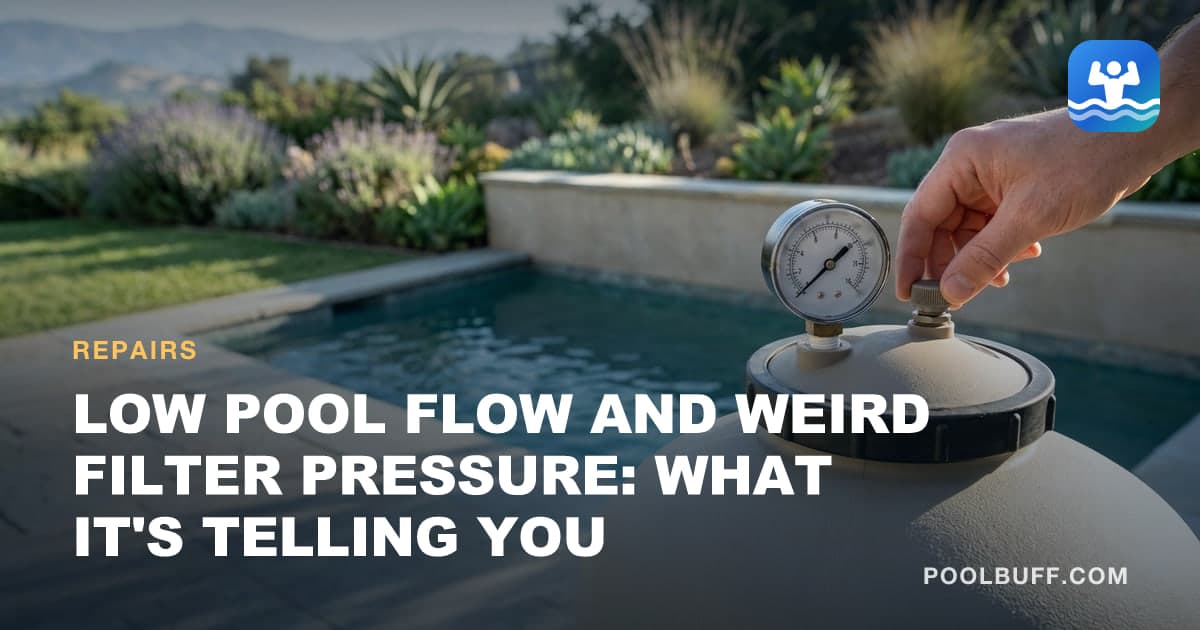
The filter pressure gauge is the most useful diagnostic tool on your equipment pad, and almost nobody uses it properly.
Two things people get wrong. They don't know their baseline, so a number means nothing. And they assume high pressure and low pressure are the same problem with different severity, when they're opposites.
Weak jets in a hot tub have their own list of checks, from the spa makers' manuals: see weak hot tub jets.
Key takeaways
- High pressure plus low flow means the blockage is downstream of the pump.
- Low pressure plus low flow means the blockage is upstream, starving the pump.
- Without a clean-pressure baseline written on the tank, the gauge tells you nothing useful.
- Gauges fail more often than people expect. Test yours before you chase a phantom problem.
- A pump running against a heavy restriction is drawing more power and wearing itself out.
Get a baseline or the gauge is decoration
Clean the filter properly. Restart the system. Write that pressure on the filter tank in permanent marker.
That's your baseline. Every reading after is relative to it.
Typical residential baselines land somewhere between 10 and 20 psi depending on your plumbing and pump speed. There's no universal "correct" number — yours is yours.
Rising 8–10 psi above baseline: clean the filter.
Baselines on a variable-speed pump
The single-baseline advice assumes one pump speed. On a variable-speed pump it needs adjusting, because pressure scales with roughly the square of the flow — halve the speed and the reading falls much further than half.
A filter reading 18 psi at 3,000 RPM may read 5 or 6 at 1,600, and neither number is wrong. Comparing a low-speed reading against a high-speed baseline is how people talk themselves into believing a loaded filter is clean.
Record a baseline for each speed you actually run, written on the tank next to each other. Two is usually enough: your filtration speed, and whatever higher speed the heater or the cleaner demands.
The 8-to-10 psi cleaning trigger scales down with speed too, and by the same square. Going from 3,000 RPM to 1,600 cuts pressure to about 28% of what it was — which is exactly why 18 psi became 5 or 6 in the example above. Run the trigger through the same arithmetic and a rise of 2 to 3 psi at 1,600 RPM means as much as 8 to 10 does at 3,000.
That is a smaller number than most people expect, and expecting a bigger one is how a filter ends up running twice as loaded as you think. If that is more bookkeeping than you want, run the pump up to its high speed once a month and take the reading there instead.
Reading the two directions
| Gauge + returns | Where to lookMy default | Likely cause | |
|---|---|---|---|
| High pressure | Above baseline, weak returns | Downstream of the pump | Dirty filter, closed return valve, blocked heater, clogged return line, undersized filter |
| Low pressure | Below baseline, weak returns | Upstream of the pump | Clogged baskets, closed suction valve, blocked skimmer line, low water, suction air leak |
| Normal pressure | At baseline, weak returns | The pump itself, or the gauge | Worn or partially blocked impeller, failing motor, faulty gauge |
| Pressure spiking | Jumps around while running | Air in the system | Suction-side air leak, low water level, air relief valve left open |
High pressure
Restriction after the pump. Work through it in this order:
1. Clean the filter. This is the answer most of the time. Not backwash — a proper clean, which on a cartridge means an overnight soak in filter cleaner rather than a hose rinse, because a hose leaves the oils that are actually blocking it.
2. Check the valves. A return-side valve that got left half-closed after somebody serviced something. Happens constantly.
3. Check the heater. Scale inside a heat exchanger restricts flow badly, and it's common in hard water. If pressure climbed gradually over a couple of seasons in Arizona or Nevada, look here.
4. Look at return lines. Rare, but roots, a collapsed line, or debris that got past a broken basket will do it.
5. Consider whether the filter is undersized. If you replaced a single-speed pump with a bigger one and pressure has been high ever since, the filter can't pass that flow. That's a sizing problem, not a fault.
Low pressure
The pump is starving. This is harder on equipment than high pressure, because a pump moving less water is also cooling itself less.
1. Empty both baskets. Skimmer, then pump, with the pump off.
2. Check the water level. Below the skimmer mouth means air, not water.
3. Check suction valves. Fully open?
4. Look for a blocked skimmer line. A ball of leaves or a kid's toy in the skimmer throat will do it. So will a tennis ball, which I have personally pulled out of a skimmer line more than once.
5. Suction-side air leak. If you're also losing water, work out whether it's actually a leak before anyone digs. Bubbles in the pump lid, air spitting from the returns, pressure jumping around. See the priming article for the water-over-the-joint test.
6. Check the impeller. A gravel-like sound alongside low pressure is cavitation — pump noises decoded here. Power off at the breaker, reach into the impeller eye, clear anything wrapped in the vanes.
Go deeperPump won't prime? Work through it in this orderThe full suction-side diagnostic, including how to actually find an air leak.When the gauge is fine and the flow is not
Occasionally everything reads normal and the returns are still weak. Two things to check.
The impeller. A partially blocked impeller cuts flow without necessarily raising filter pressure, because the restriction sits upstream of the gauge. It is the third row of the table above and the most-missed line on it. Power off at the breaker, pull the basket, and feel into the impeller eye — hair, leaf stems and pine needles all wrap around the vanes and stay there.
Flow, actually measured. If you run a salt cell, its flow switch is already a crude gauge: a cell that intermittently reports no flow while the pressure looks fine is telling you the system moves less water than the gauge suggests. An inline flow meter costs under $100 and turns the whole diagnostic from inference into measurement, which on any pool with a heater or a cell is worth having on the pad.
Check the gauge itself
Before you spend a Saturday chasing a restriction, make sure your gauge is honest.
Turn the pump off. The needle should drop to zero. If it sits at 4 or 5 psi with no pressure in the system, it's been reading 4 or 5 psi high the whole time and your baseline is wrong.
They cost $10–$15 and they fail regularly — the internals corrode, or the little glycerin fill leaks out and the needle gets sticky. If yours is more than a few years old and behaving oddly, just replace it. Cheapest fix on the pad.
Why it matters more than it looks
A system running against heavy restriction isn't just inconvenient.
- The pump draws more power for less water
- Poor circulation means dead zones and uneven sanitizer distribution
- A heater may cycle on high limit because water isn't carrying heat away fast enough
- A salt cell may report low flow and stop producing
- The pump seal runs hotter and dies sooner
I've watched people burn out a $1,200 variable-speed pump because they treated a rising gauge as normal for two years. It isn't normal. It's the system telling you something, in the one place it can.
Go deeperCheck the valves firstA half-closed diverter or a worn spider gasket looks exactly like a flow problem.Frequently asked questions
What causes high pressure in a pool filter?
A restriction after the pump, and nine times out of ten that's a dirty filter. Other causes are a closed or partly closed return valve, a blocked heater, a clogged return line, or a filter that's just too small for the pump.
What does low pressure on a pool filter mean?
The pump isn't getting enough water. Look upstream: clogged skimmer or pump baskets, a closed suction valve, a blocked skimmer line, a low water level, or an air leak on the suction side. Low pressure with weak returns is a starved pump, and it's harder on the equipment than high pressure.
Why is my pool return flow weak?
Check the filter pressure gauge first — that single reading tells you which side of the pump to investigate. High pressure means downstream restriction, low pressure means upstream starvation. Normal pressure with weak returns points at the pump itself, usually a worn impeller.
How do I know if my pool filter pressure gauge is bad?
Turn the pump off and see whether it returns to zero. If it sits at 5 psi with the system off, it's reading 5 psi high all the time. They're about $10-$15 and they fail regularly — replace it rather than making decisions on a gauge you don't trust.
Can a bad impeller cause low flow?
Yes. A partially blocked impeller or one that's worn from years of running dirty water will move some water but nowhere near design flow. Symptoms are normal-looking filter pressure with visibly weak returns, and the pump drawing less power than it should.