Pumps talk. Not usefully, but consistently — each failure has its own sound and once you know them you can diagnose from the deck.
Key takeaways
- Cavitation sounds like gravel. It's a suction problem and it eats the impeller if you ignore it.
- Screeching bearings give you weeks of warning, then the motor seizes.
- A humming pump that won't spin is either jammed or has an electrical fault. Turning the shaft by hand with the power off tells you which.
- Noise that appeared overnight is debris. Noise that crept in over months is wear.
- Vibration through the deck is often just mounting, and it's the easiest fix on this list.
Match the sound
| What it isMy default | How urgent | Fix | |
|---|---|---|---|
| Gravel / marbles rattling | Cavitation — pump starved of water | Deal with it now | Find the suction restriction |
| Screeching or squealing | Worn motor bearings | Weeks of warning | Motor replacement usually |
| Low grinding | Bearings, further gone | Soon | Motor replacement |
| Loud hum, no rotation | Jammed impeller, or a failed start capacitor | Not running anyway | Turn the shaft by hand, power off |
| Rattling or clattering | Debris in impeller, or loose mounting | Soon | Clear impeller, tighten mounts |
| Vibration through the deck | Mounting, not the pump | Cosmetic | Pad and tighten |
| Louder than it used to be | Restriction building somewhere | Investigate | Check filter pressure and baskets |
Cavitation — the one that costs you
If your pump sounds like it's pumping gravel, stop and pay attention.
Cavitation happens when the pump can't get water fast enough. Pressure at the impeller eye drops low enough that water flashes to vapor, forming bubbles that then collapse violently against the impeller vanes.
Those collapses are microscopic hammer blows, thousands per second. Over months they pit and erode the impeller, and eventually the volute.
Find the restriction:
- Water level — halfway up the skimmer opening
- Skimmer basket, then pump basket
- Suction valves fully open
- Blocked skimmer line — leaves, a toy, a tennis ball
- Suction-side air leak
- Pump speed too high for the plumbing — on a variable-speed pump, drop the RPM and see if it clears
That last one is worth dwelling on. A pump running at 3,000 RPM on 1.5-inch plumbing is asking for more water than the pipe can deliver, and cavitation is the result. It's a sizing problem masquerading as a fault, and the fix is free: turn it down.
Finding a suction-side air leak
It sits on the cavitation list above and deserves its own treatment, because it is the hardest item there to find and the one people most often get wrong.
A suction-side leak does not leak water. That pipe is under vacuum, so it draws air in rather than pushing water out, which is why there is nothing to see. The symptoms are air collecting in the pump basket, bubbles at the returns, and a pump that loses prime overnight.
Work through it in order of likelihood:
- The pump lid o-ring. By a distance the most common. Take it out, clean it, lubricate it with silicone (or soapy water only on a Jandy variable-speed pump, as its manual says), and check the lid seats flat. A dry or twisted o-ring is a leak.
- The drain plugs on the pump housing, which loosen through heat cycling.
- The unions either side of the pump.
- Valve stems on multiport or diverter valves.
- The skimmer throat, where the pipe meets the body. A hairline crack there pulls air whenever the water level drops.
The classic test is shaving cream: with the pump running, smear it along a suspect joint and watch for it to get drawn in. It is cheap, it works, and it hoses off.
Bearing noise
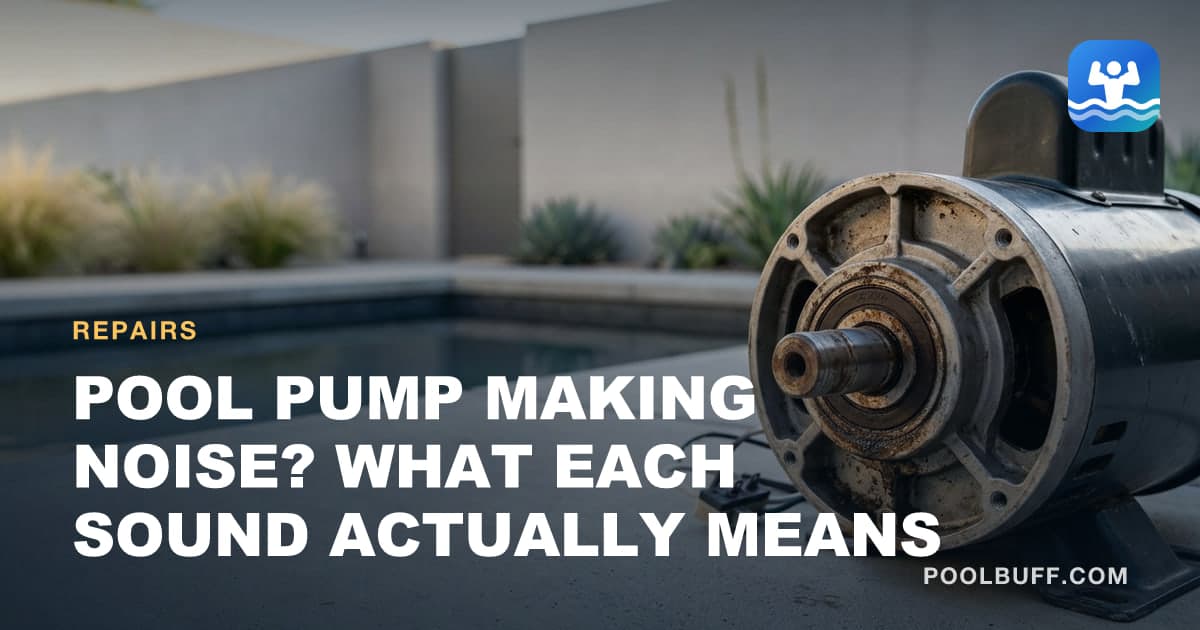
Starts as an intermittent squeal, particularly on startup. Becomes constant. Then becomes a grind.
You typically get weeks between "that's a new noise" and "the motor has seized," so there's no need to panic — but there's also no fixing it with anything other than parts.
Bearings can be replaced on some motors if you're handy with a puller and a press. On most residential pumps, the labor makes motor replacement the sensible route: $250–$600 for the motor against $500–$1,600 for a whole new pump.
Common causes: water getting into the motor from a failed mechanical seal (which is why a dripping seal is worth fixing promptly), age, or a motor that's been running in a hot enclosure for years.
Humming with no rotation
The motor is energized and can't start turning. That's a pump that won't start more than a noise, and why a pool pump won't turn on works through it properly.
The short version: with the breaker off, turn the shaft by hand. If it won't move, something is jamming it, and Hayward's troubleshooting gives an impeller jammed with debris as the cause. If it spins freely, it's electrical, and the start capacitor is on every motor maker's list. It's a cylindrical component under a cover on the motor, and a cheap part.
But: capacitors store a charge and can hold it after the power is off. They will bite you. If you're not confident discharging one safely, this is a legitimate job for a technician even though the part is trivial.
Rattling
New overnight: something got into the impeller. Kill the power at the breaker, remove the basket, reach into the impeller eye and clear it.
Gradual: check the mounting bolts, the pad the pump sits on, and whether any plumbing is touching the housing and transmitting vibration.
Just generally getting louder
Not a discrete fault, but worth investigating. A pump working harder is a pump fighting something.
Check filter pressure against your clean baseline. Check baskets. Check whether somebody nudged the RPM up.
Go deeperReading your filter pressure gaugeHigh versus low pressure means opposite things. The gauge tells you which side to look at.When the noise means buy a pump instead
Motor against whole pump is mostly arithmetic, with one exception worth checking first.
A motor swap makes sense on a wet end that is sound — no cracks in the housing, a volute that is not eroded, an impeller with clean vanes. On a single-speed pump the motor is a few hundred dollars and the job is an hour.
It stops making sense in two situations. If the pump is single-speed and more than a few years old, a variable-speed replacement pays the difference back in power inside about two seasons, and current efficiency rules mean the like-for-like motor may not be sold anymore anyway. And if the noise was cavitation that ran for months, the impeller and volute have been eroding that whole time — a new motor on a pitted wet end buys you the same noise back.
Pull the impeller and look at it before spending anything. Vanes that have gone from sharp edges to rounded, or a surface that looks sandblasted, mean the wet end is part of what you are hearing.
Making a healthy pump quieter
Once you've ruled out mechanical causes:
- Rubber vibration pad under the pump. $20, and it stops the deck acting as a soundboard.
- Tighten the mounting bolts, but don't overtighten and crack the base.
- Check plumbing isn't rigidly contacting the housing or a wall.
- Ventilate the enclosure — good for noise, essential for variable-speed drive electronics.
- Drop the RPM. A variable-speed pump at 1,750 is close to inaudible from a few feet away. If yours is loud, it's probably running far faster than it needs to.
That last point solves more noise complaints than everything else combined.
Frequently asked questions
Why does my pool pump sound like gravel?
That's cavitation — vapor bubbles forming and collapsing inside a pump that can't get enough water. It's caused by a suction-side restriction: a clogged basket, a closed valve, a low water level, an undersized suction line or a blocked skimmer. It destroys impellers, so fix the restriction rather than living with the noise.
Why is my pool pump screeching?
Worn motor bearings, nearly always. It usually starts as an intermittent squeal and becomes constant over weeks. Bearings can be replaced on some motors, but on most residential pumps replacing the motor is the practical route. Left alone the motor eventually seizes.
Why does my pool pump hum but not start?
Either something is stopping it turning, or it can't get its starting kick. With the breaker off, turn the shaft by hand. If it won't move, Hayward's troubleshooting points at an impeller jammed with debris. If it spins freely, suspect the electrical side, including the start capacitor. Capacitors hold a charge even with power off and must be discharged safely — if you're not confident, this is a job for a technician.
Is a noisy pool pump dangerous?
Not directly, but it's telling you something is wearing out or being starved. Cavitation destroys the impeller. Bad bearings eventually seize the motor. Running dry cooks the seal. None of it is an emergency today and all of it gets more expensive the longer it runs.
How do I make my pool pump quieter?
First fix the cause — cavitation and bearing noise won't be silenced by anything else. Once mechanical issues are ruled out, a rubber vibration pad under the pump, tightened mounting bolts, and a properly ventilated enclosure make a real difference. And a variable-speed pump at low RPM is dramatically quieter than any single-speed pump.