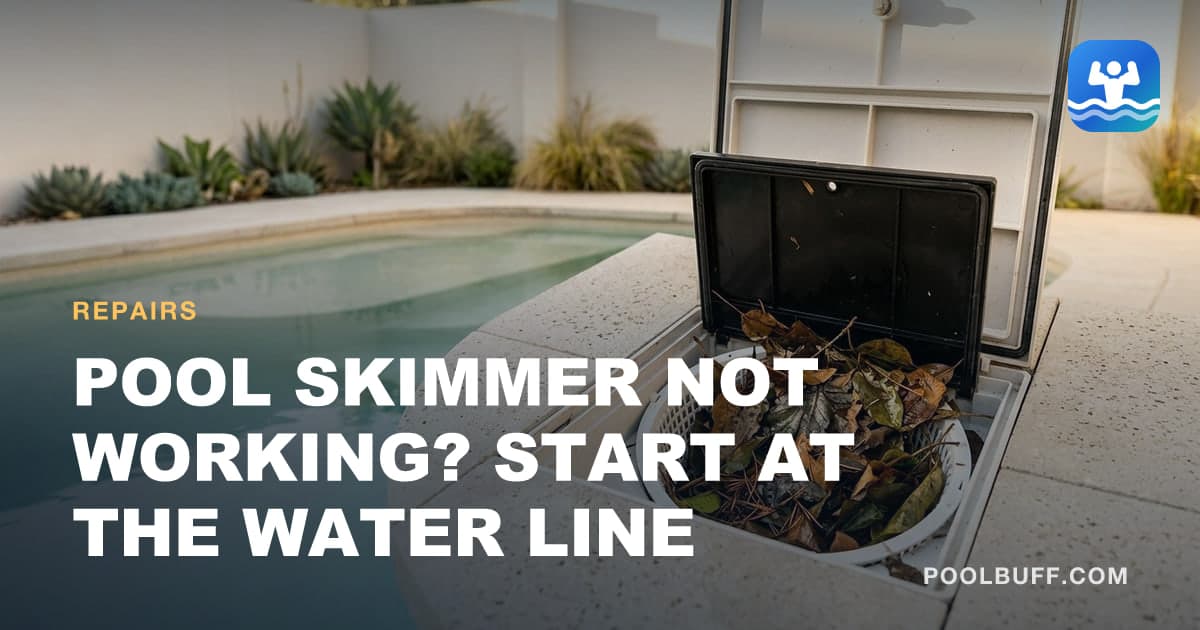
The skimmer is a plastic box in a wall that costs less than a case of chlorine, and it does more for your water than almost anything else on the pad.
It's also the part people understand least. Most owners know it holds a basket. Fewer know what the flap does, and almost nobody knows what the second hole at the bottom is for.
Key takeaways
- Water level halfway up the skimmer throat. This single thing decides whether a skimmer works.
- The weir door is not a lid. It creates a thin fast layer that drags floating debris in.
- A full basket starves the pump long before it looks full to you.
- The equalizer line below the basket stops the pump sucking air if the level drops. It is also a common leak.
- One skimmer per 400 to 500 square feet of surface is the usual rule. Most pools have too few, not too many.
What's in there
Five parts, top to bottom.
The lid in the deck. Nothing clever, but replace a cracked one — they're a trip hazard and a way for a small child to get a hand in.
The throat, the opening in the pool wall. This is where water enters.
The weir door, the hinged flap in the throat. It floats.
The basket, catching leaves and bugs before they reach your pump.
The ports underneath. One goes to the pump. On many pools there's a second, lower one — the equalizer line.
Why the weir door matters
The flap is the clever bit, and it's the part people remove because it rattles.
Left alone, it floats so its top edge sits just at the surface. Everything below it is held back. Only a thin sliver of water at the very top gets through, and because the gap is narrow, that sliver moves fast.
Fast-moving surface water is what drags floating debris in. That's skimming.
Take the weir out and the skimmer draws a slow, wide column instead. Leaves drift past the opening rather than getting pulled in, and they sink overnight to become your problem on the floor.
The right water level for a pool skimmer
Halfway up the throat. That's it, and it matters more than anything else here.
Too high, above about three quarters, and the weir floats up against the top of the opening. There's no narrow gap any more, so no fast layer, so no skimming. Debris just sits there.
Too low, at or below the bottom of the opening, and the skimmer takes gulps of air. That air goes to the pump, the basket fills with bubbles, and eventually you lose prime. Run it long enough and you cook a pump seal.
This is also why heavy rain is worth paying attention to. An overflowing pool skims nothing at all until you drop the level back.
The equalizer line
The second, lower port that confuses everyone.
It runs from beneath the skimmer through to an opening in the pool wall, below the waterline. Its job is a safety net: if the water level drops below the throat, the pump draws through the equalizer instead of sucking air.
Useful in principle. In practice it's a known weak point — it's a pipe running through the shell in the place where the shell is already cut open for a skimmer, and it's a very common source of slow leaks.
Plenty of modern pools leave it out entirely, or plug it and rely on the owner keeping the water level right. If you have one and you're chasing a leak that seems to come from the skimmer area, it's on the list.
Go deeperChasing a leak?Bucket test first, then work out which side of the system it is on.Baskets
Empty it on the weekly round at minimum. Every couple of days in fall, and after any windy day.
The mistake is judging by how full it looks. A basket half full of wet leaves is already restricting flow badly, because the leaves pack flat against the mesh. What matters is flow, not volume.
Signs it's overdue: the weir stops moving freely, the water in the skimmer sits higher than the pool, or your filter pressure drops while the pump gets noisier.
Skimmer socks — fine mesh sleeves over the basket — catch pollen, fine silt and the dust that turns water hazy. They're cheap and they work well. They also clog fast, so they're a spring and fall tool rather than a permanent fixture.
Don't leave a cracked basket in. The whole point is stopping debris reaching the impeller. A basket with a hole is worse than none, because it looks like it's doing the job.
The types you will actually meet
Everything above describes the standard in-ground skimmer, which is what most pools have. It is worth knowing the alternatives, because two of them change what you can fix and what you cannot.
Standard in-ground. Set into the wall of a concrete or vinyl pool, with a throat around six inches wide. The default, and the one every part fits.
Wide-mouth. Same idea with a throat nearer nine or ten inches. It draws a wider band of surface, so a pool under heavy leaf fall clears faster and may need fewer skimmers to do the same job. This is a specify-at-build-time decision — retrofitting one means opening the deck and the shell, which is why almost nobody does it later.
Above-ground, through-wall. Bolted through the pool wall with a gasket on each side. It works, and that gasket sandwich is a leak path an in-ground skimmer simply does not have. On an above-ground pool losing water, the skimmer gasket is the first thing to check rather than the last.
Above-ground, hang-over. Clips over the top rail with nothing penetrating the wall at all. No leak path, and correspondingly less reliable skimming, because it sits at whatever height the rail puts it rather than at the waterline.
Floating. A float on a hose, plumbed into a suction line. Genuinely useful on a pool whose fixed skimmer cannot reach a corner the wind loads up, and the usual answer on a pool that was built without one.
The practical consequence is narrow but worth knowing: the water level rule above is universal, and the leak diagnosis is not. On an in-ground skimmer a leak is usually the throat or the pipe joint. On an above-ground one it is almost always the gasket, and it is a twenty-minute fix rather than a deck excavation.
How many, and where
The general rule is one skimmer per 400 to 500 square feet of water surface.
A 16 by 32 foot pool is 512 square feet, so two skimmers is right and one is a compromise. Plenty of pools were built with one, and their owners spend the difference with a net.
Placement matters more than count. Skimmers should be on the downwind side, so the prevailing wind pushes floating debris toward them rather than away. A skimmer placed upwind spends its life waiting for debris that never arrives.
If your pool has two and the wind only ever helps one of them, that's worth knowing — you can bias the suction valve toward the useful one.
Go deeperBiasing the suction sideHow the three-way valve blends skimmer and main drain, and where to set it.Getting more out of the one you have
Run the pump when debris is landing, not just overnight. A skimmer only skims while water is moving.
Keep the level right. Worth repeating because it's most of the battle.
Check the weir moves freely every time you empty the basket. Two seconds.
Aim your returns. If your return eyeballs are adjustable, angling them to push surface water toward the skimmer sets up a slow circulation that does a lot of the work for you. Point them down and you get good mixing and poor skimming.
That last one is free and most people never touch it.
Go deeperWhere this fits in the weekThe whole routine, and how little time it actually takes in season.Surface tools
- Check price
leaf skimmer net
Debris lifted out today is not debris vacuumed off the floor next week.
- Check price
telescopic pole
Everything else attaches to this, so buy one that does not flex.
Frequently asked questions
What is the correct water level for a pool skimmer?
Roughly halfway up the skimmer opening, which usually works out around the middle of the tile line. Above about three quarters, the weir door floats too high and debris drifts past instead of being pulled in. Below the bottom of the opening, the skimmer gulps air and your pump loses prime.
What does the flap in my pool skimmer do?
That is the weir door. It floats up and down with the water and holds back everything except a thin layer at the very top, which then moves fast through the narrow gap and drags floating debris with it. Without it, the skimmer just pulls a slow column of water and skims very little.
What is the hole at the bottom of my pool skimmer?
Usually the equalizer line, a pipe running from below the skimmer through to the pool wall. If the water level drops below the skimmer throat, the pump draws through that instead of sucking air. Many modern pools leave it out or plug it, because it is a well known place for leaks to start.
How often should I empty a pool skimmer basket?
At least weekly, and every couple of days in fall or after wind. A basket does not need to look full to be a problem — once flow through it is restricted the pump is working harder and the skimmer stops skimming properly.
Can you have too many pool skimmers?
Not really, though there is a point where each one gets less flow and skims more slowly. The usual guidance is one per 400 to 500 square feet of surface. Far more pools suffer from having one skimmer on a big pool than from having too many.