The difference between a pool you enjoy and a pool you resent is almost never the equipment. It's whether somebody spends twenty-five minutes a week on it.
Skip three weeks in July and you're not three weeks behind. You're dealing with a bloom, a filter that needs stripping, and a Saturday you had other plans for. Ask me how I know.
Here's the routine, in the order that gets you back inside quickest. If your brush and net are whatever came with the house, our cleaning tool picks are worth a look first — most of this is faster with better tools.
Key takeaways
- Split the work into two short visits rather than one long one. Consistency beats intensity.
- Brush before you test. Brushing puts settled debris back into suspension where the filter can catch it.
- Filter cleaning is triggered by pressure, not by the calendar — 8–10 psi above the clean baseline.
- The corners, steps, light niche and behind ladder rails are where problems start, and they're exactly where cleaners can't reach.
- Twenty-five minutes a week is cheaper than one algae bloom, every single time.
The two-visit rhythm
Trying to cram it all into one session is why most routines die by mid-July. Split it:
Main visit (15–20 minutes), usually a weekend morning. Baskets, skim, brush, full test, dose, filter pressure check.
Quick visit (5 minutes), midweek. Baskets, quick chlorine and pH test, top up chlorine.
That midweek visit is the one everybody drops first, and it's the one that matters most. Chlorine demand isn't linear. A pool that hits zero on Thursday spends Friday growing something, and you find out about it Saturday.
The weekly checklist
Weekly pool care
Doing each job properly
Baskets: pump off, always
The skimmer basket you can empty any time. The pump basket you empty with the pump switched off, and with the lid o-ring inspected and lubricated while you're in there. Use what the pump's manual names: Hayward's is Jack's 327, and Jandy's variable-speed manual says soapy water only.
A dry, cracked or badly seated pump lid o-ring is the number one cause of a pump that won't hold prime. Ten-dollar part. I've been called out for it more times than I can count, and I always feel a bit bad taking the money.
Go deeperWhy your pool pump won't primeThe diagnostic order that starts with the cheapest causes.Brushing: technique matters more than effort
Brush from the shallow end toward the deep end and the main drain, so you're pushing debris toward where suction can collect it. Overlap each stroke by about a third.
The places that matter most are the places nothing else reaches:
- Step corners and the underside of step lips — the number one origin point for algae
- Behind and around ladder rails — permanently shaded, permanently still
- The light niche — warm, shaded, and often forgotten entirely
- Under the lip of a tanning ledge
- The waterline band, where oils and sunscreen form a film that holds dirt
If you have a robotic cleaner, you can cut general floor and wall brushing back significantly. You can't cut these. After a storm or heavy leaf drop you'll still want to vacuum manually.
Testing: sample properly or don't bother
Elbow depth, away from returns, away from the skimmer, away from wherever you poured something yesterday. Surface water reads differently to circulating water, and water in front of a return has just come from the sanitizer.
Sampling technique matters more than people think. Free chlorine and pH twice a week is the minimum in season. Total alkalinity weekly. Calcium hardness and cyanuric acid monthly.
Filter pressure: the number everyone ignores
When your filter is genuinely clean, write the pressure reading on the filter housing with a marker. That's your baseline.
Clean the filter when pressure reads 8–10 psi above that number. Not monthly. Not when it looks dirty. At the pressure.
High filter pressure means reduced flow, which means poorer filtration, uneven chlorine distribution, a pump working harder than it needs to, and in a heated pool, a heater that may start cycling on high limit.
Go deeperHow to clean a pool filter properlySand, cartridge and DE, including the chemical soak most people skip.The monthly additions
Four more jobs, once a month:
Monthly pool care
The cleaner line is worth taking seriously if you own a robot. Fifteen minutes of service a month is roughly the difference between a five-year machine and a ten-year one, and brushes are the part that goes first.
What changes with the seasons
| Peak seasonMy default | Shoulder season | Off season | |
|---|---|---|---|
| Chlorine testing | Twice weekly, sometimes more after heavy use | Twice weekly | Weekly |
| Brushing | Weekly, twice in a heatwave | Weekly | Every two weeks |
| Pump run time | 10–12 hrs at low speed | 8–10 hrs | 4–6 hrs, freeze protection on |
| Filter cleaning | Watch pressure closely — demand peaks now | Normal pressure trigger | One deep clean before closing |
| Baskets | Twice weekly | Every visit during leaf drop | Weekly |
The jobs that are not weekly
Half of what gets done weekly does not need to be, and doing it anyway either costs money or does harm.
Backwashing answers to pressure, not to Sunday. A weekly backwash sends a hundred gallons or more, and the chemistry dissolved in it, down the drain, and strips out a loaded sand bed that was filtering better than clean sand does.
Shocking answers to a reading. A weekly shock on a pool with no combined chlorine and no algae is chlorine bought and destroyed for nothing — and on a pool shocked with cal hypo, it is calcium added every single week.
Algaecide belongs at closing and in a few specific situations. Weekly dosing feeds copper into the water on the copper-based products, and pays for prevention the chlorine was already providing free.
Vacuuming answers to whether there is anything to vacuum. A working cleaner plus a weekly brush covers most weeks of most seasons.
What genuinely is weekly: testing, brushing, baskets, the waterline pass, and a look at the pressure gauge. Everything else answers to a number, and treating it as a ritual is how a routine turns into an expense.
The five-minute version, when life happens
Some weeks you get five minutes and that's it. Triage, in order:
- Test and correct free chlorine. Everything else can slip a week. This can't.
- Empty the skimmer basket.
- Brush the steps and corners.
New to all of this? The beginner's version of the whole job explains why each of these matters.
That's the triage list. It will hold a pool for a week or two while you deal with whatever else is going on.
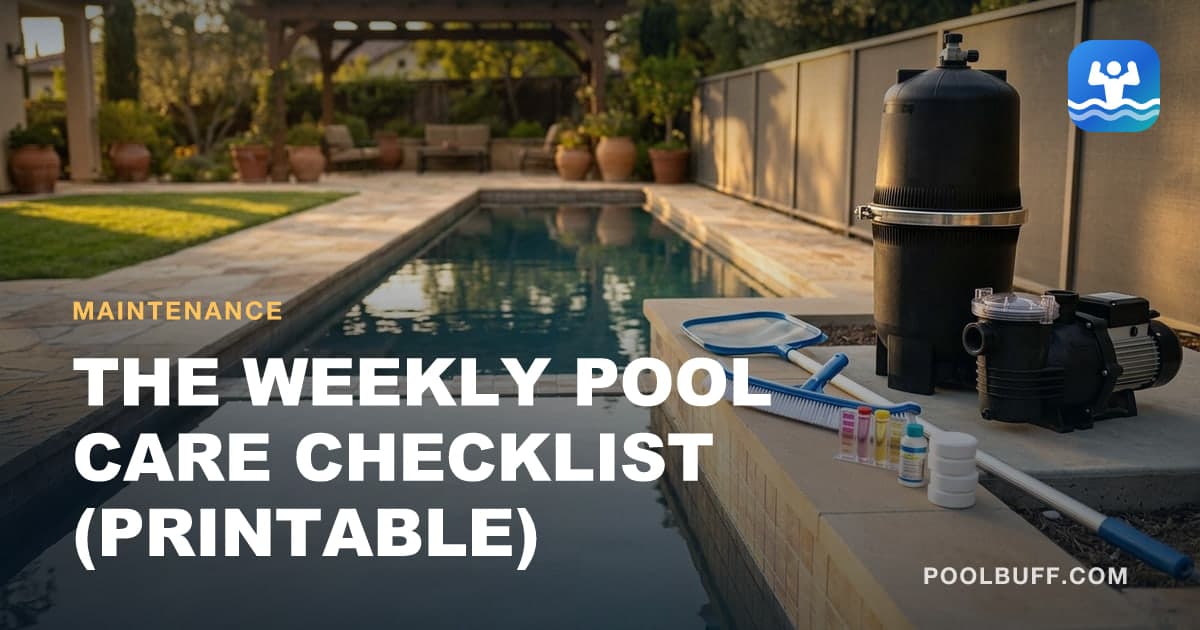
Print it and take it outside
The checklists on this page have a print button. Print the weekly one, put it in a sleeve by the equipment pad, and hand it to whoever is looking after the pool while you're away. The number of pool problems caused by a house sitter who was told "just add a tablet" is remarkable.
Go deeperGetting more from your skimmerThe water level that decides whether it skims at all, and what the weir door is for. Go deeperThe hot tub versionA much shorter routine, and the formula that tells you when to drain.The weekly kit
- Check price
telescopic pole
Everything else attaches to this, so buy one that does not flex.
- Check price
18-inch stainless pool brush
Stainless bristles for gunite and concrete only. It will damage a vinyl liner.
- Check price
leaf skimmer net
Debris lifted out today is not debris vacuumed off the floor next week.
- Check price
AquaChek Select Connect test strips
Fine for a quick mid-week pH check. Not for decisions that cost money.
Frequently asked questions
How long does weekly pool maintenance take?
About 25 minutes for a typical residential pool, best split into one longer session of 15–20 minutes and one quick 5-minute pass later in the week. Filter deep cleans add roughly an hour, a few times a season.
How often should I brush my pool?
Once a week minimum, and twice during hot weather or after heavy use. Even with a robotic cleaner you still need to brush the steps, corners, waterline and light niche — the places a cleaner structurally can't reach.
What is the correct pool water level?
Halfway up the skimmer opening. Too low and the pump can suck air and lose prime; too high and the skimmer stops skimming effectively because surface flow slows down.
Do I need to vacuum my pool every week?
Not if you have a working automatic cleaner and you brush properly. Manual vacuuming is for after storms, after a heavy leaf drop, and any time fine sediment has settled that the cleaner is pushing around rather than picking up.
What should I do after a heavy rain?
Test everything. Rain dilutes cyanuric acid and calcium, drops chlorine, and can move pH sharply. Also check the water level and empty the baskets — storms deliver a season's worth of debris in an hour.