Pool cleaning tools are cheap enough that people buy badly without noticing. A whole kit costs less than one visit from a service company, so the temptation is to grab whatever is on the shelf and get on with it.
Two of those choices actually matter. The rest genuinely do not.
Key takeaways
- The pole is the tool worth overspending on. A flexible one makes every attached job worse.
- Brush bristles must match your surface. Stainless on vinyl is a torn liner, not a clean one.
- A flat skimmer net beats a deep bag net for daily surface work, and costs less.
- Brushing is what lets chlorine reach algae. It is the highest-value two minutes in pool care.
- A cover pump is only worth owning if you have a solid cover, and then it is essential.
My picks at a glance
- 1
12-foot telescopic pole
Buy this first · everything, because everything clips to it
- 2
18-inch nylon brush
Best brush for most pools · vinyl, fiberglass and plaster — which is nearly everyone
- 3
18-inch stainless brush
Gunite and concrete only · stubborn algae on a hard surface — never on vinyl
- 4
Flat leaf skimmer net
Best for daily surface work · the two minutes of skimming that saves an hour of vacuuming
- 5
Automatic cover pump
Essential if you have a solid cover · anyone closing a pool under a solid winter cover
- 6
Filter cleaner
The one people skip · cartridge and DE filters, twice a season
The two that matter
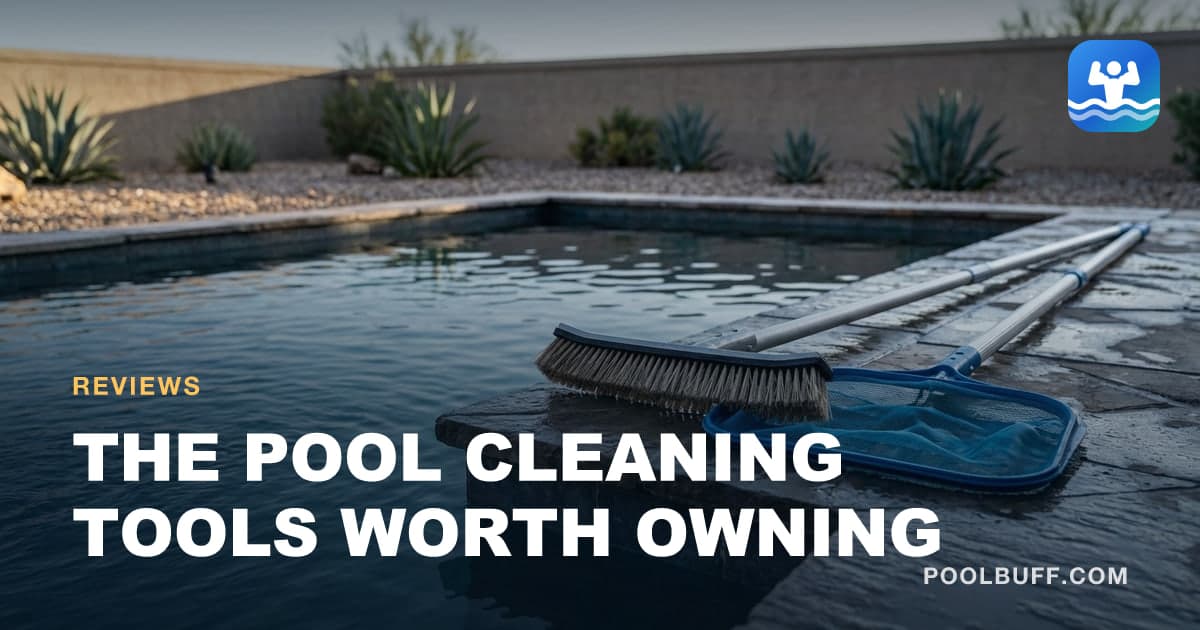
The pole, because everything else attaches to it. A pole that flexes under load turns brushing into skipping and vacuuming into hovering — the head lifts off the floor at exactly the moment you push down. You cannot fix that with technique. The difference in price between a flimsy pole and a rigid one is a few dollars, and it is the best few dollars on this page.
The brush, because the wrong bristles damage your pool. This is the one genuine hazard in an otherwise harmless category.
12-foot telescopic pole
Best for everything, because everything clips to it
The pole is the platform for your brush, net and vacuum head, and its stiffness determines how well any of them work. A flexible pole bends under load, which means the brush skips instead of scrubbing and the vacuum head lifts off the floor. Twelve feet reaches the middle of most residential pools from the edge.
Strengths
- Fits standard brush, net and vacuum head clips
- Twelve feet covers most residential pools from the side
- Cheap enough that buying the sturdier one costs almost nothing extra
Trade-offs
- Telescoping joints eventually seize with grit — rinse them
- Long poles are awkward to store
- Cheap poles flex, which defeats the point of owning one
18-inch nylon brush
Best for vinyl, fiberglass and plaster — which is nearly everyone
Nylon bristles are safe on every pool surface, which is why this is the default rather than a compromise. Eighteen inches covers ground quickly without being unwieldy on steps and corners. Brushing matters more than most owners realize: it breaks the biofilm that shields algae from chlorine.
Strengths
- Safe on vinyl, fiberglass, plaster and gunite alike
- Wide enough to be quick, narrow enough for steps
- Cheapest tool on the list with the largest effect on water quality
Trade-offs
- Nylon wears faster than stainless on rough gunite
- Bristles splay over time and need replacing every few seasons
18-inch stainless brush
Best for stubborn algae on a hard surface — never on vinyl
Stainless bristles bite into rough concrete in a way nylon does not, which makes this the better tool for black algae rooted in plaster. It is also the wrong tool for any other surface. There is no judgment call here — stainless on a vinyl liner tears it.
Strengths
- Genuinely more effective on rough plaster and gunite
- The right tool for black algae, which nylon struggles with
- Lasts a long time
Trade-offs
- Will damage vinyl and can scratch fiberglass. Never use it on either
- Can leave metal deposits on plaster if the bristles corrode
Flat leaf skimmer net
Best for the two minutes of skimming that saves an hour of vacuuming
A flat net skims the surface, which is where debris is easiest to remove and where it does the least harm. Anything you lift out today is not something you vacuum off the floor next week, and not something decomposing into the phosphates and organic load your chlorine has to deal with.
Strengths
- Fastest way to remove debris before it sinks and breaks down
- Lighter and easier to sweep than a deep bag net
- Costs very little and lasts years
Trade-offs
- Holds less than a deep bag net, so heavy leaf fall means emptying often
- Not the tool for debris already on the floor
Automatic cover pump
Best for anyone closing a pool under a solid winter cover
Water pools on a solid cover through winter, and enough of it will stretch the cover, tear the anchors or collapse it into the pool. An automatic pump sits on the cover and switches itself on when water accumulates. It is the difference between a cover lasting eight years and three.
Strengths
- Runs automatically, so it works while you are not thinking about it
- Protects a cover that costs many times what the pump does
- Attaches to an ordinary garden hose
Trade-offs
- Pointless with a mesh safety cover, which drains on its own
- Needs an outdoor outlet within reach
- Intake screens clog with leaves and need checking
Filter cleaner
Best for cartridge and DE filters, twice a season
A hose rinses debris off filter media and leaves the oils behind, and it is the oil that eventually blinds a cartridge permanently. A chemical soak twice a season is the difference between cartridges lasting two years and five, which makes this the cheapest way to avoid a real expense.
Strengths
- Removes the greasy film a hose cannot touch
- Materially extends cartridge and grid life
- One bottle covers a season
Trade-offs
- Requires an overnight soak, so you need a spare set or a day offline
- Does nothing for a sand filter
What actually makes a pole rigid
Since the pole is the first recommendation on the page, it is worth knowing what to look at, because the packaging rarely says.
Wall thickness beats diameter. A thin-walled aluminum pole of generous diameter flexes more than a thicker-walled one that is slightly narrower. Pick it up in the store — the flex is obvious in three seconds, and no printed specification communicates it.
Two sections beat three. Every joint is somewhere the pole can bend and somewhere grit can seize. A two-section 12-foot pole is stiffer than a three-section 16-foot one at the length you actually work at.
Cam locks beat spring buttons. A spring button locks at fixed holes, so the length you want is frequently not on offer, and the pin wears its hole into an oval over a few seasons. An external cam lock clamps anywhere along the travel and can be tightened as it wears.
Anodized or coated aluminum lasts. Bare aluminum pits in chlorinated water and eventually seizes at the joints.
Why brushing earns its place
Brushing looks like cosmetic tidying and is not.
Algae establishes as a biofilm — a layer that physically shields the organisms underneath from the water around them. Chlorine cannot reach through it properly, which is why a pool with a perfectly reasonable chlorine reading can still have algae growing in the shaded corner behind the steps.
Brushing breaks that film open. It does not kill anything itself; it removes the protection so the chlorine you are already paying for can do its job. That is why every serious algae treatment says to brush daily, and why the corners and steps most people never touch are exactly where algae reappears.
Two minutes a week, and it is the highest-value habit in the weekly routine.
The vacuum head, which is not on this list
A manual vacuum head is the sixth thing most pools need, and it is deliberately absent from the picks because there is almost nothing to choose between them.
Below the automatic-cleaner tier, a vacuum head is a weighted plastic shell with wheels and a hose port. What matters is two things, and neither is brand.
Weighted or brushed. A weighted head with smooth wheels is right for vinyl. A head with a brush strip on the front is right for plaster and gunite, where it agitates as it goes. Using the concrete version on a liner is a milder version of the stainless brush problem.
Whether it fits your pole. Almost everything uses a standard clip, but check before you order rather than after.
Buy the cheap one that matches your surface. The technique is what makes vacuuming work — slow passes with the head kept down — and no head compensates for rushing it.
What this kit actually costs
All six items together come to less than a single service visit in most markets, and rather less than one call-out to diagnose a green pool.
That framing is worth holding onto, because the failure mode with cheap tools is not buying the wrong one. It is not buying any, deciding the job is unpleasant with the flexing pole and the wrong brush that came free with the pool, and quietly letting the routine slide until something needs fixing.
A rigid pole and the correct brush make the weekly pass take fifteen minutes instead of forty. That is the entire argument for spending an extra few dollars at the start.
Where not to spend
Deep bag nets for daily use. A flat net skims faster and drags less. Keep a bag net for heavy leaf fall and use the flat one the rest of the year.
Multiple brush widths. Eighteen inches handles walls, floor, steps and corners. A second narrow brush sounds useful and gathers dust.
Anything sold as a complete kit. Kits pad out the price with a thin pole and a brush that suits one surface. Buy the pole and the brush separately and deliberately, then add the cheap items.
Store them out of the sun
Everything on this page is destroyed by the same thing, and it is not the pool water.
UV embrittles the plastic in net frames, brush backs and vacuum heads. A net left leaning against the fence all summer snaps at the frame inside two seasons; the same net kept in a shed lasts many years. Brush bristles stiffen and start shedding for the same reason.
A hook on a shaded wall covers it, or a shed, or simply putting things away — which is the harder habit and the whole of the maintenance requirement for five of the six items here.
The exception is the pole, which does not mind sun but does mind grit. The rinse note above is its entire care routine.
Go deeperWhere these fit in the weekThe fifteen-minute routine that keeps a pool from drifting, and the order to do it in.Frequently asked questions
What pool cleaning tools do I actually need?
A rigid telescopic pole, a brush matched to your surface, and a skimmer net cover the routine. Add a vacuum head if you do not have an automatic cleaner, a cover pump if you use a solid winter cover, and filter cleaner if you have cartridges or DE. That is the whole list, and it costs less than one service visit.
What kind of pool brush do I need for a vinyl liner?
Nylon bristles only. Stainless steel brushes are made for rough gunite and concrete, and they will cut or tear a vinyl liner. Nylon is safe on every surface including gunite, so if you are unsure or you own more than one pool, nylon is the brush to buy.
Is it worth buying an expensive pool pole?
Yes, and it is the one place on this list where spending more genuinely changes the job. A flexible pole bends under load, so the brush skips across the surface instead of scrubbing it and a vacuum head lifts off the floor. The price difference between a flimsy pole and a rigid one is small; the difference in how they work is not.
How often should I brush my pool?
Weekly at minimum, and daily during an algae treatment. Brushing breaks up the biofilm algae hides under, which is what lets chlorine actually reach it. It is the single highest-value two minutes in pool care, and it is the step people skip most often.
Do I need a cover pump?
Only with a solid cover. Mesh safety covers let water through by design, so a pump has nothing to do. On a solid winter cover, standing water stretches the material, strains the anchors and can pull the whole cover into the pool — and a pump costs a fraction of a replacement cover.