Mineral systems occupy an awkward space in pool care. The chemistry is real, the products mostly do what they claim, and the marketing around them consistently implies something slightly larger than the truth.
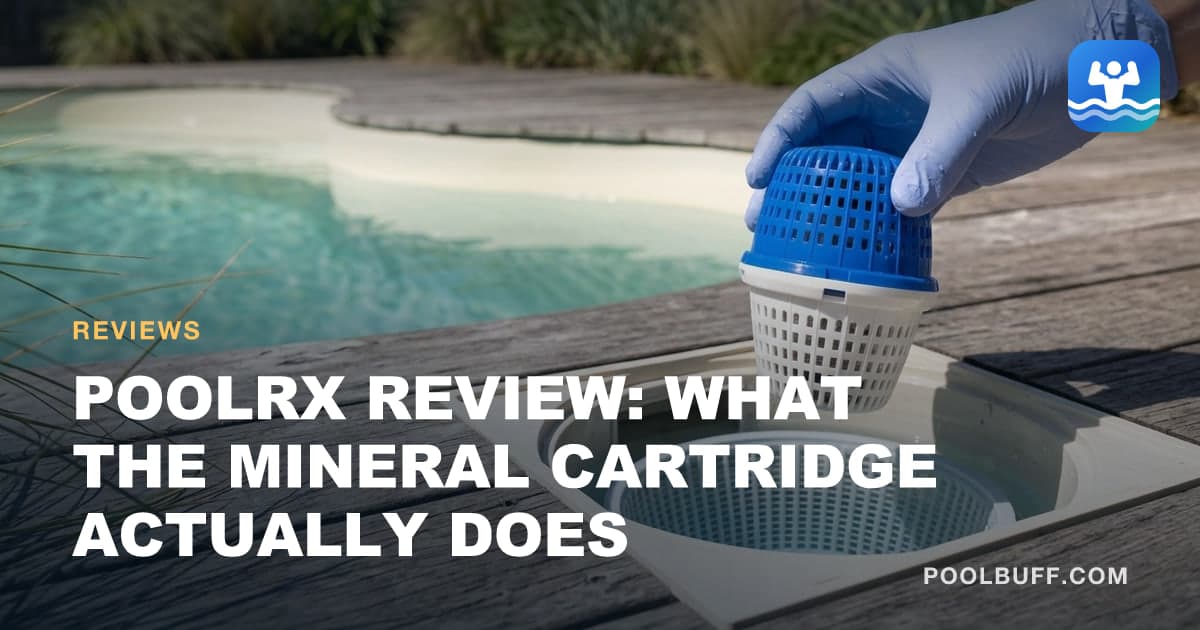
PoolRx is the clearest example. The Blue and Black units are a plastic shell around a cylinder of chelated copper sulfate granules, which sits in your skimmer or pump basket. The granules dissolve into the pool within hours, and PoolRx says the minerals then hold a residual for up to six months. PoolRx+, a separate line sold "with silver", adds zinc and silver to the copper. The sizes, booster numbers and the label's full directions are on the PoolRx Blue and Black page.
Key takeaways
- It is registered as an algaecide, not a sanitizer. It keeps algae down; it does not replace chlorine.
- The label's 0.5 to 1.0 ppm chlorine minimum is wrong for any stabilized pool.
- Test copper before you install. PoolRx says a copper test will not read its minerals reliably afterward.
- The minerals last up to six months and the unit a year. A booster covers the gap.
- On a green pool, kill the algae with chlorine first. The unit is for keeping it away.
Does PoolRx actually work?
Copper kills algae. This is not marketing: copper sulfate is PoolRx's active ingredient, and the EPA registers the product as an algaecide. Used as insurance — keeping algae from establishing in the gaps when chlorine dips — it is genuinely effective.
What PoolRx adds over dropping copper in yourself is chelation. PoolRx says the minerals are bonded to stay in solution rather than falling out onto surfaces, and it rests its claim that the product will not stain on exactly that.
On a salt pool the effect is easy to see. With algae pressure handled by minerals, the cell has less work to do, and PoolRx says you can turn the generator down by about half from its previous setting. Over a season that is real money and real cell life.
The claim to be careful with
Here is where a fair review has to be blunt.
PoolRx's label gives residential chlorine a minimum of 0.5 to 1.0 ppm, and allows cyanuric acid anywhere from 10 to 80 ppm. On a pool with stabilizer in it, that chlorine level is below the point at which chlorine does its job.
Your minimum chlorine is not a fixed number — it scales with your stabilizer level. At 40 ppm CYA you need somewhere around 3 ppm free chlorine before enough of it is active to sanitize. At 80 ppm CYA you need more. Adding copper does not change that arithmetic, because copper is not addressing the thing chlorine addresses.
The confusion is understandable, because the pool looks fine. Copper suppresses the algae, so the water stays clear, and clear water reads as clean water. It is not the same thing. Bacteria are what chlorine is for, and a pool at 1 ppm with 50 ppm CYA is not sanitized regardless of how good it looks.
The certification on the box does not settle it either. NSF lists PoolRx under NSF/ANSI 50, but its listing says the certification is for health effects only and that the product is not certified for performance claims.
Use it as insurance on top of a correct chlorine target, and it is a good product. Use it as permission to run chlorine low, and you have a clear pool that is not safe.
Copper is not used up the way chlorine is
The other thing worth understanding before you commit: once PoolRx is in the water, you cannot measure it.
PoolRx's own account is that the minerals leave through algae kill, backwashing, filter cleaning and splash-out, which is why it sells boosters to replace them. That account is also the whole of the tracking. Its FAQ says a copper test will not give an accurate or consistent reading on the chelated minerals, so you add a booster on PoolRx's signs — algae returning, dull water, chlorine demand creeping back up — rather than on a number.
The copper to worry about is the copper PoolRx did not put there. Its FAQ says not to use other copper products alongside it, because you do not want to saturate the water, and that if the water does become saturated, it is the free copper rather than the chelated minerals that falls out. Fill water, old copper plumbing and a heat exchanger being eaten by aggressive water all add copper that PoolRx never chelated.
Testing for copper, which is less simple than it sounds
The section above says you cannot track copper once PoolRx is in. Here is what testing actually involves, because it does not work like any other test you run.
Test before you install, not after. PoolRx asks for 0.2 ppm or lower before the first unit goes in, and says to resolve the source first if you are above it. Well water, old copper plumbing, a history of copper-based algaecide, or a heat exchanger that has been quietly eaten by aggressive water can all put you over the line before you have bought anything.
Once the minerals are in, the reading stops being reliable. PoolRx says so itself. The chelation that keeps its copper in solution also means a copper test will not give an accurate or consistent reading, and PoolRx says the reading will not be reliable again until the minerals have been used up and filtered out, about six months on.
So the honest sequence is: test before the first unit and keep that figure as your baseline. After that, watch the pool rather than the number — the grout at the tile line, the plaster in the shallow end, and anyone in the house with light hair.
Copper is not on your normal kit. It is not on a drop-based test kit and it is not on a 7-way strip. You need a copper-specific test, drop or strip, or a trip to a pool store to have it run on their photometer. Either way it is a separate test you have to ask for by name.
Buying the right size
The unit is rated by pool volume, and PoolRx's own FAQ is plain that more is not better.
Work out your volume first, then buy the Blue unit for 7,500 to 20,000 gallons or the Black unit for 20,000 to 30,000 gallons. Above 30,000 gallons, PoolRx's chart adds a booster at installation: a Blue unit and a Blue booster up to 40,000, a Black unit and a Blue booster up to 50,000, and a Black unit and a Black booster up to 60,000.
Do not size up on a hunch. PoolRx says an overdose cannot dissolve, and ends up as blue granules on the floor or stuck to scale. An undersized unit fails the other way, because the water never reaches the concentration the chart is built on.
Who should buy it
Worth it if you run a salt pool and want the cell working less; if you fight recurring early algae despite decent chemistry; or if you travel and the pool goes unattended for stretches.
Skip it if your cyanuric acid is already high and your instinct is to run chlorine low — this will make that habit feel safer than it is; if you have a plaster pool with any history of metal staining; if your fill water already tests above 0.2 ppm copper; or if you sanitize with bromine or a biguanide, which PoolRx says it is not compatible with.
Either way, test copper before the first unit. It is the one copper reading PoolRx says you can trust.
The honest summary
It is a good product doing a narrow job well. The algae suppression is real, the minerals last up to six months with a booster to stretch them, and on a salt pool the reduced cell output alone can justify it.
What it is not is a way to run less chlorine. The label gives 0.5 to 1.0 ppm as a residential minimum. Reduced chlorine demand is plausible, because copper is doing the algae work; a reduced chlorine target is where the label and the chemistry part ways. Keep your target where your stabilizer says it should be, treat the minerals as a second line of defense, and it will do exactly what you hoped.
Go deeperWhat sets your chlorine targetWhy the right free chlorine number depends entirely on your stabilizer, and what happens when it does not.Frequently asked questions
Does PoolRx replace chlorine?
No, and the manufacturer does not claim it does. The EPA registers PoolRx as an algaecide, and its label pairs it with a constant low level of chlorine. You still need a chlorine residual at all times, and a pool running on minerals alone is not safe to swim in.
Can I really run 1 ppm chlorine with PoolRx?
Not on most pools. PoolRx's label gives 0.5 to 1.0 ppm as the residential minimum while allowing cyanuric acid up to 80 ppm. But your minimum chlorine is set by your cyanuric acid level, not by whether you have added minerals — at 40 ppm CYA you need roughly 3 ppm free chlorine before the chlorine is meaningfully active. Copper keeps algae down at low chlorine, which is why the pool can look fine, but keeping algae down is not the same as sanitizing water.
Will PoolRx stain my pool?
PoolRx says its chelated minerals will not, even at the high pH of a salt pool. Its own FAQs name the ways it goes wrong anyway. Copper already in the water from another source is not chelated. An oversized dose leaves blue granules on the floor and stuck to scale. And granular cal-hypo sprinkled in can, PoolRx says, oxidize black or gray where it lands. Test copper before the first unit, size it by the chart, and dissolve cal-hypo in a bucket first.
How long does a PoolRx unit last?
PoolRx says the minerals last up to six months, and less in a pool that works them hard, because they are lost to algae kill, backwashing, filter cleaning and splash-out. A booster tops them up after four to six months if algae or chlorine demand starts creeping back. The unit itself is replaced every 12 months, and the label says to start each season with a new one. It is sized by pool volume, so one rated for a smaller pool does not stretch further.
Should I test for copper?
Yes, before the first unit, and almost nobody does. PoolRx asks for 0.2 ppm or less before installing, and names well water, old copper plumbing, a copper heat exchanger and other copper products as the usual sources. After that, its FAQ says a copper test will not read the chelated minerals accurately or consistently, so the number you take before installing is the one that counts.