Whether a pool light that has stopped working needs a lamp or a whole fixture depends on what kind of light it is. That distinction is worth several hundred dollars, and it is the first thing to establish before pricing anything.
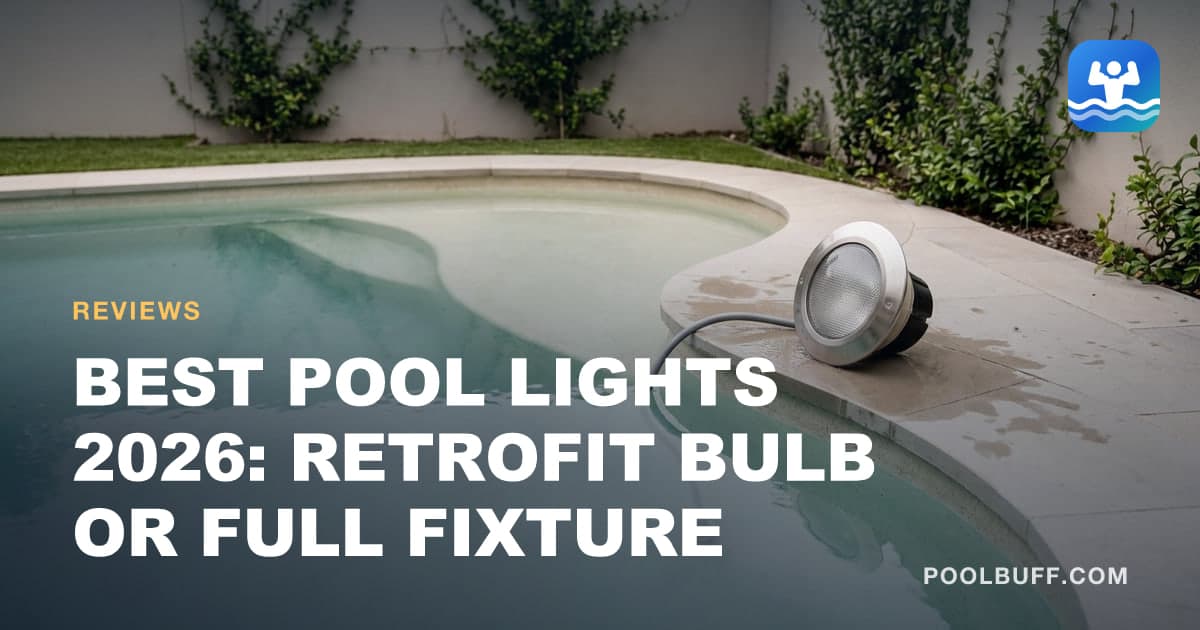
The fixture is the housing, the lens and the cord running back to a junction box. In an older incandescent fixture the lamp is a separate part inside it, and it can be replaced, with an original or with an LED retrofit lamp made for that fixture. Many LED fixtures have no such part. Hayward's ColorLogic is sealed, with no user-serviceable parts inside; Pentair's Architectural Series pool light has three replaceable LED boards, but they are Pentair parts for that light, not a lamp from someone else.
There is no retrofit lamp among the picks below. A retrofit is specific to the fixture model and voltage it replaces, so it has to be matched to the light in your wall rather than recommended in general.
Key takeaways
- Check what kind of light is in the niche before pricing anything. A screw-in lamp can be replaced; a sealed LED fixture cannot.
- A retrofit lamp reuses the housing, lens and cord already in the wall, so it only makes sense when all three are sound.
- Pool light work involves bonding and GFCI. It is licensed electrician territory, not a weekend job.
- Pentair and Hayward color lights change color by power interruptions too. Automation does the switching for you; it does not unlock a different kind of control.
- Measure your niche before ordering. Ten-inch and small-niche housings are not interchangeable.
My picks at a glance
- 1
Pentair IntelliBrite Architectural Series color
Best full fixture · replacing a Pentair light, or a pool on Pentair automation
- 2
Hayward ColorLogic 4.0
Best for Hayward systems · a Hayward niche, or a pool on Hayward automation
- 3
Jandy WaterColors nicheless
Best where there is no niche · a pool being built, or a Jandy system that wants a light without a niche
Beyond these three, every light with a page here is listed with its voltage options, parts and manuals.
Work out which you need
There is also a third path worth knowing about: nicheless lights thread into a standard 1.5-inch wall fitting instead of a niche. That saves the niche, not the conduit: Jandy's WaterColors still needs pipe through the bond beam and conduit back to a 12 V transformer, which suits a pool being built far better than one being retrofitted.
For an existing niche on a Jandy pad, the Infinite WaterColors niched light is listed for several Pentair and Hayward niches as well as Jandy's. It runs only on its own controller, though, and only with an AquaLink RS at revision Y or later.
Pull the fixture from the niche — it typically comes out on enough cord to sit on the deck — and look at it with the power off.
- Sound housing, clear lens, dry inside, dead screw-in lamp. A new lamp, original or LED retrofit, may be all it needs.
- A sealed LED fixture that has stopped working. Check the power first. If the fixture itself has failed, it is replaced whole.
- Corroded housing, cracked lens, water inside, or a damaged cord. You need the fixture, and probably an electrician's opinion on the conduit too.
The reason this matters is that the expensive part of a fixture replacement is rarely the fixture. It is the cord run back to the junction box, which on an older pool can mean discovering the conduit is not in the condition anyone hoped. Cord length is part of the part number, too: Hayward's ColorLogic 4.0 comes in 30, 50, 100 and 150-foot versions, Pentair's Architectural Series runs from 30 to 250 feet depending on the model, and the cord has to reach all the way from the niche to the junction box.
Pentair IntelliBrite Architectural Series color
Best for replacing a Pentair light, or a pool on Pentair automation
Pentair's current color fixture, and the one it names as the replacement for the discontinued IntelliBrite 5G. Its cross-reference sheet maps every 5G item number to an Architectural one; this listing is EC-602232, the online version, at 120 volts, 28 watts and a 100-foot cord. It uses the same fourteen-step switch sequence as the 5G, so it runs on a plain wall switch. Pentair says its automation can run it too, and IntelliCenter has an IntelliBrite light setting that lists the shows by name and can bring a group of lights back into step.
Strengths
- Pentair's named successor to the 5G, with a matching item number for each version
- Five fixed colors and seven shows on a wall switch, or through Pentair automation
- Cord lengths from 30 to 250 feet in the dealer range
Trade-offs
- Bought online it carries Pentair's one-year, parts-only warranty rather than two years
- Pentair niches only. Any other niche voids the warranty and the UL listing
- The cord cannot be replaced, so measure to the junction box first
Hayward ColorLogic 4.0
Best for a Hayward niche, or a pool on Hayward automation
Hayward's answer to the IntelliBrite, and the right fixture if the niche or the box on your wall says Hayward. It changes programs by power cycling, and Hayward's manual says any basic on/off switch will run it, so it is not locked to Hayward automation; Hayward lists it as OmniDirect compatible. This listing is the W3SP0527SLED100: stainless faceplate, 120V, 100 foot cord.
Strengths
- Works on any basic on/off switch, and Hayward lists it as OmniDirect compatible
- Stainless faceplate rather than plastic on this version
- Keeps its UL listing in the four Hayward pool niches its manual names
Trade-offs
- Premium price, same as any OEM fixture
- Hayward's Open Line version online: one year parts and no labor, against three years parts on the dealer model
- Cord length fixed at purchase
Jandy WaterColors nicheless
Best for a pool being built, or a Jandy system that wants a light without a niche
The third brand, and a genuinely different approach: no niche. The 12 V light threads into a standard 1.5 in. wall fitting, needs its lens only 4 in. under the water rather than a niche light's 18, and needs no bonding wire. It is not a no-conduit job, though: Jandy's manual still calls for 1.5 in. pipe through the bond beam and 1 in. rigid conduit back to a 12 V magnetic transformer. This listing is the 12 W WaterColors light with a 100 ft cord, JLU4C12W100.
Strengths
- Only 4 in. of water over the lens, against 18 in. for a niche light
- No niche and no separate bonding wire
- Runs on any switch, or on an AquaLink auxiliary relay
Trade-offs
- Bought online it carries no Jandy warranty; a dealer purchase gets three years
- Still needs pipe through the bond beam, conduit and a 12 V magnetic transformer
- Fits an existing niche only through Jandy's adapter for a Pentair GloBrite gunite niche
Measure the niche first
The most common return in this category is the wrong size.
Ten-inch niches are standard on many in-ground pools; small niches appear on newer installs, spas and above-ground pools. They are not interchangeable, and a listing that says "fits IntelliBrite" is telling you about one family of housings rather than all of them.
Measure the opening, note the cord length you need back to the junction box, and check both against the listing before ordering. Cord length in particular is fixed at purchase on a full fixture — it cannot be extended safely inside a wet niche.
Why pool lights fail, and which failure you have
Three things kill a pool light, and knowing which one you had tells you whether the replacement will last.
The lamp simply wears out. Incandescent lamps ran a couple of seasons and were treated as a consumable. LEDs last far longer but do eventually dim or fail. On a fixture that takes a replaceable lamp, this is the benign case and a new lamp fixes it; on a sealed LED fixture, it means a new fixture.
Water gets into the fixture. The lens gasket perishes, water enters, and the lamp fails quickly and permanently. If you pull a fixture and find water inside, replacing the lamp alone is a temporary fix — the gasket is the actual fault, and on an older fixture that usually means replacing the assembly.
The cord or conduit fails. The least common and the most expensive. Water tracks along the cord, or the conduit floods, and you are into work that goes beyond swapping parts. This is the scenario where a fixture replacement turns into a real job, and the reason to have an electrician look before committing to a plan.
The useful takeaway is that a dry, sound fixture with a replaceable lamp is the cheap case. Before you conclude you have any of the three, though, run the free checks — a tripped GFCI and a failed transformer both present as a dead fixture, and a color light that will not hold a color is usually not a fault at all.
What a retrofit bulb gives up
Where your fixture takes one, a retrofit lamp is often the right answer, and it is worth being clear about what you trade for it, because no listing will tell you.
Beam pattern. An OEM fixture is designed as one optical system — lamp, reflector and lens working together — and it throws light down the length of the pool. A retrofit bulb sits inside a housing built around a different lamp, so more of its output ends up in the housing and less in the water. The practical effect is a slightly hotter spot near the niche and less reach down the pool. On a small pool nobody notices. On a forty-foot pool it shows.
Color control. Less than the listings imply. Pentair's and Hayward's own color fixtures also change modes by switching power off and on, and a controller works them by switching the circuit in the right pattern. What the OEM light adds is a controller that knows its sequence: IntelliCenter lists the IntelliBrite shows by name and has a sync button for a group of IntelliBrite lights, and Hayward's manual has ColorLogic lights on one switch synchronize themselves. A retrofit bulb runs its own sequence, which a controller set up for the OEM light may not match.
Warranty and support. OEM lamps carry manufacturer coverage that survives an actual claim. Retrofit bulbs run from good to disposable, and a marketplace warranty on a part sitting behind a wet niche is worth roughly what marketplace warranties are generally worth.
What the fixture's own manual says. Read it before buying a retrofit. Pentair's manual for the Amerlite, for one, asks for a replacement lamp of the same type and wattage, and warns that another type can damage the fixture. None of Pentair's Amerlite documents lists an LED lamp for it. Hayward goes the other way: its J&J Electronics brand lists PureWhite LED lamps by name for the AstroLite, with a gasket made for it.
Set against all of that: a lower price than a new fixture, the energy saving of LED, and an installation that is a lamp change rather than a project. For a single light on a wall switch, that is usually the right trade.
Where the money actually goes
The energy case for LED is genuinely strong. Against an incandescent lamp, an LED conversion cuts consumption by roughly three quarters for comparable brightness, and the lamp lasts far longer than the two-season incandescent cycle most owners were used to.
On a light run a few hours an evening through a season, that adds up to a real line on the monthly running cost rather than a rounding error — and it removes a recurring replacement job that always seems to come due in August.
Color is the part people buy for and the part that varies. If you have automation, buy the OEM fixture matching its brand — Pentair light with Pentair automation, Hayward with Hayward. Cross the brands and the light still works, but as a plain on/off circuit: IntelliCenter's color light settings, for one, are all for Pentair products. If you do not, and your fixture takes a replaceable lamp, a color retrofit lamp cycling modes on a wall switch gets you color changing for less, and you will stop noticing the clumsiness within a week.
Go deeperThe full conversion guideBonding, GFCI, niche types and what the electrical work actually involves.Frequently asked questions
Can I replace a pool light bulb myself?
Physically it is not complicated, and electrically it is not a job to take lightly. Pool light circuits require GFCI protection and the niche and conduit must be part of the equipotential bonding grid, which is what prevents a voltage difference existing across a swimmer. In most jurisdictions this is licensed electrician work, and it is one of the genuinely dangerous DIY jobs around a pool.
Is a retrofit LED bulb as good as a new fixture?
For light output, close enough that most people cannot tell. Control is closer than it looks: Pentair's and Hayward's color fixtures also change modes by power interruptions, and automation simply does the switching. What a matching OEM light adds is a controller that knows its sequence, so a show can be picked by name and several lights kept in step. If you have no automation, that difference barely matters.
How do I know if I need a new fixture or just a bulb?
Pull the fixture out of the niche and look at it. A corroded or cracked housing, a damaged cord, or water inside the lens means the fixture. A sound housing around a dead screw-in lamp can take a new lamp. A sealed LED fixture is different: Hayward's manual for the ColorLogic, for one, says there are no user-serviceable parts inside, so once the power checks out, a dead one is replaced whole.
Do LED pool lights save money?
Substantially, against incandescent. An LED conversion cuts energy use by roughly three quarters for the same brightness, and the lamps last far longer, so the saving is running cost plus not replacing bulbs every couple of seasons. On a light run four hours a night through a season, the payback is real rather than theoretical.
What size pool light niche do I have?
Measure the opening before ordering anything. Ten-inch niches are common on older in-ground pools and small niches on newer or above-ground installations, and they are not interchangeable. Product listings state which they fit, and ordering the wrong one is the most common return in this category.