A pool light is the one piece of equipment where the cheap causes are very cheap, the expensive cause is genuinely expensive, and the middle of the diagnostic tree is a place people should not be poking about.
So this is written as much around where to stop as what to check.
Key takeaways
- Switched LED lights change color by interrupting power. A light that changed color on its own is not faulty.
- Check the GFCI before anything else. It is the single most common cause and it costs nothing to test.
- The fixture is serviced with the pool full — there are four feet of cord coiled behind it for exactly that.
- Water in the junction box, a damaged cord, or a GFCI that will not reset all mean stop. That is an electrician's job.
- Never run a pool light with the lens out of the water, even briefly.
Before anything else
Switch the lighting circuit off at the breaker, not at the wall switch. A wall switch interrupts one conductor. A breaker interrupts the circuit.
Then verify it is actually dead with a non-contact tester, at the switch. Pool wiring gets added to over decades by people of varying carefulness, and the circuit labeled in the panel is not always the circuit you are standing next to.
Most of them are not broken
Start here, because it is free and it is right more often than it has any business being.
Color-changing LED lights change color by interrupting power. That is the mechanism. The switched-style fixtures — the ones without a data connection back to an automation panel — step to the next color or show every time power is cut and restored.
Which means all of the following are normal:
- The light came on a different color from last night
- It changed color when somebody flicked the switch twice
- Two lights in the same pool are no longer showing the same color
- The color changed after a power cut
Hayward's own troubleshooting guide lists the causes of lights falling out of sync as power outages, brownouts, repeated toggling, voltage drop, and overloading a transformer. None of those is a broken light. Pentair's fixtures behave the same way — an IntelliBrite flashes white briefly on power-up, then returns to the last saved color, and it only holds that memory if power was off for less than about five seconds.
If your complaint is "it works but it will not behave", you almost certainly have a resync job rather than a repair. The procedure is in the manufacturer's guide and it is a sequence of switch flicks.
The order to check a genuinely dead light
Work from the panel outward. Every step here is free.
- 1
The GFCI
1 minutePress test, then reset. It should cut power and restore it.
If it will not reset, or it trips again the moment the light is switched on, you have a real ground fault. Stop. That is the single most useful signal on this whole page and it is pointing at water somewhere it should not be.
A GFCI that trips on a pool light is doing the job it was installed for. Resetting it repeatedly, or bypassing it, removes the only thing standing between a fault and a swimmer.
- 2
The breaker, then the switch
5 minutesA tripped breaker is obvious once you look and easy not to look at.
Wall switches fail, and pool light switches fail more than most because they get used twice a night for years. A timer that lost its schedule after a power cut, or an automation relay that has stopped calling for light, presents identically to a dead fixture.
- 3
The transformer, on a 12-volt light
10 minutesLow-voltage fixtures run through a transformer near the equipment pad. Confirm it has power arriving.
Then check what is hanging off it. Overloading a transformer causes dim output, flicker, and lights that will not stay in sync — Hayward names it explicitly, and Pentair caps a single IntelliBrite controller at 300 watts total across all the lights on it. Somebody adding a second pool light or a run of landscape lights to an existing transformer is a common way to create a fault that looks like a failing fixture. The IntelliBrite page has the per-fixture figures that add up to it, and the rest of what a wall switch can do to one of these lights.
- 4
The fixture itself
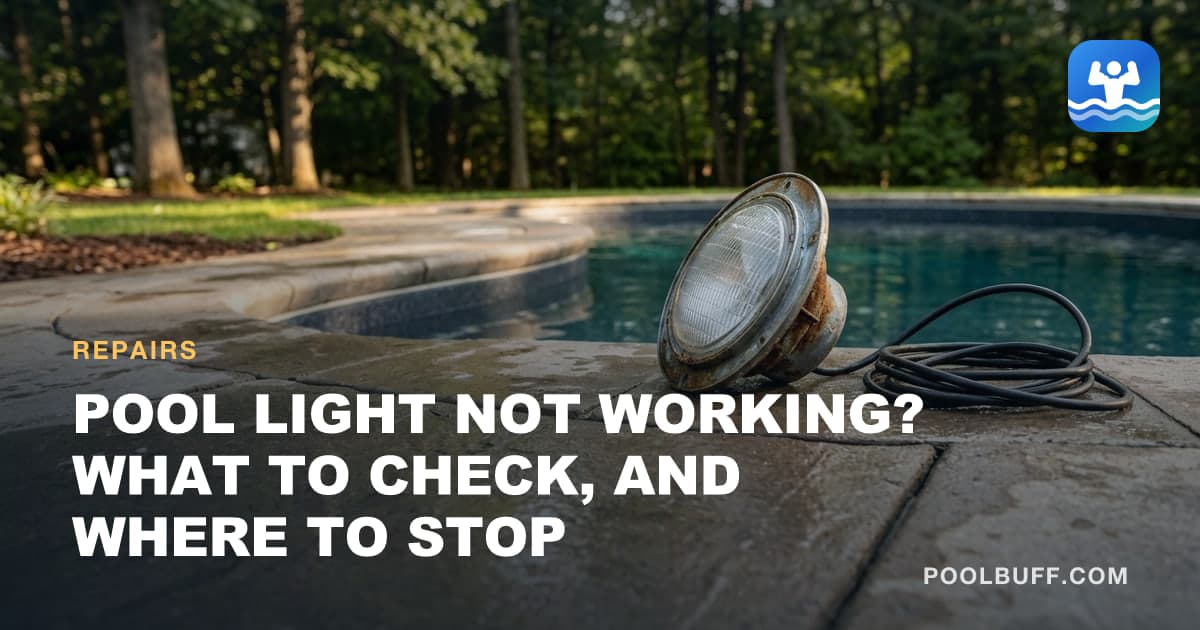
30 minutesCircuit dead, confirmed dead. Remove the single screw at the top of the face ring, and lift the fixture out of the niche and up onto the deck.
The pool stays full. Pentair's installation guide specifies at least four feet of cord coiled behind the fixture for exactly this reason — so the light can be serviced with the pool filled. If there is not enough cord to reach the deck, that is itself a finding, and it means the original install was wrong.
On the deck, look for: water inside the lens, a corroded or discolored lamp base, a perished gasket, and any nick, crack or flat spot in the cord.
- 5
The junction box, last
15 minutesThis is where stubborn faults live, and it is also where the job usually stops being yours.
It should sit at least 8 inches above the water line and at least 48 inches back from the pool edge, and it should be dry inside. Water in there, green corrosion on the conductors, or insulation that crumbles when touched all mean an electrician.
The three findings that end the job
Not hedging, and not "consider consulting a professional". These are stop signs.
Water in the junction box. That box is supposed to be dry and above the water line. Water in it means the seal or the conduit has failed, and the repair involves the buried run.
A damaged cord. A nicked, cracked or swollen cord is a conductor heading toward pool water. The cord is not a repairable item and it is not a spot for tape.
A GFCI that will not hold. Covered above, and worth repeating because the temptation is to keep resetting it.
Add a fourth, quieter one: if the light is in a metal niche on a 120-volt circuit and you find the bonding wire loose, corroded or missing, stop. The niche is bonded through a No. 8 conductor for a reason, and the whole equipotential bonding grid exists so that a fault cannot put a voltage difference across a swimmer. That is licensed work and it is not a discretionary call.
What actually kills pool lights
Two things, mostly, and both are avoidable.
Water intrusion past a tired gasket. The lens gasket is the only thing between pool water and the lamp. It hardens with heat and chemistry the way every other seal on a pool does, and when it goes the fixture fills. A light that fogged before it died was telling you about it for weeks.
Running the lamp with the lens out of the water. The water is doing cooling work. Pentair specifies the top edge of the lens sitting at least 18 inches below the surface, and the corollary is the one that catches people: if the pool level has dropped — after a hot week, or during a repair, or because the level was lowered for a cover — the light does not go on. Not even to check something. Not even for a minute.
That single habit is the difference between a fixture that lasts and one that does not.
Repair, replace, or take the opportunity
Once the fixture is on the deck and the fault is in the light itself, the decision is usually straightforward.
An incandescent fixture with a blown lamp is a bulb, and it is cheap. Fit a new lens gasket with it: on a Pentair Amerlite, the manual says a new one goes in every time the light is put back together, and Hayward's guide for the AstroLite recommends one with every lamp change. It is also the moment to ask whether you want to keep buying bulbs — converting to LED cuts the energy meaningfully and the lamps last years rather than seasons.
A failed LED fixture is generally not a component-level repair. The sealed unit is the unit.
A flooded fixture of any kind goes in the bin. It is not a drying-out job, and what killed it will kill the next lamp you put in it.
If you are replacing, the current fixtures and what separates them is worth ten minutes first — particularly the voltage question, because a retrofit lamp has to match what your niche and transformer already are.
What a pro is actually for here
Worth being clear, because "call an electrician" can read as a cop-out.
An electrician on this job is checking the things you cannot: continuity of the bonding grid, insulation resistance on a cord that looks fine, whether the junction box height and the conduit run are actually as installed, and whether the fault that tripped the GFCI is in the fixture or in the buried run between the niche and the box.
That last distinction is the expensive one, and it is the reason not to guess. A fixture is a few hundred dollars. A failed conduit run under a deck is a different conversation entirely, and you want to know which you have before anybody starts breaking concrete.
Go deeperConverting a pool light to LEDWhat a retrofit bulb does and does not solve, the voltage trap, and the cord nobody thinks about.Frequently asked questions
Why is my pool light not working?
Most often the GFCI has tripped, the breaker is off, a switch or timer has failed, or — on a 12-volt light — the transformer has. Those cost nothing to check and account for the majority. Beyond that it is the lamp itself, water in the fixture, or corroded connections in the junction box. A light that has genuinely died and a light whose circuit has been interrupted look identical from the deck.
Why does my pool light keep changing color on its own?
Because that is how it is designed to work. Switched-style color LED fixtures change color by briefly interrupting power, so every flick of the switch, every brownout and every brief outage advances the color. It is not a fault. Hayward names power outages, brownouts, repeated toggling, voltage drop and an overloaded transformer as the reasons lights drift out of sync with each other.
Can I change a pool light bulb myself?
The mechanical part is simple and the electrical context is not. The fixture lifts out onto the deck with the pool still full, using the coiled cord left behind it for that purpose. But the circuit has to be dead, the fixture has to be dry and sealed correctly on reassembly, and anything you find wrong in the niche or junction box is licensed work. If you are not confident verifying the circuit is dead, that is the honest place to stop.
Do I need to drain the pool to fix a pool light?
No, and you should not. Pentair's own installation guide calls for at least four feet of cord coiled behind the fixture specifically so the light can be serviced after the pool is filled. Draining a pool to reach a light swaps a small job for the risk of floating the shell.
Why does my pool light trip the GFCI?
A ground fault somewhere in the circuit, and on a pool light it usually means water has reached something it should not have — inside the fixture, in the junction box, or through a nicked cord. A GFCI that trips on a pool light is doing exactly the job it was fitted for. Do not keep resetting it and do not bypass it. This one is an electrician's.
How long do pool lights last?
An LED fixture should run for years rather than seasons, which is most of the argument for converting. What actually ends them is water intrusion past a perished gasket, and running the lamp with the lens out of the water. Both are avoidable.