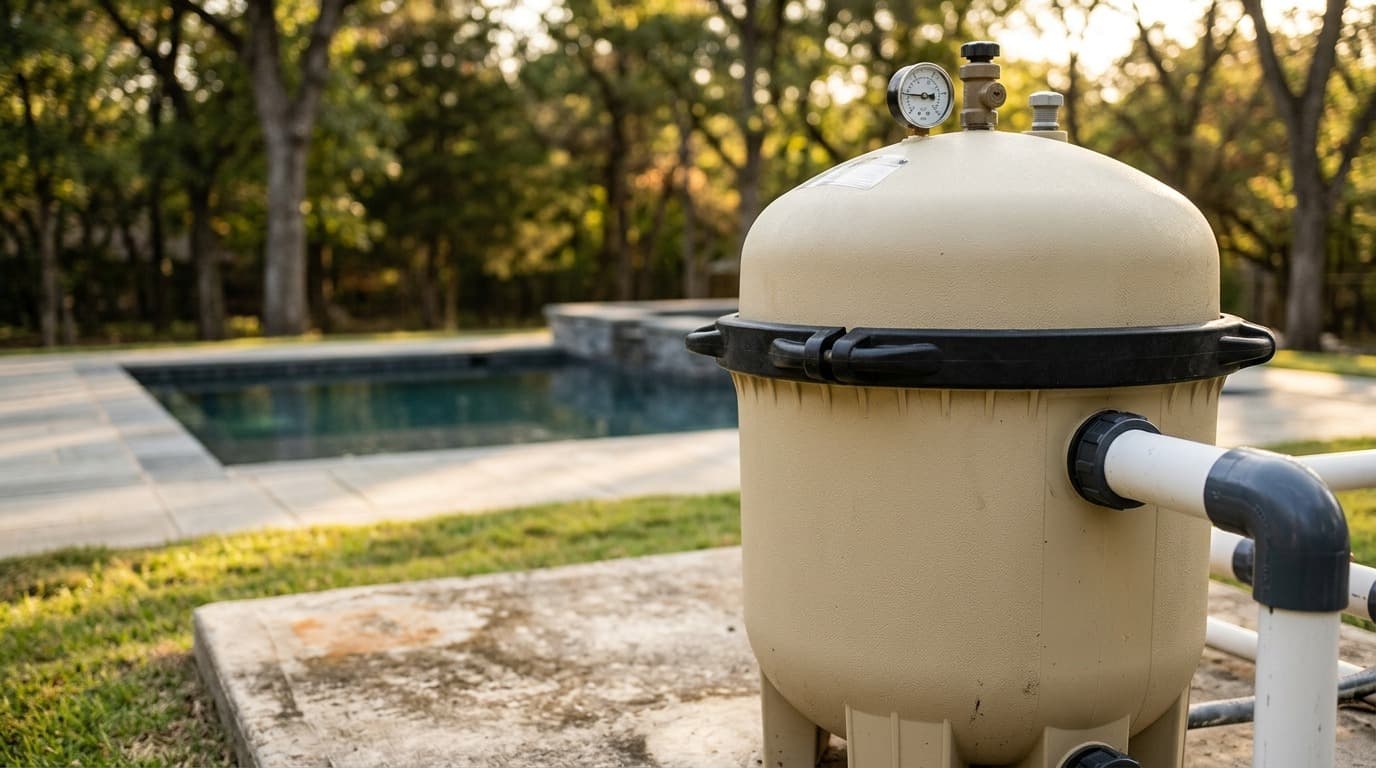
A high reading on the filter gauge is a restriction somewhere after the pump. Water is being pushed into the filter faster than it can get through, or out the other side and back to the pool.
I serviced cartridge, sand and DE filters on my routes, and I ran into every cause on this page: a filter overdue for cleaning, a cartridge or sand bed that cleaning couldn't save, a return valve left partly closed or a return line clogged, and too much DE or a gauge that wasn't telling the truth. They're in the order that costs least to check.
If your gauge reads low with weak returns, that's the opposite problem, upstream of the filter, and the low pressure guide covers it.
Key takeaways
- The gauge means nothing without a baseline: the reading with a clean filter, at the same pump speed. Jandy puts normal start-up pressure at 6 to 15 psi for its cartridge and DE filters.
- Clean at the rise your filter's manual gives: 7 to 10 psi over clean on Hayward's cartridge filters, 8 to 10 on its sand and DE filters, and about 10 on most of Pentair's and Jandy's.
- If a cleaned cartridge still starts more than 6 psi above its new reading, Hayward says to replace it. Pentair's sand and DE filters have their own version of that test: 4 to 6 psi high right after a backwash.
- Past the filter, the makers point at the return side: a partly closed return valve, small eyeball fittings, a blocked return line, a scaled heater, or a pump too big for the filter.
- Most residential filters are rated to 50 psi, and Jandy's SFTM sand filter to 35. If the gauge heads toward that, shut the pump off.
First, make sure it's really high
The gauge only means something against your baseline. That's the reading with a clean filter, and there's no universal number for it. Hayward says the clean pressure varies from pool to pool with the pump and the plumbing. The only range a maker publishes is Jandy's: a normal start-up pressure of 6 to 15 psi for its cartridge and DE filters.
Compare at the same pump speed. On a variable-speed pump, the pressure moves with the speed, so a low-speed reading against a high-speed baseline will make a dirty filter look clean. Jandy's CS manual says to record both readings at the same speed, and Pentair's FNS Plus manual asks you to write the RPM down beside the starting pressure.
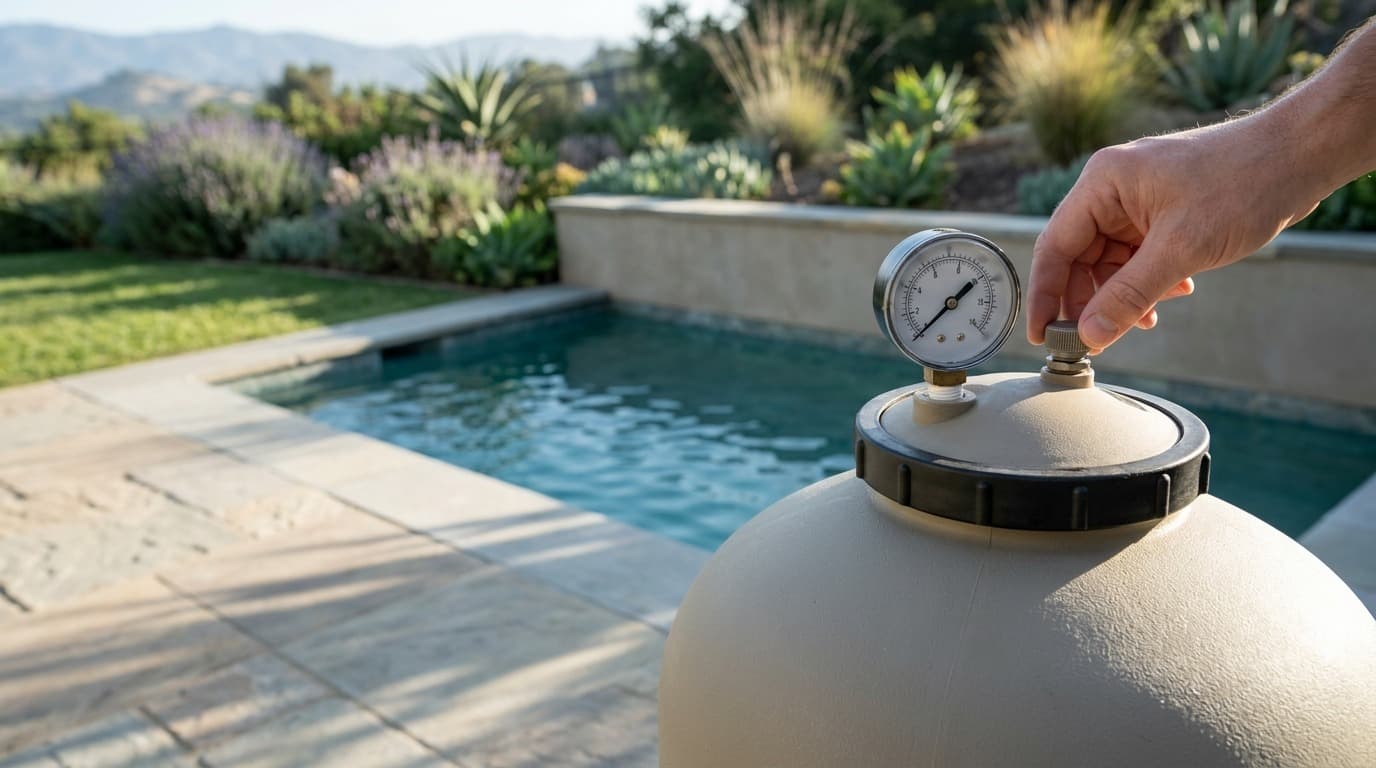
Check the gauge before you trust it. Turn the pump off and open the air relief valve. Pentair's Clean & Clear manual says the gauge should go to zero, show pressure when the system runs, and be readable and undamaged, and to replace it if it fails any of those. Open the valve first: a filter below the pool's water level can hold pressure with the pump off. Pentair lists its standard filter gauge at $13.93, the cheapest part on the pad.
When to clean, by maker
Every manual gives the rise to clean at. They're close, but not the same:
| Filter | Type | Clean or backwash at |
|---|---|---|
| Hayward SwimClear, StarClear Plus | Cartridge | 7 to 10 psi over clean |
| Hayward ProSeries, ProGrid | Sand, DE | 8 to 10 psi over clean |
| Pentair Clean & Clear | Cartridge | 8 to 10 psi over clean |
| Pentair Clean & Clear Plus | Cartridge | 10 psi over clean |
| Pentair Sand Dollar, Triton II, Tagelus | Sand | 10 psi over clean |
| Pentair FNS Plus, Quad D.E. | DE | About 10 psi over clean |
| Jandy CS, SFTM | Cartridge, sand | 10 psi over clean |
| Jandy CV, CL, DEV | Cartridge, DE | 10 to 12 psi over clean |
Clean it, properly
A proper cleaning fixes the plain case, a filter that's simply due.
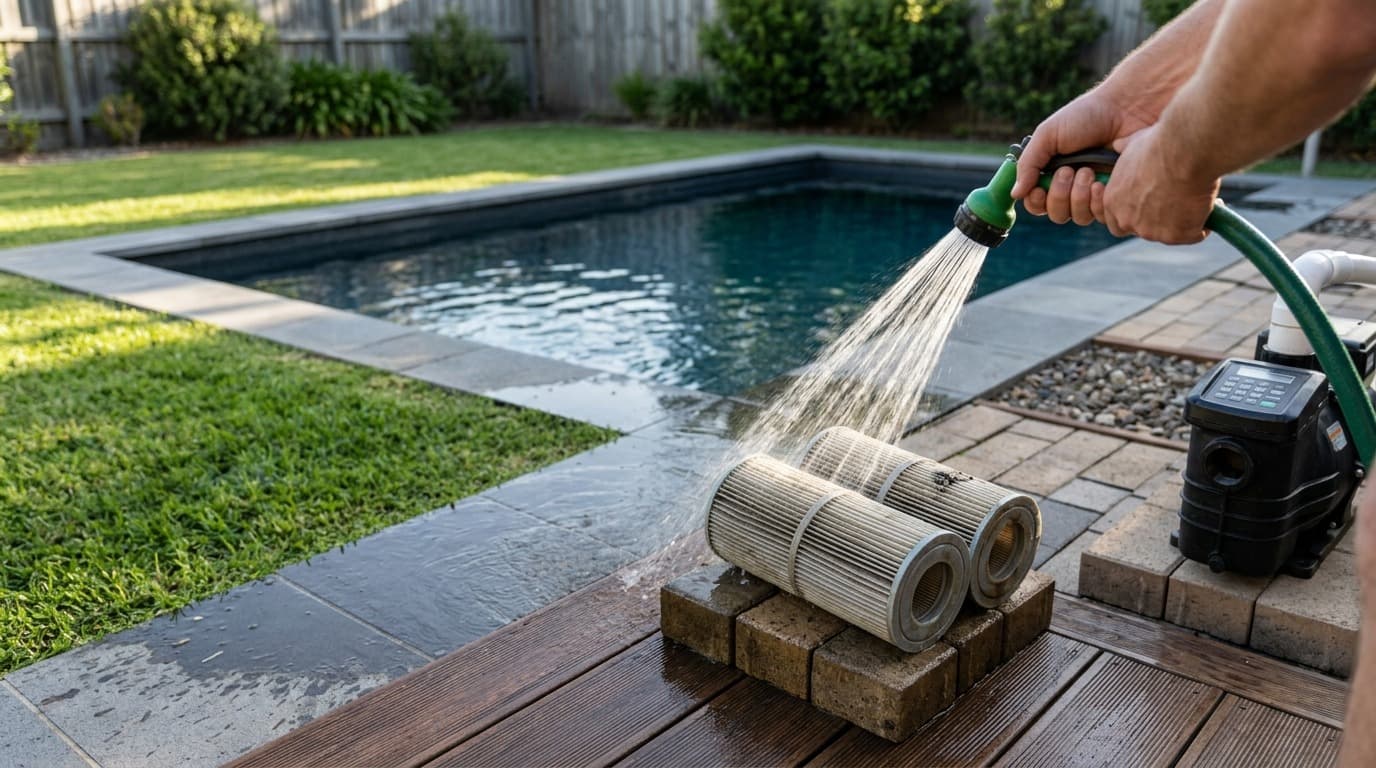
Cartridge. Hose each element from the top down, between the pleats. Don't pressure wash it: Hayward says that can damage the element. A rinse won't shift everything, though. Hayward's StarClear Plus manual says algae, suntan oil and body oils coat the pleats in a film hosing may not remove, and Jandy adds calcium to that list. For those, Jandy says to soak in a degreaser, then a descaler. Degreaser before acid, never acid on an oily element, and the filter cleaning guide has the soak step by step. A filter cleaner does the degreasing.
Sand. Backwash until the sight glass runs clear, rinse for the time your manual gives, and check the gauge. It should be back near your baseline.
DE. Backwash, then recharge with fresh DE. How much matters more than people think, and it gets its own section below.
Then write the new clean reading down, at the speed you run. That's your baseline until the next cleaning.
Go deeperHow to clean a pool filterHose, soak, backwash and recharge, for cartridge, sand and DE, with the makers' own steps.When cleaning doesn't bring it down
This is the one that eats a Saturday. The filter's clean, and the gauge still starts high. Each type has its own test for when the media is the problem.
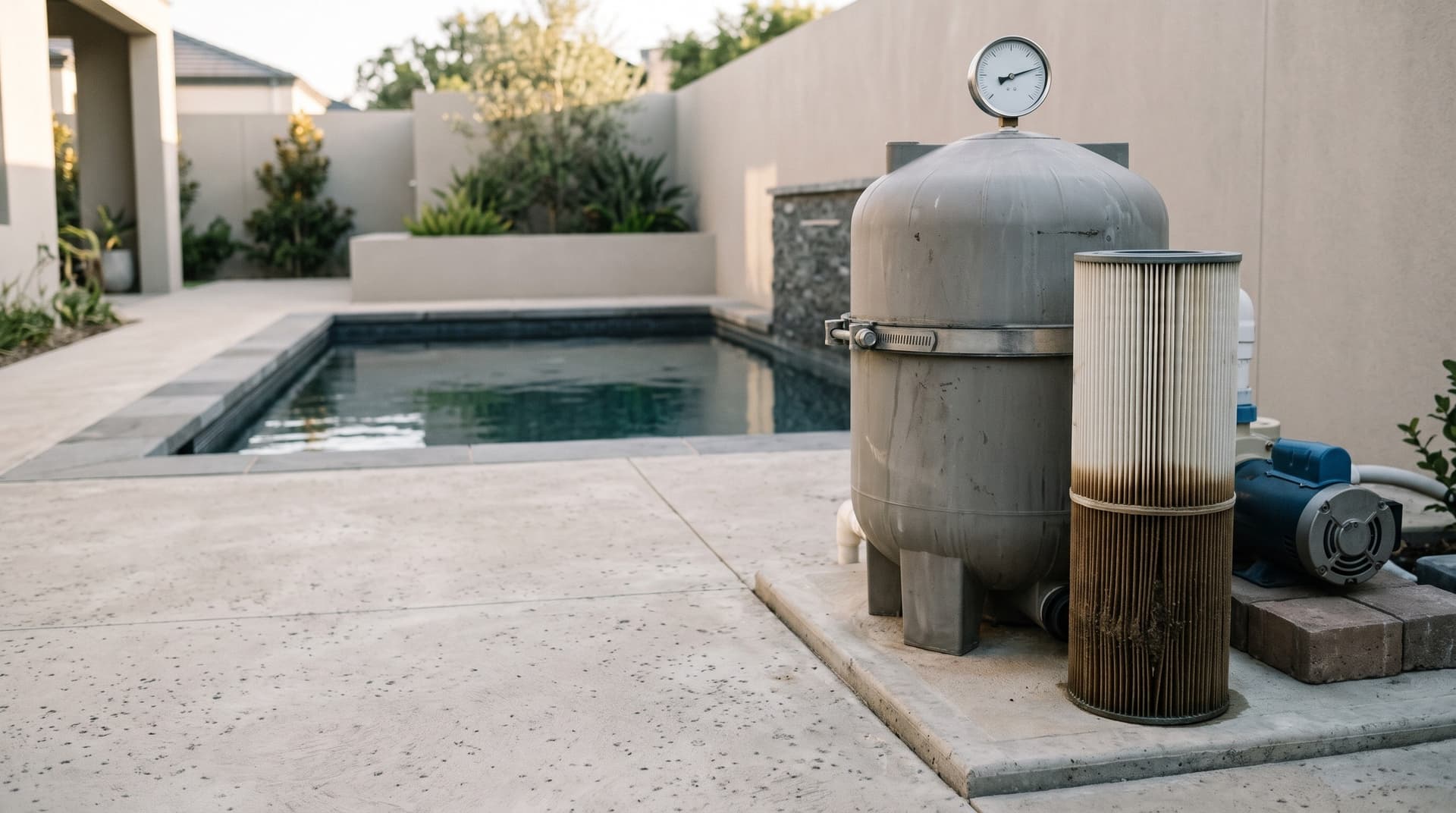
Cartridges. Hayward's SwimClear manual turns it into a number. If a cleaned element starts more than 6 psi above the pressure you recorded with new elements, replace it the next time the gauge reaches the cleaning point. An element like that isn't dirty, it's worn. Unicel, which makes replacement cartridges, gives the other signs: shorter runs between cleanings, and low flow with high pressure.
Sand. Pentair's Triton II and Tagelus manuals say that if the pressure right after a backwash is 4 to 6 psi above the original start-up reading, the bed needs a chemical clean with a sand filter cleaner, which removes oils, scale and rust. Pentair's Sand Dollar manual puts a sand bed plugged with mineral deposits on its list for high pressure, and for a plugged bed it says to take off the top inch of sand and chemically clean the filter as required. Hayward's ProSeries manual says to check the top of the bed for a crust and remove about an inch if it's there. Jandy's SFTM manual has the last word: if backwashing can't get the pressure under 35 psi, replace the sand.
DE grids. Pentair's FNS Plus manual gives a fixed order for pressure that stays high: backwash again, then pull the grids and hose them, then soak them, and only then replace them. Its 2023 manual adds a tell: a starting pressure 4 to 5 psi above normal right after a backwash means the grids need a manual clean, not another backwash. Hayward says minerals and oils embed in the grid fabric and shrink the area that filters, and that too little DE at pre-coat lets debris lodge in the fabric the same way. Its answer is a grid cleaning once a year, with a degreaser and an acid bath if needed, and new grids if that doesn't bring them back.
Before you blame the media, Hayward's checklist for pressure that climbs back fast starts with the water: look for algae, shock if you find it, and bring chlorine and pH into range. A filter catching a bloom will load up in days, whatever shape the media is in.
Too much DE
More DE isn't more filtering. Jandy's DEV manual says too much clogs the system, and to use the amount it gives: 5 lb for a DEV48, 6 lb for a DEV60. Pentair's rule for the FNS Plus is 0.1 lb per square foot of filter area, and for the Quad D.E. it's 6, 8 and 10 lb for the 60, 80 and 100. If a Quad needs cleaning too often, Pentair's first answer is to check the amount of DE.
The tell is a filter that starts high right after a recharge, with nothing else changed. Backwash it out, and recharge with the amount of DE on your filter's label, weighed rather than guessed. Go the other way and you have a different problem: Hayward says too little DE at pre-coat lets debris into the grid fabric.
Past the filter: the return side
If the filter is clean and the gauge still reads high, the restriction is after it. Water gets through the filter fine and then can't get back to the pool.
A partly closed valve. It's on every maker's list. Jandy's manuals put a partly closed return valve among the causes of high pressure at start-up, and Pentair's sand filter manuals say to open the valve or clear the obstruction in the return line. I've found return valves left partly closed, and return lines clogged. Walk the pad and check every valve after the filter is fully open, including the ones nobody remembers touching.
The returns themselves. Jandy lists small eyeball fittings in the returns. A clogged return line does the same thing, and a fitting packed with debris shows up as one return blowing weaker than the rest.
A scaled heater. Hayward's heater manual names lime scale in the heat exchanger as a cause of reduced flow, and Raypak lists scale under low flow. The US Geological Survey calls water above 180 mg/L very hard. If pressure has crept up over a couple of seasons in hard-water country and the filter checks out, look here.
A filter too small for the pump
Jandy's manuals list a pump too big for the filter as a cause of high pressure at start-up, and Pentair's Sand Dollar manual says to restrict the flow to what the filter can take. If the pressure has run high ever since a bigger pump went in, that's sizing, not a fault.
On a variable-speed pump, the cheapest fix is a slower speed. Otherwise it's a bigger filter, and the filter sizing guide covers how to size one to the pump rather than the pool. The pump and filter sizing calculator does the arithmetic.
How high is too high
Keep it from creeping back
Mark the baseline on the gauge. Hayward's gauges have a green arrow and a red one, and Jandy's a turning bezel with clean and dirty marks. Set the clean one at your fresh reading, and you'll see the climb from across the yard.
Look at it often. Jandy's CS manual says to check the pressure at least once a week.
Keep the water right. Algae, oils and scale are what load media up between cleanings. On my routes I went by a mix of the gauge and a schedule, but the gauge is the one that tells you something's wrong.
Frequently asked questions
What is normal pool filter pressure?
There's no single number. Hayward says the clean reading varies from pool to pool with the pump and the plumbing. Jandy's manuals give a normal start-up pressure of 6 to 15 psi for its cartridge and DE filters. What matters is your own filter's reading when it's clean, at the same pump speed, and how far above it the gauge has climbed.
Why is my pool filter pressure still high after cleaning?
Something cleaning didn't fix. The media may be worn out or coated with oils and scale, a sand bed may be caked, or a DE filter may have too much DE in it. If the filter's fine, look past it: a partly closed return valve, a blocked return line or small eyeball fittings, a scaled heater, or a pump too big for the filter. And check the gauge reads zero with the pump off.
Is 30 psi too high for a pool filter?
It depends on where the filter started. A filter that reads 20 psi clean is due for cleaning around 28 to 30. One that reads 10 clean is badly restricted at 30. Hayward support told one owner that 32 psi was too high for their StarClear Plus. Either way, stay well clear of the filter's maximum: 50 psi on most residential filters, 35 on Jandy's SFTM sand filter.
How do I know if my pool filter pressure gauge is bad?
Turn the pump off and open the filter's air relief valve. Pentair's manual says the gauge should go to zero, show pressure when the system runs, and be readable and undamaged, and to replace it if it fails any of those. Pentair lists its standard filter gauge at $13.93.
Is high filter pressure dangerous?
It can be. Hayward, Pentair and Jandy all warn that a filter can come apart under pressure, and Hayward calls it explosive. Pentair's Clean & Clear manual says pressure above 50 psi can blow the lid off, and Hayward says never to run or test its StarClear Plus above 50. If the gauge is climbing toward the limit, shut the pump off and find the restriction before running it again.