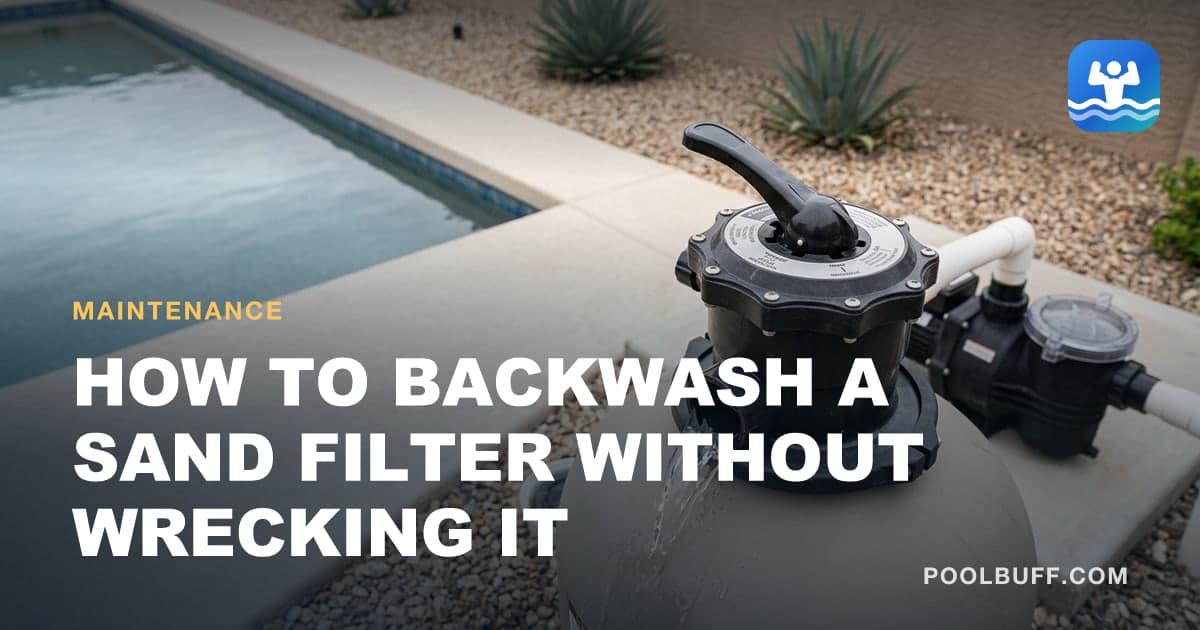
Backwashing is simple. It's also the job people do most often on the wrong trigger.
Weekly, because that's what the previous owner did. Every Sunday, because that's when they're out there. Neither of those is a reason, and both of them make your water slightly worse while sending a few hundred gallons down the drain.
The filter tells you when. You just have to read it.
Before you start
- Time
- 10 min
- Difficulty
- Easy
- Cost
- Water only
Tools
- The multiport or push-pull valve on your filter
Supplies
- Fresh water to top the pool back up
Key takeaways
- Backwash on pressure, never on a calendar. A slightly dirty sand bed filters better than a spotless one.
- The pump goes off before the valve handle moves. Turning it under pressure tears the spider gasket.
- Rinse is not optional. Skip it and the dirty water still in the filter after a backwash goes back into the pool.
- You are sending pool water down the drain, so expect to top up and re-test afterward.
- If you are backwashing weekly, something else is wrong — usually an undersized filter or a chemistry problem.
When to actually do it
Record a clean baseline. After a full clean or a sand change, run the pump normally and write down the pressure. Tape it to the filter. That number is your zero.
Backwash at 8 to 10 psi over it. Not at a fixed reading — 20 psi means nothing on its own, because one pool's clean baseline is 10 and another's is 18. The makers differ a little: Hayward's top-mount ProSeries says 8 to 10 psi and its side-mount 6 to 8, Pentair's Sand Dollar and Triton II 10, and Jandy's SFSM 10 to 12.
Depending on your pool, bather load and what's falling in it, that might be every two weeks or every two months. Both are normal.
The sequence
- 1
Turn the pump off
Wait for the pressure gauge to drop to zero. A couple of seconds.
- 2
Set the valve to Backwash
Push the handle down and rotate. On a push-pull valve, move the handle to its backwash position, which isn't the same way up on every brand: see below.
- 3
Run until the sight glass clears
Turn the pump on. Water now runs backward through the sand, lifting and tumbling the bed, and out the waste line. The sight glass will look filthy, then gradually clear. That takes a few minutes, less on a lightly loaded filter. No sight glass? Watch the discharge.
- 4
Turn the pump off again
Off before the handle moves. Same rule, every time.
- 5
Set the valve to Rinse and run it for the time your manual gives
Flow goes forward through the sand again, but still out to waste. This resettles the bed after all that tumbling and sends the dirty water left in the filter down the drain instead of into your pool. Pentair's Sand Dollar and Tagelus manuals say about 30 seconds, Hayward's about half a minute to a minute, Jandy's top-mount SFTM one to two minutes, and its side-mount SFSM one minute.
- 6
Pump off, valve to Filter, pump on
Check the gauge. It should be at or near your clean baseline. If it is not, the filter needs more than a backwash.
- 7
Top the water back up
Jandy says any backwash or drain sends 100 gallons or more out the waste line. Bring the level back to mid-skimmer and re-test, because you have diluted everything.
Push-pull valves
Same job, fewer positions: one handle position for backwash, one for filter. Which way is which depends on the maker. Hayward's slide valve backwashes with the handle up and filters with it down. Jandy's SFSM manual has you push its slide valve's handle down and turn it to lock for backwash, and pull it up for filter. Check the label on your valve, or its manual, before the first time.
The trade is that a push-pull has no Rinse position, so you can't settle the bed the same way. What most people do instead is backwash slightly longer, then accept a brief cloudy patch, or run the pump for a minute and vacuum any settled fines afterward.
Push-pulls have no spider gasket to tear, which is genuinely nice. They do have plunger O-rings, and when those wear you get water trickling to waste while filtering.
The other positions on the multiport
Six or seven positions, and most owners only ever use two. The rest are useful, and one of them will break something.
Waste sends water from the pool straight out the discharge line without passing through the sand at all. It is the position for vacuuming dead algae or heavy silt you do not want in the filter, and for lowering the level. It bypasses filtration completely, so the level drops quickly — stand there and watch it.
Recirculate sends water around the system and back to the pool, skipping the sand. Useful when you have added a chemical and want circulation without loading the filter, and when the filter is out of service.
Closed shuts everything. Never run the pump on this position — it is trying to push water into a sealed system, and something has to give. It exists so you can service equipment without draining the lines.
Winter parks the rotor between positions so the spider gasket is not held under compression for five months and does not take a set.
Two rules cover all of them. The pump goes off before the handle moves, every single time. And after any position that discharged water, top the pool back up and retest, because you diluted the chemistry along with everything else.
Where the water goes
You're discharging pool water — chlorinated, sometimes freshly treated. Where it's allowed to go is a local question and the answer varies a lot.
Some places require it to go to sanitary sewer. Some allow it on your own ground away from waterways. Some prohibit anything reaching a storm drain. Worth ten minutes on your municipality's website once, rather than finding out from a neighbor.
Backwashing too often is a symptom
If you genuinely need to backwash weekly, something upstream is wrong. Work through these:
Filter undersized for the pump. The most common cause. Too much flow through too little sand area means it loads up fast.
Chemistry out of range. Water that is scaling or full of dead algae will blind a filter repeatedly no matter how often you clean it.
Sand is worn out or channeled. No manufacturer's manual puts a number of years on filter sand. The nearest is Hayward's support team, which told an owner on its S310S product page to replace it generally every 3 to 5 years. Pentair's troubleshooting table lists sand that has eroded over time as a cause of short filter cycles, and Jandy says to replace the sand when a backwash can no longer bring the pressure back down. Too much flow can also wear channels through the bed, Hayward notes, and water takes the easy path. Before replacing all of it, Hayward and Pentair both suggest scooping out the top inch, where deposits collect, and topping it back up with fresh sand. If a backwash still won't bring the pressure down after that, the sand change guide has the procedure and the amount each filter takes.
Something is being added constantly. Heavy debris, a lot of swimmers, or a cleaner sending fine silt into the filter all day.
Go deeperIs the filter big enough?How to size a filter to your pump's flow, and why one size up is always the right call.What backwashing does not fix
A backwash lifts loose material out of the bed. It does nothing about oils, sunscreen residue or mineral scale bonded to the sand grains.
That's what a filter cleaner is for — a chemical soak once or twice a season that strips the greasy film a backwash leaves behind. If your baseline pressure has crept up over the years and never comes back down, that film is usually why.
And when a chemical clean stops restoring it, the sand is done.
Go deeperThe full clean, all three typesDeep cleaning sand, cartridge and DE filters, and how often each one needs it.For the deep clean
- Check price
filter cleaner
A hose rinse leaves the oils behind. This is what gets the greasy film.
Frequently asked questions
How often should you backwash a sand filter?
When the pressure gauge reads 8 to 10 psi above the clean baseline you recorded after the last full clean. For most pools that lands somewhere between every two weeks and every couple of months. Backwashing on a fixed schedule instead of on pressure is the most common mistake with sand filters.
How long should you backwash a sand filter?
Until the sight glass runs clear. Hayward's manual puts that at about two minutes or less and Pentair's at around three to five. Jandy's gives no time at all, just clear water, and that is the signal to go by on any filter. If your filter has no sight glass, watch the waste discharge. Running much longer than that just wastes water — once it is clear, nothing more is coming out.
Why is my pool cloudy after backwashing?
Almost always a skipped or shortened rinse. After a backwash the sand bed is unsettled and the filter still holds dirty water. Rinse resettles the bed and sends that water to waste instead of the pool. Give it the full time your manual asks for: about 30 seconds on Pentair, half a minute to a minute on Hayward, one to two minutes on Jandy's top-mount SFTM and one minute on its side-mount SFSM.
Can you backwash a sand filter too much?
Yes. A sand bed filters better once it has a light layer of dirt in it, because the trapped material narrows the gaps and catches finer particles. Backwashing a clean filter resets that and gives you worse filtration for a day or two, plus you have thrown away several hundred gallons for nothing.
Do you backwash a cartridge filter?
No. Cartridge filters have no backwash function at all — you take the element out and hose it. That is one of their main advantages, since backwashing is where sand filters lose most of their water.