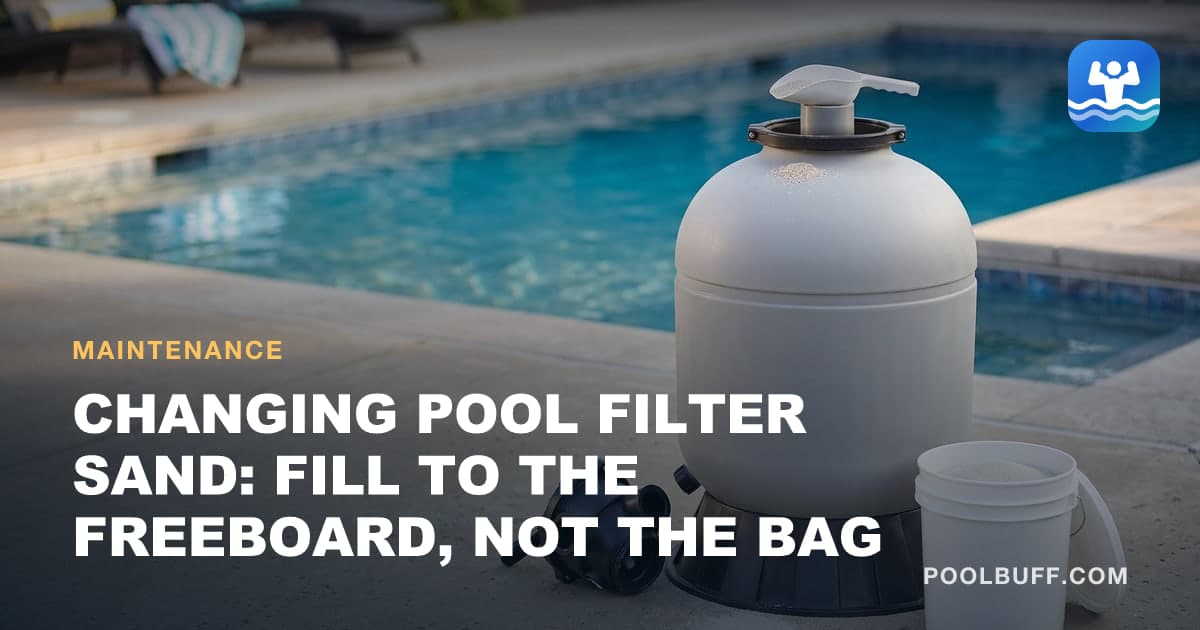
Filter sand doesn't wear out on a schedule. It wears out when it stops doing its job, and the pressure gauge is what tells you.
When the day comes, the job is simple and heavy. The parts that need care are the ones buried under the sand, and every maker's instructions are built around protecting them.
Before you start
- Time
- 3 hr
- Difficulty
- Moderate
- Cost
- The sand, plus any cracked laterals
Tools
- Wet/dry vacuum
- Small plastic scoop
- Garden hose
- Screwdriver for the valve clamp
Supplies
- No. 20 silica pool filter sand
- Silicone lubricant for the o-ring
Key takeaways
- Hayward Support says sand generally lasts 3 to 5 years. No maker's manual gives a number of years. Their tests are a backwash that no longer brings the pressure down, and cycles that keep getting shorter.
- Fill to the freeboard, the gap between the top of the sand and the top of the tank. Pentair and Jandy call their sand weights approximate and say the freeboard is the number that matters.
- Half-fill the tank with water and cap the standpipe before any sand goes in. Every maker says so, and it's what saves the laterals from the weight of the sand.
- Glass and other media depend on the maker. Hayward Support and Pentair's Sand Dollar manual say No. 20 silica only, while Jandy's SFSM manual accepts any NSF-approved media.
- Old sand doesn't go in the sandbox. Jandy's manual says used filter sand isn't appropriate for human or pet contact.
Does it actually need changing?
Hayward Support gives the only figure in years. Answering an owner on its S310S product page, it said sand generally needs replacing every 3 to 5 years. Longer if you don't see a loss of clarity, it added, and shorter if you're constantly backwashing to keep the pressure in range. No manual from Hayward, Pentair or Jandy puts a number of years on it.
What the manuals give you instead are tests:
- A backwash that doesn't bring the pressure back down. Jandy's SFTM manual says that if backwashing can't get the operating pressure below 35 psi, you need to replace the sand.
- Cycles that keep getting shorter. Pentair's troubleshooting table lists short filter cycles, and one cause is sand that "has eroded over time and is filtering poorly." Its fix for that is to replace the entire sand bed.
- High pressure right after a backwash. Pentair's Tagelus manual says a filter shouldn't run above its start-up pressure. At 4 to 6 psi over it, Pentair's answer is a chemical clean, not new sand.
So try the cheap fixes first. Hayward and Pentair both suggest scraping off the top inch of sand, where crust and debris collect, and Pentair pairs that with a chemical clean. The filter cleaning guide covers the chemical clean. If the pressure still won't come down after all that, the sand is done.
Filter pressure is the one number on the weekly checklist that makes this call, which is why it's worth writing the clean reading down.
One thing new sand won't fix is sand on the pool floor. That's usually a cracked lateral, and the sand in the pool guide covers the diagnosis. You'll change the sand as part of that repair anyway, using the steps below.
How much sand, and why the weight is only a guide
Your manual gives a weight. Buy that much, then fill to the line rather than emptying every bag.
Pentair's Tagelus and Triton manuals and Jandy's SFSM manual all say sand density varies, so their weights are approximate. The number they tell you to hold is the freeboard: the gap between the top of the sand bed and the top of the tank. During a backwash, water moves up through the bed, "stirring and dislodging" the dirt, in Jandy's words. The freeboard is the room it has to do that.
Hayward doesn't give a freeboard for each size. Its top-mount manual says the sand must stay at least 10 inches below the top of the tank, and its side-mount manual says about 6 inches.
Here's what each current manual asks for. The links go to each filter's page, with its parts list: Hayward's ProSeries top-mount and side-mount, Pentair's Sand Dollar, Tagelus and Triton II, and Jandy's SFTM and SFSM.
| Sand by model | How full | |
|---|---|---|
| Hayward ProSeries top-mount | S144T 50 lb, S166T 100, S180T 150, S210T 200, S220T 250, S244T 300, S270T 350, S310T2 500, S360T2 700 | At least 10 in. below the top |
| Hayward ProSeries side-mount | S244S 300 lb, S310S 500 | About 6 in. below the top, leveled |
| Pentair Sand Dollar | SD 35 100 lb, SD 40 150, SD 60 250, SD 70 300, SD 80 350 | The amount on the filter's name plate |
| Pentair Tagelus | TA 40D 125 lb, TA 50D 175, TA 60D 275, TA 100D 450 | Freeboard 7.75, 9.25, 10.25 and 11.25 in. |
| Pentair Triton II | TR 40 175 lb, TR 60 325, TR 100 600, TR 140 925 | Freeboard 8.25, 10.5, 11.25 and 13.5 in. |
| Jandy SFTM | SFTM22 250 lb, SFTM24 300 | No freeboard given |
| Jandy SFSM | SFSM60 375 lb, SFSM100 625, SFSM120 1,050, SFSM140 1,200 | Freeboard 12.4, 15.0, 13.5 and 16.0 in. |
Pentair's own paperwork shows why the freeboard matters more than the weight. Its 2025 Tagelus manual asks for 125 lb in a TA 40D, and its 2019 brochure says 175. On the TA 100D it's 450 in the manual and 600 in the brochure, a 150-pound difference for the same tank. The table uses the manual. Fill to its freeboard and it doesn't matter which weight is right.
The grade. Every maker specifies No. 20 silica pool filter sand, and the size ranges barely differ: 0.45 to 0.55 mm from Hayward and the Sand Dollar manual, 0.44 to 0.55 from the Tagelus and Triton tables, 0.40 to 0.55 from Jandy's SFTM. Pentair also asks for a uniformity coefficient of 1.75 or less, which measures how evenly sized the grains are. If a bag isn't sold as No. 20 silica pool filter sand, it isn't what any of them specify.
Sand, glass or something else
This one depends on who made your filter, and the three makers don't agree.
- Hayward puts nothing about other media in its manuals, but its support team has answered the question over and over. Asked about activated glass, about glass over pea gravel, about 20/40 sand and about polyethylene fiber balls, it gave the same answer: it recommends only No. 20 silica pool sand.
- Pentair's Sand Dollar manual says you must use only No. 20 standard silica sand.
- Jandy says two different things. The SFSM side-mount manual says the filter is designed to work with any NSF-approved media, filled to Jandy's own freeboard. The SFTM top-mount manual says to follow the media maker's directions, and warns that other media may deliver unexpected results and may void the warranty.
Jandy's SFSM is also the one filter here with a layered option in its manual: 1/8 to 1/4 inch pea gravel about an inch over the laterals, then sand on top. On an SFSM100 that's 150 lb of gravel under 500 lb of sand, instead of 625 lb of sand alone. Pentair's catalog lists a gravel-and-sand option for the Triton II as well, though the Triton manual gives sand only.
The filter comparison covers what glass media's makers claim for it. If your filter's maker hasn't said yes, stick with sand.
Before you open the tank
Know what you're lifting. Pentair's manual warns that a filter full of sand and water can weigh several hundred pounds, and the old sand comes out wet. A 150 lb top-mount on an above-ground pool is a very different job from the 1,200 lb bed in Jandy's biggest side-mount.
It also depends on where the valve sits:
- Top-mount: the valve sits on top of the tank. The clamp comes off and the whole valve lifts out, and everything comes out through that opening.
- Side-mount: the valve stays plumbed in on the side. You open a lid or closure on top instead. Pentair's Triton and Jandy's SFSM also let you flush the sand out through the drain at the bottom, and so do Pentair's top-mounts.
Changing it
- 1
Shut it down and vent the tank
Breaker off, timer and automation off. If the filter sits below the pool's water level, close the isolation valves, as Jandy's manual says, or the pool will drain through it. Then open the air relief and wait until the gauge reads zero and nothing more comes out.
- 2
Drain it down, but not dry
Open the drain at the base and let most of the water out. Leave enough to keep the sand wet. Jandy's sand change keeps the old sand in a "semi fluid slurry," and wet sand makes no dust.
On a Pentair filter, take off only the drain cap for now. Pentair's manual warns that removing the whole fitting lets the sand drain as well, which you'll want in step 4 but not yet.
- 3
Open the tank
On a top-mount, loosen and remove the clamp and lift the valve off. Keep its o-ring.
On a side-mount, leave the valve where it is and open the lid or closure on top. Jandy's SFSM lid comes off by its hand wheel, and if it's stuck, Jandy says to strike the handles alternately with a mallet or soft-faced hammer. On Hayward's side-mount, lift off the top diffuser and move the air relief tube aside. Then cover the diffusers with plastic bags, which is Jandy's trick for keeping sand out of them.
- 4
Get the old sand out
Scoop out what you can reach, then vacuum the rest as a slurry with a wet/dry vacuum. That's the tool Jandy's procedure names.
If your filter has a bottom sand drain, finish from there. Pentair says to remove the entire drain fitting and flush the tank with a garden hose, and its manuals list a sand vacuum, part 542090, as another way to do it. On Jandy's SFSM you remove the union nut, draw out the drain screen, keep track of its o-ring, and flush. Hayward's manuals describe no sand drain, so on a Hayward, plan on everything coming out the top.
- 5
Check every lateral and the standpipe
This is the only time you'll see them, so look properly. Check each lateral for cracks, including hairline ones, and replace any that are damaged. The sand in the pool guide has the part numbers and how each maker sells them.
Make sure the standpipe is seated in the hub at the bottom of the tank. Hayward's folding laterals all have to be folded down before sand goes in. Jandy's SFSM laterals have to be screwed firmly into the hub, sitting level, with the hub centered in the tank.
- 6
Cap the standpipe and add water
Put the drain cap back on. Then cover the top of the standpipe so no sand can fall into it. Hayward calls the cover a sand shield, Pentair a sand guide and Jandy a sand deflector, and Jandy says it must be used any time media goes in.
Pentair's Sand Dollar and Tagelus manuals say to discard the guide once the sand is in, so you may not have one. The Tagelus parts list includes it, part 155051. A plastic bag taped over the opening does the same job, the way Jandy bags its diffusers.
Now fill the tank about half full of water. Hayward and Pentair say about half, and Jandy's SFTM says a third to a half. The water is a cushion. It stops the weight of falling sand from landing on the laterals.
- 7
Pour in the sand to the freeboard
Pour slowly with a small scoop, and keep the standpipe centered in the opening as the bed builds. Stop at the freeboard or level in your manual, and level the surface.
Keep the dust down while you pour. Pool filter sand is crystalline silica, and its safety data sheet says not to breathe the dust and to keep it moist.
- 8
Close it up
Take the shield or bag off the standpipe, and rinse any sand off the tank opening and threads. Pentair and Jandy both ask for that. Clean the o-ring and lubricate it: Pentair says silicone lubricant, and Jandy a non-petroleum one.
On a side-mount, the air vent tube has to end up exactly where the manual shows it. Pentair's Triton needs its automatic air vent sticking up into the closure. Jandy's SFSM needs the vent tubing threaded through the diffuser, with its screen at the top, and Hayward's air relief tube goes through the hole in its diffuser. Pentair and Jandy both warn that trapped air can blow the lid off. Then refit the valve or lid and tighten it the way your manual says.
- 9
Restart in Backwash
Set the valve to Backwash, open the air relief and stand clear of the filter. Start the pump, and close the air relief once a steady stream of water comes out. Run it until the water runs clear. Hayward says at least 2 minutes, and Pentair's Tagelus manual notes that shipping can abrade sand enough to need a longer first backwash.
Then Rinse: 30 seconds to a minute on Hayward, 1 to 2 minutes on Jandy's SFTM. Back to Filter, and write down the new clean pressure. Jandy says to set the gauge's clean marker to it. That's your new baseline for every backwash from here on.
A little grit in the pool for the first few days is normal, because new sand sheds fines. The sand in the pool guide explains how long that should last.
Getting rid of the old sand
Jandy's manual is blunt about it: used filter sand isn't appropriate for human or pet contact. It has spent years catching whatever the pool collected. It doesn't go in the sandbox, under the swing set or in the vegetable bed.
Bag it and check what your local waste service takes. The safety data sheet for pool filter sand says to dispose of it in line with local regulations.
When to hand it over
Asked for step-by-step instructions on its own product page, Hayward Support recommended leaving the job to a professional unless you've done it before. That's fair for the big side-mounts. An above-ground top-mount is well within reach for one person.
Call someone if the tank is cracked, if the standpipe won't seat, or if the lid or closure won't seal once it's back together. A filter that leaks is a nuisance. A lid that isn't seated properly can come off under pressure.
Go deeperKeeping the new sand working longerWhen to backwash, when a chemical clean helps, and what each filter type costs to keep running.Frequently asked questions
How often should pool filter sand be changed?
Hayward Support's answer, on its own product page, is generally every 3 to 5 years. It says longer if the water stays clear, and shorter if you keep having to backwash to hold the pressure down. None of the manuals gives a number of years. Pentair and Jandy give tests instead: short cycles from sand that has worn down, or pressure a backwash can't bring back down.
How much sand does my pool filter need?
Your manual gives the weight, and Pentair's Sand Dollar manual sends you to the name plate on the filter. But Pentair and Jandy both say sand density varies, so their weights are approximate. The number to hit is the freeboard: the gap between the top of the sand and the top of the tank. Hayward's top-mount manual says the sand must stay at least 10 inches below the top.
Can I use glass media instead of sand?
Check your filter's maker first. Hayward Support has answered questions about activated glass, glass over pea gravel and 20/40 sand the same way: it recommends only No. 20 silica pool sand. Pentair's Sand Dollar manual says to use only No. 20 silica. Jandy's SFSM manual accepts any NSF-approved media, filled to Jandy's freeboard, while its SFTM manual warns that other media may void the warranty.
Do I have to take all the old sand out?
Not always. For short filter cycles, Hayward and Pentair both suggest taking off just the top inch of sand, where crust and debris collect, and Pentair adds a chemical cleaning. When the sand itself has worn out, Pentair's answer is to replace the entire bed.
What do I do with old pool filter sand?
Bag it and follow your local rules. Jandy's manual says used filter sand isn't appropriate for human or pet contact, so it doesn't belong in a sandbox or a play area. The safety data sheet for pool filter sand says to dispose of it in line with local regulations.