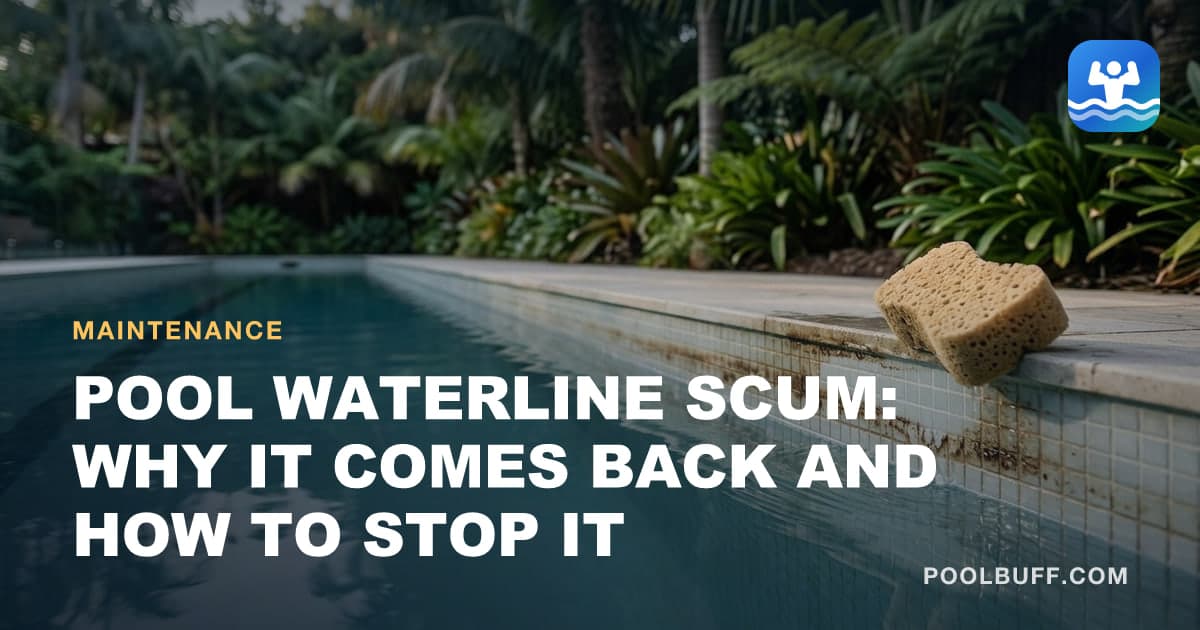
Everything that floats ends up at the waterline, and most of what floats is greasy.
Sunscreen, body lotion, hair product, the natural oil off skin — all lighter than water, all pushed to the surface, all held against the wall by surface tension. Airborne dust and pollen land on that film and stick. Then the level drops an inch on a hot day, the film dries onto the tile, and you have a band.
It is not a chemistry failure. A perfectly balanced pool with four swimmers a day will grow a scum line, because the cause is bathers rather than water.
Key takeaways
- The band forms at the surface because oil floats and dust sticks to it.
- Household cleaners foam and the foam ends up in your pool for days. Use a pool-specific one.
- A skimmer that never quite reaches the surface is the most common reason it returns fast.
- White scale at the waterline is a different problem with a different fix. Test before you scrub.
- Rinsing off before swimming does more for this than any cleaner does.
Check what you are actually looking at
Two different deposits form in the same place and want opposite treatments.
- Scum is dark or tan, feels greasy, and smears under a thumb. It is organic.
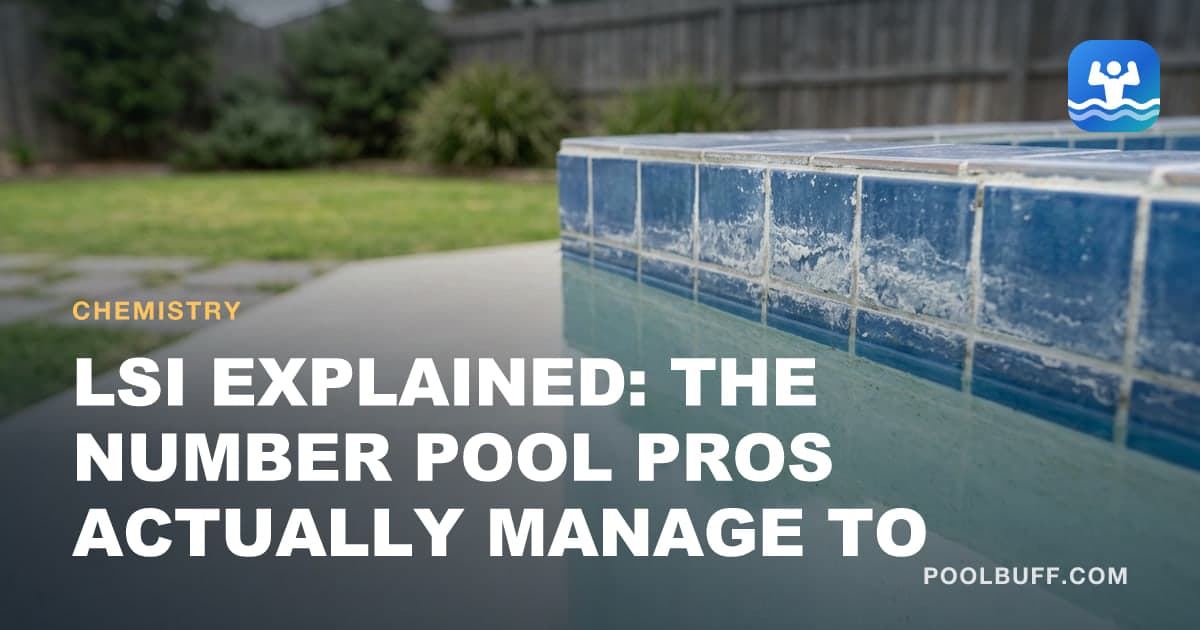
- Scale is white or gray, gritty, and does not smear. It is calcium carbonate that has come out of solution, and scrubbing is treating a symptom — the real answer lives in your saturation index.
If you have both, deal with the scum first. It is faster, and it stops you attacking scale with a brush you will only wear out.
Removing it
Before you start
- Time
- 30 min
- Difficulty
- Easy
- Cost
- $10-$25
Tools
- Waterline brush or melamine pad
- Bucket
- Gloves
Supplies
- Non-foaming tile cleaner
- 1
Drop the level an inch or two
10 minutesOnly if the band sits partly underwater. Working on a wet, submerged line is slow and you cannot see what you have missed.
Lower it just enough to expose the band. There is no need to drain properly, and every reason not to.
- 2
Pick something that will not foam
—This is where most people go wrong. Household degreasers and dish soap shift the grease beautifully and then put surfactant into your pool, and you spend the next three days watching foam blow around the surface.
A pool-specific tile cleaner is formulated not to do that. A melamine pad — the white magic-eraser kind — with plain water works on tile and is remarkably effective on nothing but friction.
Never use anything abrasive on vinyl. On a vinyl liner, a soft cloth and a nylon pool brush are as aggressive as you should get.
- 3
Work in short sections
20 minutesTwo or three feet at a time, cleaner on, thirty seconds to soften, then scrub along the band rather than up and down.
Rinse the pad often. A loaded pad just redistributes grease, which is why the second lap of a pool always looks worse than the first.
- 4
Refill and let the filter work
—Bring the level back to mid-skimmer and run the pump. Whatever you loosened is now floating, and the skimmer is what collects it.
If the water looks slightly hazy afterward, that is normal and clears within a cycle.
Making it come back slower
Scrubbing is the fix. Skimming is the prevention, and this is where a pool that needs monthly attention differs from one that needs weekly.
Get the surface actually skimming. The single most common cause of a fast-returning band is a skimmer that never quite reaches the film. Water level halfway up the skimmer mouth, weir flap swinging freely, basket not packed. If the level sits high the film drifts past; if it sits low the skimmer gulps air and the flow stutters. A skimmer working properly removes surface oil continuously, which is precisely what you want.
Run the pump when people have been swimming. Surface film is heaviest in the hours after use. A schedule that shuts the pump off at five leaves the day's oil sitting on the wall overnight to dry on.
Reduce what goes in. A rinse before swimming removes most of the lotion and a good share of the body oil, and it does more than any product you can buy. Nobody enforces this at a private pool, but it is worth mentioning to whoever arrives wearing a full coat of sunscreen.
Put something absorbent in the skimmer. Oil-absorbing sponges sit in the basket and soak up film as it arrives. Tennis balls do a weaker version of the same thing for less money.
Keep on top of the weekly routine. A quick pass along the waterline with a brush every week takes about ninety seconds and stops a band ever setting hard enough to need a cleaner.
When the tile itself is the problem
Sometimes the band is not a deposit at all — the tile has changed.
Loose or missing tiles at the waterline are common on older pools, and they usually mean movement rather than a bad tile. That band sits exactly where the shell meets the deck, which is where the expansion joint does its work. When the joint fails and the deck starts loading the coping, tiles come off in a row rather than one at a time. Re-sticking them without dealing with the joint means doing it again.
Failed grout shows as dark lines no cleaner touches, because you are looking at the shadow of a missing joint rather than dirt on a surface. Regrouting a waterline is straightforward with the level dropped, and it is worth doing before water gets behind the tile and lifts more of them.
Freeze damage shows as tiles cracked or pushed off in a band, generally after a winter where the level sat too high under the cover. Water freezing at the tile line expands against the face of the tile. It is precisely why the level gets dropped at closing, and it is a repair that arrives all at once in April.
Calcium in the grout joints rather than on the tile face is scale that has worked into porous material. Surface cleaning does not reach it, and this is the case where a professional bead blast genuinely earns its money.
When it will not come off
A band that resists a melamine pad and a proper cleaner has usually been there long enough to bond, and on porous surfaces it can sit slightly below the surface rather than on top of it.
On plaster and grout, a long-neglected line sometimes needs a bead blast, which is a professional job. On tile, a second pass with a dedicated tile cleaner and a longer dwell time will normally get there.
Either way, once it is off, the ninety seconds a week is what keeps it off.
Go deeperThe weekly routineWhere the waterline pass fits, and the rest of the fifteen minutes that keeps a pool from drifting.Frequently asked questions
What causes the dirty ring around my pool at the waterline?
Body oil, sunscreen, hair product and cosmetics float to the surface, where airborne dust and pollen stick to them. Surface tension holds that film against the wall, and it dries onto the tile or plaster in a band exactly at water level. It is grease with dirt in it, which is why plain water never shifts it.
Can I use household cleaners on pool tile?
Avoid them. Most contain surfactants that foam, and that foam goes into your pool and can take days of filtering to clear. Some also contain ingredients that upset water chemistry. A non-foaming pool tile cleaner, or a magic-eraser style melamine pad with plain water, does the job without the aftermath.
How do I tell scum from scale at the waterline?
Scum is dark, greasy and smears when you rub it. Scale is white or gray, gritty, and feels like rough stone that will not smear. Scale is calcium coming out of solution, so it points to your saturation index rather than to bathers, and it needs a different treatment entirely.
Why does the scum line come back so quickly?
Usually because the skimmer is not clearing the surface. If the water level sits too low or too high, or the weir flap is stuck, surface film never reaches the skimmer and just keeps redepositing on the wall. Fix the skimming before you blame the cleaner.
Do tennis balls in the skimmer actually work?
Somewhat. The felt absorbs a little surface oil, and it is cheap enough to be worth doing. Purpose-made oil-absorbing sponges hold considerably more. Neither is a substitute for correct water level and a working weir, which is what actually gets the film to the skimmer in the first place.