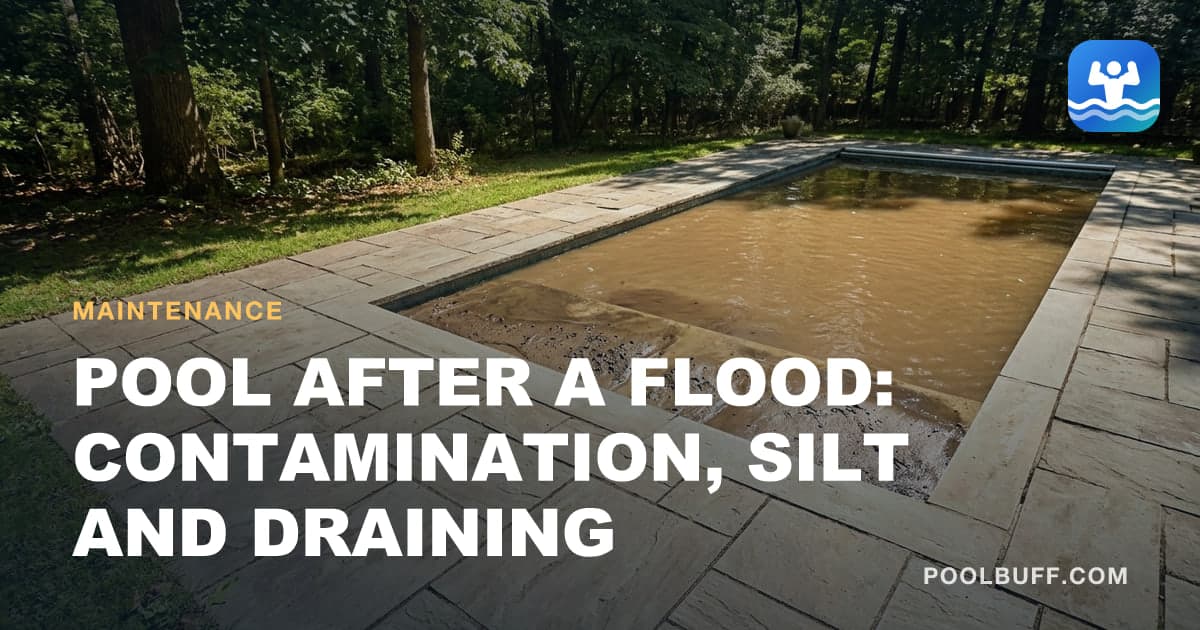
A flooded pool is a different problem from a pool after heavy rain, and it is worth being clear about why. Rain dilutes your chemistry and adds organic load. A flood adds whatever was on the ground — and around most houses that includes sewage, fuel and whatever the neighbors keep in the garage.
That makes it a health problem first and a chemistry problem second.
Key takeaways
- Floodwater carries sewage, fuel and agricultural runoff. Nobody swims until it is cleared.
- This is the worst possible moment to drain. The water table is at its highest.
- Vacuum silt to waste, never through the filter.
- Filter media that has processed floodwater usually gets replaced, not cleaned.
- Submerged equipment gets inspected before it gets power. Not after.
Nobody swims
Not for a look, not for the kids, not the dog.
Floodwater carries sewage overflow, agricultural runoff, fuel, pesticides and industrial residue depending on what it crossed getting to you. None of that is visible, and clear water is not evidence of anything — the pool can look completely normal and still be unsafe.
Post it, cover it if you have a safety cover, and treat it as out of service until you have a test result rather than an impression.
Why you still don't drain
Every instinct says empty it and start again. This is the single worst moment to act on that instinct.
The ground around your pool is as saturated as it will ever be. Hydrostatic pressure from below is at its maximum, and the only thing counteracting it is the weight of the water inside the shell. Empty it now and a fiberglass or vinyl pool can lift; a concrete one can too, given enough water.
That failure is not a repair. It is a replacement, and it happens to people who were trying to do the right thing.
The full explanation of why draining is dangerous applies here at maximum. When the time comes, exchange the water in stages — a third out, refill, repeat — and only once groundwater has genuinely receded, which may be a week or more after the water leaves your yard.
What you need
- Check price
liquid chlorine, 12.5% sodium hypochlorite
Adds no stabilizer and no calcium. Heavy to ship, so local is usually cheaper.
- Check price
Taylor K-2006C test kit
Drop-count titration rather than color matching, and it tests CYA properly.
- Check price
filter cleaner
A hose rinse leaves the oils behind. This is what gets the greasy film.
The order of work
- 1
Skim what floats, fast
1 hourDebris stains as it sinks, and you have a day or two. This is the same time-sensitive job as after any storm, just with more in the water.
- 2
Vacuum silt to waste
2–4 hoursThere will be far more than you expect — often inches across the floor.
To waste, not through the filter. Fine silt blinds filter media within minutes and much of it comes straight back into the pool. Move slowly in overlapping passes, and top up with fresh water as the level drops, because you are removing water as well as silt.
- 3
Superchlorinate and hold it
3–7 daysRaise free chlorine well above your normal shock level and keep it there with the pump running continuously. Contaminated water needs sustained sanitizer over days rather than one large dose.
Test two or three times a day and top it up. If it disappears within an hour, you have an organic load large enough to be its own problem — work out which demand you have before spending more.
If sewage was in the water, there is a specific number. Cryptosporidium is the pathogen that matters after a sewage event, because it shrugs off normal chlorine levels for days. The CDC protocol is 20 ppm free chlorine held for 12.75 hours, with pH at or below 7.5 and water at 77°F or warmer. That combination is what gets you a 99.9% kill.
And the stabilizer has to come down first. Cyanuric acid substantially delays chlorine's effect on Crypto, and the CDC's own guidance caps it at 15 ppm for hyperchlorination — it used to allow 50, and was tightened. A pool sitting at the 30–50 ppm this site recommends for normal operation, or the 60–80 of a salt pool, cannot run the protocol until some of that water has been exchanged. That is one of the few genuinely good reasons to get water out early, and it is still done in stages rather than by draining.
- 4
Replace the filter media
1 hourCartridges and DE grids that have processed floodwater hold contaminated material in the pleats, and they are cheaper to replace than to trust. Sand can usually be backwashed hard and reused, though a filter that was fully submerged is worth opening either way.
Expect to clean or change media more than once as the water clears.
- 5
Rebalance, then test again
DaysOnce chlorine holds overnight and the water is clear, bring pH, alkalinity and the rest back to normal.
Then leave it a day and test again before anyone gets in. A pool that has held sanitizer and stayed clear for twenty-four hours is a pool you can trust.
What the water exchange actually looks like
Once the ground has dried out and the pool is clear, you may still want fresh water — for the stabilizer level, the hardness, or simply for confidence after sewage contamination.
Do it in thirds. Lower by roughly a third, refill to full, let it circulate, then repeat. Each cycle removes a meaningful share of what was in there without ever taking the ballast out of the shell.
It is slower than draining and it is the difference between a long weekend and a new pool.
What the flood did around the pool
The water is the visible problem. Several others are not, and they are worth walking before you call the job finished.
Under the deck. Floodwater crossing a yard washes material out from under paving and from around the shell. A paver deck can look perfectly intact and be sitting on nothing in places — stand on each section near the coping and feel for movement. On a poured deck, look for a new gap at the expansion joint, which means one side of it moved.
The equipment pad slab. The same story. A pad that has shifted takes the plumbing with it, and a hairline crack at a pipe penetration under a pump is a leak you will chase for a season without finding.
The bonding grid, mentioned above and worth repeating because it is invisible. Ground that moved can pull a bonding conductor off its lug.
Backfill behind a fiberglass or vinyl pool. If water got behind the shell or the liner it may have carried sand or gravel out as it drained. Voids behind a wall surface later as a bulge or a settlement, so a shell that looks fine today is still worth a professional look if the water was deep.
Photograph everything before you clean up. The same advice as after a storm and more important here, because flood claims often turn on documentation of how deep the water got and what it touched. Put something in frame for scale, and take the pictures before the silt gets vacuumed away.
If your health department has rules
Some jurisdictions have specific requirements after confirmed sewage contamination, and they are worth a phone call rather than a guess — particularly if the pool is shared, rented, or covered by any kind of inspection regime.
Where a full water replacement is required, the sequencing above still applies. The requirement is about the water, not about how fast you are allowed to take it out.
Go deeperBefore you empty anythingWhy an empty shell in wet ground floats, and the staged exchange that avoids it.Frequently asked questions
Should I drain my pool after a flood?
Not while the ground is saturated, which is exactly when people want to. Post-flood groundwater is at its highest, and an empty or near-empty shell in that condition can lift out of the ground — the one failure that turns a cleanup into a rebuild. Exchange the water in stages once the water table has dropped, a third at a time with refilling in between.
Is pool water safe after flooding?
No, not until it has been treated and tested. Floodwater carries sewage overflow, agricultural runoff, fuel and whatever was stored in nearby garages. Treat the pool as contaminated, keep everyone out including pets, and do not judge it by appearance — clear water can still be unsafe, and this is the case where a test result rather than a look decides it.
How do I get silt off the bottom of my pool?
Vacuum it to waste, which sends it out of the pool entirely rather than through the filter. Running fine silt through a filter blinds the media within minutes and pushes much of it straight back into the pool. Move slowly, in overlapping passes, and expect to lose enough water that you will be topping up as you go.
Do I need to replace my filter after a flood?
The media, usually yes. Cartridges and DE grids that have processed floodwater hold contaminated material in the pleats and are cheaper to replace than to trust. Sand can often be backwashed hard and reused, though a filter that has been fully submerged is worth opening and inspecting either way.
Can I run my pool equipment after it has been under water?
Not until it has been inspected. A submerged motor holds water in windings and bearings, a flooded control panel can fail dangerously, and floodwater moving through a yard can disturb bonding. Energizing wet equipment is how a repairable problem becomes a replacement and how somebody gets hurt. Get an electrician or a pool professional to look at it first.