Here's the thing that trips almost everybody up.
"Shock" isn't a product. It's not a bag. It's a level you take your chlorine to and then hold.
The bag with SHOCK printed on it in big letters is just chlorine — usually cal hypo, sometimes dichlor — packaged for people who don't know that. Our shock and chlorine picks go through which bag is which. And the dosing instructions on the back are written for an average pool with an average CYA level, which means for your pool they're probably wrong in one direction or the other.
Key takeaways
- Shock is a level you hold, not a product you dump. The bag is just chlorine.
- Your shock target is roughly 40% of your CYA reading. At 80 ppm CYA that's 32 ppm, which is a lot of chlorine.
- Do it at dusk. Shocking at noon in July wastes most of what you add before it does any work.
- You're done when the overnight chlorine loss test comes back under 1 ppm, not when the water looks clear.
- Non-chlorine shock is a different product doing a different job. It won't kill algae.
Work out your target before you open anything
Your shock level is roughly 40% of your cyanuric acid reading.
That's the number. It comes out of the same CYA-to-chlorine relationship that governs your normal target, just at the level that actually kills things rather than the level that maintains clean water.
| Your CYA | Shock to | 12.5% liquid chlorine, 20k pool |
|---|---|---|
| 20 ppm | 8 ppm | About 1.3 gallons. Easy. |
| 30 ppm | 12 ppm | About 1.9 gallons. Straightforward. |
| 40 ppm | 16 ppm | About 2.5 gallons. Normal. |
| 60 ppm | 24 ppm | About 3.8 gallons. Getting expensive. |
| 80 ppm | 32 ppm | About 5 gallons, held for two days. |
| 100 ppm | 40 ppm | About 6.4 gallons a round. Price a partial drain against it first. |
Those gallon figures assume you're starting near zero free chlorine, which is usually where a pool that needs shocking actually is. If you're starting at 3 ppm, take that off the target before you work out the dose. A gallon of 12.5% raises 20,000 gallons by about 6 ppm, and everything above is just that number scaled — use it to size any pool.
That bottom row is worth pausing on. Once CYA is over about 80, shocking gets expensive and slow enough that partial dilution is often the cheaper route — but whether it actually is depends on what water costs where you live and how stubborn the bloom turns out to be. The shock calculator runs both routes on your own prices, because on cheap water diluting wins easily and on expensive water it does not. I've had that conversation with a lot of frustrated people in August, and the honest answer was always "it depends".
Go deeperChlorine dosage calculatorPunch in your CYA and it sets the shock target and the dose for you.Get pH down first
Chlorine's killing power drops off hard as pH rises. At pH 8.0 you're getting a fraction of the disinfection you'd get at 7.2 from the same chlorine reading.
So before you shock, drop pH to around 7.2. Not lower — you don't want to go acidic on plaster — but 7.2 rather than 7.6 makes a real difference in how fast the job goes and how much chlorine you use.
Add the acid, let it circulate a couple of hours, then start.
The job
Before you start
- Time
- 48 hr
- Difficulty
- Easy
- Cost
- $40-$90 in liquid chlorine
Tools
- Drop-based FAS-DPD kit
- Wall brush and pole
- Gloves and eye protection
Supplies
- Liquid chlorine, 10-12.5%
- 1
Test CYA, set your target
10 minTest cyanuric acid. Multiply by 0.4. That's your free chlorine target.
Also test your current free chlorine, because the dose is based on the gap between where you are and where you're going — not on the target itself.
- 2
Drop pH to about 7.2
15 min plus circulationMuriatic acid, pump running, deep end, diluted in a bucket first.
Give it a couple of hours to move around before you start adding chlorine.
- 3
Clean everything first
30-45 minEmpty the skimmer and pump baskets. Clean or backwash the filter — you're about to ask it to do a lot of work, and a dirty filter will bottleneck the whole job.
Then brush. Everything. Walls, floor, steps, the underside of step lips, behind the ladder rails, around the light niche. Algae hides where water doesn't move, and chlorine can't kill what it can't reach.
If you've got visible black algae spots, brush them hard with a stainless brush first. They've got a protective layer over the top and chlorine won't touch them until you break it.
- 4
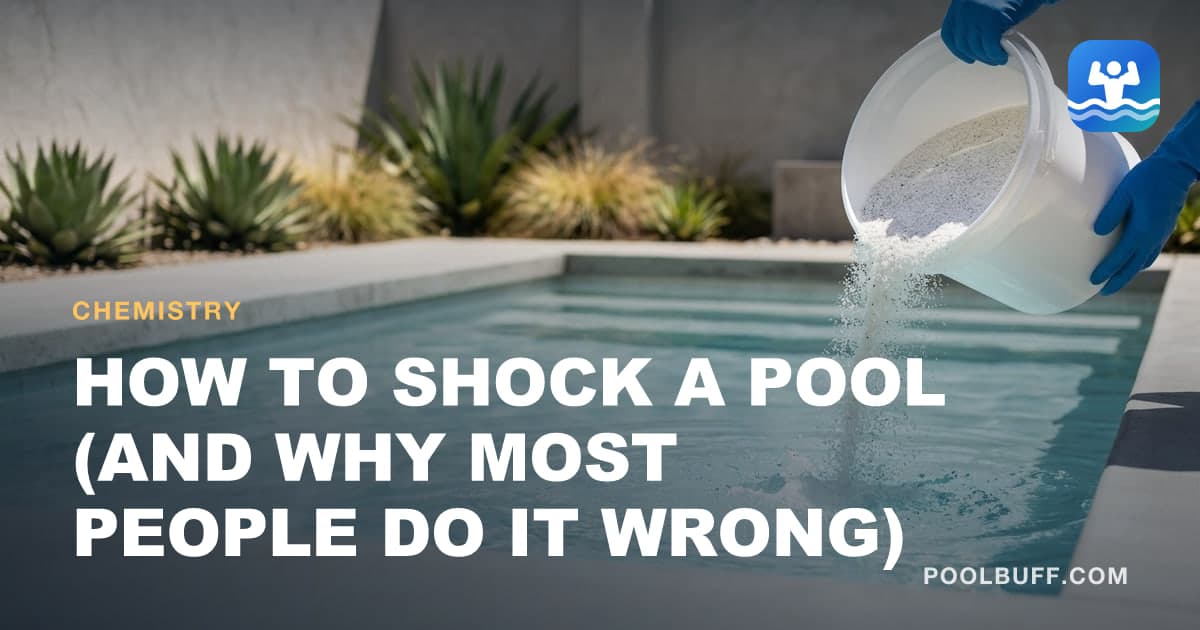
Add chlorine at dusk
20 minLiquid chlorine, always, for this job. Cal hypo will work but it dumps calcium into your water at exactly the volume where that starts to matter. Cal hypo adds roughly 0.7 ppm of calcium hardness for every 1 ppm of free chlorine, so a 32 ppm shock puts about 22 ppm of hardness into the pool — and you can't take that back out. Do that four or five times in a season on water that started hard and you have built yourself a second problem.
Pour slowly around the perimeter with the pump running. Don't dump it all in one spot, and keep it off the liner if you've got vinyl.
Dusk matters more than people think. At shock levels a lot of your chlorine is unbound by CYA, which means the sun eats it. Start at 9 p.m. and you get eleven hours of work before the sun shows up. Start at noon in July and you've wasted a good chunk of a $40 jug.
- 5
Hold the level
24-48 hoursThis is the step everyone skips, and it's the whole job.
Retest every 3–4 hours while you're awake and add more chlorine to bring it back to shock level. In a bad bloom your chlorine can drop 10 ppm in a few hours — that's the algae dying, and it's what you want, but it means the level won't hold itself.
Hitting shock level once and going to bed is the difference between killing an algae bloom and annoying it.
- 6
Run the overnight chlorine loss test
OvernightThis is how you know you're finished. Not the water clarity — the test.
Test free chlorine right at sunset. Test it again first thing in the morning before the sun's on the water. No UV in between, so anything you lost was consumed by something living in the pool.
- Under 1 ppm lost: done. Let chlorine drift back to normal, and go by the reading rather than the clock before anyone swims.
- 1–3 ppm lost: close. One more day at shock level.
- Over 3 ppm lost: something's still alive. Keep going, and check your filter and your brushing.
- 7
Filter it out
1-3 daysDead algae is a lot of very fine particulate, and now your filter has to catch all of it.
Run the pump around the clock. Watch the filter pressure — on a heavy bloom you might clean the filter two or three times over a couple of days. A cartridge filter clogging every six hours during a bloom is normal, not a sign anything is wrong.
If the water is clear but hazy after chlorine is back to normal, a clarifier will help the filter grab the last of it. That's the one time I actually reach for clarifier.
When you should shock
Not on a schedule. "Shock weekly" is retail advice, and on a pool with proper chlorine levels it's mostly a waste of money.
Shock when:
- Combined chlorine reads above 0.5 ppm. (Free vs total chlorine explains what that reading actually is.) That's chloramines, that's the smell people blame on too much chlorine, and breakpoint is the fix.
- You've got visible algae, any color.
- After a heavy bather load — a party, a swim meet, anything with a lot of people in the water.
- After a storm that dumped debris and runoff in.
- Opening in spring and closing in the fall.
- After a fecal incident, following the CDC's remediation guidance, which is stricter than normal shocking.
- Free chlorine hit zero and you don't know for how long.
That's it. A pool sitting at correct free chlorine with clear water and no combined chlorine doesn't need shocking because the calendar says Sunday.
Chlorine shock vs non-chlorine shock
These get shelved next to each other and they do completely different jobs.
| Chlorine shockMy default | Non-chlorine (MPS) | |
|---|---|---|
| Kills algae | Yes | No |
| Kills bacteria | Yes | No — not a sanitizer |
| Destroys chloramines | Yes, at breakpoint | Yes, and this is its actual job |
| Swim wait | 8-24 hours | 15-30 minutes |
| Affects CYA | Only if you use dichlor | No |
| Best use | Algae, contamination, spring opening | Weekly oxidation on a busy pool, indoor pools |
One warning on MPS: it reads as combined chlorine on a DPD test for a day or two after you add it. So don't add MPS, test the next morning, see combined chlorine at 2 ppm and panic. Wait 48 hours before you trust a CC reading.
What goes wrong
Not going high enough. Covered above. Test CYA.
Not holding the level. One dose, then bed. The algae recovers.
Shocking at noon. You're funding UV.
Using cal hypo for a big shock on a hard-water pool. You'll fix the algae and create a calcium problem. In Phoenix or Las Vegas that's a genuinely bad trade.
Dirty filter. You kill everything and then can't remove it. The water stays cloudy, people assume the shock failed, and they shock again.
Shocking with the cover on. Damages the cover, and doesn't work as well.
The follow-up nobody does
Once the water's clear, go back and ask why it happened.
Ninety percent of the time the answer is that free chlorine spent time below the level your CYA demanded. Either CYA crept up on tablets and nobody adjusted the chlorine target, or the pool went a week without testing during a hot spell.
Fix that and you won't be shocking again in three weeks.
Go deeperCYA too high to shock effectively?Work out the partial drain that brings it back into range.What you need to shock properly
- Check price
cal-hypo shock
68% calcium hypochlorite in 1 lb bags, so you dose a bag rather than guess at a scoop.
- Check price
Taylor K-2006C test kit
Drop-count titration rather than color matching, and it tests CYA properly.
Frequently asked questions
How much shock do I need for my pool?
It depends on your cyanuric acid level, not on your pool size alone. Target about 40% of your CYA reading in free chlorine. For a 20,000 gallon pool at 40 ppm CYA sitting at 1 ppm free chlorine, you're raising 15 ppm, which takes roughly 2.5 gallons of 12.5% liquid chlorine.
Should I shock my pool at night or during the day?
At dusk, always. UV destroys unstabilized chlorine fast, and at shock levels a lot of that chlorine is unbound. Shocking at noon in July can waste half of what you add before it gets any work done.
How long after shocking can you swim?
Once free chlorine is back under about 4 ppm — or under your normal target for your CYA level — and pH is back in range. That's usually 8 to 24 hours depending on how high you went and how much sun the pool gets.
What is non-chlorine shock and when should I use it?
Potassium monopersulfate, usually sold as MPS. It oxidizes organic waste and reduces the chlorine smell, and it lets people swim sooner. It does not kill algae and it is not a sanitizer. It's a useful supplement in a heavily used pool, not a substitute for chlorine.
Why didn't shocking my pool work?
Almost always one of three things. You didn't go high enough because you never tested CYA. You hit the level once instead of holding it for a day or two. Or your filter is dirty or undersized and can't remove the dead algae you just killed.
Can I shock a pool with the cover on?
No. High chlorine levels will damage most covers, particularly solar and vinyl covers, and the cover prevents the gas exchange that helps chlorine work. Take the cover off, shock, and leave it off until levels come back down.