Walk into a pool store and there are perhaps thirty products on the chlorine shelf. You need two of them, and occasionally a third.
The reason the aisle is confusing is that the products are differentiated by marketing rather than by chemistry. Underneath, there are only a handful of actual compounds, and what separates them is not how well they sanitize — they all become the same thing in water — but what else they leave behind.
Key takeaways
- Two products cover almost everything: tablets for daily, cal hypo for shocking.
- Buy shock in one-pound bags, not a bulk tub. You dose a bag instead of guessing at a scoop.
- Liquid chlorine loses strength in storage. Buy it fresh and often, not in bulk.
- Trichlor and cal hypo react with each other. Separate shelves, separate scoops, no exceptions.
- Price per pound is the wrong comparison. Price per ppm delivered is the real one.
My picks at a glance
- 1
3-inch stabilized tablets
Best for daily chlorination · routine chlorination while your stabilizer has room
- 2
Cal hypo shock, 1 lb bags
Best for shocking · algae, after a party, and spring openings
- 3
Liquid chlorine
Best once stabilizer is high · pools past 50 ppm cyanuric acid, and anyone dosing daily
Buy for the job, not for the year
The most common mistake is buying one product and using it for everything.
Tablets for daily chlorination and cal hypo for shocking is the combination that covers a normal season. Tablets hold a residual with almost no effort; cal hypo delivers a big unstabilized dose when something has gone wrong. Neither does the other's job well.
The third product enters when your stabilizer climbs. Tablets add cyanuric acid — around 0.6 ppm for every 1 ppm of chlorine — so a pool run on them all summer gains roughly 35 ppm a month. Past about 50 ppm it is time to move daily dosing to liquid, or you will spend August wondering why a pool that tests fine keeps growing algae.
3-inch stabilized tablets
Best for routine chlorination while your stabilizer has room
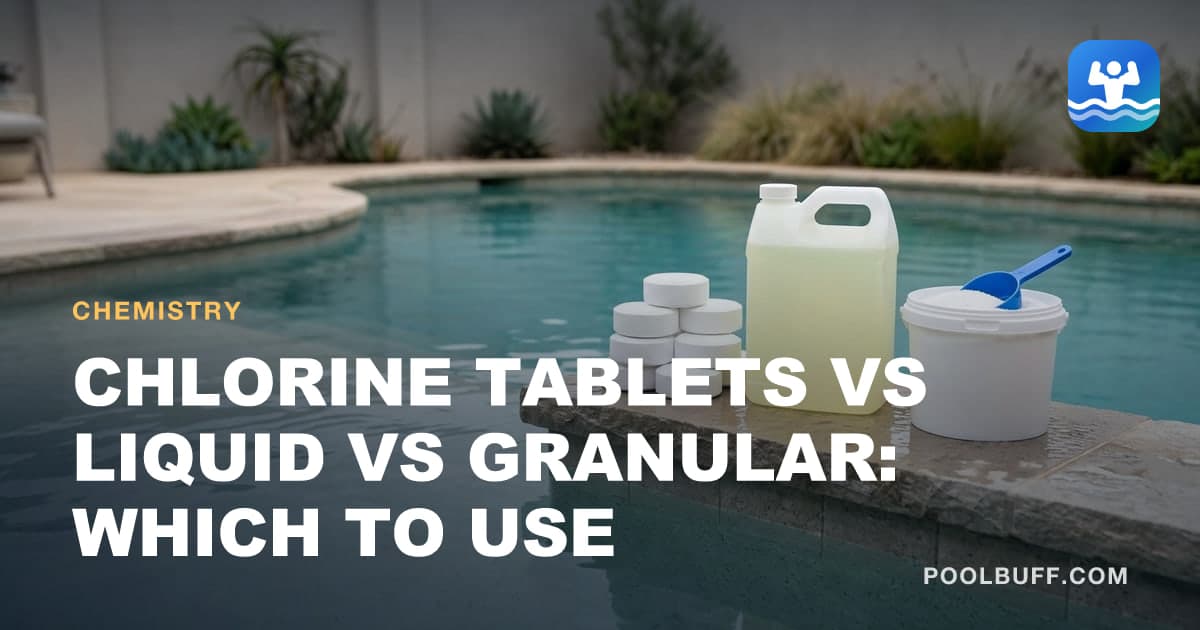
Trichlor pucks in a feeder or floater are the lowest-effort way to hold a chlorine residual: load once a week and walk away. At 90% available chlorine they are also the most concentrated thing you can buy. The catch is that every tablet adds stabilizer, so this is the right product until it suddenly is not.
Strengths
- Highest available chlorine of anything on the shelf
- Slow-dissolving, so one loading lasts a week
- Long shelf life — a sealed bucket keeps for years
Trade-offs
- Adds about 0.6 ppm of cyanuric acid per ppm of chlorine delivered
- Acidic, so it drags pH and alkalinity down steadily
- Never for a hot tub, and never stored beside cal hypo
Cal hypo shock, 1 lb bags
Best for algae, after a party, and spring openings
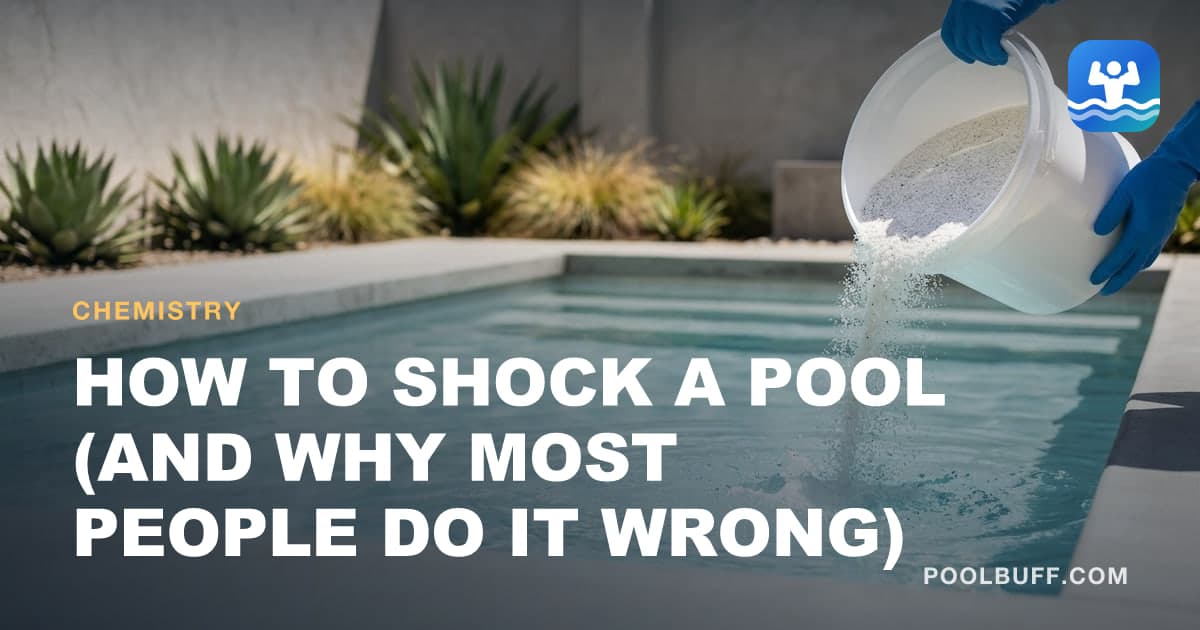
Calcium hypochlorite at around 68%, sold in one-pound bags. The bags matter more than they sound: dosing is arithmetic against pool volume, and a measured bag removes the guesswork that a scoop out of a bulk tub introduces. Adds no stabilizer, which is exactly what you want when shocking.
Strengths
- No stabilizer added, so shocking does not compound a CYA problem
- One-pound bags make dosing arithmetic rather than estimation
- Keeps for years if it stays dry and sealed
Trade-offs
- Adds calcium, which matters in already-hard water
- Must be pre-dissolved or it bleaches vinyl and stains plaster
- Reacts violently with trichlor — genuinely a fire risk
Liquid chlorine
Best for pools past 50 ppm cyanuric acid, and anyone dosing daily
Sodium hypochlorite at 10 to 12.5%, the same chemistry as household bleach at roughly twice the strength. It adds nothing but a trace of salt — no stabilizer, no calcium — which makes it the cleanest way to hold chlorine on a pool that has already accumulated one or the other. It ships, but it is heavy and it degrades, so a local supplier with turnover usually wins on both price and strength.
Strengths
- Adds no stabilizer and no calcium
- Net pH-neutral across a full cycle, despite the label
- Cheapest per ppm delivered if bought fresh
Trade-offs
- Loses strength in storage, badly in summer heat
- Heavy and awkward, and it will eventually spill on something
- Needs dosing every day or two rather than weekly
Why bags beat buckets
Cal hypo is sold both ways, and the bulk tub is usually cheaper per pound. Buy the bags anyway.
Shocking is arithmetic: your volume, the ppm you want to add, the product's strength. A one-pound bag turns that into counting. A scoop out of a tub turns it into estimation, and estimation runs low — people under-dose shock far more often than they over-dose it.
An under-dosed shock is worse than none, because it costs the same effort, uses most of the chemical, and fails to reach the threshold where it actually does anything. Getting the level right is the whole exercise.
Three that look like answers
Most of the remaining shelf is one of these, and each has a narrow right use and a wide wrong one.
Dichlor is stabilized granular chlorine, around 56% available, and it dissolves in seconds — which is why it gets sold as a shock. It is a poor one. Per unit of chlorine delivered it adds more stabilizer than trichlor does, so shocking with dichlor is the fastest way to lock a pool into a stabilizer problem. Where it earns its place is a hot tub, which gets drained every few months so nothing accumulates, and spot-dosing a small volume where a fast dissolve genuinely matters.
Multi-action tablets — 3-in-1, 4-in-1, the ones with a blue core — are trichlor with clarifier and algaecide pressed in. The algaecide is usually a copper compound, and copper fed continuously into water that periodically drifts acidic is how pools acquire blue-green staining on plaster and green tints in blonde hair. You also pay for algaecide every day, whether or not there is any algae.
Non-chlorine shock — potassium monopersulfate, sold as MPS — is an oxidizer and not a sanitizer. It burns off the organic waste that makes water smell of chlorine, and it kills nothing. It will not clear algae, whatever the box implies. Its real uses are narrow: an indoor pool with a chloramine problem, a hot tub between chlorine doses, and the case where somebody wants to swim within the hour. Worth knowing that it also reads as combined chlorine on a DPD test for a day afterward, which sends people chasing a problem the test invented.
The price comparison everyone gets wrong
Chlorine is sold by weight and used by concentration, so price per pound tells you very little.
Tablets look expensive per bucket and are the cheapest per ppm delivered, because they are 90% available chlorine. Liquid looks cheap per jug and is only 10 to 12.5%, so you are largely buying water and carrying it home. Cal hypo sits between.
Then the real cost arrives, and it is not on the label. Tablets deliver cheap chlorine and expensive stabilizer, and the bill for that comes due as a partial drain and refill when cyanuric acid gets away from you. Factor that in and the arithmetic looks quite different — which is why the answer is to use tablets while there is room and stop when there is not, rather than to pick a favorite and stay loyal to it.
Buying for a season rather than for a trip
The arithmetic is worth doing once, because it changes what goes in the cart.
Take a 20,000-gallon pool in peak summer losing around 2 ppm of chlorine a day to sunlight and swimmers. One pound of pure chlorine moves 10,000 gallons by 12 ppm, so that pool needs about a third of a pound of actual chlorine daily.
In tablets, that is roughly five 3-inch pucks a week, and a 25-pound bucket holds about fifty of them — ten weeks of dosing. But those same five pucks add around 8 ppm of cyanuric acid a week, so a pool that opened at 30 ppm reaches 50 in under three weeks and 80 by week six. Read the two numbers together and the honest conclusion is that a bucket of tablets is not a season's supply. It is about a month of daily dosing, after which the bucket is still half full and the pool has outgrown it.
In liquid, the same daily loss is two to three gallons a week, and it adds nothing — which is the entire point of switching.
For shock, work from your stabilizer rather than from habit. At 50 ppm cyanuric acid, shock level is about 20 ppm, and getting 20,000 gallons there from a normal residual takes roughly four one-pound bags of cal hypo. People buy two, add two, and wonder why the algae came back.
Go deeperThe full comparisonEvery chlorine type, what each one adds besides chlorine, and when each is the right call.Frequently asked questions
What is the best chlorine for a pool?
There is no single best, because each one adds something different. Stabilized tablets are best for daily chlorination while your cyanuric acid has headroom. Liquid chlorine is best once it does not. Cal hypo is best for shocking. Most pools only need two of the three, and which two depends on where your stabilizer sits.
Is pool shock the same as chlorine?
Usually yes. Shocking means adding a large dose of chlorine quickly, and most shock products are simply concentrated unstabilized chlorine — cal hypo most often. The exception is non-chlorine shock, potassium monopersulfate, which oxidizes waste but does not sanitize and will not kill algae.
How much shock do I need for my pool?
It depends on volume and on what you are treating, but the reason one-pound bags are worth buying is that they turn it into arithmetic. Work out your volume, decide the ppm you need, and count bags. Scooping from a bulk tub is where most under-dosing happens, and an under-dosed shock is money spent for nothing.
Can I store chlorine tablets and shock together?
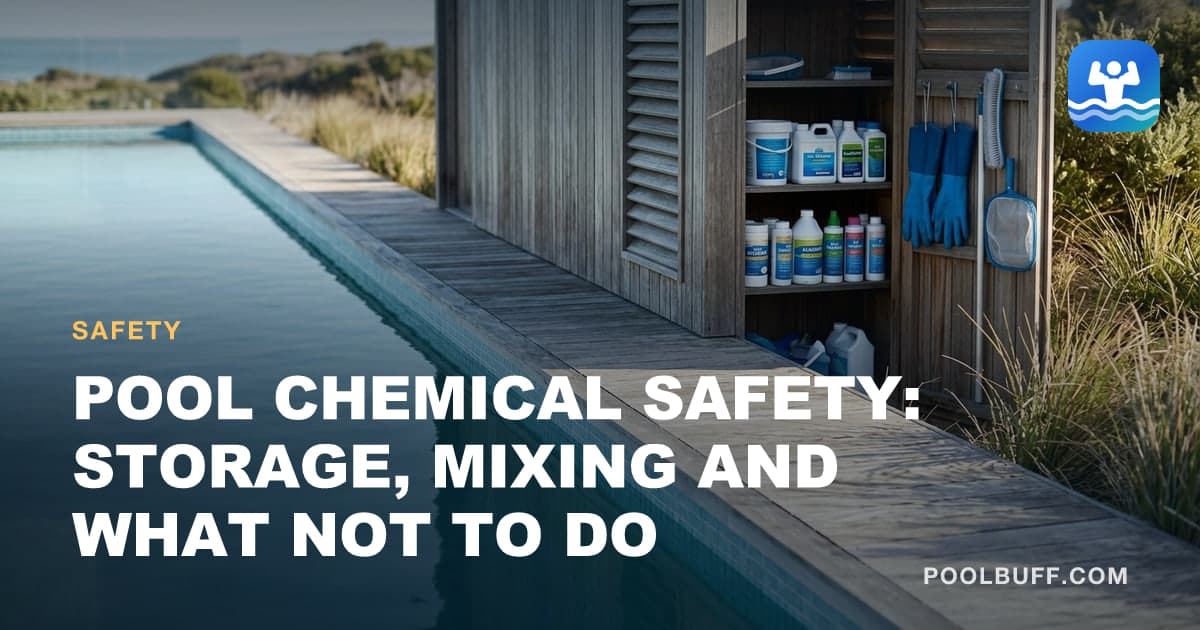
No, and this is the one genuine safety warning in pool chemistry. Trichlor and calcium hypochlorite react with each other, and with a little moisture the reaction can be violent enough to start a fire. Separate containers, separate shelves, separate scoops, and never pour one into a tub that held the other.
Does liquid chlorine go bad?
Yes, faster than people expect. Sodium hypochlorite degrades on its own, and heat accelerates it — a jug in a hot shed can lose a third of its strength in a month. Buy from somewhere with turnover, buy what you will use in a few weeks, and store it somewhere cool and dark.