There is a reason so many pools need their filter cleaned every few weeks, and it is rarely the filter's fault.
Builders fit the smallest unit that satisfies the sizing calculation, because at install time a smaller tank is a cheaper line item on a quote the customer is already wincing at. It works. It meets the specification. And the owner spends the next fifteen years cleaning it twice as often as they needed to.
Key takeaways
- Filter area, not brand, decides how often you clean and how hard the pump works.
- Builders fit the smallest filter that satisfies the calculation, because it is cheaper at install.
- Cartridge filters waste no water, which matters more every year in a drought region.
- Sand is the cheapest to own and the coarsest filtration. That trade is fine for most pools.
- DE filters the finest and asks the most of you, and some municipalities restrict the discharge.
My picks at a glance
- 1
Hayward SwimClear C3030
Best overall · most in-ground pools, if you can fit it
- 2
Pentair Clean & Clear Plus 320
Best cartridge alternative · Pentair pads, and anyone who wants the flow headroom
- 3
Hayward ProSeries W3S166T
Best value · most above-ground pools, on a budget
- 4
Pentair FNS Plus DE
Best filtration · anyone who wants genuinely polished water
Beyond these four, every filter with a page here is listed by media, with its parts and manuals.
Area is the whole decision
Filter media has a surface area, debris loads it, and pressure climbs as it does. A filter with twice the area takes roughly twice as long to reach the same pressure.
That single fact drives everything you actually care about:
- How often you clean it. The difference between a seasonal job and a monthly one.
- What your pump costs to run. Higher filter pressure means more resistance and more watts for the same flow.
- How clear the water is at the end of a cycle. A filter near its pressure limit filters worse than a clean one.
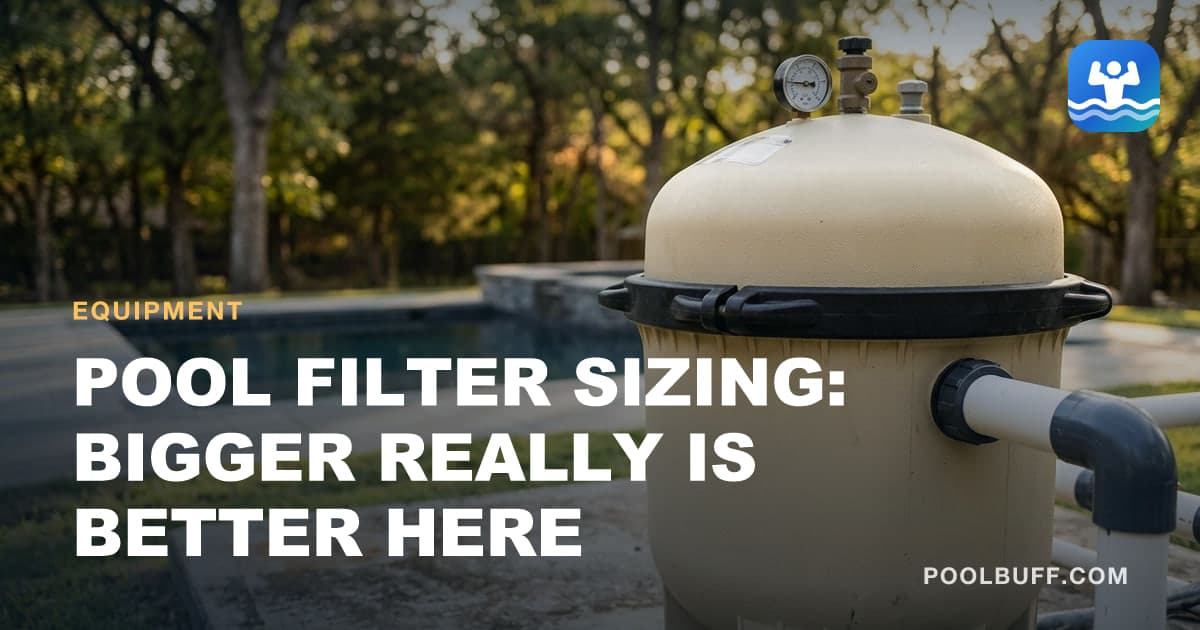
So the practical advice is unglamorous: work out the minimum with the sizing guide, then buy a size up from it. The premium is modest and paid once.
Pick the type before the model
| CartridgeMy default | Sand | DE | |
|---|---|---|---|
| Filtration fineness | Good | Coarsest | Finest |
| Water wasted cleaning | None | Every backwash | Every backwash |
| Effort to clean | An hour by hand | A few minutes | Backwash plus recharge |
| Ongoing consumable | Cartridges, every few years | Sand, when backwashing stops working | DE powder, every backwash |
| Cost to buy | Higher | Lowest | Higher |
| Watch out for | Headroom to lift cartridges | Multiport valve wear | Local discharge rules |
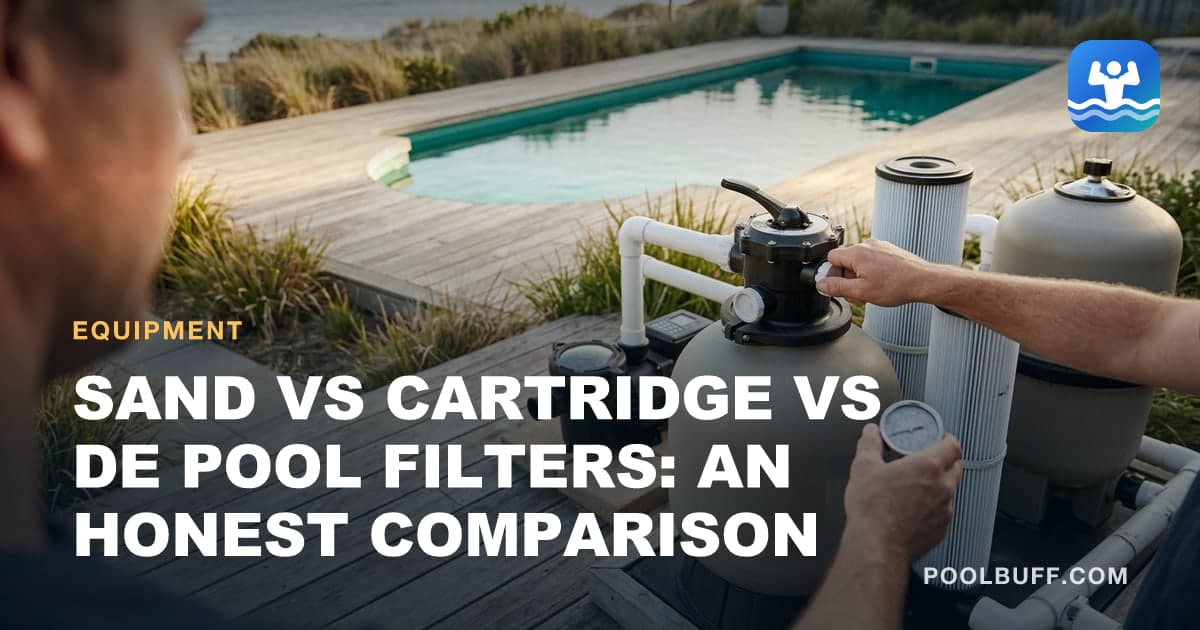
For most people reading this, cartridge is the answer — it filters well, wastes no water, and the hour of hand-cleaning happens once or twice a year rather than constantly. Sand is the right answer on a budget or an above-ground pool. DE is for people who want the clearest possible water and do not mind the involvement. The full type comparison goes deeper if you are undecided.
Hayward SwimClear C3030
Best for most in-ground pools, if you can fit it
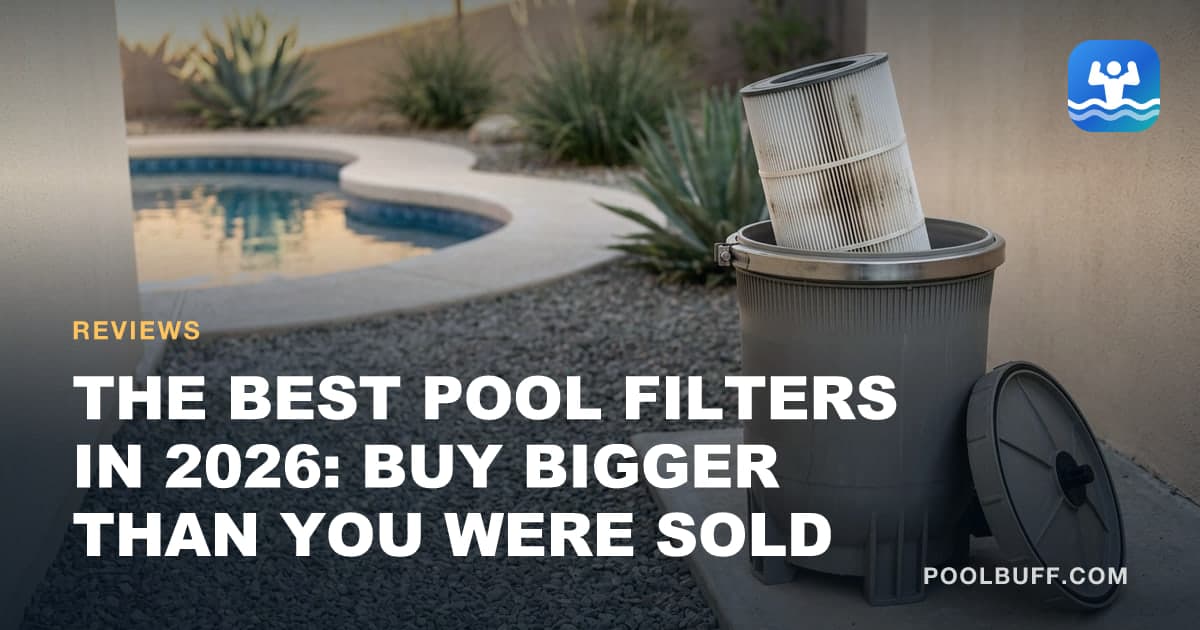
A large cartridge filter with no backwash valve to get wrong and no water sent to waste. Around 325 square feet of media means long intervals between cleanings on a normal residential pool — often a whole season if the water is kept properly. Clean it by hand twice a year and it asks nothing else of you.
Strengths
- No backwashing, so no water wasted and no valve to misuse
- Enough area that cleaning is a seasonal job rather than a monthly one
- Simple: a tank, a lid, and four cartridges
Trade-offs
- Physically large, and it needs headroom above to lift the cartridges out
- Cartridges are a real replacement cost every few years
- Hand-cleaning four pleated cartridges is a genuinely tedious hour
Pentair Clean & Clear Plus 320
Best for Pentair pads, and anyone who wants the flow headroom
The direct competitor to the SwimClear and the better performer on flow at a given pressure drop, which in practice means slightly lower resistance for your pump to fight. If your pad is already Pentair, the parts and service familiarity is worth something on its own.
Strengths
- Excellent flow at low pressure drop, so the pump works less
- Well-supported parts and widely serviced
- Same no-backwash advantage as any cartridge filter
Trade-offs
- Premium price, as with any large cartridge tank
- Same footprint problem — these are not small
- Cartridge replacement cost is not trivial
Hayward ProSeries W3S166T
Best for most above-ground pools, on a budget
The default sand filter, and there is nothing wrong with that. Sand filters are the cheapest to buy, the cheapest to keep, and the least demanding — you backwash instead of hand-cleaning, and the media lasts years. The trade is filtration fineness, which for most pools is a trade worth making.
Strengths
- Cheapest of the three types to buy and to own
- Backwashing takes minutes and needs no disassembly
- The sand only needs replacing when backwashing stops working
Trade-offs
- Coarsest filtration of the three — fine particles pass through
- Backwashing sends pool water to waste every time
- A multiport valve is one more thing that eventually leaks
Pentair FNS Plus DE
Best for anyone who wants genuinely polished water
DE filters to a finer particle size than either alternative, and the difference in water clarity is visible rather than theoretical. What you pay for it is involvement: recharging with fresh powder after every backwash, and a teardown clean once or twice a season.
Strengths
- Finest filtration available on a residential pool, by a clear margin
- Water clarity noticeably better than sand or cartridge
- Grids last a long time when they are looked after
Trade-offs
- Must be recharged with DE powder after every backwash
- Some municipalities restrict discharging DE to drains or ground
- The most hands-on filter to own, by some distance
The numbers, so you can check what you have
Filters are rated by how much flow each square foot of media can take without pushing debris straight through. The design rates differ by type, and they are why the three tanks look so different standing next to each other:
- Cartridge — about 0.375 gallons per minute per square foot.
- DE — about 2 gpm per square foot.
- Sand — about 15 to 20 gpm per square foot of bed area, which is the tank's cross-section rather than a property of the media.
Work out your pump's real flow, divide, and you have the minimum. A single-speed pump on a typical residential pool moves somewhere around 40 to 60 gpm, so the cartridge floor lands between roughly 110 and 160 square feet — meaning anything sold as a 100 sq ft unit is already marginal before it has collected a single leaf.
That is the arithmetic behind buying a size up. Going from 150 to 320 square feet does not make the water twice as clean; it roughly doubles the time before pressure climbs, which is the number you actually live with.
If you are checking an existing filter rather than shopping for one, the area is usually on the label, and often in the model number. Pentair's Clean & Clear Plus 320 names its 320 square feet outright; Hayward's SwimClear runs C2030, C3030, C4030 and C5030 for 225, 325, 425 and 525 square feet, so the C3030 on this page is a 325 — you just have to know the scheme. There was a C7030 above them, at 680 square feet on eight cartridges, but Hayward has discontinued it. Sand filters follow a diameter scheme instead: Hayward's ProSeries W3S166T above is the 16-inch tank, with 1.40 square feet of sand bed rated for 30 gpm, and the 18-inch S180T steps up to 1.75 and 35. DE filters name their area again: Hayward's ProGrid DE4820 is 48 square feet and the FNS Plus FNSP60 is 60. Compare the figure against your pump's flow and you will often find the answer to why you are cleaning it so often, without buying anything at all.
Three things to measure before you order
Headroom above the tank. A cartridge filter is serviced by lifting the lid and drawing the elements straight up, and a four-element unit wants roughly 15 to 22 inches of clear space above it. Under a low deck or a soffit, the filter that fits the pad will not open on the pad — and you find this out the first time it needs cleaning.
Manufacturers publish the figure, so there is no need to guess. Hayward's manual asks for 15 inches above a C2030 and 22 above a C5030, and 28 above the eight-cartridge C7030; the SwimClear page lists it per model alongside the tank heights. Jandy gives the total height instead: 57 inches from the pad to lift the cartridges out of a 41-inch CV460, and 69 inches for the 47-inch CV580, which the Jandy CV and CL page has for all six models.
Footprint and plumbing runs. Bigger tanks are wider as well as taller, and the union spacing rarely matches the unit you are replacing. Budget for a few fittings and an hour of pipework rather than expecting a straight swap.
Port size. Most residential filters take 2-inch or 2.5-inch connections, and dropping a 2-inch filter into 2.5-inch plumbing throws away the flow advantage the larger pipe was giving you. Match the pipe you have, or accept the restriction knowingly rather than by accident.
A note on warranty before you buy
Worth knowing on any of these, because the model number carries information.
Hayward sells the same equipment in two lines. A W3 prefix is its Open Line — approved for online sale, and what you will find on Amazon. The same unit without the W3 is Expert Line, sold only through authorized dealers, and it carries longer coverage. The ProSeries here is a W3, so buying it online is sanctioned rather than void; you are trading warranty length for price.
Pentair's version is stricter, and it is worth naming. Its prefix is EC, and it marks the online versions of TradeGrade products, which Pentair means for stores, pool builders and service companies. Pentair's warranty page puts e-commerce products and online purchases on one year, parts only, and states plainly that labor is not covered for internet purchases — so what the online price costs you is the labor on any claim. The FNS Plus above is an EC-180009, and its Amazon listing says "Limited Warranty" in the title itself. The Clean & Clear Plus is the same arrangement, and its own page here goes through it.
In both cases, if you want real coverage, buy from a pool retailer and register it. If price matters more, buy online knowing the trade rather than discovering it later — and on the Pentair side, know that the trade is bigger than it looks.
Neither is the wrong choice. Making it without knowing is.
What actually goes wrong
Filters rarely fail. What happens instead is that they get neglected in one of two directions.
Never cleaned. Pressure climbs, flow drops, the pump strains, the water clouds, and eventually someone diagnoses a pump problem that is really a filter problem. Track the pressure and clean at eight to ten psi above clean, not on a schedule.
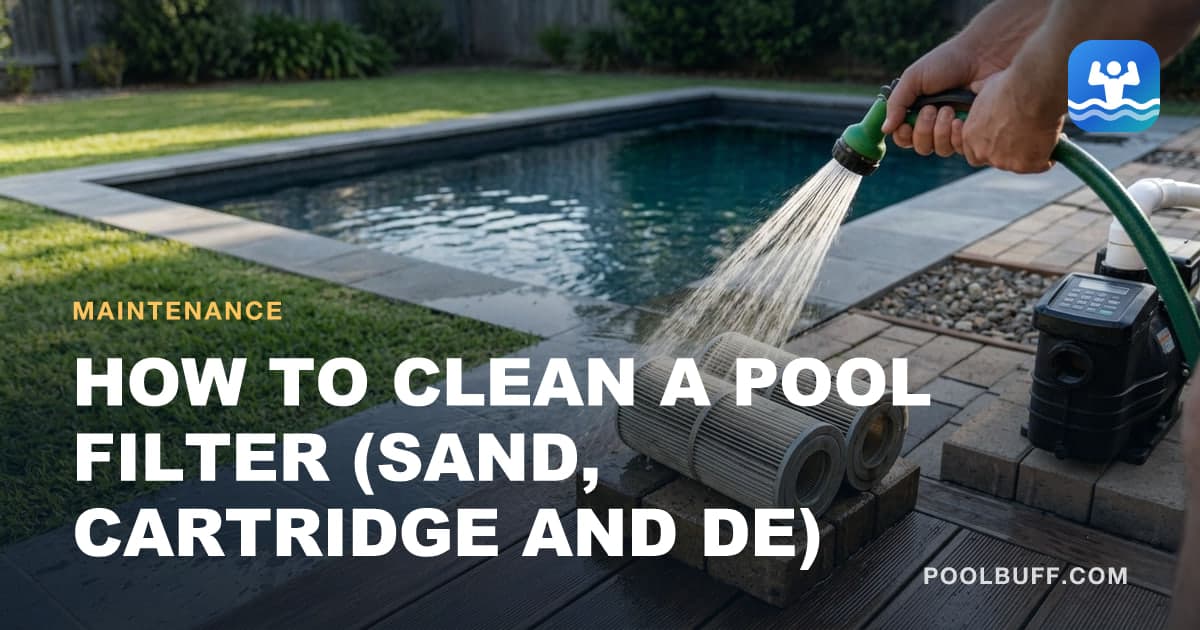
Cleaned with a hose and nothing else. Water shifts debris and leaves the oils behind, and those oils are what eventually blind a cartridge for good. A proper chemical soak once or twice a year is the difference between cartridges lasting two seasons and five.
Neither of those is about which filter you bought. But an oversized filter forgives both of them for longer, which is one more argument for the size up.
Go deeperWorking out the size properlyTurnover, flow rate and square footage, and how to check what you already have.Frequently asked questions
What size pool filter do I need?
Bigger than the minimum. The calculation gives you a filter that can handle your pump's flow, but meeting the minimum only guarantees it works, not that it works well. More filter area means longer intervals between cleanings, lower pressure across the media and less resistance for the pump to fight, which shows up on your electricity bill.
Is a cartridge filter better than sand?
For most pools, yes, on two counts: it filters finer, and it wastes no water because there is no backwashing. Sand wins on price and on effort — a backwash takes a few minutes where a cartridge clean takes an hour. Neither is wrong, and a well-sized sand filter on a well-run pool produces perfectly clear water.
How often should I clean a pool filter?
By pressure, not by calendar. Note the clean pressure when the filter is fresh, and clean it when the gauge reads eight to ten psi above that. On a properly oversized cartridge filter that can be once or twice a season. On an undersized one it can be monthly, which is the clearest sign of a filter that was bought too small.
Do DE filters get banned anywhere?
Not banned as such, but some municipalities restrict discharging diatomaceous earth into storm drains or sanitary sewers, which affects how you can backwash. Check locally before buying one, because the answer changes what owning it involves — a separation tank is the usual solution and it is an extra cost.
Can I put a bigger filter on my existing pump?
Almost always, and it is one of the better upgrades available. A filter larger than your pump needs is not a problem; the pump simply sees less resistance. The constraint is physical space and plumbing, not compatibility. Going the other way — a small filter on a big pump — is what causes short cycles and high pressure.